Compressed air is widely used to power pneumatic equipment, control production machinery, operate instruments, and support manufacturing processes. But atmospheric air naturally contains water vapor, and compression does not make that moisture disappear.
As compressed air subsequently cools, water vapor can condense into liquid inside receivers, pipelines, filters, valves, and downstream equipment. This is the fundamental reason compressed air requires a dryer in many industrial applications.
A properly selected dryer reduces water vapor to a specified pressure dew point (PDP), helping control downstream condensation and protect both equipment and production processes.
Why Does Water Appear in a Compressed Air System?
Atmospheric air always contains some water vapor. The amount varies with temperature, relative humidity, and local environmental conditions.
When a compressor takes in atmospheric air, it concentrates this water vapor along with the air itself. Compression also raises the air temperature.
As the hot compressed air passes through an aftercooler, receiver, piping, and other downstream equipment, it begins to cool. Cooler air cannot retain the same amount of water vapor, so part of the moisture condenses.
This is why water can appear in a compressed air system even when the surrounding environment does not feel particularly humid.
Upstream cooling and separation can remove a substantial amount of liquid condensate, but they do not necessarily reduce the remaining water vapor sufficiently for downstream use. A dryer provides controlled moisture reduction to achieve the required PDP.
What Happens If Compressed Air Is Not Properly Dried?
The consequences depend on the system and application, but excessive moisture can create several recurring problems.
Corrosion in Compressed Air Piping
Liquid water inside carbon-steel piping, receivers, valves, and other components can contribute to internal corrosion.
Over time, corrosion can produce rust and scale that may travel downstream and create additional contamination or restrictions.
This is particularly important in older compressed air distribution systems where accumulated moisture has been present for long periods.
Pneumatic Equipment Problems
Water can interfere with pneumatic valves, cylinders, actuators, air motors, and tools.
Repeated exposure to moisture may contribute to corrosion, lubricant degradation, sticking components, and premature wear.
A dryer cannot correct every mechanical problem in a pneumatic system, but controlling moisture removes one important source of deterioration.
Freezing in Cold Environments
Pressure dew point becomes especially important when compressed air piping is exposed to low temperatures.
If downstream air temperature falls below the delivered PDP, additional water can condense.
When temperatures fall below freezing, this moisture can freeze inside valves, instruments, controls, or piping.
For systems operating in cold environments, the required PDP should therefore be selected with the minimum downstream temperature in mind.
Product and Process Problems
Some manufacturing processes are much more sensitive to moisture than ordinary pneumatic tools.
Painting, electronics manufacturing, pharmaceutical production, food processing, laboratory equipment, and precision manufacturing can all impose different compressed-air quality requirements.
In these applications, the objective is not simply to “remove water.” The treatment system may need to control water, particles, oil aerosols, oil vapor, and other contaminants to specified limits.
What Does an Air Dryer Actually Remove?
A compressed air dryer primarily reduces water vapor.
This distinction matters because dryers and filters perform different functions.
A moisture separator can remove bulk liquid water.
A filter can remove specified particles, oil aerosols, or other contaminants according to its design.
A dryer reduces water vapor and establishes a lower pressure dew point.
A complete compressed air treatment system can therefore involve several stages:
compressor → aftercooler → condensate separation → receiver → filtration → dryer → downstream filtration → distribution → point of use
The exact configuration should be designed according to compressor type, dryer technology, required air quality, and application.
Lingyu’s precision compressed air filters can be incorporated into treatment systems where particle and oil contamination must be controlled in addition to moisture.
Pressure Dew Point Explains Why Drying Matters
Pressure dew point is one of the most useful specifications when deciding whether compressed air is sufficiently dry.
PDP represents the temperature at which water vapor in compressed air would begin to condense at system pressure.
For example, if the compressed air has a PDP higher than the minimum temperature encountered by downstream piping, condensation may occur as the air cools.
This is why simply stating that compressed air is “dry” is not sufficiently precise.
The better question is:
What pressure dew point does the application require?
The answer helps determine which dryer technology is appropriate.
Refrigerated Air Dryers for General Moisture Control
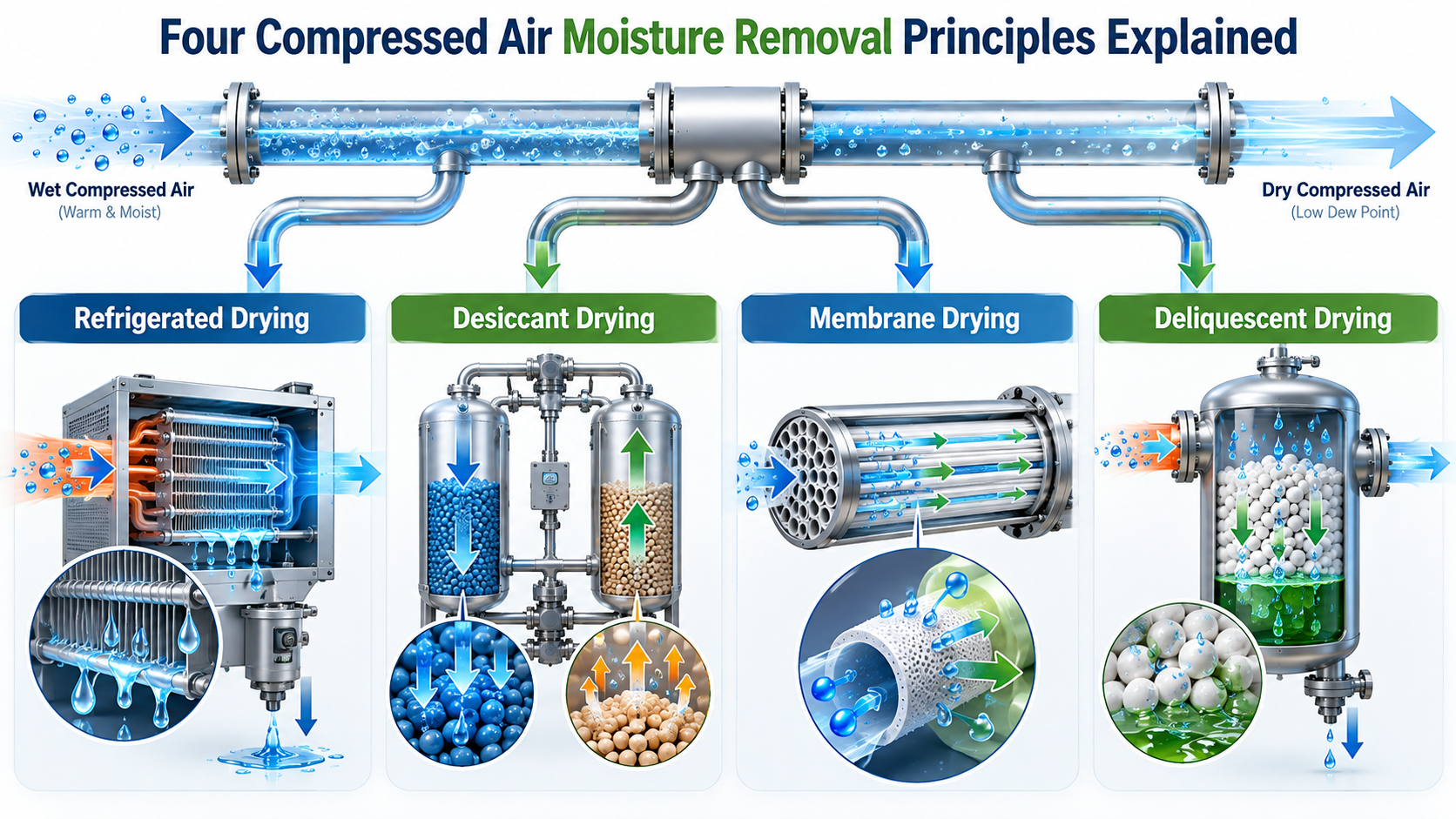
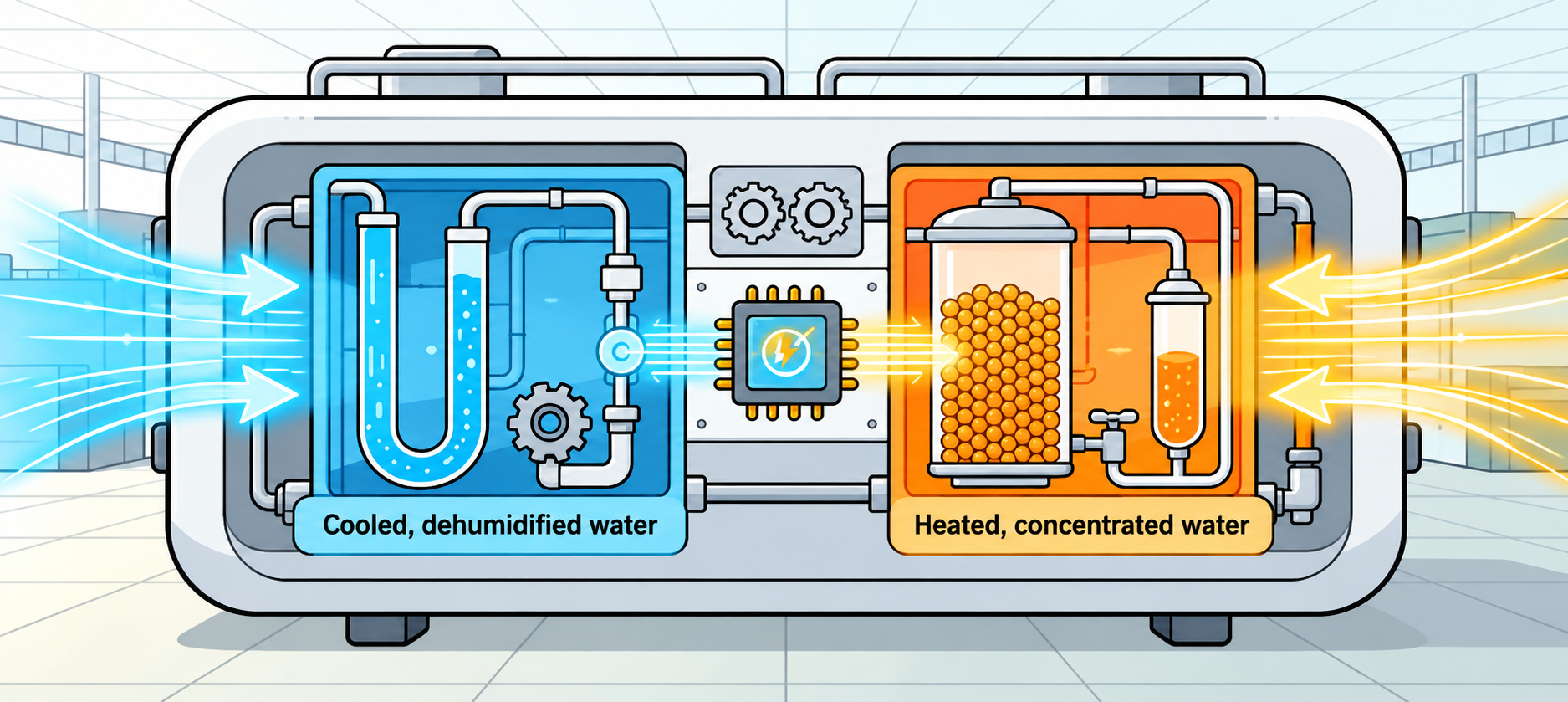
A refrigerated air dryer reduces moisture by cooling compressed air.
As the air temperature falls inside the dryer, water vapor condenses. The condensed liquid is separated and automatically discharged before the dried air is reheated and sent downstream.
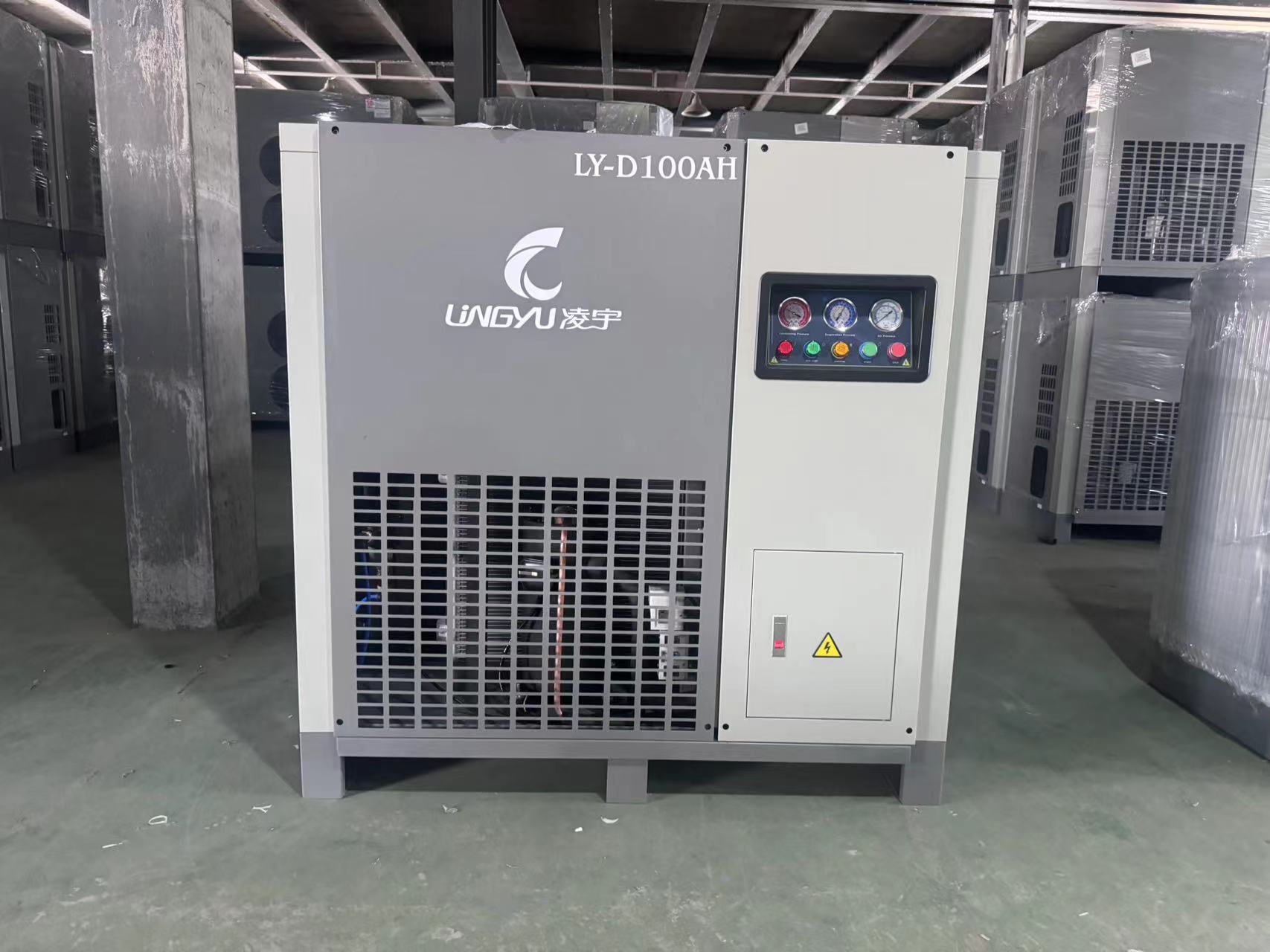
For Lingyu’s conventional AH air-cooled and WH water-cooled refrigerated dryers, typical specified conditions include:
| Parameter | Specification |
|---|---|
| Rated inlet pressure | 0.7 MPa |
| Operating pressure | 0.6–1.0 MPa |
| Rated inlet temperature | 50°C |
| Maximum inlet temperature | ≤80°C |
| Pressure dew point | 2–10°C |
| Rated ambient temperature | 32°C |
| Ambient operating range | 2–45°C |
| Pressure drop | ≤0.025 MPa |
A 2–10°C PDP can be appropriate for many indoor industrial applications where compressed air lines remain above the delivered dew point.
The key advantage is that substantially deeper drying is not always necessary. If refrigerated drying already satisfies the process specification, installing a more complex low-dew-point system may add unnecessary capital and operating costs.
When Does Compressed Air Require a Desiccant Dryer?
Some applications need compressed air substantially drier than conventional refrigerated technology can provide.
A desiccant air dryer uses an adsorption material to remove water vapor.
Industrial adsorption dryers commonly use twin towers. One tower dries the compressed air while the other undergoes regeneration, after which the towers switch functions.
Lingyu’s CH heatless adsorption technology, for example, specifies a −50°C to −20°C PDP under its specified operating conditions.
Typical conditions include 0.7 MPa rated inlet pressure, a 0.6–1.0 MPa operating range, 10–30°C rated inlet temperature, ≤40°C maximum inlet temperature, and 8–14% regeneration air consumption.
The CH Series heatless regeneration adsorption dryer is one option where lower PDP is required.
Why Regeneration Method Matters
Not all adsorption dryers regenerate their desiccant in the same way.
Heatless dryers use part of the dried compressed air for regeneration.
Heated regeneration systems introduce external heat and can reduce compressed-air purge requirements. Lingyu’s CH heated technology, for example, specifies 4–8% regeneration air consumption under its stated operating conditions.
Blower regeneration uses a blower and heating system to further reduce dependence on compressed-air purge.
Heat-of-compression technology can utilize thermal energy available from the compressor system for regeneration.
For installations where compressor heat and operating conditions are suitable, Lingyu’s HOC-Z zero-gas-consumption heat-of-compression adsorption dryer provides another approach to low-dew-point air treatment.
The appropriate regeneration method should be selected according to airflow, required PDP, load profile, compressor configuration, energy consumption, and lifecycle cost.
Combined Drying for More Demanding Systems
Refrigerated and adsorption technologies do not always have to be treated as alternatives.
A combined dryer can use refrigerated drying for initial bulk moisture removal before the compressed air enters the adsorption stage.
The simplified process is:
wet compressed air → refrigerated drying → condensate removal → adsorption drying → low-PDP compressed air
This can reduce the moisture load imposed on the desiccant stage.
Lingyu’s DC Series combined compressed air dryer integrates refrigerated and adsorption drying into one system for applications where deeper drying is required.
Why Compressed Air Drying Matters in Automotive Manufacturing
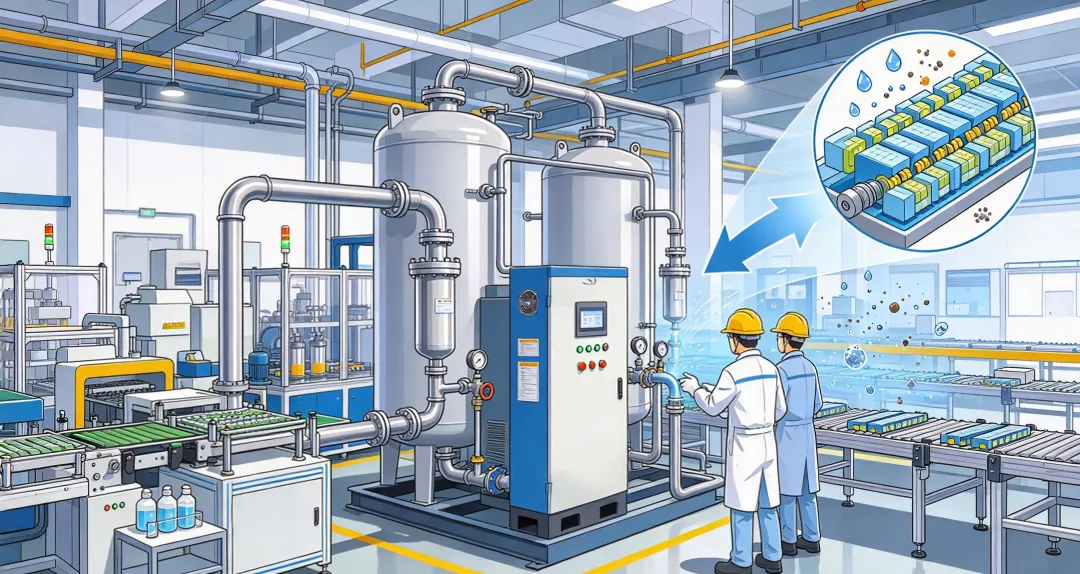
In automotive and general manufacturing, compressed air can operate assembly equipment, pneumatic tools, cylinders, automation systems, and paint-related equipment.
Moisture in air lines can contribute to corrosion and pneumatic component problems.
Painting introduces additional air-quality considerations. Moisture can contribute to finish defects, but water is not the only contaminant that matters. Oil aerosols and particles can also affect coating quality.
Drying and filtration should therefore be considered together according to the finishing process.
Why Electronics Manufacturing Requires Careful Moisture Control
Compressed air is used throughout electronics and precision manufacturing for automation, pneumatic machinery, and process-related operations.
The required dryness depends on how compressed air interacts with the production process.
General pneumatic equipment may have relatively moderate moisture requirements, while highly moisture-sensitive operations may require a substantially lower PDP.
A refrigerated dryer should therefore not automatically be considered sufficient—or insufficient—simply because the application is electronics manufacturing.
The actual process specification determines the treatment level.
Food and Beverage Compressed Air
Compressed air may support packaging, pneumatic equipment, conveying, bottling, and other operations in food and beverage production.
Moisture control is important, but a dryer alone does not automatically produce hygienic or food-contact-quality compressed air.
Depending on the application, the treatment system may also need to control particles, oil aerosols, oil vapor, and microbiological contamination.
The required air quality should therefore be determined by how the compressed air is used and whether it has direct or indirect product contact.
Pharmaceutical and Biopharmaceutical Applications
The same principle applies to pharmaceutical and biopharmaceutical manufacturing.
Compressed air used for general pneumatic equipment can have very different requirements from air associated with sensitive production processes.
A refrigerated dryer does not automatically produce sterile compressed air, and an adsorption dryer does not automatically guarantee pharmaceutical compliance.
Dryer selection establishes moisture performance; the complete treatment and validation strategy determines whether the air meets the application’s overall quality requirements.
Does Dry Compressed Air Reduce Energy Consumption?
Drying compressed air should not automatically be described as an energy-saving measure.
A dryer itself consumes energy directly or indirectly.
Refrigerated dryers require electrical energy for refrigeration. Heatless adsorption dryers consume compressed air for regeneration. Heated and blower systems require additional electrical energy, while other regeneration technologies have their own energy characteristics.
Pressure drop also affects system efficiency.
Every filter, dryer, valve, and pipe restriction contributes to total pressure loss. If excessive pressure drop forces the compressor to operate at a higher discharge pressure, energy consumption can increase.
The objective should therefore be to achieve the required air quality with reasonable total pressure drop and lifecycle energy consumption, rather than simply installing the driest possible system.
Does ISO 8573 Require Every Compressed Air System to Have a Dryer?
Not in that simplistic sense.
ISO 8573-1 classifies compressed air quality according to contaminants such as particles, water, and oil.
The required class depends on the application.
A dryer is selected to help achieve the required water or pressure-dew-point specification, while filters and other treatment equipment address additional contaminants.
This distinction prevents over-treatment while ensuring critical applications receive adequate air quality.
How to Know Whether Your System Needs Better Drying
Visible liquid water downstream can indicate inadequate moisture control, but it does not automatically mean the dryer itself is defective.
Possible causes include excessive inlet temperature, airflow above dryer capacity, poor condensate drainage, inadequate upstream cooling, abnormal ambient or cooling-water conditions, dirty heat exchangers, incorrect dryer sizing, or a required PDP below the dryer’s capability.
For this reason, troubleshooting should include both the dryer and the operating conditions around it.
How to Choose the Right Dryer
Dryer selection should begin with the required pressure dew point and actual operating conditions—not simply compressor horsepower or nominal CFM.
Important factors include maximum airflow, operating pressure, inlet temperature, ambient temperature, cooling-water conditions where applicable, minimum downstream temperature, required PDP, allowable pressure drop, compressor type, and operating profile.
For large-flow installations where water cooling is appropriate, Lingyu’s 8830 CFM water-cooled high-temperature refrigerated dryer provides a dedicated high-capacity refrigerated solution.
Actual model selection should still be based on the complete operating conditions rather than nominal airflow alone.
Frequently Asked Questions
Do I need an air dryer if the environment is not humid?
Low ambient humidity reduces the moisture entering the compressor, but it does not necessarily eliminate the need for drying.
The decision should be based on the moisture load, required PDP, and minimum downstream temperature.
Can compressed air be used without a dryer?
In some applications, yes.
If upstream cooling and separation provide sufficient moisture control and the end use tolerates the resulting air quality, a separate dryer may not always be necessary.
For many industrial systems, however, a controlled PDP is required to prevent downstream condensation or satisfy process requirements.
Which dryer is better for very dry compressed air?
Adsorption dryers are generally used when the required PDP is substantially below the capability of conventional refrigerated drying.
The appropriate regeneration method should then be selected according to energy use, airflow, operating conditions, and lifecycle cost.
Why is a dryer important for painting?
Moisture can contribute to coating defects and inconsistent finishing.
However, painting air quality also depends on oil and particle control, so drying should be combined with suitable filtration.
Does seeing water downstream always mean I need a larger dryer?
No.
First verify airflow, inlet temperature, operating pressure, ambient conditions, condensate drains, heat-exchanger condition, and actual PDP.
A larger dryer is appropriate only when system loading and sizing analysis show that additional capacity is required.
The Real Reason Compressed Air Requires a Dryer
The purpose of a compressed air dryer is not simply to make air “clean.”
Its specific job is to reduce water vapor to a pressure dew point appropriate for the downstream system and process.
For many indoor industrial applications, refrigerated drying provides sufficient moisture control. For freezing environments or moisture-sensitive processes, adsorption drying can provide substantially lower pressure dew points. Combined systems offer another approach where deeper drying and integrated treatment are required.
The correct decision therefore starts with:
required PDP → minimum downstream temperature → peak airflow → inlet temperature → operating pressure → environmental conditions → pressure drop → lifecycle cost
Once those requirements are defined, the dryer can be matched to the actual compressed air system rather than selected from a generic rule.
For application-specific dryer sizing and system configuration, contact Lingyu with your airflow, operating pressure, inlet temperature, minimum downstream temperature, required pressure dew point, and compressor configuration.