Industrial users have several options for obtaining nitrogen, but two technologies are commonly considered for on-site production: the PSA nitrogen generator and the cryogenic nitrogen generation system.
Both separate nitrogen from air, but they do so in fundamentally different ways. PSA uses adsorption at near-ambient temperatures, while cryogenic separation cools air to extremely low temperatures and separates its components through distillation. The original comparison correctly centers the decision on purity, production volume, investment, operating conditions, and whether liquid nitrogen is required.
For many manufacturing plants that need gaseous nitrogen on demand, a PSA nitrogen generator can provide a practical balance of purity, automation, operating flexibility, and installation requirements. Cryogenic technology becomes more relevant when production scale, exceptionally high purity, or liquid nitrogen requirements justify a more complex system.
What Is a PSA Nitrogen Generator?
PSA stands for Pressure Swing Adsorption.
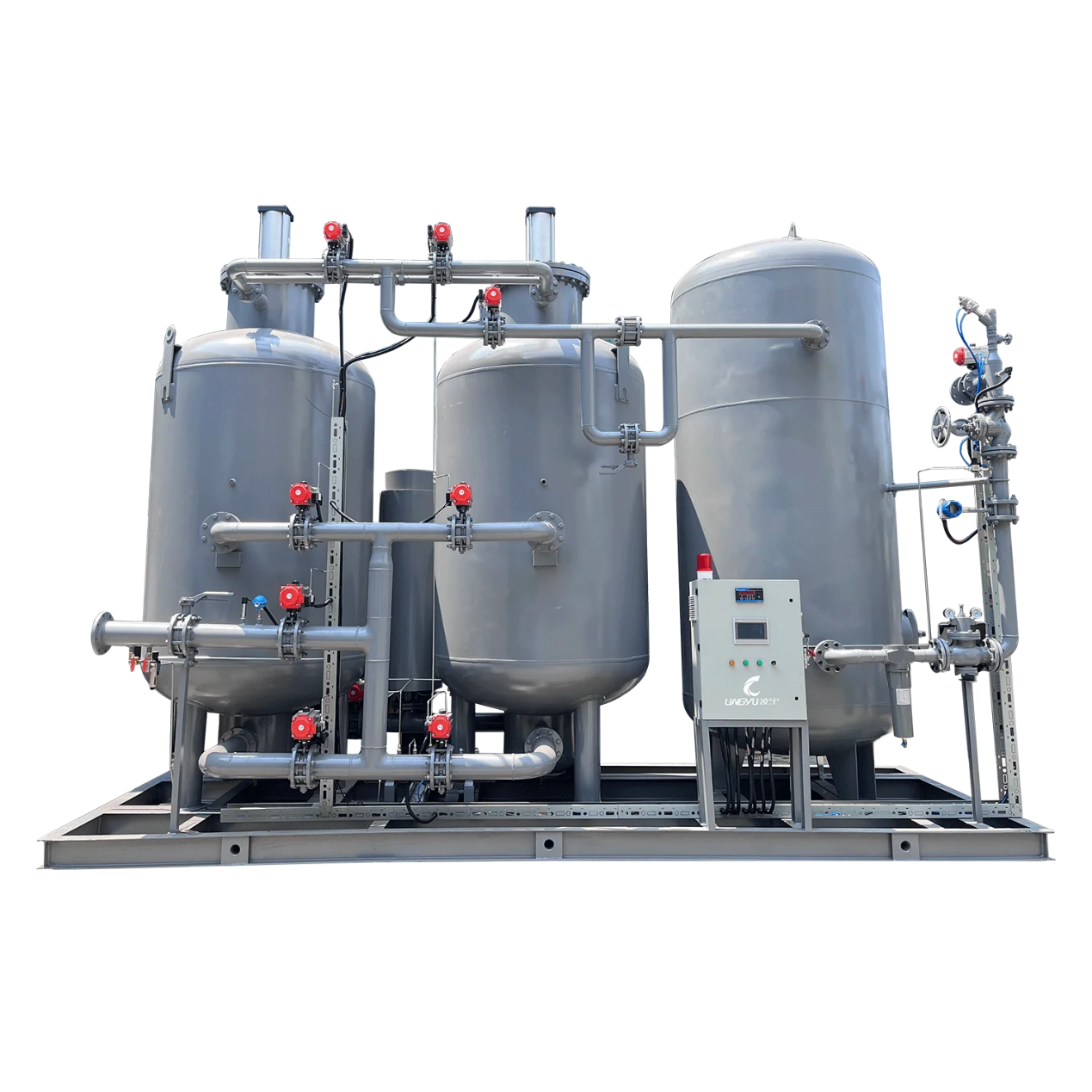
A PSA nitrogen generator separates nitrogen from compressed air using a selective adsorbent, typically carbon molecular sieve (CMS). The system normally contains two adsorption towers that alternate between nitrogen production and adsorbent regeneration.
During the adsorption stage, compressed air enters a tower containing CMS. Oxygen and certain other components are preferentially adsorbed, allowing nitrogen-rich gas to leave the tower as product nitrogen.
When the adsorbent approaches saturation, the tower is depressurized. The adsorbed gases are released, regenerating the CMS so that it can be used again.
The second tower continues producing nitrogen while the first regenerates. By repeatedly switching the towers, the generator can maintain continuous nitrogen production.
Lingyu’s PSA system operates with automatic PLC control and continuously monitors nitrogen purity and flow. Its standard operating specification covers nitrogen purity from 95% to 99.999%, depending on system configuration and operating requirements.
For users who want a deeper explanation of the separation process, see how a PSA nitrogen generator works.
What Is a Cryogenic Nitrogen Generation System?
Cryogenic nitrogen production separates the components of air at extremely low temperatures.
Instead of using an adsorbent such as CMS, the process cools and liquefies air before separating nitrogen, oxygen, and other components according to their different boiling characteristics through cryogenic distillation.
This approach is typically associated with very large production requirements or situations where extremely high purity and/or liquid nitrogen production are required.
Cryogenic technology can deliver both gaseous and liquid products, but the system is considerably different from a PSA unit. It requires specialized cold-box equipment, refrigeration or expansion processes, heat exchangers, distillation columns, and associated infrastructure.
As a result, the decision between PSA and cryogenic generation is not simply a question of which technology can produce purer nitrogen. It is primarily a question of which process best matches the plant’s required purity, flow, physical product form, operating pattern, and economics.
PSA Nitrogen Generator vs. Cryogenic Nitrogen Generator
The major differences can be summarized as follows:
| Factor | PSA Nitrogen Generator | Cryogenic Nitrogen Generation |
|---|---|---|
| Separation principle | Pressure Swing Adsorption using CMS | Low-temperature air separation and distillation |
| Product form | Primarily gaseous nitrogen | Gaseous nitrogen and potentially liquid nitrogen |
| Purity | Adjustable according to system design | Suitable for extremely high-purity requirements |
| Startup | Relatively fast | Generally more involved |
| Installation | Comparatively compact | More extensive infrastructure |
| Load flexibility | Well suited to variable demand | Strongest in large, relatively steady production |
| System complexity | Relatively straightforward | Significantly more complex |
| Typical use | On-site industrial gaseous nitrogen | Very large-scale or liquid/ultra-high-purity requirements |
Neither process is universally better. The most economical option depends heavily on the actual nitrogen requirement.
1. Nitrogen Purity
Purity is often the first parameter buyers compare, but it should not be considered in isolation.
Lingyu’s PSA nitrogen generation system supports purity levels from 95% to 99.999% under specified operating conditions.
The available product range also includes dedicated configurations such as a 99% purity nitrogen generator, a 99.5% purity nitrogen generator, and higher-purity configurations.
This flexibility matters because nitrogen purity has a significant effect on PSA system sizing and compressed-air consumption.
A plant that only requires 99% nitrogen generally should not specify 99.999% simply because a higher number appears preferable. Producing unnecessarily high purity may increase feed-air requirements, equipment size, and operating cost without improving the process.
Cryogenic air separation becomes more attractive where extremely high purity is mandatory as part of a very large and continuous nitrogen requirement.
2. Nitrogen Flow Capacity
Required flow rate is another major selection factor.
PSA systems are well suited to many small, medium, and substantial industrial nitrogen requirements, but the generator must be sized around both flow and purity.
Two plants requiring the same nitrogen flow may need very different PSA configurations if one requires 99% nitrogen and the other requires 99.999%.
Cryogenic systems generally become more economically attractive as production reaches very large, continuously utilized volumes.
Therefore, there is no universal flow threshold at which a plant should switch from PSA to cryogenic technology. The comparison should include:
- Required Nm³/h of nitrogen
- Required purity
- Daily operating hours
- Demand variation
- Compressed-air production cost
- Required nitrogen pressure
- Future capacity expansion
- Whether liquid nitrogen is needed
3. Ability to Respond to Changing Demand
One of PSA’s practical advantages is its compatibility with industrial facilities whose nitrogen demand changes over time.
The system can be started and stopped automatically and its operation can be integrated into plant demand controls.
Lingyu’s PSA nitrogen generator uses automatic PLC-controlled switching between adsorption towers, along with real-time nitrogen purity and flow monitoring.
This makes PSA attractive for production lines that do not consume the same volume of nitrogen continuously.
For manufacturers evaluating capacity planning, a detailed PSA nitrogen generator selection guide can help connect purity, flow, and future demand.
4. Installation and Infrastructure
A PSA nitrogen generator operates as part of a compressed-air treatment system.
A typical installation can include:
- Air compressor
- Air receiver
- Compressed air purification equipment
- PSA nitrogen generator
- Nitrogen buffer tank
- Nitrogen purity analyzer
- Product nitrogen distribution system
Lingyu’s system configuration specifically incorporates an air compressor, receiver, refrigerated dryer, buffer equipment, PSA generator, nitrogen buffer tank, and nitrogen/oxygen analysis before product delivery.
This makes feed-air quality important.
Water, oil, and particulate contamination can negatively affect the carbon molecular sieve. Proper compressed-air treatment should therefore be incorporated before the PSA generator.
Cryogenic plants require a substantially different installation, involving the equipment needed to cool, liquefy, and distill air at cryogenic temperatures. Consequently, project engineering and infrastructure requirements are typically more extensive.
5. Maintenance Requirements
PSA nitrogen generators rely heavily on valves, CMS adsorption beds, instrumentation, and compressed-air treatment equipment.
Maintenance therefore focuses on items such as:
- Pneumatic valve operation
- Feed-air filters
- Dryer performance
- CMS condition
- Pressure stability
- Nitrogen purity analyzer calibration
- Tower switching sequence
Lingyu’s design uses PLC-controlled pneumatic valves and incorporates an automatic CMS compaction system intended to maintain packing density and reduce problems associated with adsorbent movement.
A detailed explanation of one common adsorbent problem is available in this guide to PSA nitrogen generator CMS powdering, troubleshooting, and prevention.
Cryogenic systems have different maintenance requirements because they include low-temperature processing equipment and more complex air-separation infrastructure.
6. Energy Consumption
PSA does not require cryogenic liquefaction, but it should not be described as operating with almost no energy consumption.
The largest energy input associated with many PSA installations is the compressed air required to feed the generator.
Therefore, PSA energy efficiency depends on:
- Nitrogen purity
- Nitrogen recovery rate
- Feed-air pressure
- Compressor efficiency
- Pressure drop
- Generator sizing
- Load profile
- Air-treatment equipment
Lingyu’s PSA system uses an optimized unequal-pressure equalization process intended to improve nitrogen recovery efficiency and indirectly reduce overall energy consumption.
For this reason, plants should evaluate nitrogen generation as an integrated compressed-air system rather than considering only the electrical consumption of the PSA cabinet itself.
7. High-Purity Nitrogen Does Not Always Require Cryogenic Separation
One assumption that should be avoided is that every very-high-purity requirement automatically requires a cryogenic nitrogen plant.
PSA-produced nitrogen can also be combined with downstream purification.
For example, Lingyu’s carbon-based deoxygenation purification system uses approximately 99.9% PSA nitrogen as feed gas and further removes residual oxygen and contaminants to produce nitrogen with a specified purity of ≥99.999%, oxygen content ≤10 ppm, and atmospheric dew point ≤−60°C.
This creates another possible system architecture:
Compressed air → PSA nitrogen generation → nitrogen purification
For facilities that need high-purity gaseous nitrogen but do not require liquid nitrogen or extremely large cryogenic-scale production, this type of arrangement may deserve evaluation.
Which Industries Use PSA Nitrogen Generators?
Food and Beverage
Nitrogen is widely used for applications such as modified-atmosphere packaging, tank blanketing, and oxidation control.
Because different food processes require different residual oxygen levels, selecting only the necessary nitrogen purity can help balance production quality and operating efficiency.
Plants considering on-site supply can review broader food and beverage industrial solutions.
Electronics and Semiconductor Production
Nitrogen can provide an inert atmosphere for manufacturing, soldering, storage, and related electronics processes.
Purity requirements can vary substantially between general electronics operations and highly sensitive semiconductor processes. The nitrogen-generation solution should therefore be designed around the actual allowable oxygen level rather than an arbitrary purity target.
Pharmaceutical and Biopharmaceutical Manufacturing
Nitrogen may be used for blanketing, packaging, inerting, process protection, and other controlled manufacturing operations.
The required quality must be determined by the actual pharmaceutical process and relevant internal quality standards.
See pharmaceutical and biopharmaceutical applications for the broader industrial context.
Chemical and Petrochemical Processing
Chemical facilities use nitrogen for tank blanketing, inerting, purging, and process safety applications.
Continuous demand can range from relatively small local systems to very large centralized nitrogen networks. Consequently, both PSA and cryogenic generation may be relevant depending on the scale of the facility.
Metal Fabrication and Laser Cutting
Nitrogen can be used as a cutting assist gas where oxidation-free edges are required.
High flow, pressure, and purity requirements can make generator sizing particularly important. More application information is available for metal fabrication and laser cutting.
When Should You Choose a PSA Nitrogen Generator?
A PSA system is especially worth evaluating when the facility:
- Requires gaseous rather than liquid nitrogen
- Wants on-site nitrogen production
- Has variable or intermittent nitrogen demand
- Needs adjustable purity within the PSA operating range
- Prefers a comparatively compact installation
- Already operates an industrial compressed-air system
- Wants to reduce dependence on delivered nitrogen
- Requires automated unattended operation
The choice should still be based on lifecycle economics rather than these characteristics alone.
When Should You Consider Cryogenic Nitrogen Production?
Cryogenic technology becomes more relevant where:
- Nitrogen demand is extremely large and continuous
- Liquid nitrogen production is required
- Extremely high purity is required at large production scale
- Multiple air-separation products are valuable
- The facility can support the required infrastructure and specialized operation
These conditions often occur in major steelmaking, petrochemical, large chemical, industrial-gas, and other high-volume processing operations.
How to Select the Right Nitrogen Generation Technology
Start with the process instead of the equipment.
Determine how much nitrogen is actually needed, what purity is required, what delivery pressure is needed, and whether the demand is continuous or variable.
Then evaluate capital investment, compressed-air or power requirements, maintenance resources, installation space, redundancy, and expected annual operating hours.
For PSA systems, feed-air conditions should receive particular attention. Lingyu specifies inlet air pressure of 0.5–0.8 MPa and inlet temperature ≤40°C for its PSA nitrogen generator under the stated operating conditions.
The generator should not be selected by nitrogen purity alone.
FAQ: PSA Nitrogen Generator vs. Cryogenic Nitrogen Generator
What is the main difference between PSA and cryogenic nitrogen generation?
PSA uses carbon molecular sieve and alternating pressure cycles to separate nitrogen from compressed air. Cryogenic technology cools and distills air at extremely low temperatures.
What nitrogen purity can a PSA generator produce?
Lingyu’s PSA system specifies a nitrogen purity range of 95%–99.999%, depending on configuration and operating requirements.
Can a PSA system produce 99.999% nitrogen?
Yes, PSA configurations can be designed for high purity, and downstream purification can also be used where appropriate. Lingyu offers nitrogen generator configurations up to 99.999%, and its additional purification system can upgrade approximately 99.9% feed nitrogen to ≥99.999%.
Can a PSA nitrogen generator produce liquid nitrogen?
A conventional PSA generator produces gaseous nitrogen. Applications that specifically require liquid nitrogen need a different production or supply solution.
Is PSA always cheaper than cryogenic separation?
Not universally. PSA can be economically attractive for many on-site gaseous nitrogen requirements, while cryogenic separation can become advantageous at very large continuous production scales. The correct comparison requires lifecycle cost analysis.
Does higher nitrogen purity always mean better performance?
No. The correct purity is the purity required by the process. Specifying unnecessarily high purity can increase equipment size and energy consumption.
Does a PSA nitrogen generator need an air dryer?
Feed-air treatment is normally an important part of a PSA installation. Moisture, oil, and particles should be controlled to protect the carbon molecular sieve and maintain reliable nitrogen production.
Can PSA handle changing nitrogen demand?
Yes. Automatic controls and twin-tower operation make PSA well suited to many variable-demand applications, although the generator and buffer storage must still be sized correctly.
Conclusion
Choosing between a PSA nitrogen generator and a cryogenic nitrogen generation system is not simply a competition between two technologies.
A PSA nitrogen generator offers a practical on-site solution for many industrial users that need gaseous nitrogen, flexible purity, automated operation, and the ability to respond to changing production demand.
Cryogenic nitrogen production is more appropriate when very large continuous volumes, liquid nitrogen, or particular ultra-high-purity requirements justify a substantially larger and more complex air-separation installation.
The best decision therefore begins with four questions:
What purity does the process actually require? How much nitrogen is needed? Is the demand stable or variable? Is gaseous nitrogen sufficient, or is liquid nitrogen necessary?
Once these requirements are defined, investment cost, energy consumption, feed-air preparation, maintenance, installation space, and future expansion can be compared realistically.
For many manufacturing facilities, PSA provides an efficient path to on-site nitrogen production. For exceptionally large or liquid-nitrogen-intensive operations, cryogenic separation remains an important alternative.