An energy-saving dryer is increasingly important in modern compressed air systems because drying performance is only one part of the operating-cost equation. Industrial users also need to consider pressure loss, regeneration air consumption, refrigeration power, load variation, and the amount of energy required to produce compressed air in the first place.
For industries such as pharmaceuticals, food and beverage, automotive manufacturing, electronics, new energy, chemicals, and general manufacturing, reliable moisture control helps protect pneumatic equipment, stabilize processes, and maintain the required compressed air quality. At the same time, reducing unnecessary energy consumption can lower the long-term cost of operating the entire compressed air station.
Modern energy-saving dryer development is therefore moving toward three closely related goals: higher system efficiency, more intelligent control, and better use of available energy.
What Is an Energy-Saving Dryer?
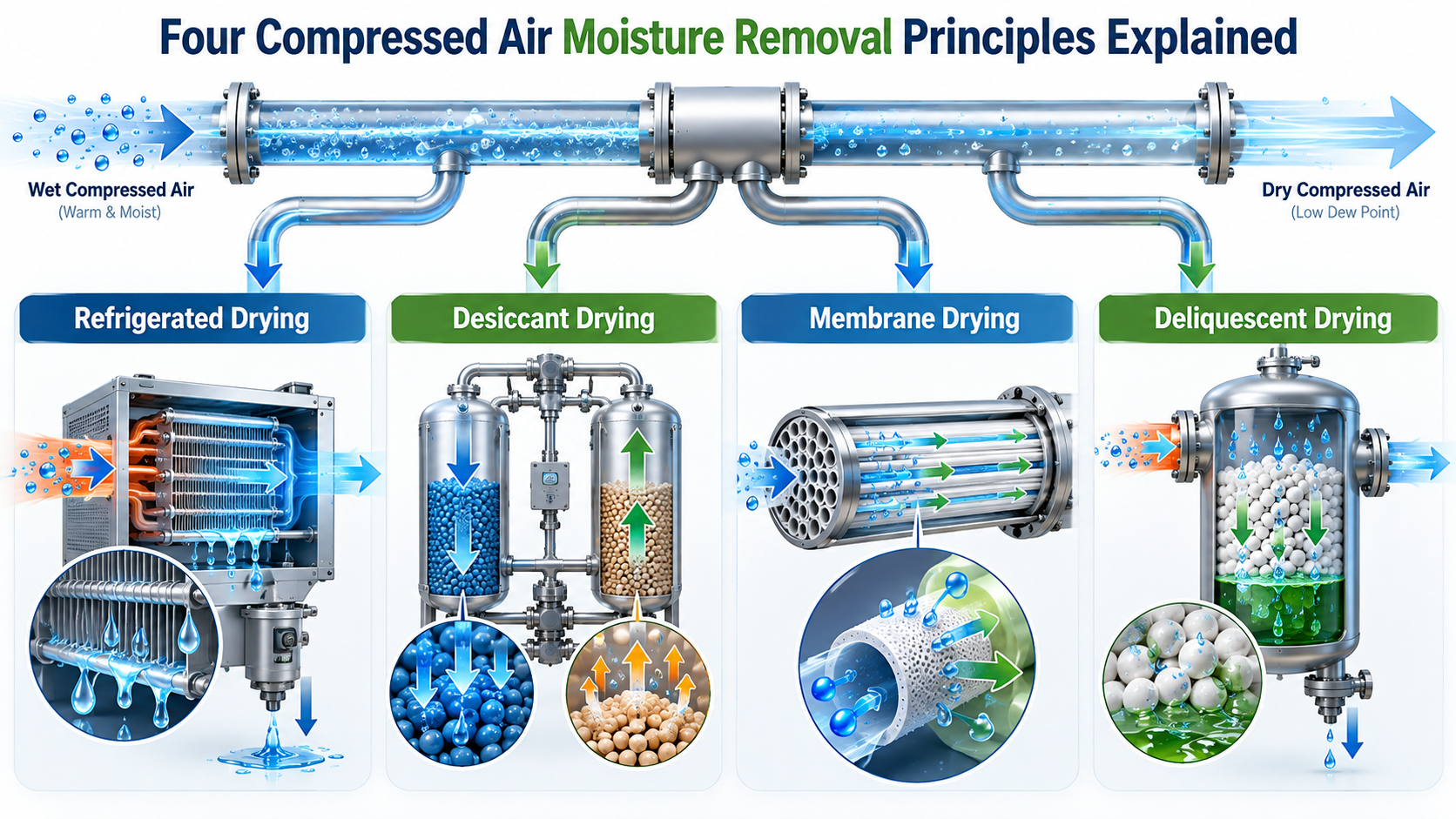
The term energy-saving dryer does not describe one single dryer technology. Instead, it refers to compressed air drying equipment designed to achieve the required pressure dew point while reducing avoidable energy losses.
Depending on the application, this may include refrigerated dryers with variable-frequency control, low-pressure-drop designs, blower-heated adsorption dryers, zero-purge regenerative dryers, or heat-of-compression systems.
The correct solution depends heavily on the required pressure dew point. Refrigerated drying is generally appropriate for applications that need reliable moisture removal without an extremely low dew point, while adsorption drying is used when much drier compressed air is required.
This is why energy efficiency should always be considered together with air-quality requirements rather than simply selecting the dryer with the lowest rated electrical power.
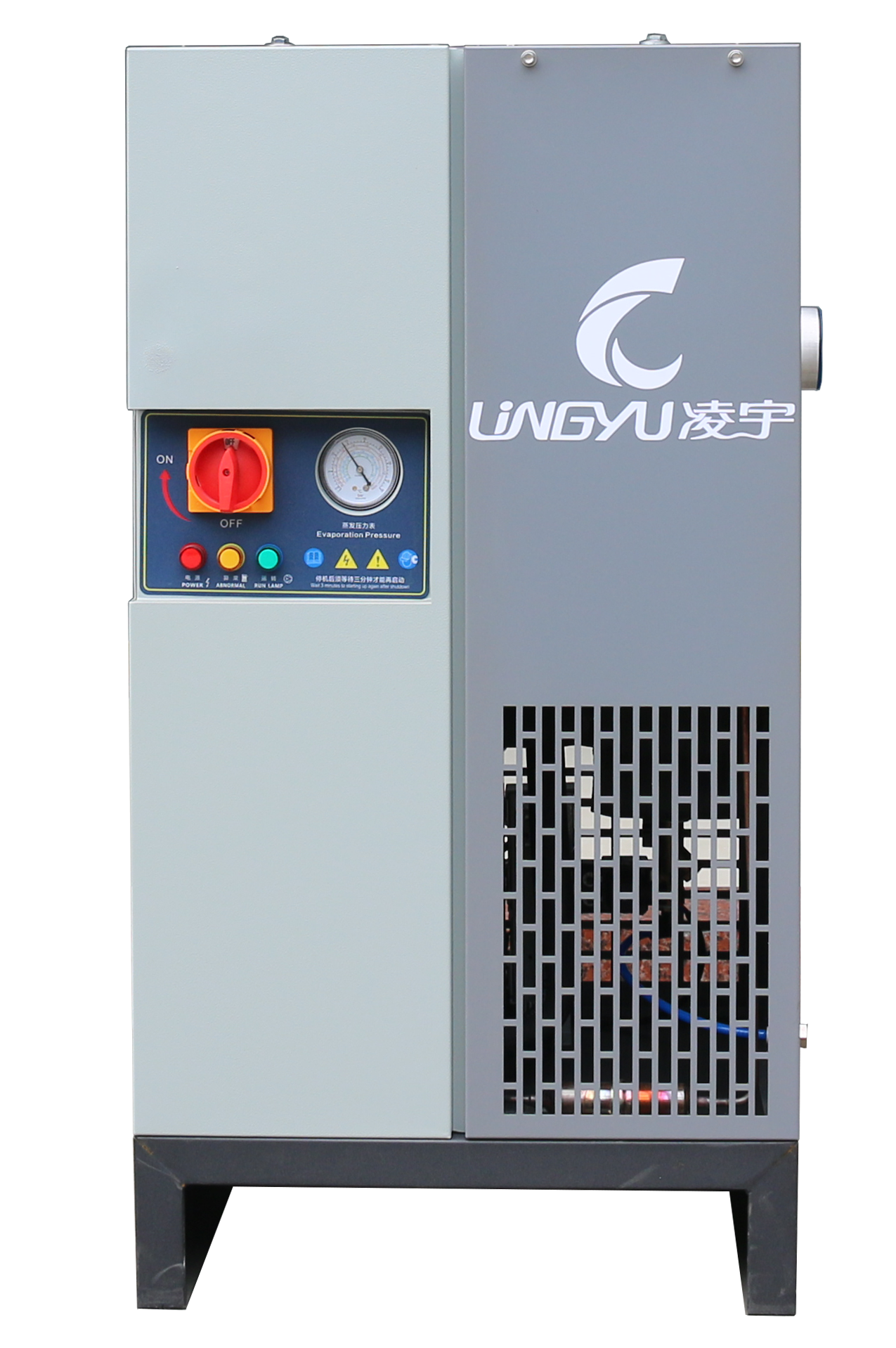
Trend 1: Higher Drying Efficiency with Lower Total Energy Consumption
The first major development trend is straightforward: dryers need to remove moisture effectively while consuming less energy and creating less resistance in the compressed air system.
However, dryer efficiency involves more than electricity consumed directly by the machine.
Variable-Frequency Refrigeration
Compressed air demand rarely remains constant throughout an entire production day. Machines start and stop, production shifts change, and seasonal conditions can alter system load.
A conventional refrigeration system that cannot adapt efficiently to these changes may continue consuming more energy than necessary during periods of reduced airflow.
A frequency conversion refrigerated air dryer can regulate refrigeration output according to the actual treatment demand. Lingyu’s PB Series, for example, adjusts compressor speed as system load changes rather than relying on a completely fixed refrigeration output.
This load-matching approach is especially useful in factories where compressed air consumption fluctuates significantly throughout the day.
Lower Pressure Drop
Pressure drop is another major source of hidden energy consumption.
Every dryer, filter, valve, heat exchanger, and section of piping creates resistance. If the total pressure loss becomes excessive, the compressor may need to operate at a higher discharge pressure simply to maintain sufficient pressure at the point of use.
For this reason, future energy-saving dryer designs will increasingly focus on efficient heat exchangers and optimized internal airflow.
Lingyu’s energy-efficient refrigerated dryer applications already combine variable-frequency operation with low-pressure-drop design, showing that reducing refrigeration energy and reducing airflow resistance can be addressed together.
Facilities looking specifically at this aspect of system design can also review the low-pressure differential refrigerated dryer.
Better Heat Exchange
Heat exchanger performance directly influences refrigerated dryer efficiency.
An efficient pre-cooling and reheating process allows cold outgoing compressed air to remove heat from the warmer incoming air. This reduces the load placed on the refrigeration system while reheating the treated air before it enters the downstream network.
Modern plate heat exchanger designs can therefore improve both compactness and energy performance. In Lingyu’s PB Series, the high-performance heat exchanger is designed around a larger heat-transfer area and low pressure drop.
Trend 2: Intelligent Control Based on Actual Operating Conditions
The second major trend is the transition from fixed operation toward demand-based control.
An energy-saving dryer should not simply run the same way under every operating condition. Airflow, temperature, pressure, pressure dew point, and production demand can change continuously.
Modern control systems make it possible to respond to these changes more precisely.
Real-Time Operating Data
Future industrial dryers will increasingly provide operators with visibility into important parameters rather than functioning as isolated mechanical devices.
Depending on dryer technology, useful monitored parameters can include:
- Pressure dew point
- Compressed air inlet and outlet temperatures
- Compressed air pressure
- Refrigeration pressures and temperatures
- Regeneration temperature
- Tower pressure
- Differential pressure
- Compressor operating frequency
For example, Lingyu’s variable-frequency refrigerated dryer platform monitors multiple refrigeration and compressed-air parameters and provides an RS-485 communication interface.
This information can help plant operators identify abnormal operating conditions earlier and integrate dryer operation into a broader compressed air management system.
Dew-Point-Based Control
Intelligent control is particularly valuable for adsorption dryers.
Traditional fixed-cycle regeneration can regenerate the desiccant according to a predetermined schedule even when the adsorption bed still has usable drying capacity.
A dew-point-based control strategy can extend the adsorption cycle when operating conditions allow it. This reduces unnecessary regeneration and can significantly lower energy consumption under variable loads.
Lingyu’s regenerative dryer technology includes optional dew-point-based energy-saving control designed to adapt the adsorption cycle to actual demand.
Remote Communication and System Integration
Industrial plants increasingly expect compressors, dryers, filters, and other utility equipment to communicate with centralized control systems.
RS-485 communication and optional IoT connectivity allow operating information to be transmitted to plant management or monitoring platforms.
The practical value is not simply “smart” equipment. Better system visibility can help maintenance teams identify abnormal trends, compare actual energy performance, coordinate compressed air equipment, and avoid unnecessary operating hours.
Trend 3: Reducing Regeneration Air Loss and Reusing Available Energy
For adsorption dryers, electrical efficiency is only part of the picture.
Compressed air itself is an expensive utility. If a dryer consumes a substantial proportion of treated compressed air during regeneration, the compressor must produce additional air simply to compensate for that loss.
This is why reducing purge-air consumption is a major direction in energy-saving adsorption dryer development.
Low-Purge Blower-Heated Drying
Blower-heated regenerative dryers use externally supplied ambient air during regeneration rather than relying entirely on dry compressed product air.
A low-purge design can therefore reduce the quantity of compressed air sacrificed during the regeneration process.
This type of system is useful when a very low pressure dew point is required but the facility also wants to reduce the operating cost associated with traditional purge regeneration.
Zero-Purge Blower-Heated Drying
A further step is the blower zero-purge adsorption dryer.
In Lingyu’s zero-purge configuration, ambient air is used during heating, while the cooling stage uses a closed-loop circulation arrangement rather than dry compressed product air. This allows regeneration to be completed without consuming compressed air during the regeneration process.
For large compressor stations, eliminating continuous purge losses can make a meaningful difference because every cubic meter of compressed air that is lost must first be produced by the compressors.
Heat-of-Compression Drying
Another important direction is recovering thermal energy that already exists within the compressed air system.
A heat-of-compression dryer uses the high temperature of compressor discharge air as part of the desiccant regeneration process rather than rejecting all of that heat as waste.
The HOC-Z zero gas consumption heat-of-compression dryer is designed around this principle and can achieve zero regeneration-air consumption under its specified operating conditions.
This technology can be particularly attractive for large, continuously operating compressor stations where suitable high-temperature discharge air is consistently available.
Energy Saving Is a System-Level Issue
One of the most important developments in compressed air treatment is a shift away from evaluating dryers only as individual machines.
A dryer with low electrical consumption can still contribute to an inefficient system if it creates excessive pressure drop, consumes large quantities of purge air, is oversized, or operates continuously when demand is low.
A more complete energy evaluation should therefore consider:
- Electrical power consumption
- Regeneration air consumption
- Pressure drop
- Required pressure dew point
- Actual airflow variation
- Inlet temperature and pressure
- Heat recovery opportunities
- Compressor operating pressure
- Filtration pressure loss
- Maintenance condition
In other words, the most energy-efficient dryer is not necessarily the model with the smallest motor. It is the drying solution that achieves the required air quality with the lowest reasonable total system energy cost.
Industrial Applications of Energy-Saving Dryers
Energy-saving drying technology can be valuable wherever compressed air operates continuously or represents a significant part of plant energy consumption.
Pharmaceutical and Biopharmaceutical Production
Compressed air may support production equipment, packaging, process control, and other applications where moisture and contamination must be carefully managed.
Dryer selection should be based on the required compressed air quality and the specific point of use. More detailed industry information is available for pharmaceutical and biopharmaceutical applications.
Food and Beverage Production
Compressed air is commonly used for packaging, automation, conveying, and production equipment.
A properly designed air-treatment system helps reduce moisture-related problems while efficient dryer operation can lower the energy cost associated with continuous compressed air demand. Lingyu’s project experience includes energy-efficient drying systems used in pharmaceutical and food-related operations.
Automotive Manufacturing
Automotive plants use compressed air extensively for pneumatic tools, assembly equipment, automation, painting support, and general manufacturing.
Because air demand can change substantially between shifts and production areas, variable-frequency refrigerated dryers can be particularly relevant where loads fluctuate.
More information is available for automotive and general manufacturing.
Electronics and Semiconductor Manufacturing
Electronics production often relies on stable compressed air utility systems and may have strict requirements for moisture and contamination control.
For large centralized compressor stations, pressure drop, load-responsive control, system monitoring, and dryer redundancy can all influence both reliability and energy consumption.
Chemical and Petrochemical Processing
Chemical facilities can have large and continuous compressed air requirements, making both air quality and total operating cost important.
Different areas of the plant may require different drying technologies. General instrument air may use one solution, while processes requiring very low pressure dew points may need adsorption drying.
Industry-specific information is available for petrochemical and chemical processing.
How to Choose an Energy-Saving Dryer
The correct dryer should be selected from the process requirement backward rather than purchasing equipment simply because it carries an energy-saving label.
Start by defining the required pressure dew point. This determines whether refrigerated or adsorption drying is the more appropriate technology.
Next, determine the actual maximum airflow and evaluate inlet temperature, operating pressure, ambient conditions, and load profile. A dryer operating under highly variable demand may benefit more from variable-frequency or demand-responsive control than a system operating continuously at a stable load.
Pressure drop should also be included in the evaluation because even a highly efficient dryer can create additional compressor energy costs if airflow resistance is excessive.
For adsorption drying, compare regeneration methods carefully. Heatless, heated-purge, blower-heated, zero-purge, and heat-of-compression systems have different energy characteristics, installation requirements, and appropriate operating conditions.
Finally, compare total lifecycle energy rather than only purchase price or motor power.
FAQ
What makes an energy-saving dryer different from a conventional dryer?
An energy-saving dryer is designed to reduce total compressed air treatment energy through technologies such as variable-frequency refrigeration, low-pressure-drop airflow design, demand-based control, reduced regeneration air consumption, or waste-heat utilization.
Are all energy-saving dryers refrigerated dryers?
No. Energy-saving technology is used in both refrigerated and adsorption dryers. The appropriate technology depends primarily on the required pressure dew point and operating conditions.
Can an energy-saving dryer be installed in an existing compressed air system?
In many cases, yes, but compatibility must be evaluated carefully. Airflow, pressure, inlet temperature, connection size, available utilities, installation space, drainage, cooling requirements, and the existing control system should all be reviewed before replacement or retrofit.
Does variable-frequency control always save energy?
It is most beneficial where demand varies significantly. A system operating continuously near full rated load may have a different energy-saving potential than one operating at partial load for long periods.
What is zero-purge regeneration?
Zero-purge regeneration means that compressed product air is not consumed as regeneration purge air. Different technologies achieve this in different ways, including blower-based closed-loop cooling and heat-of-compression regeneration.
Is the lowest dew point always the most efficient choice?
No. Producing air that is much drier than the process actually requires can increase equipment complexity and energy consumption. Dryer selection should match the pressure dew point requirement of the application.
Can intelligent controls reduce dryer operating costs?
Yes, when they allow the dryer to respond to actual demand. Variable-frequency control, dew-point-based regeneration, operating-data monitoring, and communication with plant systems can reduce unnecessary operation and improve system management.
Conclusion
The future of the energy-saving dryer is not defined by a single new technology. It is being shaped by a combination of efficient heat exchange, lower pressure drop, variable-frequency operation, intelligent control, reduced purge-air consumption, and better recovery of available energy.
Refrigerated dryers are becoming better at matching refrigeration output to actual compressed air demand, while adsorption dryers are reducing regeneration losses through blower, zero-purge, and heat-of-compression technologies. At the same time, more advanced monitoring and communication are allowing dryers to operate as integrated parts of the compressed air station rather than isolated equipment.
For industrial users, the most important goal is not simply to purchase a dryer marketed as energy efficient. It is to select a drying system that delivers the required pressure dew point with the lowest practical total energy consumption over its operating life.
When pressure drop, airflow variation, regeneration consumption, compressor conditions, controls, and air-quality requirements are evaluated together, an energy-saving dryer can contribute to lower operating costs, more stable compressed air quality, and a more efficient industrial utility system.