Nitrogen is widely used in industrial processes ranging from food packaging and pharmaceutical manufacturing to electronics, chemical processing, and metal fabrication. While nitrogen is readily available in the atmosphere, supplying nitrogen at the required purity, flow rate, and pressure can become costly when a facility depends entirely on delivered cylinders or bulk gas.
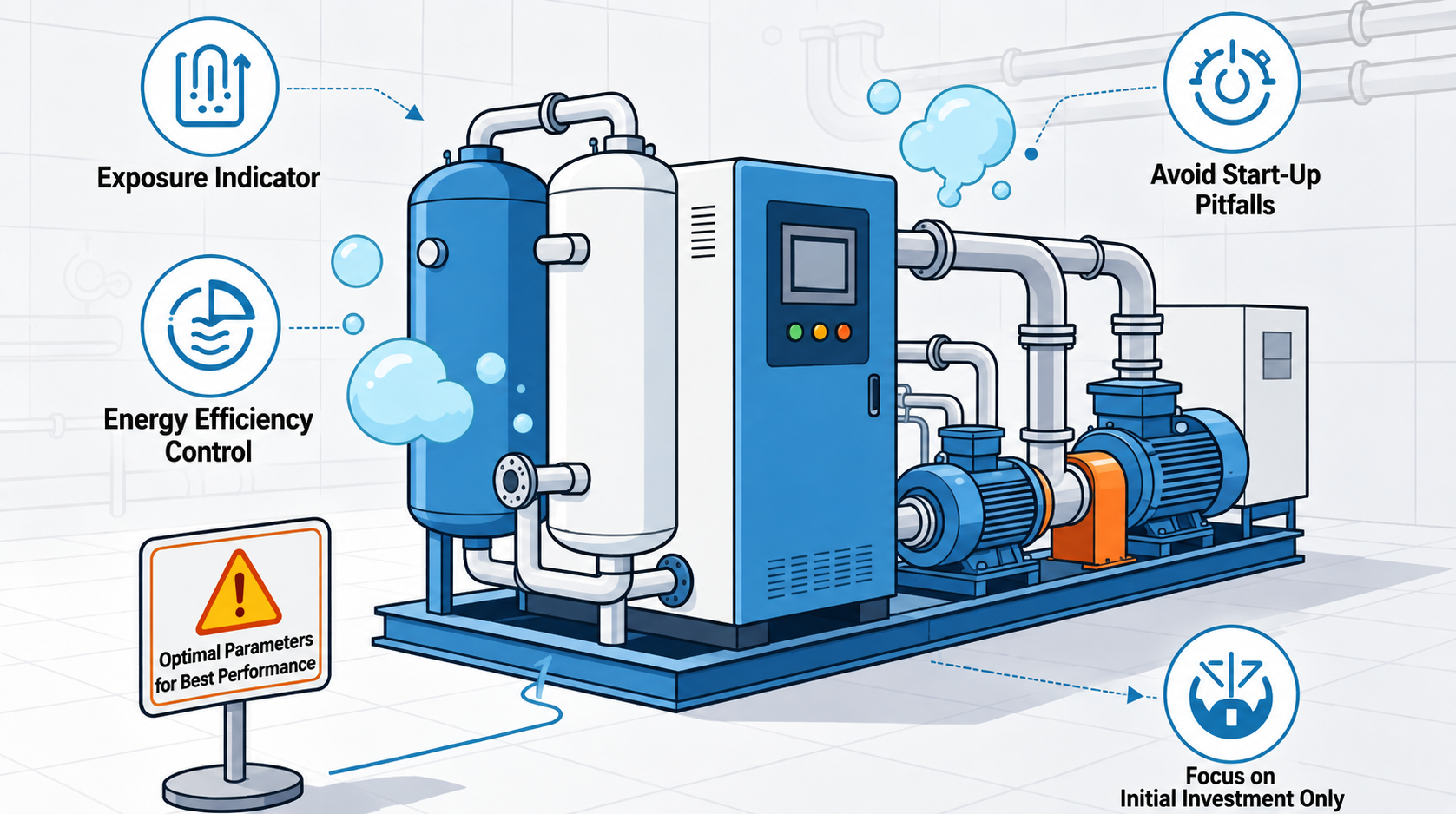
A high pressure nitrogen generator system provides an alternative by generating nitrogen on-site and, where elevated delivery pressure is required, integrating the nitrogen generation stage with appropriate downstream compression, storage, and pressure-control equipment.
For industrial users, it is important to understand that nitrogen generation and nitrogen pressurization are related but separate functions. A PSA nitrogen generator separates nitrogen from compressed air; a downstream booster or compression stage may then be required when the process pressure exceeds the generator’s normal delivery conditions.
What Is a High Pressure Nitrogen Generator?
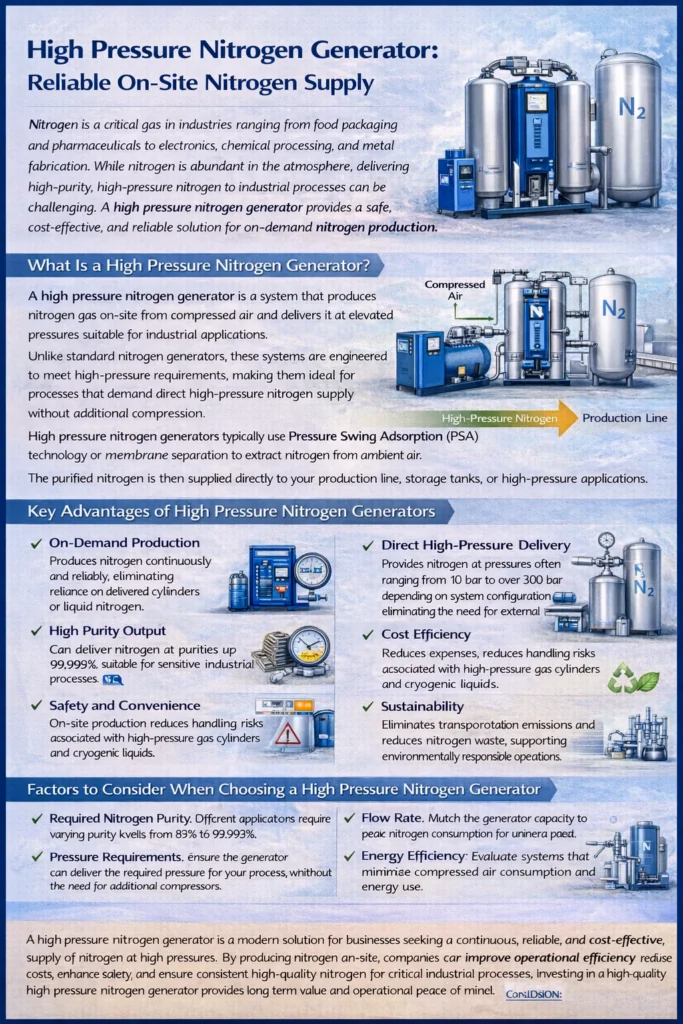
A high pressure nitrogen generator is best understood as an integrated on-site nitrogen supply system designed to meet an elevated end-use pressure requirement.
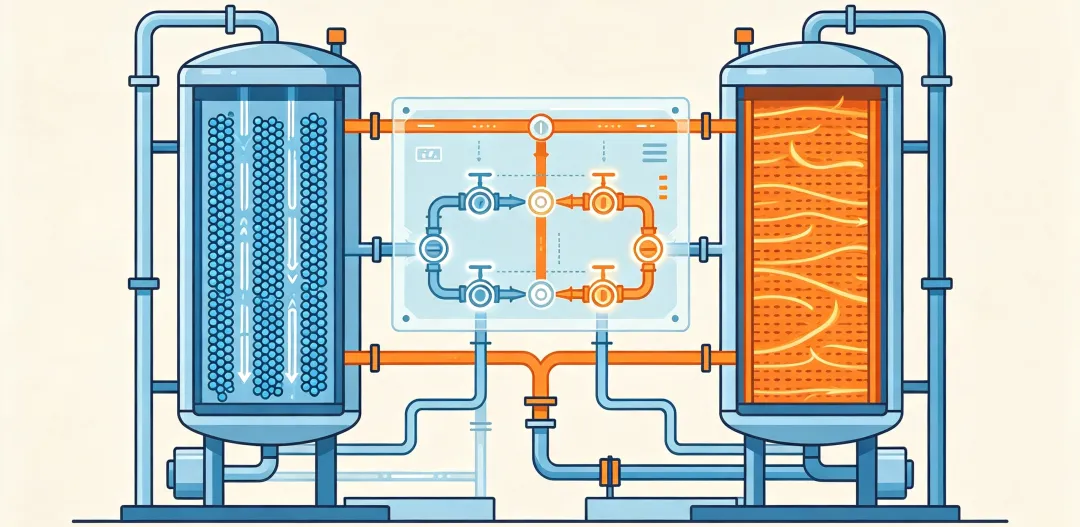
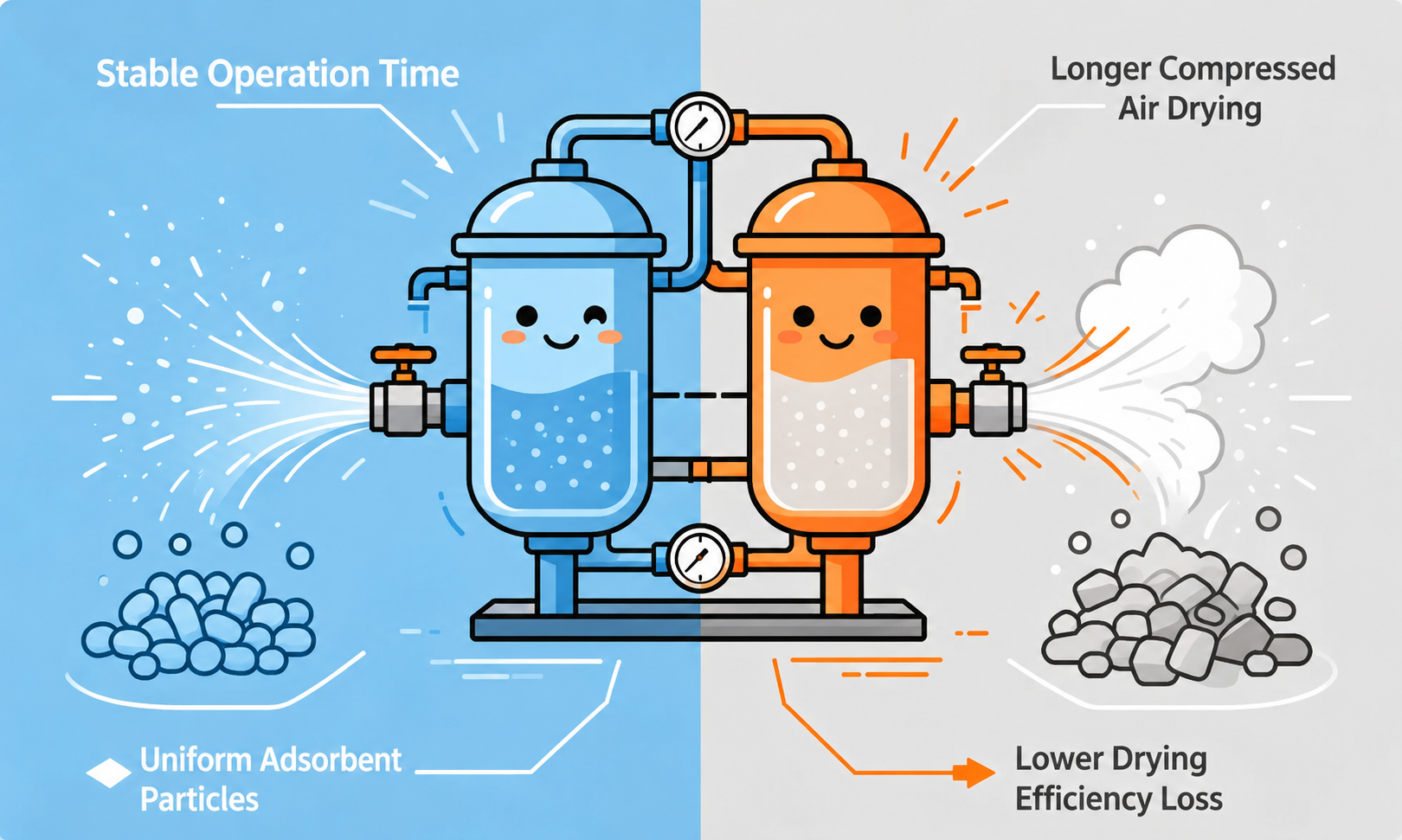
The nitrogen production stage can use Pressure Swing Adsorption (PSA) technology. In a PSA system, compressed air enters adsorption vessels filled with Carbon Molecular Sieve (CMS). Oxygen is preferentially adsorbed while nitrogen passes through as product gas.
Lingyu’s PSA design uses two adsorption towers that alternate between adsorption and regeneration under automatic PLC control, allowing nitrogen to be produced continuously at the specified purity.
Readers who want a more detailed explanation can refer to the PSA nitrogen generator working principle.
Where the required end-use pressure is higher than the normal discharge conditions of the nitrogen generation stage, the complete system may include a nitrogen booster, high-pressure receiver or storage vessel, valves, regulators, instrumentation, and other appropriately pressure-rated components.
Therefore, the term “high pressure nitrogen generator” does not necessarily mean that the PSA adsorption unit itself directly generates nitrogen at extremely high pressure.
How a High Pressure Nitrogen Supply System Works
A typical on-site system starts with compressed air.
The compressed air is first treated to control moisture, oil, and particulate contamination before entering the PSA nitrogen generator. The generator separates nitrogen from oxygen, after which the product nitrogen can pass through buffer storage and any additional treatment or compression required by the application.
A typical system arrangement can be expressed as:
Air compressor → air receiver → compressed-air treatment → PSA nitrogen generator → nitrogen buffer tank → nitrogen booster, if required → high-pressure storage/control → point of use
The exact arrangement depends on nitrogen purity, required pressure, flow profile, storage strategy, and the downstream process.
For users designing the nitrogen-generation stage itself, Lingyu’s PSA nitrogen generator provides the relevant product family.
When pressure requirements extend beyond the normal PSA generation system, the high-pressure section should be engineered separately according to the required working pressure, nitrogen flow, storage capacity, applicable pressure-vessel requirements, and downstream equipment.
Nitrogen Purity and Pressure Are Different Specifications
One of the most important principles when selecting a high pressure nitrogen system is that nitrogen purity and nitrogen pressure are not the same specification.
Lingyu’s PSA nitrogen generator supports nitrogen purity from 95% to 99.999%, with an inlet air pressure of 0.5–0.8 MPa and nitrogen dew point of ≤−40°C under the specified operating conditions.
Available PSA configurations include 99.0%, 99.5%, 99.9%, 99.99%, and 99.999% nitrogen purity.
Purity should be determined by the process and its acceptable residual oxygen concentration, while pressure should be determined by downstream equipment and delivery requirements.
A process requiring high pressure does not automatically require 99.999% nitrogen. Likewise, a process requiring 99.999% nitrogen does not automatically require high-pressure delivery.
For applications specifically requiring very high purity, Lingyu also provides a 99.99% nitrogen generator configuration.
When Is Additional Nitrogen Compression Required?
Additional nitrogen compression should be considered whenever the required point-of-use pressure is significantly above the pressure available from the nitrogen generation system.
This may occur in applications involving high-pressure laser cutting, pressure testing, charging or filling operations, gas storage, specialized chemical processes, or other equipment designed to operate at elevated gas pressure.
A useful engineering principle is:
Generate nitrogen under suitable PSA operating conditions, then compress the product nitrogen when the downstream process actually requires higher delivery pressure.
The required booster or compressor configuration depends on inlet nitrogen pressure, final delivery pressure, flow demand, duty cycle, nitrogen purity, storage strategy, and allowable temperature rise.
This distinction prevents a common selection error: treating the PSA adsorption unit and the high-pressure nitrogen compression stage as if they were the same piece of equipment.
Key Advantages of an On-Site High Pressure Nitrogen System
On-Demand Nitrogen Production
A PSA system can generate nitrogen continuously from compressed air rather than depending entirely on routine cylinder deliveries.
The twin-tower PSA process alternates automatically between adsorption and regeneration, supporting continuous nitrogen production for facilities with stable or predictable nitrogen demand.
Nitrogen Purity Matched to the Process
Different processes require different gas quality.
Instead of specifying maximum purity for every application, the PSA system can be configured according to the actual residual oxygen and product-quality requirements.
For applications requiring further purification, an additional carbon-based deoxygenation purification system can upgrade approximately 99.9% PSA nitrogen to ≥99.999% purity.
Reduced Dependence on Delivered Gas
Generating nitrogen at the facility can reduce the logistics associated with transporting, replacing, and storing nitrogen cylinders or arranging routine bulk gaseous nitrogen deliveries.
Whether this creates an economic advantage depends on actual nitrogen consumption, electricity cost, compressor efficiency, required purity, pressure, operating hours, maintenance, and capital investment.
Automated Monitoring and Control
Lingyu’s PSA system includes real-time monitoring of nitrogen purity and flow rate.
If nitrogen purity falls below the specified value, the system can issue an alarm. If the off-spec condition persists for a preset period, the system can shut down automatically for protection.
Automatic PLC control also manages operating-cycle switching and pneumatic valve sequencing, while touchscreen monitoring provides access to important system operating information.
Flexible System Integration
On-site nitrogen generation can be integrated with compressed-air treatment, buffer storage, product-gas analysis, pressure control, and additional nitrogen compression where required.
This allows the overall nitrogen supply system to be configured around actual plant requirements rather than treating nitrogen as a single fixed-pressure utility.
Applications of High Pressure Nitrogen Systems
Laser Cutting and Metal Fabrication
Laser cutting is one of the clearest examples of an application where both nitrogen flow and delivery pressure can be important.
Nitrogen is used as an assist gas in selected laser-cutting processes to help remove molten material from the cutting zone while limiting oxidation of the cut surface.
Required pressure and flow can vary substantially according to material type, thickness, nozzle configuration, laser power, cutting speed, and desired edge quality.
A laser-cutting nitrogen system should therefore be sized from the actual machine specification rather than a generic pressure range.
Lingyu provides dedicated metal fabrication and laser cutting solutions for this application.
Chemical and Petrochemical Processing
Nitrogen is used in chemical facilities for tank blanketing, pipeline purging, process inerting, material transfer, and atmosphere control.
Some operations may require elevated delivery pressure, while others operate effectively at relatively modest nitrogen pressure.
The system should therefore be designed around actual vessel, piping, pressure, flow, and process requirements.
More information about this sector is available through Lingyu’s petrochemical and chemical processing solutions.
Food and Beverage Production
Nitrogen is commonly used for packaging, blanketing, and atmosphere control in food and beverage production.
These applications may place greater emphasis on gas quality, stable flow, and process hygiene than on extremely high pressure. A high-pressure compression stage should therefore only be added when the specific production or packaging equipment requires it.
Pharmaceutical Manufacturing
Pharmaceutical manufacturing can use gaseous nitrogen for blanketing, purging, packaging, material protection, and selected laboratory or production processes.
Nitrogen purity, dew point, pressure, filtration, documentation, monitoring, and system qualification requirements should be established according to the specific process.
For a more focused discussion, see the nitrogen generator for pharmaceutical industry guide.
Electronics and Semiconductor Manufacturing
Nitrogen is widely used throughout electronics and semiconductor manufacturing to establish controlled atmospheres and reduce unwanted oxidation.
Semiconductor processing, soldering, component production, storage, and other applications can have significantly different purity, dew point, pressure, and contaminant requirements.
System specifications should therefore be determined from the actual production process rather than from a universal “high-purity, high-pressure” specification.
High Pressure Does Not Automatically Mean High Purity
A common sizing mistake is to combine “high pressure” and “high purity” into a single specification without considering the actual process.
One application may require very high nitrogen purity but only moderate delivery pressure. Another may require high pressure and high flow while accepting a lower nitrogen purity.
Increasing nitrogen purity can also increase the amount of compressed air required to produce a given amount of product nitrogen, affecting both operating cost and equipment sizing.
The correct approach is to define purity and pressure independently and then size the complete nitrogen system around both requirements.
For more detailed sizing guidance, see the PSA nitrogen generator selection guide.
The Importance of Feed-Air Treatment
PSA nitrogen generation depends on compressed air, so feed-air quality is an important part of the complete nitrogen system.
Moisture, oil, and particulates should be controlled before compressed air enters the PSA generator.
A complete system may include an air receiver and refrigerated air dryer upstream of the nitrogen-generation stage, together with appropriate compressed-air filtration.
Facilities with more demanding moisture-control requirements may need to evaluate a desiccant air dryer as part of the upstream treatment system.
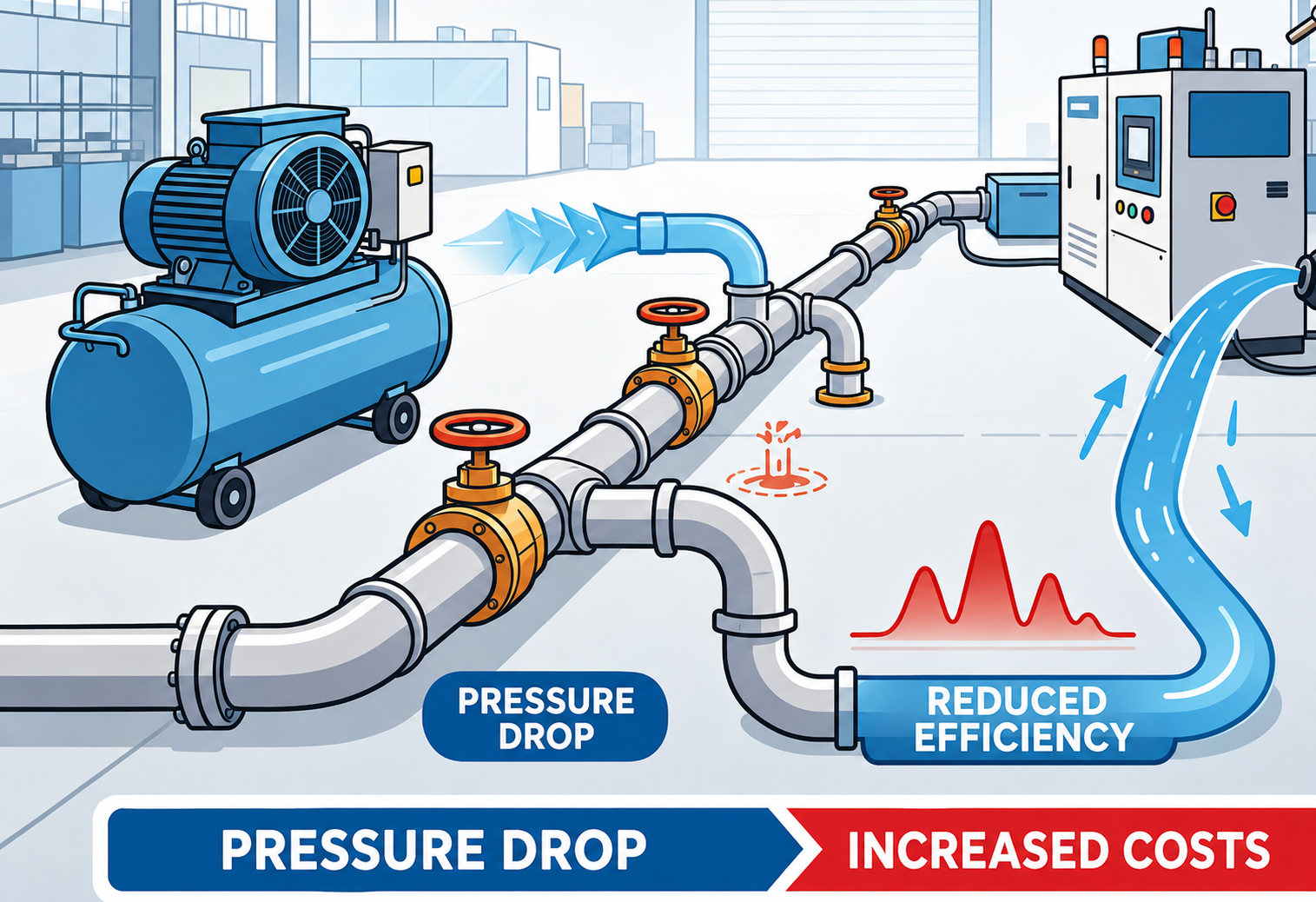
This becomes particularly important when both the nitrogen-generation and high-pressure compression stages are expected to operate continuously.
Factors to Consider When Choosing a High Pressure Nitrogen Generator System
A high pressure nitrogen system should be selected from the actual end-use requirements rather than from pressure or purity alone.
Nitrogen purity should be based on the process oxygen limit and gas-quality requirement. Final delivery pressure should be based on downstream equipment; where it exceeds the normal output of the PSA section, an appropriately engineered nitrogen booster should be included.
Nitrogen flow rate should account for normal demand, peak demand, simultaneous users, leakage, and future expansion. Buffer and storage capacity should be selected to manage short-term load fluctuations and support efficient generator and booster operation.
Feed-air capacity and quality must be sufficient for the selected nitrogen purity and flow. Energy consumption should include both compressed-air production and any additional nitrogen compression.
Monitoring and controls should cover relevant parameters such as purity, flow, pressure, operating status, and alarms.
Finally, all pressure-rated components must be selected for the final system pressure. This is particularly important for high-pressure receivers, piping, valves, fittings, regulators, relief devices, and downstream equipment.
Safety Considerations for High Pressure Nitrogen
Nitrogen is non-flammable under normal industrial conditions, but a high-pressure nitrogen system still requires careful safety engineering.
Compressed gas stores substantial energy. Pressure-vessel integrity, correctly rated piping, pressure relief, isolation, inspection, and preventive maintenance are therefore essential.
Nitrogen can also displace oxygen in enclosed or poorly ventilated spaces, creating an asphyxiation hazard.
Ventilation and oxygen monitoring should be determined according to the installation, nitrogen volume, workplace configuration, applicable requirements, and site-specific risk assessment.
For a broader explanation, see nitrogen flammability and industrial safety.
Is an On-Site System More Cost-Effective Than Cylinders?
It can be, particularly where nitrogen consumption is continuous or relatively high, but the answer depends on the complete lifecycle cost.
The on-site system calculation should include the air compressor, compressed-air treatment, PSA generator, nitrogen booster where required, receiver vessels, storage, electricity, maintenance, filter and adsorbent replacement, installation, inspection, and equipment depreciation.
The alternative supply calculation should include cylinder or bulk nitrogen purchase costs, transportation, rental, handling, storage, and supply losses.
For this reason, “on-site nitrogen generation is always cheaper” is not a reliable universal conclusion.
The economic case should be calculated using the plant’s actual nitrogen consumption profile, required purity, delivery pressure, operating hours, local energy cost, and delivered-gas cost.
Conclusion
A high pressure nitrogen generator system can provide a reliable on-site nitrogen supply for industrial processes requiring controlled purity, continuous availability, and elevated delivery pressure.
However, the system should not be understood as a PSA nitrogen generator that automatically produces nitrogen at extremely high pressure.
In a properly engineered installation, the PSA generator produces nitrogen from treated compressed air, while additional booster compression, pressure-rated storage, and pressure-control equipment can be added when the downstream application requires higher pressure.
Lingyu’s PSA nitrogen generator supports 95%–99.999% nitrogen purity and incorporates automatic PLC operation, real-time nitrogen purity and flow monitoring, and off-spec protection under its specified operating conditions.
By matching nitrogen purity, flow rate, delivery pressure, feed-air quality, storage, and compression to the actual process requirement, industrial users can build an on-site nitrogen system that is more technically appropriate and economically predictable than selecting equipment on pressure or purity alone.