Nitrogen is one of the most widely used industrial gases, with applications ranging from food packaging and pharmaceutical production to semiconductor manufacturing, metal fabrication, and chemical processing.
One of the most common safety questions surrounding the gas is: Is nitrogen flammable?
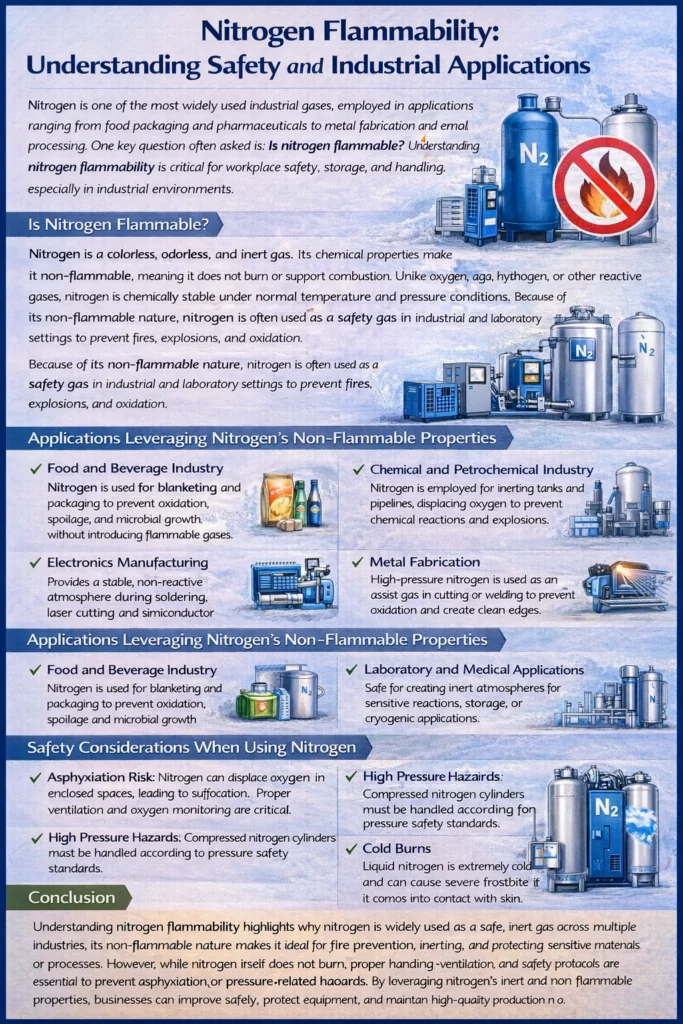
No. Under normal industrial conditions, nitrogen is non-flammable and does not support ordinary combustion. This property makes nitrogen useful for inerting, blanketing, purging, and other processes where reducing oxygen exposure is important.
However, non-flammable does not mean risk-free. Nitrogen can create serious hazards when it displaces breathable oxygen, while compressed nitrogen introduces pressure hazards and liquid nitrogen introduces additional cryogenic hazards.
Understanding both nitrogen’s non-flammable properties and its associated risks is therefore essential before using it in an industrial environment.
Is Nitrogen Flammable?
No. Nitrogen gas is not flammable under normal temperature and pressure conditions.
Molecular nitrogen, N₂, is chemically stable under ordinary industrial conditions. It does not act as a conventional fuel and does not support ordinary combustion.
This is fundamentally different from hydrogen, which can burn, and oxygen, which is not itself a fuel but strongly supports combustion.
Because nitrogen can reduce the concentration of oxygen in a vessel or process space, it is commonly used to create controlled low-oxygen atmospheres.
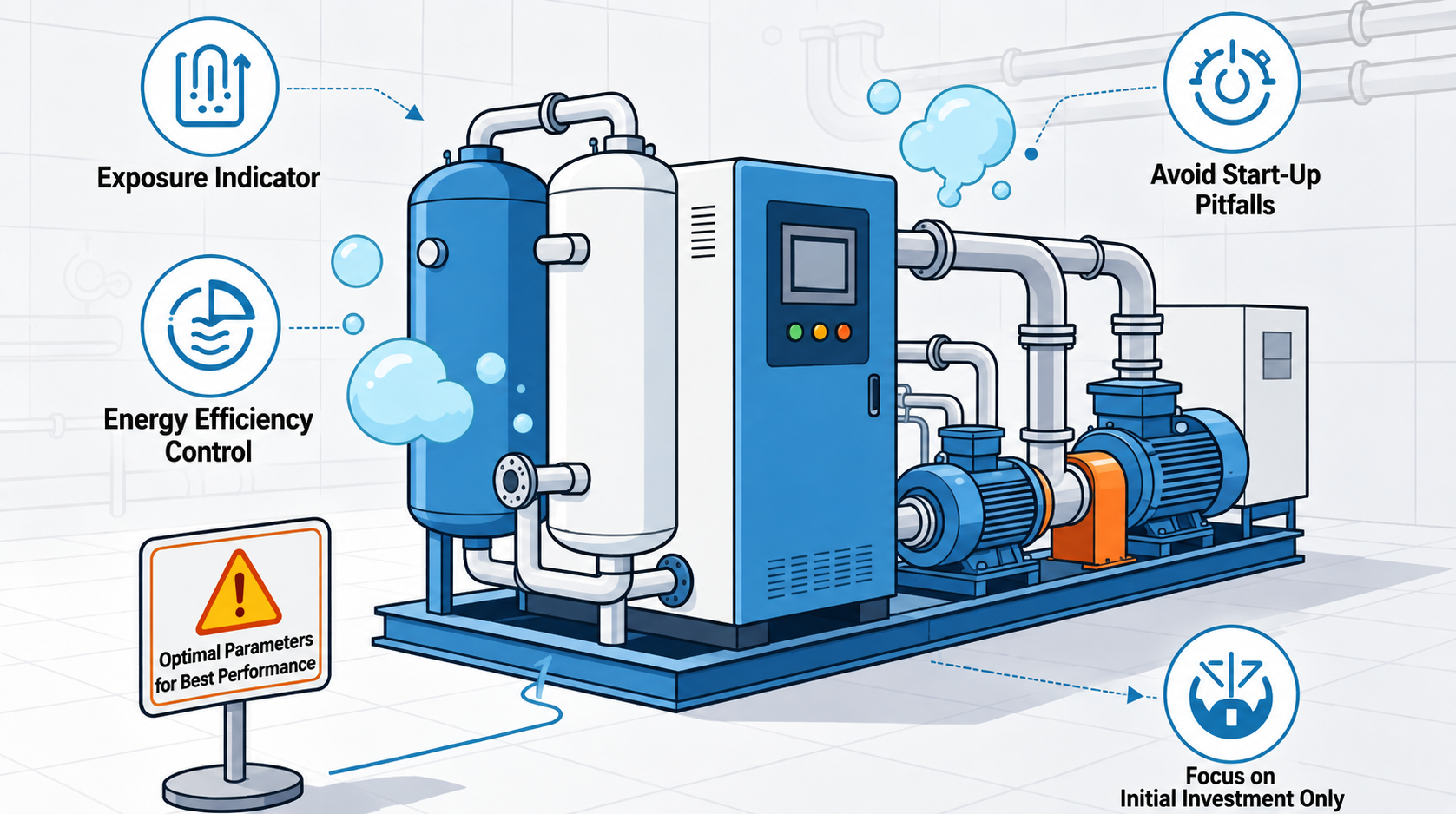
For businesses considering on-site nitrogen production instead of relying entirely on cylinders or bulk gaseous nitrogen deliveries, a PSA nitrogen generator can produce gaseous nitrogen continuously from compressed air.
Why Nitrogen Is Used in Safety-Critical Processes
Nitrogen’s value in many industrial processes is closely related to its chemical stability and its ability to displace oxygen.
Nitrogen Is Non-Flammable
Nitrogen itself does not ignite under normal industrial conditions.
Introducing nitrogen into an appropriately designed process therefore does not add another conventional combustible gas.
Nitrogen Does Not Support Ordinary Combustion
Combustion generally requires sufficient oxidizer.
By reducing oxygen concentration inside a properly engineered enclosed process system, nitrogen can help establish conditions in which combustion and unwanted oxidation are more difficult to sustain.
This does not mean that simply adding nitrogen automatically makes a process safe. The required oxygen concentration must be determined from the actual materials, process conditions, equipment, and applicable safety requirements.
Nitrogen Can Be Used for Inerting and Blanketing
Nitrogen can be introduced into tanks, reactors, pipelines, storage vessels, and other equipment to reduce contact between oxygen and sensitive or potentially reactive materials.
This principle is particularly relevant in petrochemical and chemical processing, where atmosphere control can form an important part of process design.
Effective nitrogen inerting should be engineered according to the actual material, equipment, required oxygen limit, pressure, ventilation, instrumentation, and applicable safety requirements.
Industrial Applications That Use Nitrogen’s Non-Flammable Properties
Food and Beverage Industry
Nitrogen is widely used in food production and packaging where manufacturers need to limit oxygen exposure.
Replacing part of the oxygen inside suitable packaging can help reduce oxidation and protect characteristics such as flavor, color, and product quality. Nitrogen can also be used for tank blanketing and selected processing operations.
Because nitrogen itself is non-flammable, it can provide a controlled atmosphere without introducing a conventional combustible gas.
Nitrogen purity should still be selected according to the specific production or packaging process rather than assuming that every food application requires the highest available purity.
Chemical and Petrochemical Processing
Chemical plants use nitrogen for applications such as tank blanketing, pipeline purging, vessel inerting, material transfer, and atmosphere control.
The objective is often to reduce the amount of oxygen available to react with process materials.
However, nitrogen does not eliminate every fire or explosion hazard. Effective inerting requires controlled oxygen concentration, appropriate instrumentation, suitable equipment, operating procedures, and a process-specific risk assessment.
Where a continuous gaseous nitrogen supply is required, an on-site generator can be evaluated as an alternative to relying entirely on delivered nitrogen.
Electronics and Semiconductor Manufacturing
Nitrogen is also widely used to establish controlled atmospheres in electronics and precision manufacturing.
Depending on the process, nitrogen can support soldering, component manufacturing, semiconductor processing, storage, purging, and other operations where oxidation or moisture exposure must be controlled.
Certain sensitive processes may require higher nitrogen purity or tighter contaminant limits. Purity, dew point, pressure, flow stability, and other gas-quality requirements should therefore be determined from the actual production process.
Metal Fabrication and Laser Cutting
Nitrogen is commonly used as an assist gas in certain laser-cutting applications.
Because nitrogen does not support ordinary combustion like oxygen, it can provide an oxidation-controlled cutting environment and is often selected where reduced oxidation and suitable edge quality are priorities.
The required nitrogen pressure, flow, and purity depend heavily on material type, material thickness, laser equipment, cutting speed, and desired cut quality.
For these applications, see Lingyu’s metal fabrication and laser cutting solutions.
Pharmaceutical and Laboratory Applications
Nitrogen can be used in pharmaceutical manufacturing and laboratory operations for inerting, blanketing, purging, packaging, analytical instruments, and other controlled-atmosphere applications.
Different processes can require very different nitrogen specifications.
General tank blanketing, for example, may not require the same gas quality as sensitive analytical instrumentation. Purity, flow stability, pressure, dew point, particulate levels, hydrocarbons, and other contaminants may all need to be evaluated.
For pharmaceutical applications, see the nitrogen generator for pharmaceutical industry guide.
Nitrogen Is Non-Flammable, but It Is Not Harmless
A common mistake is to interpret “non-flammable” as meaning “completely safe.”
Nitrogen presents several important industrial hazards that are unrelated to flammability.
Oxygen Displacement and Asphyxiation
The most important hazard associated with gaseous nitrogen is oxygen displacement.
Nitrogen is naturally present in air and cannot be detected by human smell or appearance. If additional nitrogen is released into an enclosed or poorly ventilated space, the oxygen concentration can fall to dangerous levels.
This can occur around nitrogen generators, storage systems, pipelines, process vessels, laboratories, or other facilities using significant quantities of nitrogen.
Appropriate ventilation, oxygen monitoring where justified, operating procedures, confined-space controls, and site-specific risk assessments should therefore be considered wherever nitrogen accumulation is possible.
Importantly, nitrogen’s ability to displace oxygen is both the reason it is useful for inerting and the reason it can create an asphyxiation hazard.
High-Pressure Nitrogen Hazards
Gaseous nitrogen is frequently stored, transported, distributed, or used under pressure.
The gas itself may not burn, but pressurized equipment introduces mechanical hazards.
Pressure vessels, cylinders, pipelines, valves, regulators, hoses, and associated components must therefore be suitable for their intended operating pressures and conditions.
Systems requiring elevated pressure should be designed around actual downstream requirements rather than simply producing nitrogen at the highest available pressure.
For more information on this topic, see the high-pressure nitrogen generator guide.
Liquid Nitrogen Presents Different Hazards
Liquid nitrogen requires an important distinction.
A PSA nitrogen generator produces gaseous nitrogen from compressed air. It does not directly produce cryogenic liquid nitrogen.
Liquid nitrogen is maintained at extremely low temperatures and therefore introduces cryogenic hazards in addition to oxygen-displacement risks. Direct contact can cause severe cold injuries, while rapid vaporization can release a large volume of nitrogen gas.
Storage, handling, equipment, ventilation, and personal-protection requirements for liquid nitrogen therefore differ from those for conventional PSA-generated gaseous nitrogen.
Readers comparing these technologies can refer to cryogenic nitrogen generator vs. PSA nitrogen generator.
How an On-Site PSA Nitrogen Generator Works
For industrial plants with continuous gaseous nitrogen demand, Pressure Swing Adsorption is a common on-site generation method.
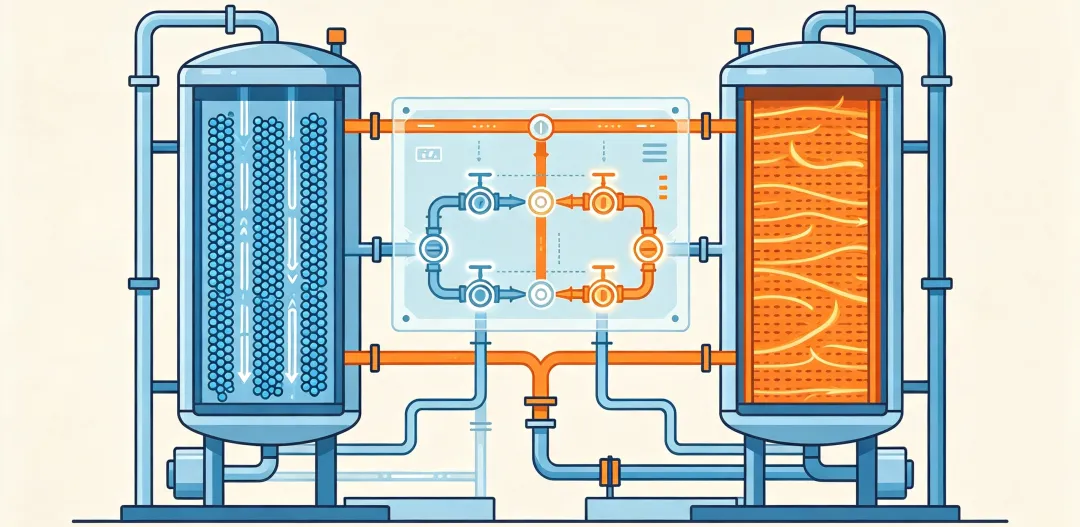
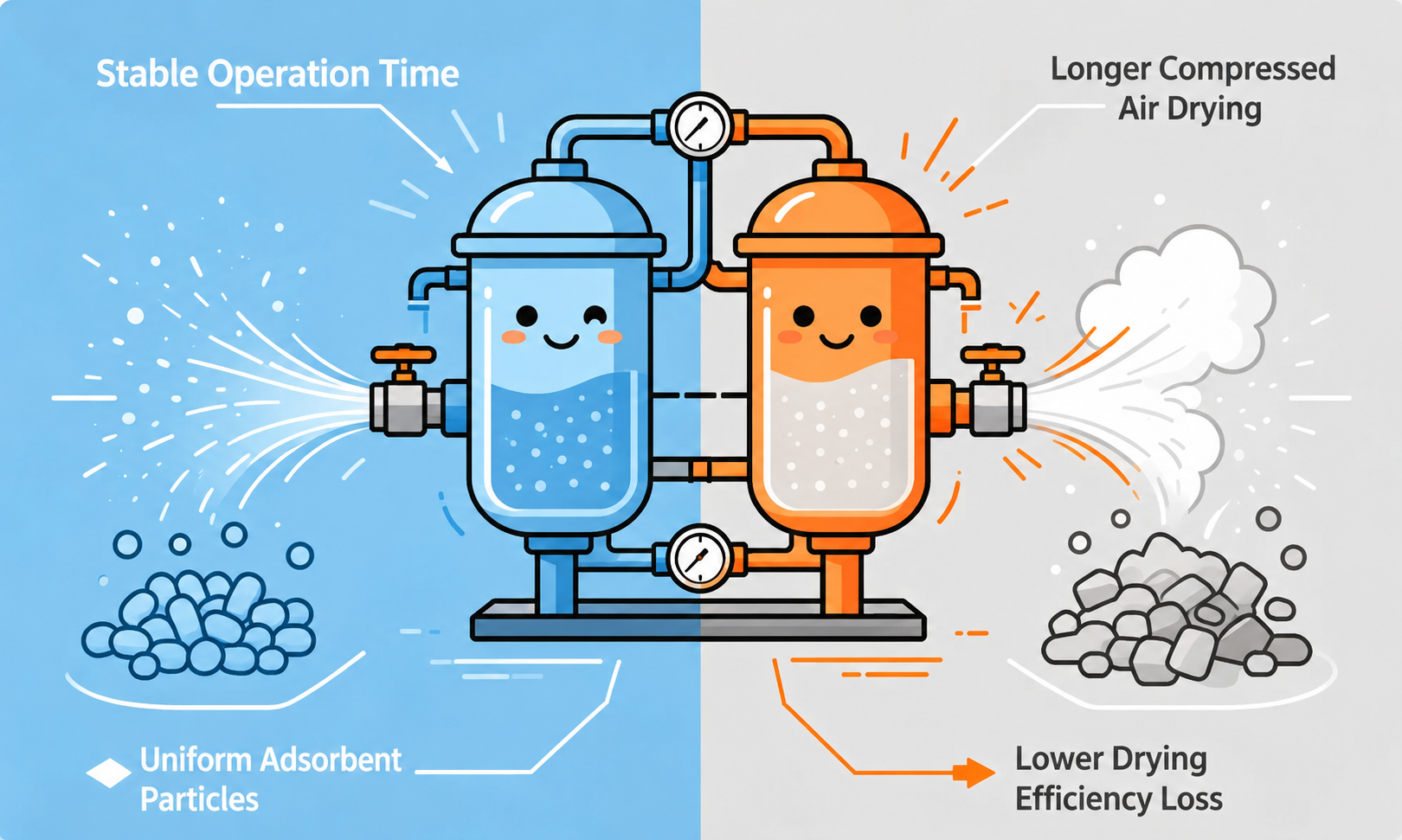
Lingyu’s PSA nitrogen generator uses two adsorption vessels filled with Carbon Molecular Sieve (CMS).
Compressed air enters one tower, where oxygen is preferentially adsorbed by the CMS while nitrogen passes through the adsorption bed and is collected as product gas. Meanwhile, the second tower undergoes depressurization and regeneration.
The towers automatically alternate between adsorption and regeneration, allowing the system to maintain continuous nitrogen production.
Under the specified operating conditions, Lingyu PSA equipment supports nitrogen purity from 95% to 99.999%, with:
Inlet air temperature: ≤40°C
Inlet air pressure: 0.5–0.8 MPa
Nitrogen dew point: ≤−40°C
Ambient temperature: ≤40°C
Switching cycle: 45–60 s
Power supply: 220 V / 50 Hz
Noise level: ≤75 dB
These operating parameters should be evaluated together rather than treating nitrogen purity as the only system specification.
The PSA system also provides real-time nitrogen purity and flow monitoring, off-spec nitrogen alarm and protection, automatic PLC-controlled operation, and touchscreen monitoring of operating parameters.
For a deeper explanation of the separation process, see PSA nitrogen generator working principle.
Does Higher Nitrogen Purity Mean Better Safety?
Not necessarily.
Nitrogen purity should be determined by the actual process requirement.
For inerting applications, one of the critical objectives is achieving and maintaining the required oxygen concentration in the protected process.
For laser cutting, electronics manufacturing, pharmaceutical production, and analytical applications, nitrogen purity may also be determined by product-quality requirements or equipment specifications.
Lingyu PSA nitrogen generation systems cover a wide purity range from 95% to 99.999%, allowing different configurations to be matched to different industrial requirements.
For applications requiring particularly high nitrogen purity, an additional carbon-based deoxygenation purification system can further purify approximately 99.9% PSA-generated nitrogen to ≥99.999%.
The correct engineering approach is therefore to establish the required purity, flow, pressure, dew point, oxygen concentration, and consumption profile before selecting the nitrogen generation system.
Basic Nitrogen Safety Practices
Although nitrogen does not present a conventional flammability hazard, industrial facilities must manage risks associated with oxygen displacement, pressure, and, where applicable, cryogenic temperatures.
Typical considerations include suitable ventilation where nitrogen could accumulate; oxygen monitoring where required by the risk assessment; inspection of pipelines, valves, and connections for leakage; operation of pressure equipment within specified limits; personnel training; appropriate emergency procedures; and strict controls for confined-space work.
Liquid nitrogen requires additional equipment, personal protective measures, and procedures appropriate for cryogenic liquids.
The exact safety measures should always be determined according to the installation, nitrogen volume, operating pressure, workplace configuration, process conditions, applicable regulations, and site-specific risk assessment.
Conclusion
So, is nitrogen flammable? No.
Nitrogen is non-flammable and does not support ordinary combustion under normal industrial conditions. These properties are among the reasons nitrogen is widely used for inerting, blanketing, purging, packaging, chemical processing, electronics manufacturing, laser cutting, pharmaceutical production, and other controlled-atmosphere applications.
However, nitrogen’s non-flammable nature should never be confused with an absence of hazards.
Gaseous nitrogen can displace oxygen and create an asphyxiation hazard. Compressed nitrogen involves pressure-related hazards, while liquid nitrogen introduces significant cryogenic risks.
When nitrogen is used with suitable system design, ventilation, monitoring, pressure control, operating procedures, and risk assessment, its stable and non-flammable characteristics make it a valuable industrial process gas.
For facilities requiring a continuous supply of gaseous nitrogen, a properly sized on-site PSA system can provide a practical alternative to delivered gas while allowing nitrogen purity and capacity to be matched to the actual industrial process.