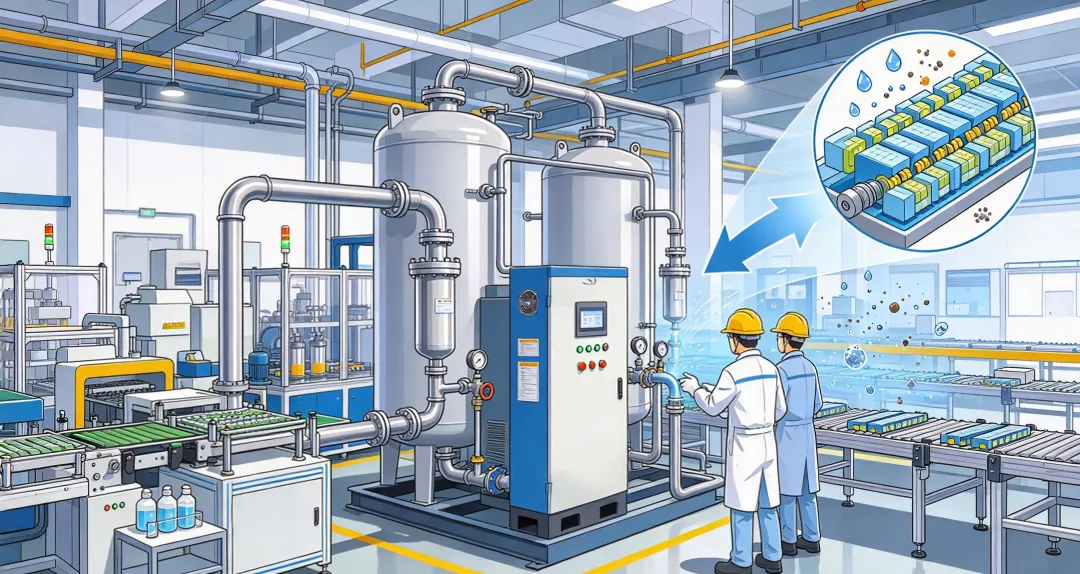
Compressed air is widely used in manufacturing, automotive production, food processing, electronics, pharmaceuticals, packaging, and many other industrial applications.
However, every air compressor draws in atmospheric air containing water vapor. When that air is compressed and later cooled, part of the moisture can condense inside receivers, pipelines, valves, pneumatic equipment, and production machinery.
Choosing the best air dryer for an air compressor therefore means matching the dryer to the actual compressor output and downstream air-quality requirement.
The right choice depends on pressure dew point, compressor airflow, operating pressure, discharge temperature, ambient conditions, pressure drop, regeneration method, filtration, energy use, and maintenance—not simply on which dryer produces the lowest dew point.
Lingyu provides refrigerated air dryers, desiccant air dryers, combined drying systems, and precision filtration for different compressed-air treatment requirements.
Why Does an Air Compressor Need a Dryer?
An air compressor does not remove the moisture naturally present in atmospheric air.
Compression increases the concentration of water vapor in the compressed air. As that air subsequently cools, the water vapor can reach saturation and begin condensing into liquid water.
Without effective moisture control, condensate can contribute to corrosion, freezing, pneumatic-control problems, contamination, and equipment deterioration.
An air dryer reduces the moisture content so that compressed air remains sufficiently dry for downstream piping and process conditions.
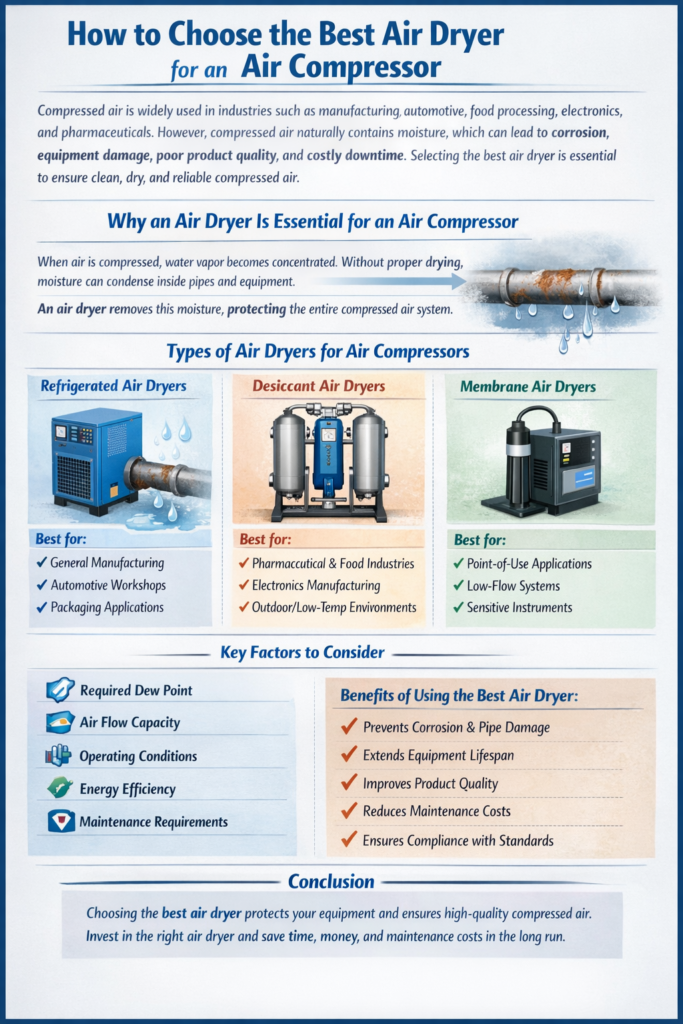
For users comparing the available technologies, see the guide to types of compressed air dryers.
Start With the Compressor, Not the Dryer
A common sizing mistake is to select a dryer based only on nominal compressor capacity.
The dryer actually receives compressed air under a specific combination of flow, pressure, temperature, and moisture load.
A compressor operating at a high discharge temperature can place a much greater moisture and thermal load on the dryer than the same nominal airflow entering at a lower temperature.
Likewise, the flow reaching the dryer may differ from compressor nameplate capacity because of operating pressure, load variation, multiple compressors, receiver arrangements, or future plant expansion.
The correct selection sequence is therefore:
Compressor operating conditions → Required downstream air quality → Dryer technology → Corrected dryer capacity
Refrigerated Air Dryers
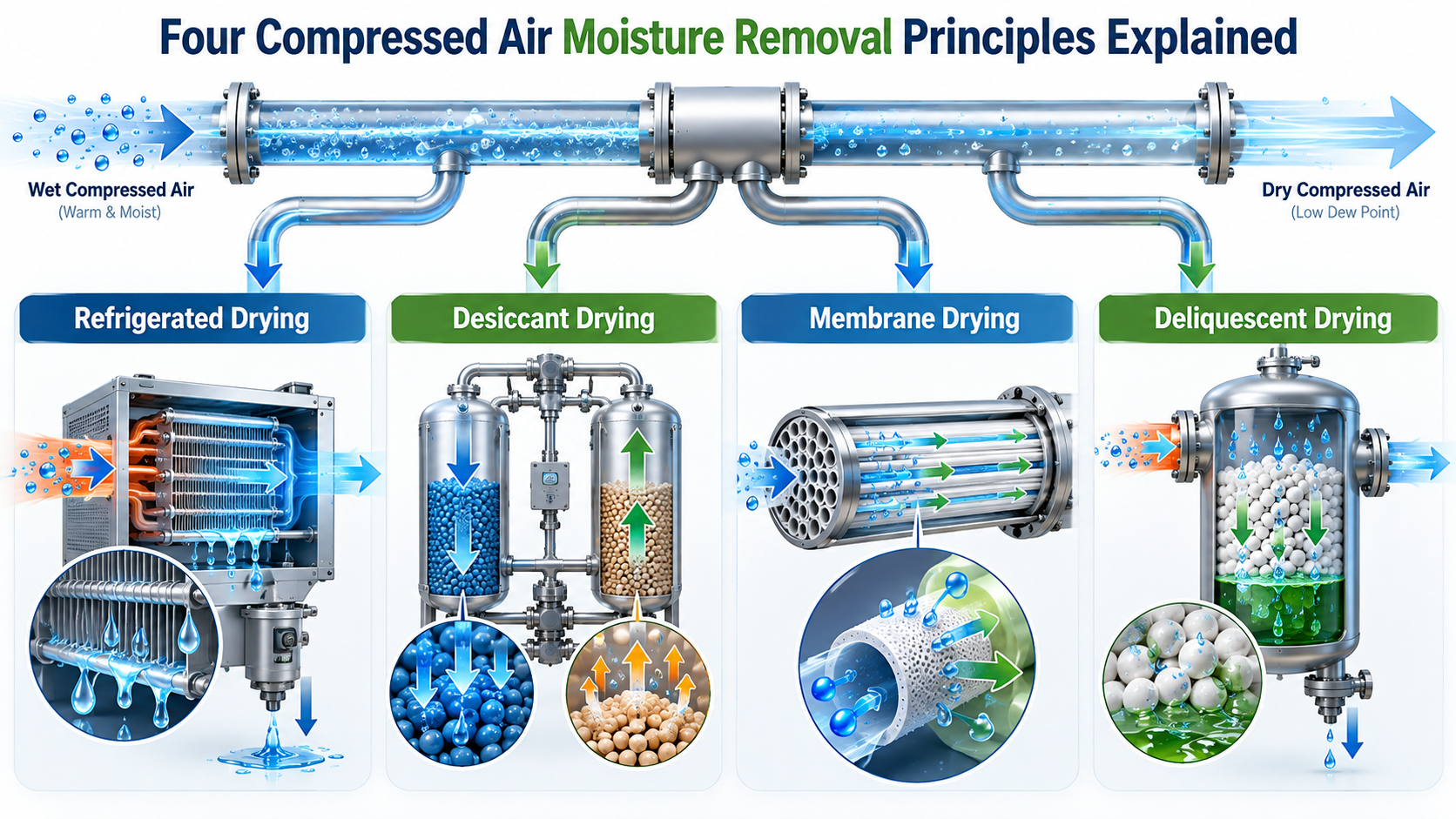
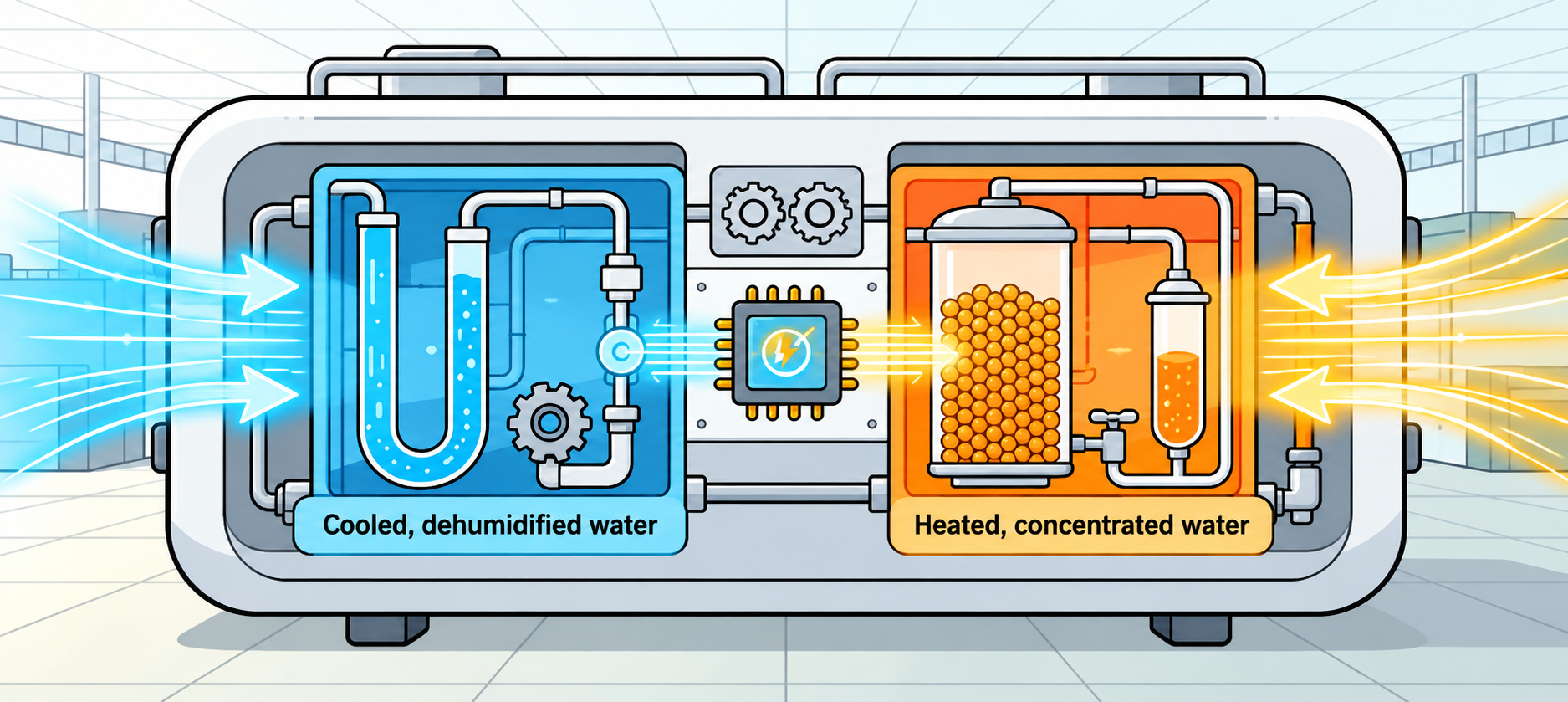
A refrigerated air dryer cools compressed air until water vapor condenses.
The condensate is then separated and discharged before the dry compressed air continues downstream.
This technology is widely used for general industrial compressed-air systems because it provides practical moisture control without the regeneration-air requirements associated with many adsorption dryers.
Lingyu’s refrigerated dryer range includes air-cooled, water-cooled, low-pressure-drop, plate heat exchanger, and variable-frequency configurations.
Depending on the series and specified operating conditions, Lingyu refrigerated dryers generally provide a 2–10°C pressure dew point.
For a more detailed explanation of the process, see how a refrigerated air dryer works.
When Is a Refrigerated Dryer a Good Choice?
A refrigerated dryer is often a practical starting point when:
- General plant air is required.
- Downstream piping will not regularly experience temperatures below the selected dew point.
- The process does not require extremely dry compressed air.
- Straightforward operation is important.
- Regeneration-air losses are undesirable.
This makes refrigerated drying suitable for many manufacturing, assembly, automotive, packaging, machinery, and general pneumatic applications.
The key question is not whether refrigerated drying is inherently “better” than adsorption drying. It is whether its pressure dew point range is sufficient for the application.
Desiccant Air Dryers
A desiccant air dryer is used when the compressed-air system requires a significantly lower pressure dew point.
Instead of relying primarily on condensation, the dryer passes compressed air through an adsorption material that captures residual water vapor.
Regenerative designs normally alternate between adsorption and regeneration so that compressed air can be supplied continuously.
Lingyu provides heatless, heated-purge, modular, blower-heated, zero-purge blower-heated, and heat-of-compression regenerative adsorption dryer configurations.
For example, the HRB-E low-purge blower-heated regenerative dryer provides:
Outlet pressure dew point: −20°C / −40°C optional
Regeneration air consumption: 2–3%
Rated inlet pressure: 0.7 MPa
Operating pressure range: 0.6–1.0 MPa
Rated inlet temperature: 10–30°C
Maximum inlet temperature: ≤40°C
For more information about adsorption drying, see the desiccant air dryer working principle.
Do You Really Need a −40°C Pressure Dew Point?
Not every compressor system needs extremely dry air.
If the process operates reliably with a refrigerated dryer’s pressure dew point, specifying −40°C can unnecessarily increase capital cost, energy consumption, regeneration requirements, and maintenance.
On the other hand, a lower pressure dew point can be necessary where downstream piping operates in cold conditions or where the production process itself requires very dry compressed air.
The target pressure dew point should therefore be determined from the actual process requirement and minimum downstream temperature rather than simply choosing the lowest available number.
The lowest dew point does not automatically mean the best dryer.
What About −70°C?
A −70°C pressure dew point should not be treated as a general standard specification for Lingyu desiccant dryers unless the specific dryer configuration is explicitly rated for it.
For the regenerative dryer families discussed here, model-specific values such as −20°C and −40°C should be used where those are the supported specifications.
This avoids selecting or describing equipment according to a generic dew-point value that may not correspond to the actual dryer configuration.
What About Membrane Air Dryers?
Membrane drying is used in the broader compressed-air industry, particularly for certain low-flow or point-of-use applications.
Lingyu’s current dryer range, however, centers on refrigerated dryers, regenerative adsorption dryers, and combined drying systems.
For a Lingyu-based equipment selection, these are therefore the primary dryer technologies to compare.
Combined Air Dryers
Sometimes the answer is not simply “refrigerated or desiccant.”
A combined dryer uses a refrigerated stage to remove a substantial portion of the initial moisture load before the compressed air enters the adsorption stage.
This arrangement reduces the moisture load entering the adsorption section and can reduce regeneration demand while maintaining a low pressure dew point.
Lingyu’s DC Series combines refrigerated and adsorption drying and provides an outlet pressure dew point of ≤−40°C under its specified operating conditions.
For applications requiring deeper drying while also reducing the moisture burden placed on the adsorption stage, the DC Series combined compressed air dryer provides an integrated option.
Match the Dryer to Compressor Airflow
The dryer’s rated airflow should be matched to the maximum compressed-air demand it may actually receive.
This means looking beyond average plant consumption.
If the dryer is undersized during peak production periods, it may not maintain the required pressure dew point.
When several compressors share one dryer, selection should consider the maximum combination that can operate simultaneously.
Future expansion also matters. A dryer sized with no spare capacity may become undersized when another production line is added.
However, excessive oversizing is not automatically desirable either, especially where it increases capital cost or reduces operating efficiency.
The goal is to select appropriate capacity for normal demand, peak demand, operating conditions, and realistic future expansion.
Check the Actual Dryer Inlet Pressure
Do not use only the pressure shown on the compressor nameplate.
The relevant value is the actual pressure entering the dryer.
Filters, receivers, piping, valves, and other treatment equipment can create pressure losses between the compressor and the dryer or between the dryer and the point of use.
Many Lingyu regenerative adsorption dryer configurations use:
Rated inlet pressure: 0.7 MPa
Operating pressure range: 0.6–1.0 MPa
Other pressure ratings may be available depending on the specific configuration.
The selected dryer should therefore be checked against the real operating pressure of the compressed-air station.
Pay Close Attention to Compressor Discharge Temperature
Temperature is one of the most important dryer-sizing variables.
Hotter compressed air can carry a greater moisture load and place more demand on downstream treatment equipment.
This can be especially important with compressors operating in high ambient temperatures or where aftercooling is limited.
Different dryer technologies also require very different inlet conditions.
For example, Lingyu’s HRB-E blower-heated regenerative dryer has:
Rated inlet temperature: 10–30°C
Maximum inlet temperature: ≤40°C
By contrast, the HOC-E heat-of-compression regenerative dryer is specifically designed around high-temperature compressor discharge air:
Rated inlet temperature: 120°C
Allowable inlet temperature range: 110–180°C
Regeneration air consumption: ≤3%
Outlet pressure dew point: −20°C / −40°C optional
This illustrates why dryer technology must be matched to the compressor architecture rather than selected by dew point alone.
Consider the Compressor Type
Compressor type can influence which dryer technology makes sense.
A standard refrigerated or regenerative adsorption dryer can be used downstream of many conventional compressed-air systems when its required inlet conditions are satisfied.
Heat-of-compression dryers are different because they intentionally use thermal energy available from high-temperature compressor discharge air for desiccant regeneration.
Therefore, HOC drying should not be selected solely because its regeneration-air consumption appears attractive. The compressor configuration and operating conditions must actually support the technology.
Do Not Ignore Pressure Drop
Dryer efficiency is not only about electrical power.
Pressure drop across the dryer affects the entire compressor system.
If downstream equipment requires a fixed pressure, excessive treatment-system pressure loss may require the compressor station to operate at a higher discharge pressure, increasing overall energy consumption.
Pressure drop should therefore be evaluated together with pressure dew point, flow capacity, and regeneration energy.
For example, Lingyu’s DD Series low-pressure-drop refrigerated dryer is specified at a full-load pressure drop of <0.01 MPa.
For additional system-level information, see the guide to compressed-air pressure drop.
Compare Regeneration-Air Consumption
When choosing a regenerative adsorption dryer, the regeneration method can significantly change operating economics.
Different Lingyu configurations illustrate this clearly:
| Dryer Configuration | Regeneration Air Consumption |
|---|---|
| HH Series heatless | 8–14% average |
| Heated-purge configuration | 4–8% |
| HRB-E low-purge blower-heated | 2–3% |
| HOC-E heat-of-compression | ≤3% |
| HOC-Z zero-purge heat-of-compression | 0% |
These differences become particularly important in large compressed-air systems operating continuously.
A dryer with a higher purchase price may sometimes provide lower long-term operating costs by reducing compressed-air losses, but the actual economic result depends on airflow, operating hours, electricity cost, compressor efficiency, maintenance, and other site conditions.
Dry Air Is Not the Same as Clean Air
An air dryer primarily controls moisture.
Oil aerosols, oil vapor, dust, corrosion particles, and desiccant particles may require separate filtration.
A complete compressed-air treatment system can therefore include the compressor, receiver, dryer, upstream and downstream filters, drains, separators, and point-of-use treatment as required.
Where additional contaminant control is needed, Lingyu’s precision compressed air filter can form part of the treatment system.
This distinction is particularly important where compressed-air quality directly affects the product or production process.
Match the Dryer to the Application
General Manufacturing and Automotive Production
For general manufacturing and many automotive-production applications, refrigerated drying can provide an appropriate balance between moisture removal, operating simplicity, and lifecycle cost.
Food Processing
For food processing, the dryer and filtration arrangement should be selected according to how compressed air interacts with the process or product.
Lingyu’s food and beverage compressed-air solutions provide additional application context.
Electronics and Semiconductor Manufacturing
For electronics and semiconductor operations, moisture requirements may be more demanding.
The required pressure dew point should still be defined by the actual process rather than assumed solely from the industry name.
Lingyu’s semiconductor and PCB manufacturing solutions provide industry-specific information.
Maintenance and Lifecycle Cost
The lowest purchase price does not necessarily mean the lowest total cost.
For refrigerated dryers, maintenance can involve condensate drains, heat exchangers, condensers, refrigeration components, and controls.
For desiccant dryers, lifecycle cost can include regeneration-air losses, desiccant replacement, valves, silencers, heaters, blowers, filters, and monitoring instruments.
The compressor energy associated with overcoming dryer and treatment-system pressure drop should also be considered.
A meaningful comparison therefore considers:
Capital cost + compressor energy + dryer energy + regeneration-air losses + maintenance + consumables + downtime
This provides a much more useful basis for equipment selection than purchase price alone.
A Practical Selection Checklist
Before choosing the dryer, define:
- Actual compressor airflow
- Maximum compressor airflow
- Dryer inlet pressure
- Normal inlet temperature
- Maximum inlet temperature
- Required pressure dew point
- Minimum downstream or ambient temperature
- Compressor type
- Daily and annual operating hours
- Acceptable pressure drop
- Required filtration
- Acceptable regeneration-air consumption
- Cooling-water availability where relevant
- Electrical and control requirements
- Maintenance access
- Redundancy requirements
- Expected future capacity expansion
Once these values are known, dryer selection becomes a technical sizing exercise rather than a comparison of marketing labels.
For a more detailed selection process, see Lingyu’s compressed air dryer selection guide.
Conclusion
Choosing the best air dryer for an air compressor starts with understanding what actually leaves the compressor and what the downstream process requires.
A refrigerated dryer is often suitable where a moderate 2–10°C pressure dew point is sufficient.
A regenerative desiccant dryer is more appropriate when substantially lower moisture levels are required, with configurations such as −20°C and −40°C available depending on the dryer series.
A combined dryer can reduce the initial moisture load before deeper adsorption drying, with Lingyu’s DC Series providing an outlet pressure dew point of ≤−40°C under its specified operating conditions.
For large or continuously operated systems, the regeneration method—heatless, heated, low-purge blower, zero-purge, or heat-of-compression—can materially affect compressed-air losses and lifecycle operating cost.
The best dryer is therefore not simply the unit with the lowest pressure dew point or lowest purchase price.
It is the dryer correctly matched to compressor airflow, inlet pressure, discharge temperature, required pressure dew point, ambient conditions, pressure drop, filtration requirements, regeneration energy, maintenance strategy, and lifecycle cost.