Compressed air dryers are an important part of industrial air-treatment systems. They remove moisture from compressed air and help protect downstream equipment, production processes, and piping systems.
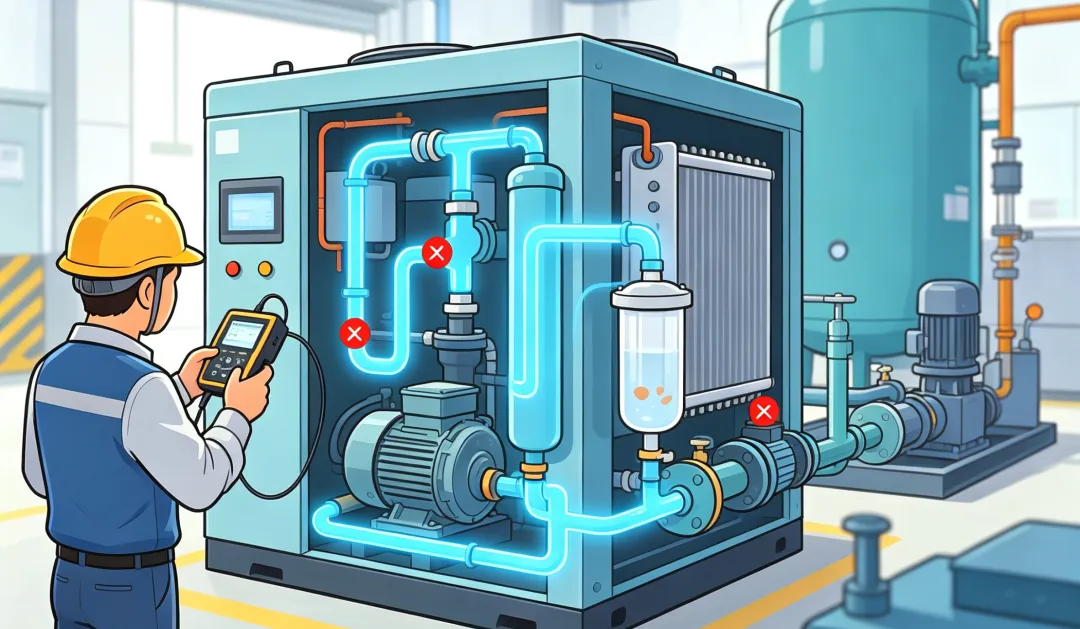
Like other industrial equipment, dryers can develop faults over time. When pressure dew point rises, condensate appears downstream, or the dryer begins operating abnormally, timely air dryer repair can prevent a minor problem from developing into a larger system failure.
Whether the installation uses a refrigerated or desiccant air dryer, effective repair begins with identifying the actual cause rather than simply replacing parts.
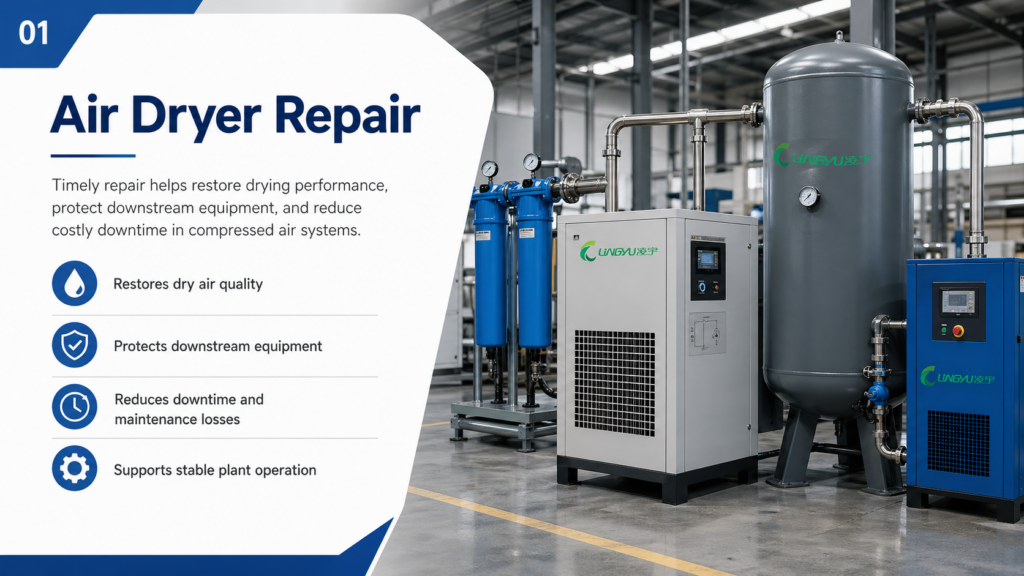
Why Air Dryer Repair Is Important
A poorly performing dryer can allow excess moisture into the compressed-air network.
This may contribute to:
- Pipeline corrosion
- Pneumatic equipment problems
- Unstable process conditions
- Moisture contamination
- Increased maintenance
- Unplanned downtime
Repairing the dryer therefore protects not only the dryer itself but also the downstream compressed-air system.
The objective of repair should be to restore the required pressure dew point and stable operation while correcting the underlying condition that caused the failure.
Common Signs That an Air Dryer Needs Repair
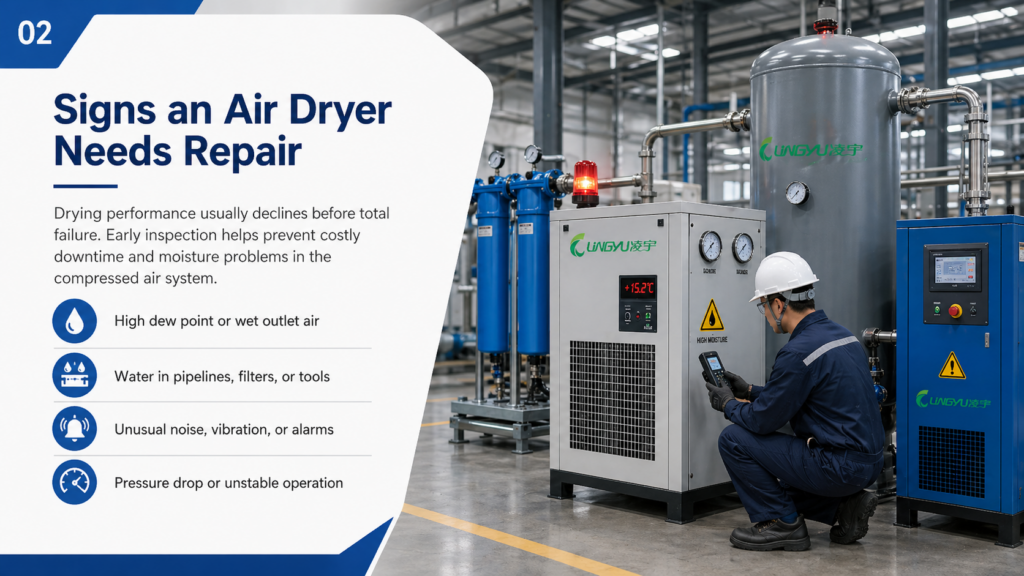
Air dryers often show warning signs before complete failure.
Typical symptoms include:
- Higher-than-normal pressure dew point
- Moisture downstream
- Water collecting in filters or piping
- Excessive pressure drop
- Unusual noise or vibration
- Poor cooling performance
- Abnormal tower switching
- Controller or sensor alarms
- Frequent shutdowns
- Unexpected increases in operating energy
These symptoms should be investigated systematically rather than treated as proof of one specific component failure.
For example, a high pressure dew point does not automatically mean that a refrigerated dryer is low on refrigerant or that a desiccant dryer needs new desiccant. Several operating or component faults can produce similar symptoms.
Common Causes of Air Dryer Problems
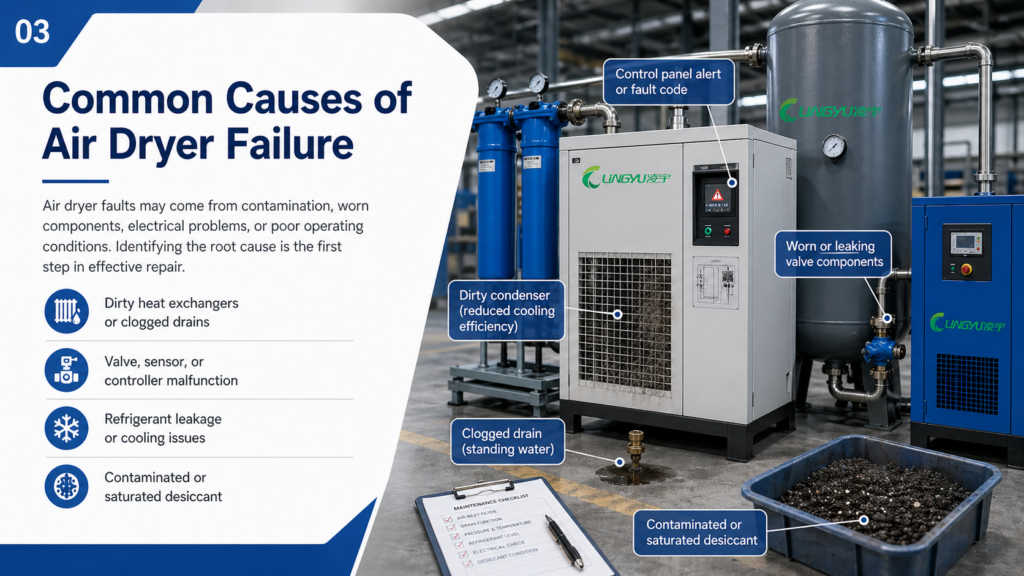
The likely cause depends strongly on dryer technology.
Refrigerated Air Dryer Problems
Possible problem areas include:
- Dirty condensers
- Failed cooling fans
- Blocked or malfunctioning drains
- Refrigeration compressor problems
- Refrigerant-circuit faults
- Expansion-valve problems
- Evaporator faults
- Pressure-switch faults
- Hot-gas bypass problems
- Control-system faults
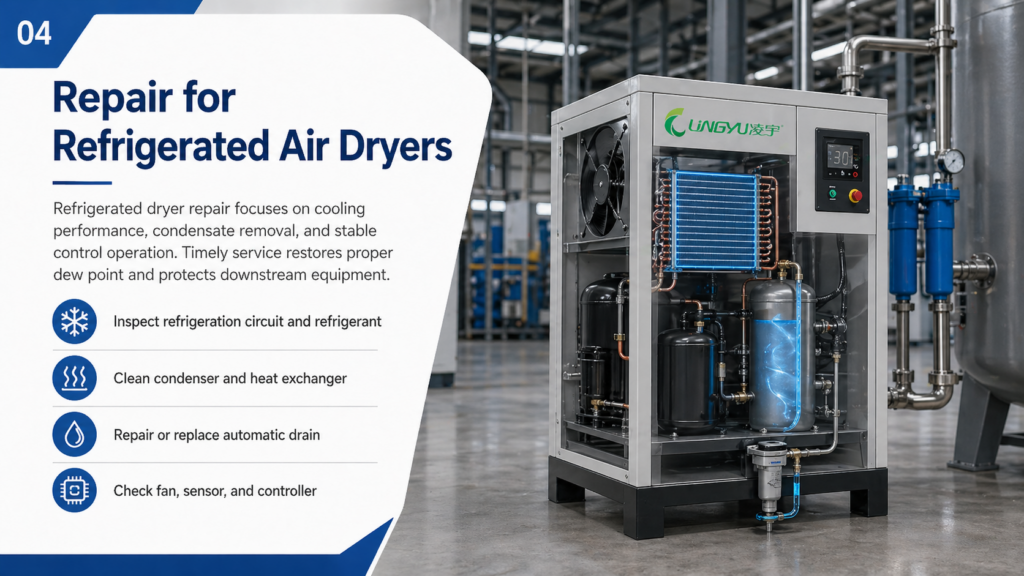
Common service components include fans, refrigeration compressors, condensers, evaporators, filter driers, expansion valves, bypass valves, pressure gauges, and drain valves.
Desiccant Air Dryer Problems
For adsorption dryers, common problem areas include:
- Switching valves
- Desiccant condition
- Regeneration systems
- Pneumatic actuators
- Solenoid valves
- Check valves
- Silencers
- Controllers
- Heaters
- Blowers
- Temperature sensors
The specific components involved depend on whether the dryer uses heatless, heated-purge, blower-heated, or heat-of-compression regeneration.
Refrigerated Air Dryer Repair
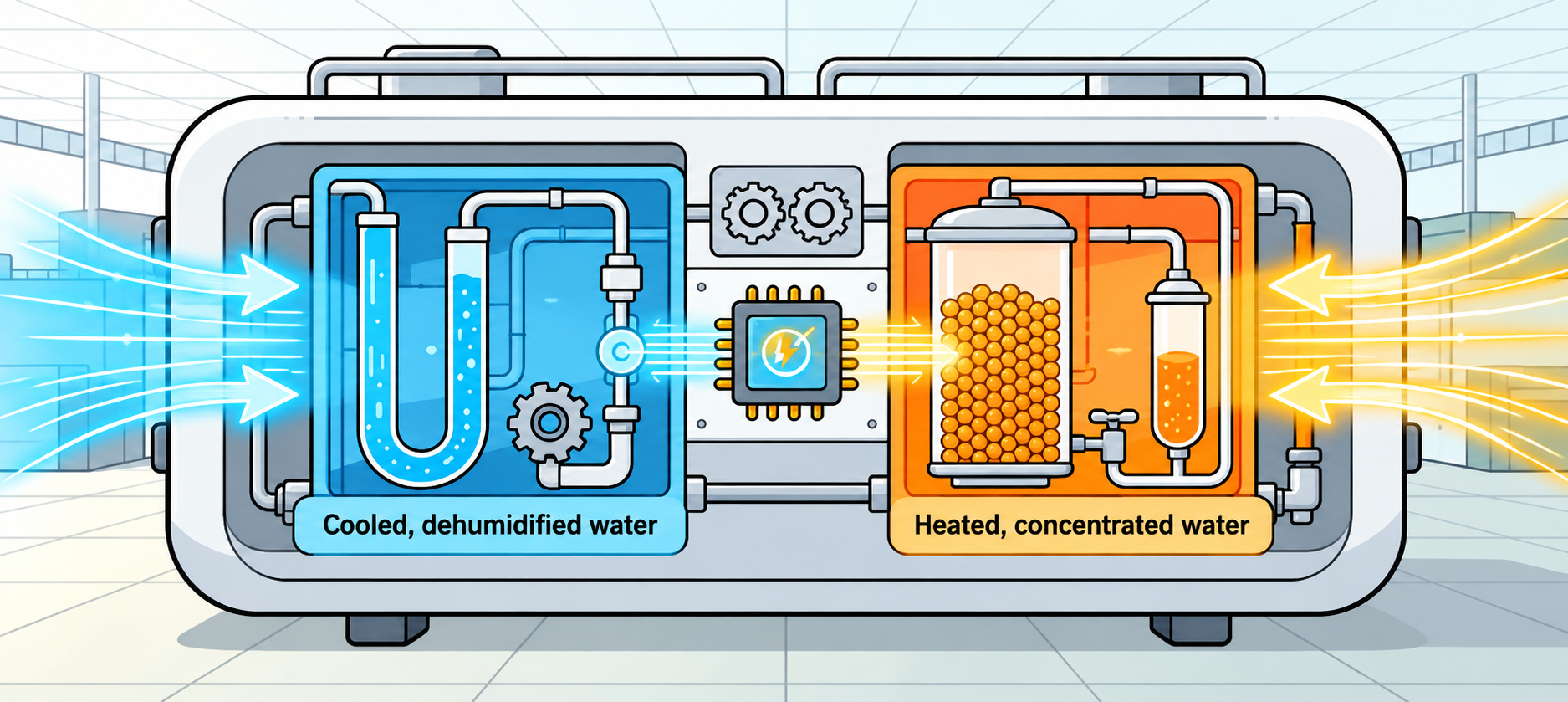
A refrigerated air dryer cools compressed air so that water vapor condenses into liquid water, which is then separated and discharged.
When cooling, separation, or condensate removal becomes abnormal, outlet moisture levels can rise.
Inspect the Refrigeration Circuit
If the dryer cannot maintain its expected pressure dew point, inspect the refrigeration system rather than assuming that low refrigerant is always the cause.
Important areas include:
- Refrigeration compressor
- Refrigerant pressure
- Expansion valve
- Filter drier
- Condenser
- Evaporator
- Pressure switches
- Hot-gas bypass valve
Diagnosis should consider operating temperatures, refrigerant pressures, dryer load, cooling conditions, and pressure dew point together.
Refrigerant pressure alone should not be compared with a universal target because normal values depend on refrigerant type, load, ambient or cooling-water conditions, dryer design, and other operating factors.
For more detailed diagnosis of this type of fault, see abnormal refrigerant low-pressure troubleshooting.
Inspect the Condenser and Heat Exchangers
Dust, restricted cooling airflow, contamination, or inadequate cooling water can reduce heat-transfer performance.
For air-cooled dryers, check:
- Condenser cleanliness
- Cooling-fan operation
- Airflow through the condenser
- Ventilation around the dryer
- Abnormal operating temperatures
For water-cooled dryers, check:
- Cooling-water flow
- Cooling-water temperature
- Cooling-water pressure
- Condenser condition
- Signs of fouling or restricted heat transfer
Poor condenser heat rejection can cause refrigeration problems even when the refrigerant circuit itself has no leak.
Check the Condensate Drain System
Condensed moisture must leave the dryer reliably.
A blocked or malfunctioning automatic drain can cause condensate to accumulate inside the dryer or move downstream.
Check for:
- Blocked drain passages
- Failure to discharge condensate
- Continuous compressed-air leakage
- Damaged drain valves
- Loose or damaged connections
- Abnormal separator operation
If water appears downstream, the drain system should be checked before assuming that the refrigeration circuit is unable to remove moisture.
Inspect the Evaporator
Leakage or heat-transfer problems in the evaporator can affect dryer performance.
Possible warning signs include:
- Reduced cooling performance
- Rising pressure dew point
- Abnormal refrigerant behavior
- Unusual temperature patterns
- External leakage
- Unstable dryer operation
These symptoms do not by themselves confirm evaporator failure. Other refrigeration, airflow, and operating conditions should be evaluated as part of the diagnosis.
Where leakage is suspected, use the refrigerated dryer evaporator leak inspection guide.
Desiccant Air Dryer Repair
Desiccant air dryers remove residual water vapor by adsorption and regenerate the drying bed so that the desiccant can be reused.
Because many systems use alternating adsorption towers, valve sequencing and regeneration performance are especially important.
Check Desiccant Condition
Desiccant should not be replaced simply because it becomes saturated during a normal adsorption cycle.
Moisture adsorption is part of normal operation, and regeneration should remove the accumulated moisture before the tower returns to adsorption service.
Replacement may become necessary when the desiccant is:
- Contaminated
- Physically degraded
- Excessively powdered
- Mechanically damaged
- Unable to maintain the required pressure dew point despite correct regeneration
Before replacing desiccant, verify that regeneration, switching, airflow, inlet conditions, and upstream filtration are operating correctly.
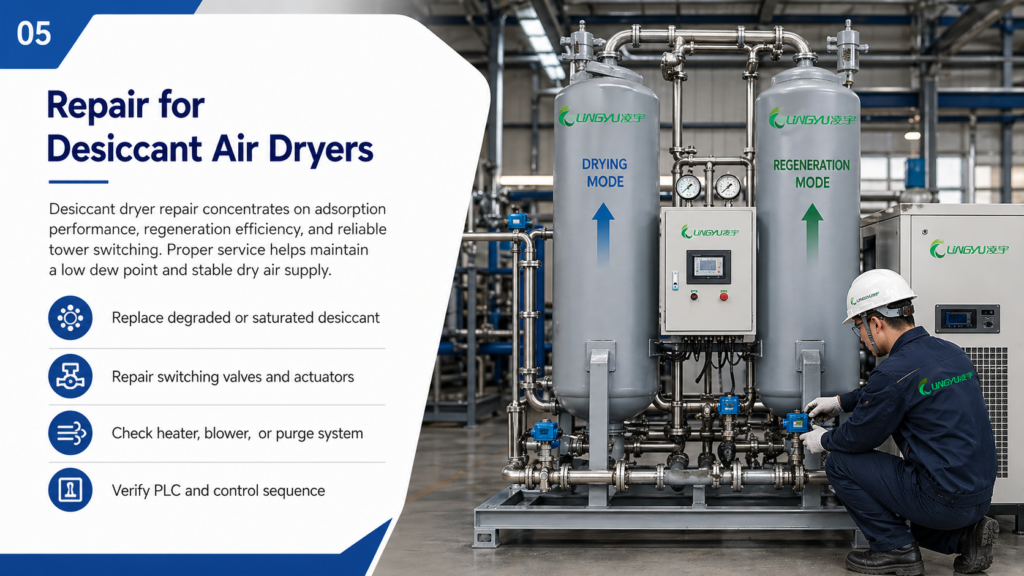
Inspect Switching Valves
Twin-tower dryers depend on reliable valve sequencing.
Problems with pneumatic valves, solenoid valves, actuators, or controls can prevent proper adsorption and regeneration.
Possible symptoms include:
- Tower switching at the wrong time
- Failure of one tower to pressurize
- Failure to depressurize correctly
- Abnormal purge flow
- Unstable outlet pressure
- Dew-point deterioration
- Controller alarms
For this failure mode, see desiccant dryer switching troubleshooting.
Check the Regeneration System
Different desiccant dryers use different regeneration methods.
Depending on the configuration, repair may involve:
- Purge-air circuits
- Heaters
- Blowers
- Cooling systems
- Regeneration valves
- Temperature sensors
- Control sequencing
The correct diagnosis depends on whether the system is heatless, heated-purge, blower-heated, or heat-of-compression.
A heater fault, for example, is relevant to a heated regeneration system but not to a conventional heatless dryer.
Verify Purge or Regeneration Flow
Insufficient regeneration flow can leave the desiccant too wet for the next adsorption cycle.
Excessive purge flow creates a different problem by wasting compressed air and increasing operating cost.
Purge or regeneration airflow should therefore be adjusted according to the dryer design and operating requirements rather than by applying one universal setting to every adsorption dryer.
For a more detailed procedure, see the guide to adjusting adsorption dryer regeneration airflow.
Do Not Ignore the Root Cause
Replacing a failed component is only part of an effective air dryer repair.
Repeated dryer failures can also be associated with:
- Poor upstream air treatment
- Excessive inlet temperature
- Operation outside rated pressure
- Inadequate ventilation
- Incorrect cooling conditions
- Excessive pressure drop
- Oil contamination
- Drain failures
- Actual airflow differing substantially from design conditions
For example, oil contamination entering an adsorption dryer can impair desiccant performance. Simply replacing the desiccant without addressing the contamination source can result in another premature failure.
Where oil contamination is suspected, see the compressed-air oil contamination troubleshooting guide.
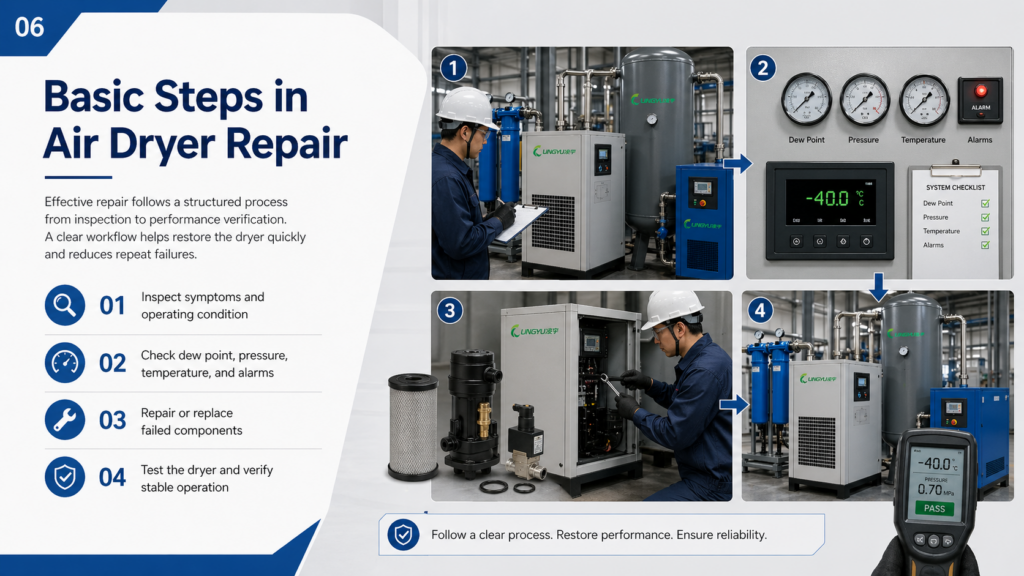
Basic Air Dryer Repair Process
A practical repair process should follow a clear sequence.
1. Identify the Symptom
Determine the main problem first, such as:
- High pressure dew point
- Moisture downstream
- Excessive pressure drop
- Alarm
- Abnormal noise
- High or low temperature
- Cooling problem
- Tower-switching problem
Avoid replacing parts before the symptom has been clearly defined.
2. Review Operating Data
Check relevant operating information, including:
- Inlet pressure
- Inlet temperature
- Airflow
- Pressure dew point
- Alarm history
- Operating temperatures
- Refrigeration parameters
- Regeneration parameters
Operating trends can be more useful than a single measurement.
3. Inspect the Affected System
Based on the symptoms and operating data, inspect the relevant components.
These may include:
- Drains
- Valves
- Filters
- Heat exchangers
- Refrigeration components
- Desiccant
- Sensors
- Heaters
- Blowers
- Controllers
4. Repair or Replace the Defective Component
Once the fault has been identified, repair or replace the affected component according to the dryer design and service requirements.
Refrigeration-system work, electrical repairs, and other specialist procedures should be performed by appropriately qualified personnel.
5. Test the Dryer Under Operating Conditions
After repair, return the dryer to normal operating conditions and confirm:
- Stable pressure dew point
- Correct pressure
- Reliable condensate drainage
- Normal tower cycling where applicable
- Correct temperatures
- Stable refrigeration or regeneration operation
- No recurring alarms
6. Correct the Underlying Cause
If operating conditions contributed to the failure, correct them before returning the dryer to long-term service.
This reduces the likelihood of repeated repairs.
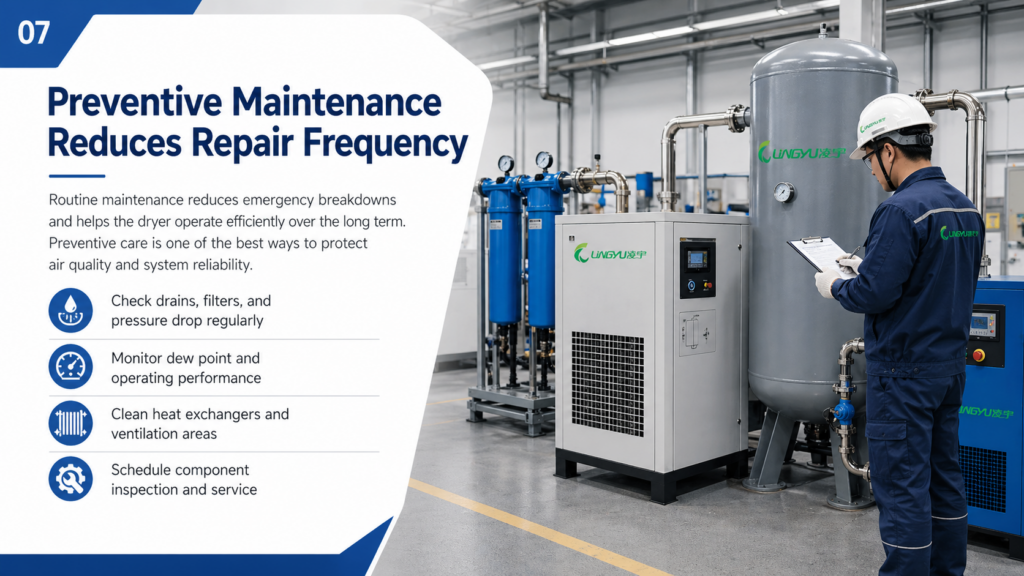
Preventive Maintenance Reduces Repair Frequency
Routine maintenance can identify deterioration before it develops into an emergency repair.
Important checks include:
- Pressure dew point
- Condensate drains
- Condenser condition
- Filters
- Pressure drop
- Heat exchangers
- Valves
- Regeneration performance
- Sensors
- Operating alarms
- Fans and ventilation
Maintenance frequency should reflect actual operating hours, environment, dryer load, compressed-air quality, and equipment requirements.
For routine refrigerated dryer service procedures, see the refrigerated air dryer maintenance guide.
Air Dryer Repair or Replacement?
Repair can be practical when the dryer still matches system requirements and the fault is limited to serviceable components.
Replacement may deserve consideration when:
- The dryer is structurally damaged
- Repeated repairs are becoming uneconomical
- Required airflow has changed significantly
- Spare parts are difficult to obtain
- The dryer no longer achieves the required pressure dew point
- Existing technology no longer meets efficiency requirements
- The equipment is no longer suitable for current operating conditions
The decision should consider repair cost, equipment condition, spare-parts availability, current operating demand, energy performance, and expected future service life.
A single component failure does not necessarily justify replacing the entire dryer. Conversely, repeatedly repairing an undersized or unsuitable dryer may not be economical.
Choosing Air Dryer Repair Support
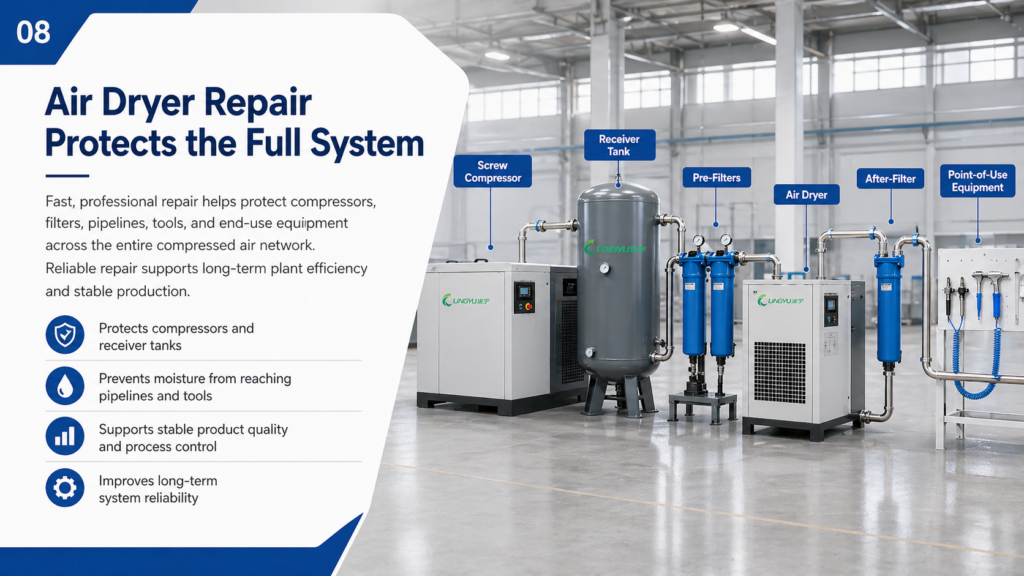
Industrial air dryer repair can involve refrigeration systems, electrical controls, pneumatic valves, heat exchangers, desiccants, drainage systems, and the wider compressed-air installation.
Service support should therefore be able to diagnose the complete operating system rather than simply replace individual parts.
Lingyu provides after-sales technical consultation, commissioning, equipment repair and maintenance, onsite inspection, customized maintenance solutions, and spare-parts support.
A proper repair assessment should identify the failure, determine why it occurred, restore dryer operation, and verify performance under actual operating conditions.
Conclusion
Air dryer repair should begin with accurate diagnosis rather than immediate component replacement.
For refrigerated dryers, attention should focus on the refrigeration circuit, heat exchangers, condenser cooling, condensate drains, fans, sensors, and controls.
For desiccant dryers, key areas include desiccant condition, switching valves, regeneration systems, purge flow, heaters or blowers where applicable, and control sequencing.
In both cases, operating conditions such as inlet temperature, pressure, airflow, upstream contamination, cooling conditions, and pressure drop should be evaluated as part of the diagnosis.
Finding and correcting the root cause helps restore dryer performance while reducing repeated failures and protecting the wider compressed-air system.
For repair assessment, replacement parts, or technical support, contact Lingyu.