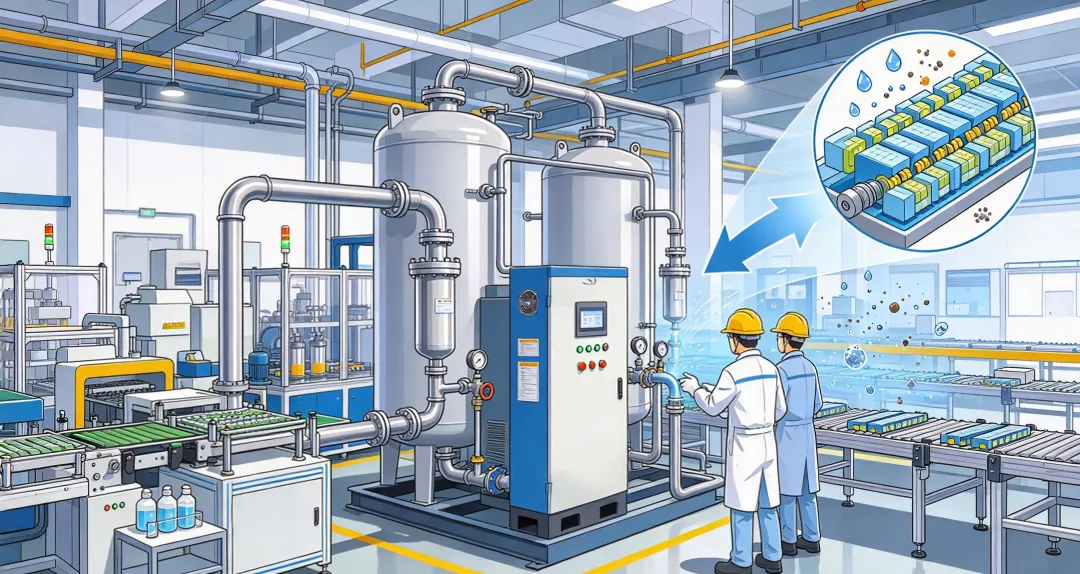
Choosing the right compressed air dryer is an important part of designing a reliable compressed air treatment system.
Ambient air naturally contains water vapor. After air is compressed and subsequently cooled, excess moisture can condense into liquid water. If this moisture is not properly controlled, it can contribute to pipeline corrosion, equipment problems, freezing, product-quality issues, and production downtime.
However, selecting a dryer is not simply a matter of matching the dryer’s rated airflow to the compressor.
The correct choice depends on the required pressure dew point, actual airflow, operating pressure, inlet temperature, ambient conditions, pressure drop, filtration requirements, load profile, and lifecycle operating cost.
This guide explains how to evaluate those factors and select the most appropriate compressed air dryer for your application.

1. Start With the Required Compressed Air Quality
Before choosing a dryer type or model, define what the downstream process actually needs.
The dryer’s primary job is to control water vapor and reduce the risk of moisture condensing in the compressed air system. It does not automatically remove every other contaminant.
Oil and solid particles may require separate filtration or separation equipment.
This means that “clean compressed air” should be treated as a system-level requirement involving both drying and filtration rather than as a function of the dryer alone.
For applications requiring additional oil and particle control, a precision compressed air filter can form part of the complete air-treatment system.
2. Determine the Required Pressure Dew Point
Pressure dew point is one of the most important specifications in dryer selection.
It indicates the temperature at which water vapor would begin to condense from the compressed air at operating pressure.
A lower pressure dew point means drier compressed air, but lower is not automatically better. Producing unnecessarily dry air can increase capital and operating costs.
A practical comparison is:
| Pressure Dew Point Requirement | Typical Dryer Technology | General Selection Context |
|---|---|---|
| Approximately 2–10°C | Refrigerated dryer | General industrial compressed air |
| Around −20°C | Adsorption dryer | Processes requiring substantially drier air |
| Around −40°C | Regenerative adsorption dryer | Moisture-sensitive or low-temperature applications |
| Down to approximately −50°C in selected series | Heated-purge adsorption dryer | Applications with more demanding low-dew-point requirements |
Lingyu refrigerated dryers provide pressure dew points of approximately 2–10°C under their specified operating conditions.
The M Series modular adsorption dryer provides an outlet pressure dew point of ≤−20°C, with −40°C available as an option, while selected blower-heated and heat-of-compression systems offer −20°C / −40°C options.
The CH Series Heated Purge Regenerative Desiccant Air Dryer can provide an outlet pressure dew point of −50°C to −20°C in the applicable configuration.
Therefore, the correct question is not “How low can the dryer go?” but “What pressure dew point does my actual process require?”
3. Choose the Appropriate Dryer Technology
For Lingyu’s current product range, the main selection decision is between refrigerated drying, adsorption drying, and a combined refrigerated-plus-adsorption system.
Refrigerated Air Dryers
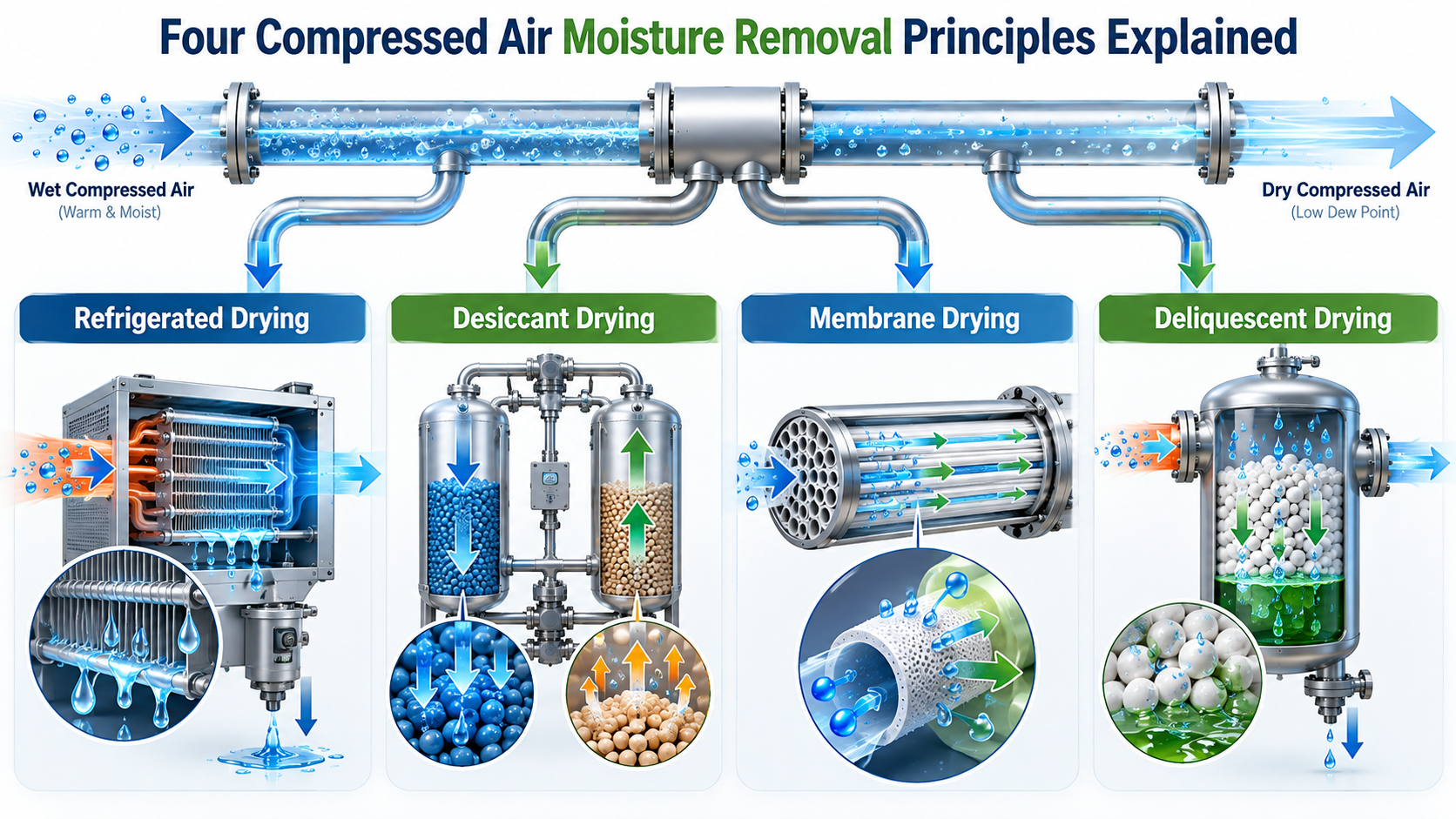
A refrigerated dryer cools compressed air so that water vapor condenses into liquid water. The condensate is separated and drained before the air continues downstream.
These dryers are commonly selected when a pressure dew point around 2–10°C is sufficient.
They are appropriate for many general industrial compressed air applications where extremely low dew points are not necessary.
Users evaluating this technology can review the refrigerated air dryer range.
Refrigerated drying can be a good fit for general manufacturing, pneumatic equipment, packaging, automotive production, and other applications where the distribution system will not be exposed to temperatures below the achieved dew point.
Desiccant Air Dryers
Desiccant or adsorption dryers remove water vapor by adsorbing moisture onto materials such as activated alumina and molecular sieve.
They are used where the process requires significantly lower pressure dew points.
Different regeneration methods are available, including heatless, heated purge, blower-heated, zero-purge, modular, and heat-of-compression designs.
Lingyu’s adsorption portfolio includes these different regeneration configurations rather than one universal desiccant dryer design.
For a broader product overview, users can explore the desiccant air dryer category.
Combined Compressed Air Dryers
Some applications benefit from using refrigerated and adsorption drying together.
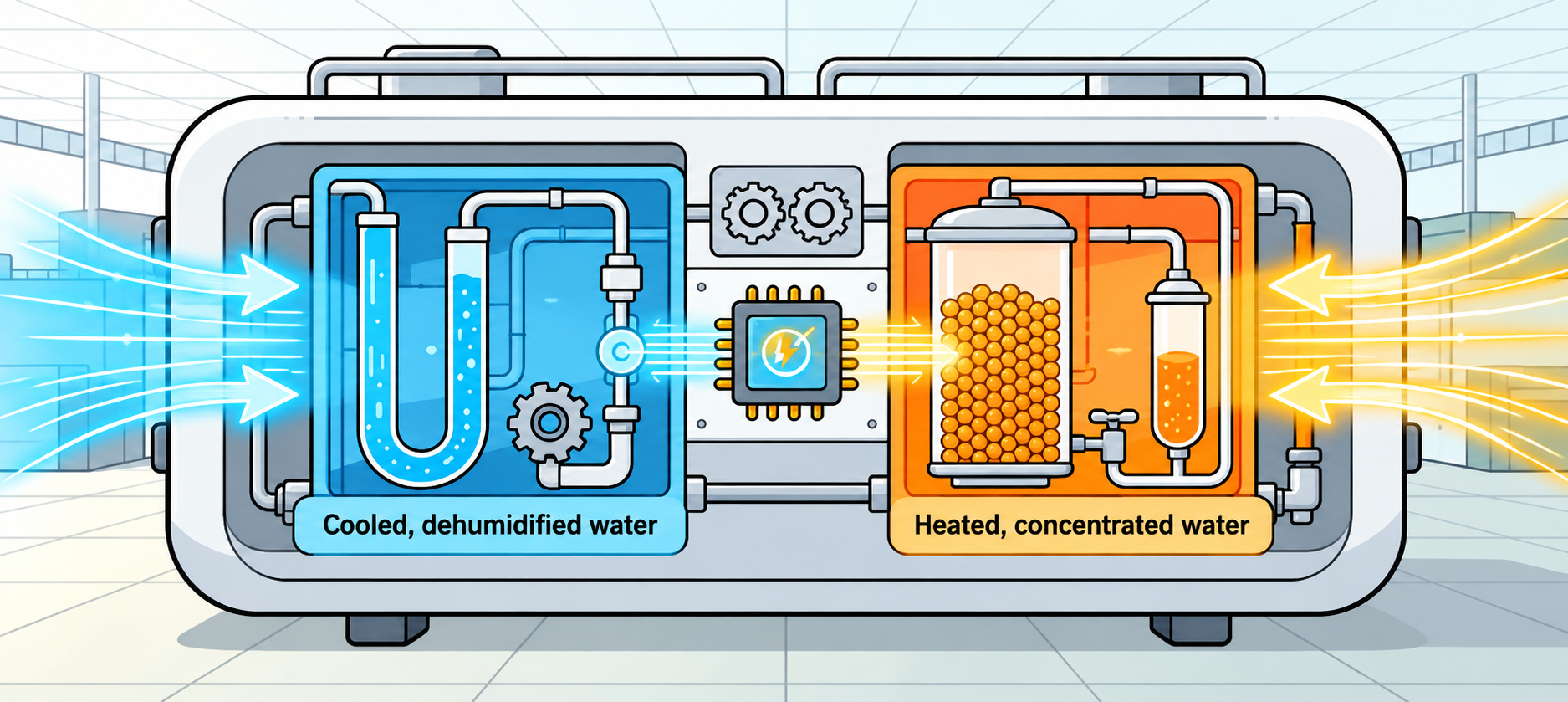
In this arrangement, the refrigerated stage removes a large portion of the moisture first. The partially dried compressed air then enters the adsorption stage for deeper moisture removal.
This reduces the moisture load placed on the adsorption bed and can reduce regeneration requirements while helping extend desiccant service life.
Lingyu’s DC Series combined compressed air dryer integrates these two drying stages and provides an outlet pressure dew point of ≤−40°C under its specified operating conditions.
This option can be considered when a facility needs low-dew-point compressed air but also wants refrigerated pre-drying to reduce the moisture load on the adsorption section.
4. Size the Dryer According to Actual Airflow
Dryer sizing should begin with the maximum realistic compressed air flow that the dryer must treat.
However, airflow alone is not enough.
A dryer rated for a certain m³/min or CFM under standard conditions may have a different usable capacity when actual inlet pressure, inlet temperature, or ambient conditions differ from its rating conditions.
For this reason, a universal rule such as “always add 20–30% to compressor capacity” is not sufficiently accurate.
Instead, evaluate the dryer’s rated conditions and apply the appropriate sizing or correction method for the actual installation.
The dryer should be able to handle realistic peak demand without being unnecessarily oversized.
Future expansion can be considered, but excessive oversizing may reduce operating efficiency or increase unnecessary capital cost.
5. Check Operating Pressure
Operating pressure affects dryer capacity and overall compressed air system performance.
For example, Lingyu’s HRB-E low-purge blower-heated regenerative desiccant air dryer is rated at 0.7 MPa, with an operating range of 0.6–1.0 MPa.
Other products may have different operating conditions.
Do not assume that a dryer rated at one pressure will provide identical flow capacity and performance at another.
The actual inlet pressure should therefore be included when requesting dryer selection.
6. Check Inlet Air Temperature
Inlet temperature can significantly influence moisture load.
Warmer compressed air can carry more water vapor. When that air cools inside the dryer, more moisture must be removed.
This means a dryer selected correctly by airflow but incorrectly by inlet temperature can still be undersized.
For example, the M Series modular adsorption dryer has a rated inlet temperature of 10–30°C, with a maximum inlet temperature of ≤40°C.
By comparison, the DC Series combined compressed air dryer has a rated inlet temperature of 50°C and a maximum inlet temperature of ≤80°C.
This illustrates why equipment should be compared under its actual design conditions rather than by flow rating alone.
7. Consider Ambient Conditions and Installation Environment
Ambient temperature and ventilation also affect dryer operation.
For air-cooled refrigerated dryers, high ambient temperatures can make heat rejection more difficult.
For adsorption dryers, ambient conditions can influence blower cooling, heater performance, controls, and other regeneration components.
Many Lingyu adsorption dryer series use a rated ambient temperature around 35°C, with the applicable operating range varying by product series.
If the dryer will operate in an unusually hot, cold, dusty, corrosive, or outdoor environment, that condition should be specified before final equipment selection.
Do not assume that a standard indoor configuration is automatically suitable for outdoor installation.
8. Evaluate Pressure Drop
Pressure drop is sometimes overlooked because buyers focus mainly on dew point and electrical power.
However, pressure lost across the dryer can affect the energy consumption of the entire compressed air system.
If downstream equipment requires a fixed pressure, excessive dryer restriction may force the compressor to operate at a higher discharge pressure.
For facilities focused on total system efficiency, the compressed air pressure drop guide provides additional context.
In one installation using four 85 m³/min refrigerated dryers with low-pressure-drop and variable-frequency technologies, terminal pressure increased from 6.45 bar to 6.8 bar, while overall energy savings were approximately 39% under the specific project conditions.
This is a project-specific result rather than a universal performance guarantee.
9. Compare Regeneration Energy for Desiccant Dryers
If adsorption drying is required, regeneration method becomes an important selection factor.
Heatless dryers use dry compressed air for regeneration.
Heated-purge designs add thermal energy and can reduce the quantity of product air needed for regeneration.
Blower-heated systems use ambient blower air during regeneration and can reduce compressed-air losses further.
Zero-purge configurations are designed to eliminate or nearly eliminate dry product-air consumption during regeneration.
For example, Lingyu’s HRB-E low-purge blower-heated system provides 2–3% regeneration air consumption, with optional −20°C / −40°C pressure dew points.
The HRB-Z zero-purge blower-heated configuration provides approximately 0% regeneration air consumption, also with optional −20°C / −40°C pressure dew points.
Large or continuously operating facilities can therefore evaluate a blower zero-purge adsorption dryer when reducing compressed-air regeneration losses is a major lifecycle objective.
The best choice should still consider blower power, heater power, purge consumption, operating hours, maintenance, and capital cost together.
10. Consider Variable Air Demand
Many factories do not consume compressed air at a constant rate.
Demand can change with production shifts, machine utilization, or seasonal operation.
In these applications, control strategy can affect energy consumption.
For refrigerated drying, variable-frequency technology can adjust refrigeration capacity according to load.
A frequency conversion refrigerated air dryer may therefore be useful where airflow varies substantially.
Variable-frequency refrigerated dryers can automatically adjust refrigeration-system operation according to actual air-treatment demand.
For adsorption systems, time-based or optional dew-point-based control can similarly adjust regeneration behavior according to actual drying demand.
Selected Lingyu blower-heated systems support dew-point-based control that can extend adsorption cycles during fluctuating-load operation.
11. Match the Dryer to the Application
Industry type can provide useful context, but it should not replace actual air-quality specifications.
For example, automotive and general manufacturing may include many applications where refrigerated drying is sufficient.
In electronics and precision manufacturing, some moisture-sensitive processes may require adsorption drying or lower pressure dew points.
The actual dryer should still be selected according to the individual process.
A pharmaceutical plant, semiconductor facility, automotive factory, and food-processing operation can each have multiple compressed air uses with different dew-point and filtration requirements.
Therefore, avoid selecting a dryer solely because it is commonly associated with a particular industry.
12. Refrigerated or Desiccant: Which Should You Choose?
A useful starting rule is simple:
If a pressure dew point around 2–10°C meets the process requirement, refrigerated drying is usually the first technology to evaluate.
If the process requires around −20°C, −40°C, or lower within the supported product range, adsorption drying becomes more appropriate.
If deeper drying is required but refrigerated pre-drying can improve the overall treatment arrangement, a combined dryer may also be considered.
For users deciding between the two main technologies, the refrigerated air dryer vs. desiccant air dryer guide provides a more focused comparison.
13. Review Filtration and System Layout
The dryer should be selected as part of a complete compressed air purification system rather than as an isolated machine.
Depending on air-quality requirements, a system may contain an air receiver, refrigerated or adsorption dryer, oil-removal filters, particulate filters, drainage equipment, and downstream storage or distribution components.
In a combined drying system, oil-removal filtration can be installed before the adsorption section, while high-efficiency particulate filtration downstream can remove residual particles or desiccant dust.
Proper sequencing helps protect the dryer and achieve the required downstream air quality.
14. Consider Maintenance and Serviceability
Purchase price should not be the only consideration.
Before selecting equipment, evaluate maintenance access, availability of spare parts, drain maintenance, heat exchanger cleaning, refrigeration components, switching valves, desiccant condition, heaters, blowers, control systems, and filters depending on dryer type.
A refrigerated dryer generally avoids desiccant replacement but still contains refrigeration and condensate-management components.
An adsorption dryer has additional regeneration components and requires attention to valves and adsorbent condition.
The easiest dryer to purchase is not necessarily the easiest or least expensive dryer to operate over its entire service life.
Compressed Air Dryer Selection Checklist
Before requesting a quotation or confirming a model, provide the supplier with the maximum airflow, normal and minimum airflow, operating pressure, inlet temperature, ambient temperature or cooling-water conditions, required pressure dew point, allowable pressure drop, operating hours, load variation, available utilities, filtration requirement, installation environment, and any future expansion requirement.
With those parameters, the dryer can be selected around actual operating conditions instead of relying on a nominal CFM figure alone.
Conclusion: Selecting the Right Compressed Air Dryer
Selecting a compressed air dryer is not simply about choosing between a refrigerated and desiccant model.
The correct decision starts with the required pressure dew point and then considers airflow, pressure, inlet temperature, ambient conditions, pressure drop, regeneration method, load variation, filtration, maintenance, and lifecycle energy cost.
Refrigerated dryers are suitable for many general industrial applications requiring approximately 2–10°C pressure dew point. Adsorption dryers provide significantly lower dew points for moisture-sensitive processes, while combined dryers integrate refrigerated pre-drying with adsorption drying where appropriate.
Avoid specifying a lower pressure dew point than the process actually needs, and avoid sizing a dryer using airflow alone.
For an application-specific recommendation, users can contact Lingyu with the actual operating conditions and required compressed air quality.