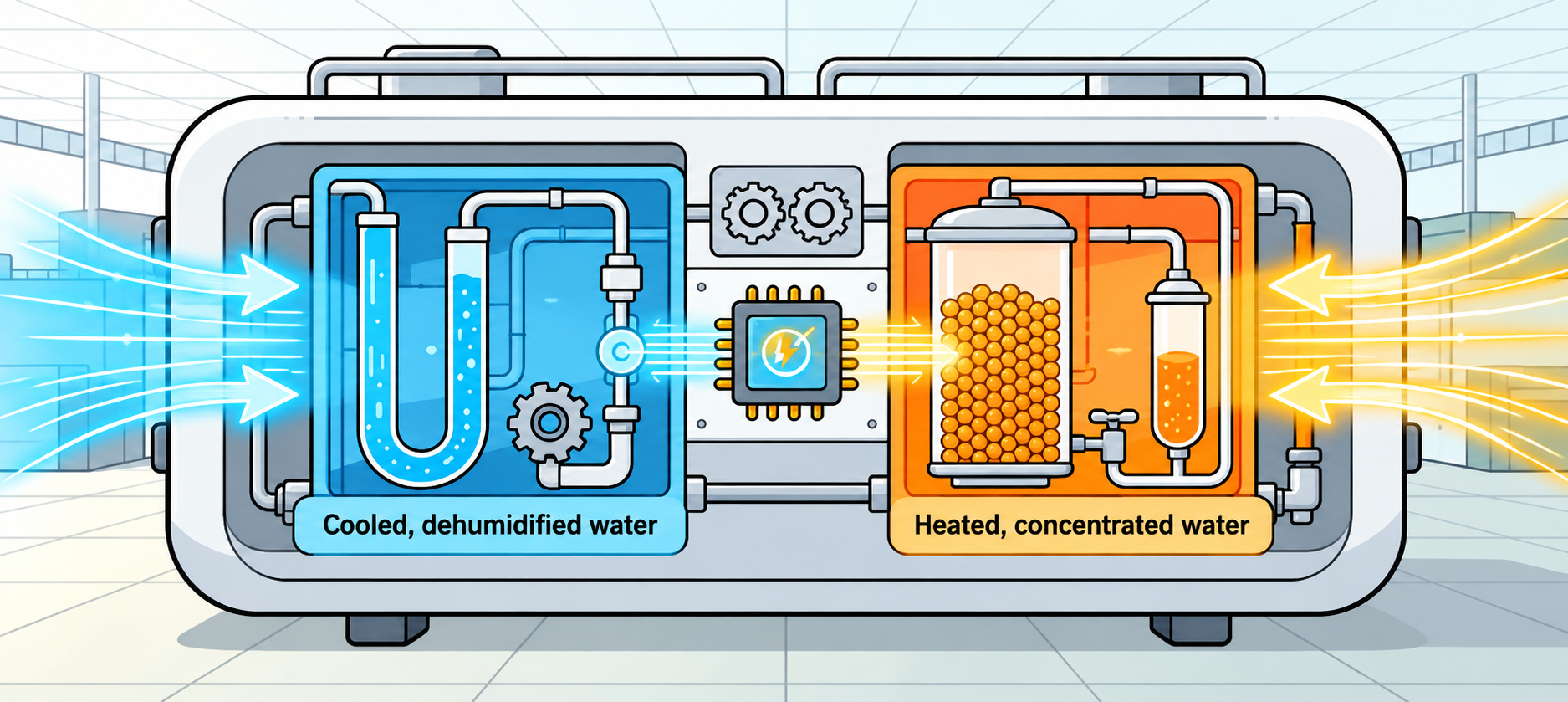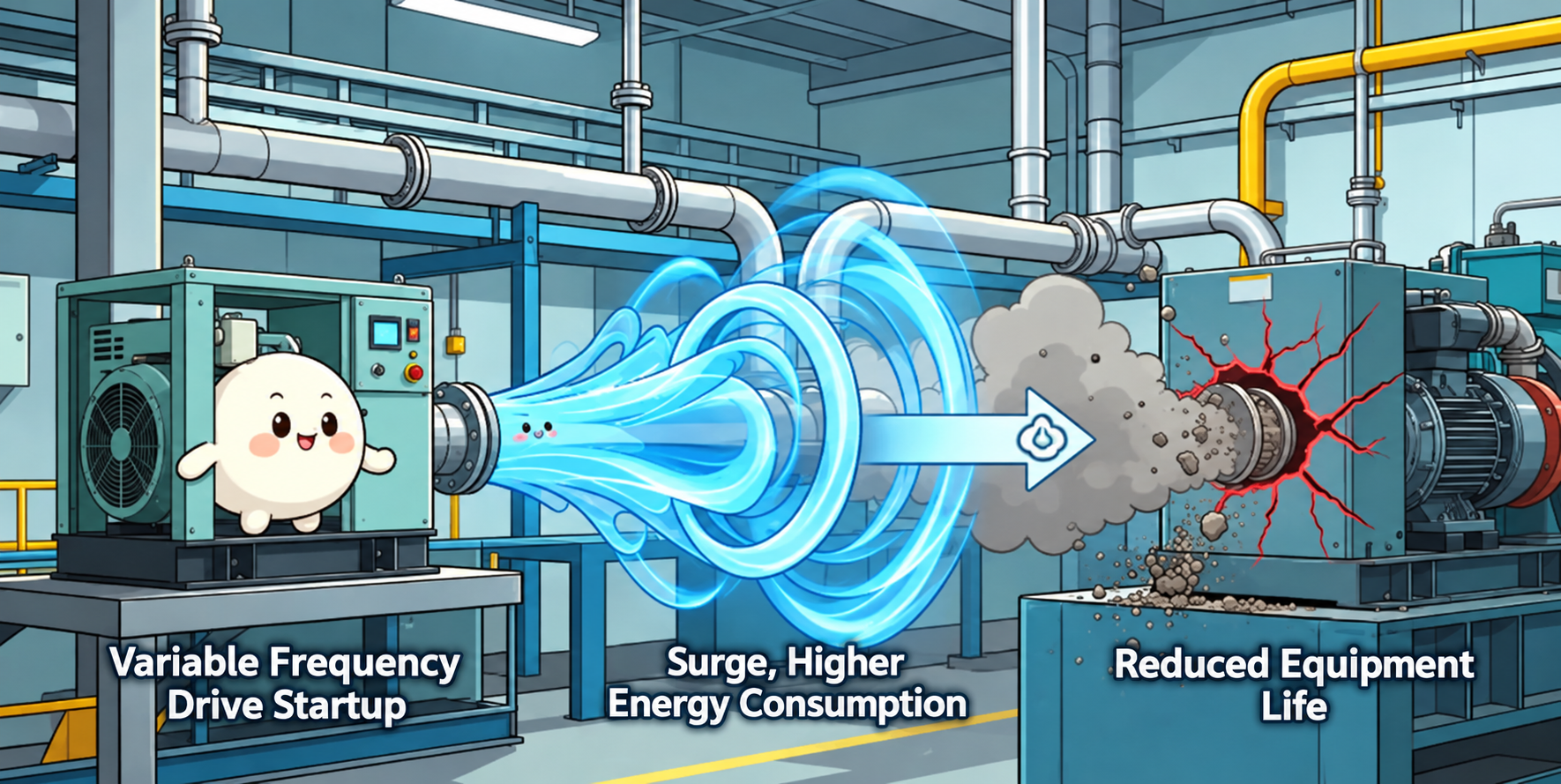
Choosing among industrial air dryer manufacturers is an important decision for any compressed-air system. The dryer does more than remove moisture—it can affect pressure dew point stability, pressure loss, energy consumption, downstream equipment reliability, and the overall operating cost of the compressed-air station.
For this reason, selecting a manufacturer should not be based on purchase price alone. A reliable supplier should be able to match the dryer technology to actual operating conditions, provide suitable air-treatment components, and support the system throughout its service life.
This guide explains what industrial air dryer manufacturers provide, how their capabilities differ, and what buyers should evaluate before choosing a supplier.
What Industrial Air Dryer Manufacturers Do
Industrial air dryer manufacturers design and manufacture equipment that removes moisture from compressed air before it reaches production equipment or critical processes.
Common solutions include:
- Refrigerated air dryers for general industrial applications where moderate pressure dew points are sufficient
- Desiccant air dryers for processes requiring much lower pressure dew points
- Heatless and heated regenerative adsorption dryers
- Modular adsorption systems for installations where footprint and flexibility are important
- Blower-heated and heat-of-compression regeneration systems for larger compressed-air installations
- Combined dryers integrating refrigeration and adsorption technologies
- Filters, drains, and other purification equipment for complete compressed-air treatment
Lingyu’s product range includes refrigerated dryers, multiple types of adsorption dryers, combined dryers, nitrogen generators, and precision filters.
Experienced manufacturers should also provide engineering support rather than simply supplying a machine. This can include dryer sizing, pressure dew point selection, pressure and temperature correction, filtration configuration, control options, and system integration.
Why Manufacturer Capability Matters
The performance of an industrial air dryer depends not only on its rated specifications but also on how the equipment is engineered, manufactured, selected, and integrated into the compressed-air system.
Several operating characteristics are directly influenced by manufacturer capability.
Pressure dew point stability is one of the first considerations. A dryer must maintain the required pressure dew point under its specified operating conditions and accommodate the expected range of inlet temperature, ambient conditions, and compressed-air demand.
Pressure drop is equally important. Excessive pressure loss can require the compressor system to operate at a higher discharge pressure to maintain the required downstream pressure, increasing energy consumption.
Energy efficiency becomes particularly important for larger systems. Depending on operating conditions, technologies such as variable-frequency refrigeration, blower regeneration, and heat-of-compression regeneration can reduce unnecessary electrical consumption or compressed-air losses.
Manufacturers should also understand how dryers interact with upstream compressors, air receivers, filters, drains, piping, and downstream applications. There is no single treatment arrangement that is ideal for every compressed-air system.
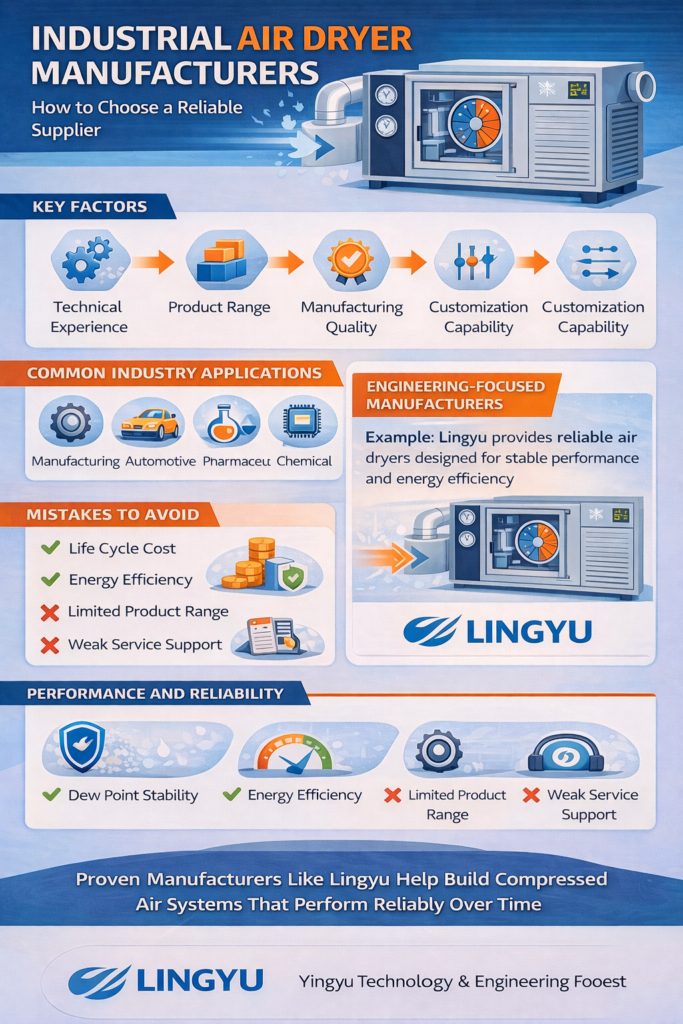
Key Factors When Evaluating Industrial Air Dryer Manufacturers
When comparing industrial air dryer manufacturers, buyers should look beyond basic flow capacity and price.
Technical Experience
A capable manufacturer should first understand the operating conditions of the compressed-air system.
Important parameters normally include:
- Required flow capacity
- Operating pressure
- Inlet air temperature
- Ambient temperature
- Required pressure dew point
- Cooling method
- Oil and particle requirements
- Daily operating hours
- Load fluctuations
These factors determine which dryer technology and capacity are appropriate.
For example, refrigerated dryers and adsorption dryers serve different pressure dew point requirements. Choosing between them should therefore begin with the required air quality rather than simply comparing equipment prices.
For buyers still determining the appropriate technology, Lingyu’s compressed air dryer selection guide provides a useful starting point.
Product Range
A manufacturer’s product range provides a useful indication of whether it can support different operating requirements.
A supplier with only one dryer technology may have limited flexibility when conditions change. A broader portfolio makes it easier to select the appropriate technology instead of forcing every application into the same solution.
Lingyu’s range includes heatless regenerative, heated regenerative, modular, blower-heated, heat-of-compression, and combined drying systems.
This becomes particularly valuable when a facility expands or when different production lines require different levels of compressed-air dryness.
Manufacturing and Quality Control
Industrial air dryers often operate continuously, so manufacturing consistency is important.
When evaluating a supplier, consider:
- Heat exchanger manufacturing quality
- Pressure vessel construction
- Valve and piping configuration
- Electrical and control components
- Refrigeration components
- Adsorbent selection and filling method
- Testing procedures before shipment
Certifications and quality-management systems can provide additional information about manufacturing controls.
Lingyu holds:
ISO 9001 — Quality Management System Certification
ISO 14001 — Environmental Management System Certification
ISO 45001 — Occupational Health & Safety Management System Certification
CE certificates are also listed for refrigerated compressed-air dryers, adsorption compressed-air dryers, and combined compressed-air dryers.
These certifications should be interpreted according to their actual scope rather than assumed to apply universally to every product.
Lingyu’s corporate credentials can be reviewed on its certificates page.
Customization Capability
Industrial projects rarely operate under identical conditions.
Depending on the application, a manufacturer may need to accommodate different:
- Pressure ratings
- Flow capacities
- Power supplies and voltages
- Cooling methods
- Materials
- Ambient conditions
- Control systems
- Communication protocols
For Lingyu’s air-cooled refrigerated dryer configurations, available options can include PLC control, dry contacts, Modbus communication, and IoT connectivity. Special configurations can also be engineered where operating conditions fall outside standard specifications.
This type of flexibility can be particularly important for OEM projects, overseas installations, and automated production plants.
Energy Efficiency
Energy consumption should be considered over the entire operating life of the dryer.
A lower purchase price can become less attractive if the dryer creates excessive pressure drop, consumes large amounts of purge air, or operates inefficiently during changing load conditions.
When evaluating manufacturers, ask how efficiency is achieved rather than relying only on an “energy-saving” label.
For facilities with fluctuating compressed-air demand, a frequency-conversion refrigerated air dryer can be considered where variable-load operation makes this technology appropriate.
For larger compressed-air stations where regeneration-air consumption is a major concern, technologies such as blower zero-purge adsorption dryers or heat-of-compression systems may also be worth evaluating.
Service and Spare Parts Support
A dryer may operate for many years, so after-sales capability should be considered before purchasing.
A reliable supplier should be able to support areas such as:
- Installation and commissioning
- Troubleshooting
- Preventive maintenance
- Replacement filters and adsorbent
- Refrigeration components
- Valves and control components
- Technical information
- Spare-parts supply
Lingyu provides after-sales technical consultation as well as commissioning, repair, maintenance, and spare-parts support for its equipment.
Long-term support can therefore be just as important as initial machine specifications.
Applications Served by Industrial Air Dryer Manufacturers
Different industries place very different demands on compressed-air quality.
Common applications include manufacturing, automotive production, food and beverage processing, pharmaceutical manufacturing, electronics, semiconductor production, chemical processing, metal fabrication, energy storage, and other industrial processes.
For electronics and precision manufacturing, moisture and contaminants can affect sensitive processes and equipment.
In food and beverage production, compressed-air treatment should be selected according to how the compressed air interacts with the process or product.
Because operating conditions vary considerably between industries, an experienced manufacturer should start with the application requirements and then determine the appropriate dryer and filtration configuration.
Engineering and Manufacturing Capability
When comparing suppliers, it is useful to determine whether a company operates primarily as an equipment seller or provides broader compressed-air treatment engineering, manufacturing, and service capabilities.
Lingyu specializes in compressed-air purification and separation technologies and integrates R&D, manufacturing, sales, and service.
Its manufacturing and organizational capabilities include approximately:
40,000 m² of manufacturing facilities
More than 300 employees
More than 40 sales and after-sales service locations
Industrial project experience is also valuable when selecting equipment for large-flow, low-dew-point, or energy-sensitive compressed-air systems.
A manufacturer’s ability to support different industries, operating conditions, and treatment configurations can provide useful evidence of its system-engineering experience.
Choose the Right Product for the Application
Instead of selecting one dryer technology for every facility, the dryer should match the actual air-quality and operating requirements.
Refrigerated Air Dryers
For general industrial moisture removal, refrigerated air dryers are often a practical solution where a moderate pressure dew point is sufficient.
Depending on the series and operating conditions, Lingyu refrigerated dryers generally provide a 2–10°C pressure dew point.
Modular Adsorption Air Dryers
Where installation space is limited and a substantially lower pressure dew point is required, a modular adsorption air dryer can provide a more compact adsorption configuration.
Combined Compressed-Air Dryers
For applications where refrigeration and adsorption drying need to work together, Lingyu’s DC Series combined compressed air dryer integrates both drying stages.
The refrigerated stage removes a substantial portion of the initial moisture load before the compressed air enters the adsorption section. This reduces the moisture load entering the adsorption stage and can reduce regeneration demand while maintaining a low pressure dew point.
The DC Series provides an outlet pressure dew point of ≤−40°C under its specified operating conditions.
The correct technology ultimately depends on flow, pressure, inlet temperature, required pressure dew point, load profile, installation conditions, and lifecycle cost.
Avoiding Common Selection Mistakes
Several mistakes can lead to poor long-term results when choosing an industrial air dryer manufacturer:
- Selecting equipment based only on initial purchase price
- Comparing rated flow without correcting for actual inlet pressure and temperature
- Ignoring pressure drop and its effect on compressor energy consumption
- Choosing a refrigerated dryer when the process requires a substantially lower pressure dew point
- Oversizing or undersizing adsorption dryers
- Ignoring regeneration-air consumption
- Purchasing from suppliers with limited spare-parts or technical support
- Failing to consider future production expansion
- Treating the dryer separately from filters, receivers, drains, piping, and the overall compressed-air system
A more balanced evaluation should consider air quality, reliability, energy consumption, maintenance requirements, and lifecycle cost together.
Questions to Ask an Industrial Air Dryer Manufacturer
Before making a final decision, ask the supplier several practical questions:
- What dryer technology is recommended for my required pressure dew point, and why?
- Has rated flow been corrected for my actual pressure, inlet temperature, and ambient temperature?
- What is the expected pressure drop across the dryer?
- How much purge air or regeneration energy does the system consume?
- Which components require regular replacement?
- Can the manufacturer provide customized voltage, materials, controls, or communication interfaces?
- Are spare parts readily available?
- Does the manufacturer have experience with similar applications?
- What commissioning and after-sales support is available?
- What operating conditions apply to the quoted performance?
A trustworthy supplier should be able to answer these questions with relevant engineering data rather than relying only on general sales claims.
Conclusion
Selecting the right industrial air dryer manufacturer is essential for maintaining dry and reliable compressed air over the long term.
Rather than focusing only on equipment price, buyers should evaluate engineering experience, product range, manufacturing quality, pressure dew point performance, pressure drop, energy consumption, customization capability, application experience, and after-sales support.
Lingyu provides refrigerated, adsorption, and combined drying technologies, allowing the dryer configuration to be matched more closely to different industrial requirements.
The best manufacturer is not simply the supplier with the lowest initial quotation. It is the supplier capable of matching the dryer to the application’s actual flow, pressure, inlet temperature, required pressure dew point, air-quality requirements, operating profile, and lifecycle objectives, while providing appropriate technical and service support throughout the equipment’s operating life.