Compressed air is essential in manufacturing, automotive, electronics, pharmaceuticals, food processing, and many other industries. However, moisture in compressed air can lead to corrosion, equipment problems, contamination, and increased maintenance costs.
Industrial air dryers reduce moisture in compressed air, helping protect equipment, maintain stable air quality, and support reliable production.
What Are Industrial Air Dryers?
Industrial air dryers are devices designed to remove water vapor from compressed air.
As compressed air cools after compression, moisture can condense inside pipelines, tanks, and downstream equipment. If this moisture is not properly controlled, it may cause:
- Rust and corrosion
- Reduced equipment life
- Problems with pneumatic tools and valves
- Product or process contamination
- Increased maintenance and downtime
Dryers are therefore an important part of a complete compressed-air treatment system. Filters and separators are typically used alongside dryers to remove oil, particles, liquid water, and other contaminants according to the required air quality.
Types of Industrial Air Dryers
The appropriate dryer technology depends primarily on the required pressure dew point, airflow, operating conditions, energy requirements, and sensitivity of the downstream process.
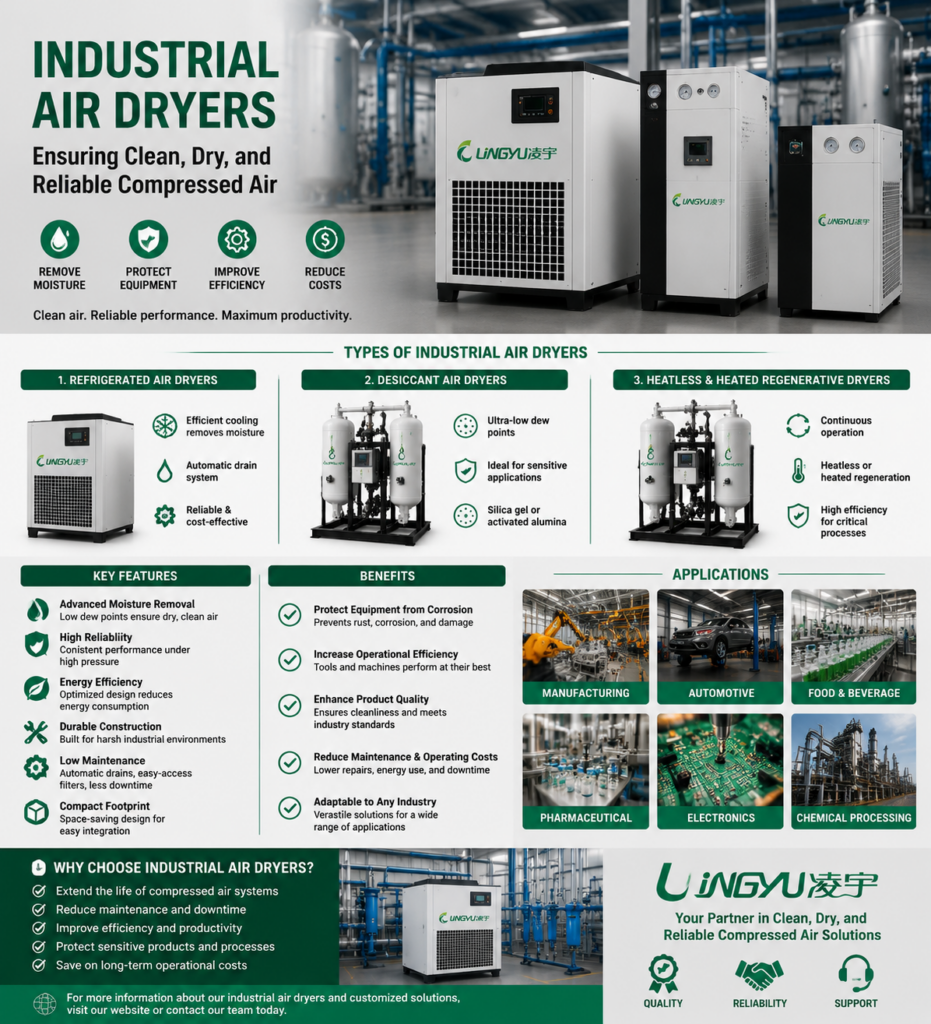
1. Refrigerated Air Dryers
Refrigerated air dryers cool compressed air so that water vapor condenses into liquid water, which can then be separated and drained from the system.
They are commonly used for general industrial applications where extremely low pressure dew points are not required.
Lingyu refrigerated dryers are typically designed for a pressure dew point of approximately 2–10°C, depending on the model and operating conditions.
Key advantages include:
- Reliable moisture removal
- Suitability for many general industrial applications
- Relatively simple operation
- Multiple configurations for different operating requirements
- Air-cooled and water-cooled options
- Low-pressure-drop and variable-frequency designs
For users deciding between the two major drying technologies, see the refrigerated vs. desiccant air dryer selection guide.
2. Desiccant Air Dryers
Desiccant air dryers use adsorption materials to remove residual water vapor from compressed air and achieve significantly lower pressure dew points than refrigerated drying.
Lingyu’s adsorption dryer range includes:
- Heatless regeneration dryers
- Heated regeneration dryers
- Modular adsorption dryers
- Blower-heated dryers
- Heat-of-compression dryers
Key advantages include:
- Lower pressure dew points
- Suitability for moisture-sensitive processes
- Continuous drying with twin-tower designs
- Multiple regeneration methods for different operating and energy requirements
Blower-heated and heat-of-compression systems include configurations designed to reduce purge-air consumption, including low-purge and zero-purge solutions.
For a broader overview of available dryer technologies, see the compressed air dryer types guide.
3. Combined Drying Systems
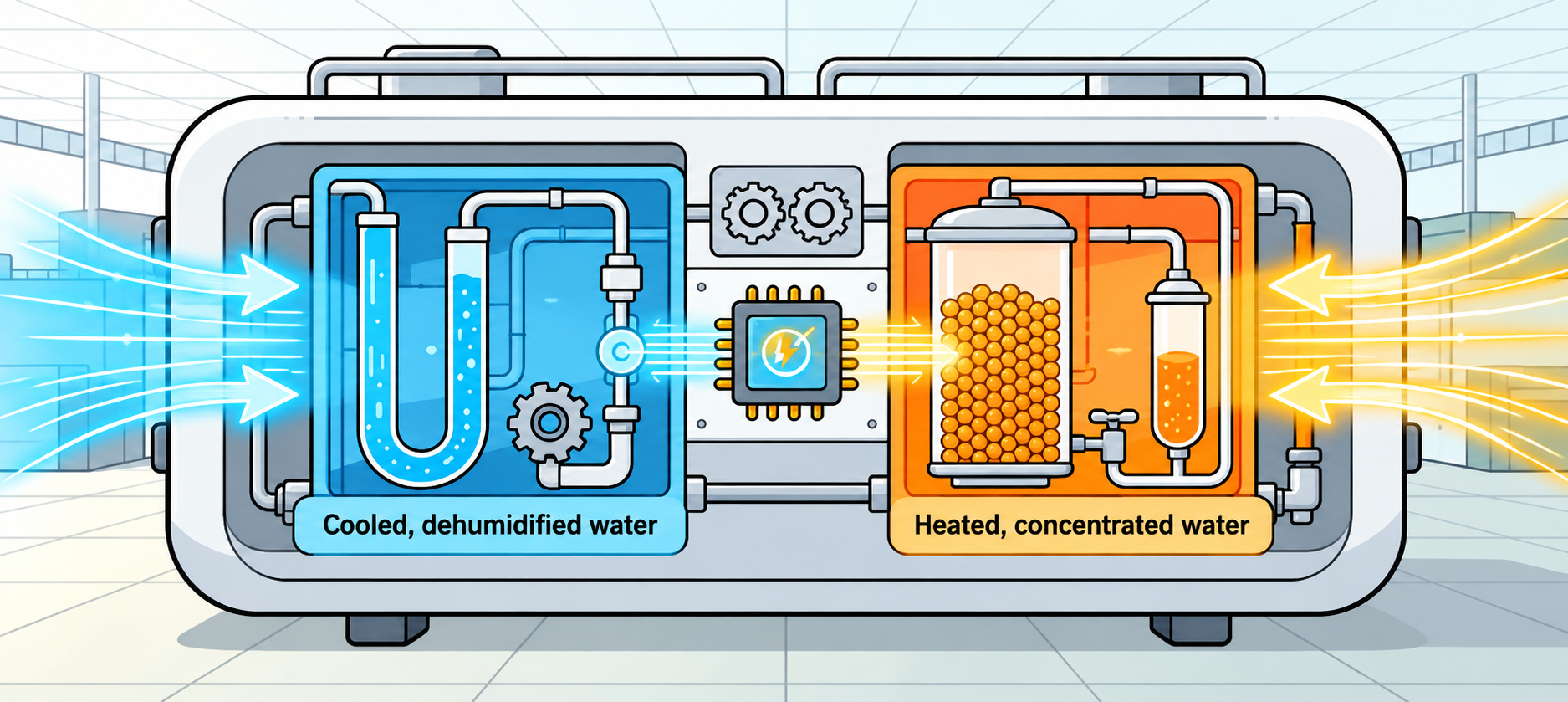
Some applications benefit from combining refrigerated and adsorption drying in a single treatment process.
In a combined system, compressed air is first cooled in the refrigerated stage to remove a large portion of the moisture. It then passes through oil-removal filtration before entering the adsorption stage for deeper drying.
By removing much of the moisture before the adsorption dryer, the refrigerated stage reduces the moisture load placed on the desiccant and can reduce regeneration demand.
This configuration can be useful where a low pressure dew point is required together with improved overall drying efficiency.
Key Features of Industrial Air Dryers
Important features vary according to dryer type and model, but several factors have a direct influence on system performance.
Stable Dew-Point Performance
The dryer should maintain compressed-air moisture at the level required by the downstream process.
Selecting the correct pressure dew point is important because different applications have very different moisture-control requirements.
Low Pressure Drop
Every pressure loss in a compressed-air system can increase the pressure the compressor must generate to maintain the required downstream operating pressure.
A dryer with controlled pressure drop can therefore help avoid unnecessary compressor energy demand.
Automatic Condensate Drainage
Refrigerated dryers separate condensed moisture from the compressed-air stream.
Reliable drainage is necessary to discharge this condensate and prevent separated water from accumulating or being carried downstream.
Reliable Desiccant Regeneration
In adsorption dryers, the desiccant must be regenerated after adsorbing moisture.
Regeneration can use purge air, heat, blower air, compression heat, or a combination of methods depending on the dryer configuration.
Monitoring and Controls
Depending on the model, available functions can include:
- Touchscreen controls
- Dew-point monitoring
- Programmable operating logic
- RS-485 communication
- Alarm functions
- Automated regeneration control
These functions can improve operating visibility and support integration with plant control systems.
Energy-Saving Configurations
Energy performance depends on the complete dryer design and actual operating conditions.
Variable-frequency refrigerated dryers can adjust operation according to demand, while blower-heated and zero-purge adsorption technologies can reduce compressed-air losses associated with regeneration.
The most efficient option depends on airflow, operating hours, load profile, pressure dew point, energy cost, and other site-specific factors.
Benefits of Using Industrial Air Dryers
The primary benefit of an industrial air dryer is reliable moisture control.
Dry compressed air can help:
- Reduce internal corrosion
- Protect pneumatic components
- Reduce moisture-related equipment problems
- Maintain process stability
- Protect moisture-sensitive production
- Reduce condensation in downstream piping
- Support consistent compressed-air quality
However, the correct dryer should match the actual application.
Using a dryer that produces a much lower pressure dew point than necessary can increase capital and operating costs without providing additional process value.
Dryer selection should therefore focus on achieving the required air quality efficiently rather than simply selecting the lowest possible dew point.
Applications of Industrial Air Dryers
Industrial compressed-air dryers are used across many sectors, but the required dryer technology and air quality can differ substantially among applications.
Manufacturing and Automotive
Dry compressed air can support:
- Pneumatic tools
- Automation
- Assembly equipment
- Painting
- Production machinery
- Instrumentation
General plant-air applications may be adequately served by refrigerated drying, while moisture-sensitive processes may require a lower pressure dew point.
Food and Beverage
Food and beverage production may require controlled compressed-air quality for packaging, processing, pneumatic equipment, and other production operations.
The required moisture level depends on how the compressed air is used and whether it interacts directly or indirectly with the process or product.
Pharmaceutical Manufacturing
Pharmaceutical processes can require tighter moisture control for sensitive equipment and controlled manufacturing operations.
Dryer selection should be based on the required compressed-air quality and specific process conditions.
Electronics Manufacturing
Electronics and semiconductor manufacturing can place greater emphasis on contamination and humidity control.
Where very low moisture levels are required, adsorption drying may be more appropriate than conventional refrigerated drying.
Chemical and Petrochemical Processing
Chemical and petrochemical plants use treated compressed air for instrumentation, pneumatic controls, process equipment, and other applications.
The dryer should be selected according to required pressure dew point, operating conditions, air quality, and process requirements.
How to Choose the Right Industrial Air Dryer
Dryer selection should be based on actual operating requirements rather than industry name alone.
Required Pressure Dew Point
The first question is how dry the compressed air needs to be.
For many general industrial applications, refrigerated drying may provide sufficient moisture control.
Where significantly lower pressure dew points are required, adsorption drying is generally more appropriate.
Airflow
The dryer must be sized for the required compressed-air volume.
Sizing should consider normal demand, realistic peak flow, and regeneration consumption where applicable.
Inlet Pressure
Dryer capacity and performance can change with inlet pressure.
The equipment should therefore be selected according to actual operating pressure rather than nominal compressor capacity alone.
Inlet Temperature
Higher inlet temperatures can increase the moisture and heat load placed on the dryer.
Actual inlet temperature should be considered during equipment selection, particularly in high-temperature compressed-air systems.
Ambient Conditions
Ambient temperature and installation conditions can affect dryer performance, especially for air-cooled refrigerated systems.
Site conditions should therefore be included in the selection process.
Pressure Drop
Excessive pressure loss increases the compressor pressure required to maintain the desired downstream pressure.
Pressure drop should be evaluated across the complete air-treatment system, including dryers, filters, separators, and piping.
Operating Hours and Load Profile
A dryer operating continuously has different energy and maintenance priorities from equipment used intermittently.
For variable-demand applications, technologies that adapt to changing load conditions may offer operating advantages.
Energy Consumption
Energy analysis should consider the complete drying process.
Depending on dryer type, this can include:
- Refrigeration power
- Purge-air consumption
- Heater power
- Blower power
- Pressure-drop-related compressor demand
- Regeneration energy
Maintenance Requirements
Routine maintenance can include inspection of drains, filters, heat exchangers, valves, desiccant, refrigeration components, and monitoring devices depending on dryer technology.
Maintenance accessibility and service requirements should be considered during equipment selection.
For more detailed selection guidance, see the compressed air dryer buyer’s guide.
Refrigerated, Desiccant, or Combined Dryer: Which Should You Choose?
The best choice depends on the required air quality and operating conditions.
Refrigerated air dryers are suitable for many general plant-air applications where a pressure dew point around 2–10°C meets process requirements.
Desiccant air dryers are more appropriate where significantly lower pressure dew points are required or where downstream processes are particularly sensitive to moisture.
Combined drying systems can be considered where deeper drying is required and reducing the moisture load on the adsorption stage provides an operating advantage.
Advanced regenerative configurations such as blower-heated, zero-purge, and heat-of-compression dryers can also be considered where reducing compressed-air regeneration losses is an important design objective.
No single dryer technology is optimal for every facility. The final choice should balance air quality, airflow, pressure, temperature, load profile, energy consumption, maintenance, and total operating cost.
Lingyu Industrial Air Dryer Solutions
Lingyu’s industrial air dryer range includes refrigerated dryers, adsorption dryers, and combined drying systems for different compressed-air treatment requirements.
The adsorption portfolio includes heatless, heated, modular, blower-heated, and heat-of-compression technologies.
The refrigerated range includes multiple configurations designed for different cooling methods, capacities, pressure-drop requirements, and energy-management strategies.
For users comparing available equipment, the Lingyu compressed air dryer product range provides the main product entry.
Conclusion
Industrial air dryers help maintain reliable compressed-air quality by controlling moisture before it reaches downstream equipment and production processes.
Refrigerated dryers are suitable for many general industrial applications and typically provide a pressure dew point of approximately 2–10°C in Lingyu configurations.
Desiccant dryers provide lower pressure dew points for moisture-sensitive processes, with heatless, heated, modular, blower-heated, and heat-of-compression regeneration technologies available for different operating requirements.
Combined drying systems provide another option where deeper drying and reduced moisture loading on the adsorption stage are both important.
The correct industrial air dryer should therefore be selected according to required pressure dew point, airflow, inlet pressure, inlet temperature, ambient conditions, pressure drop, operating hours, energy use, maintenance requirements, and the actual production process.