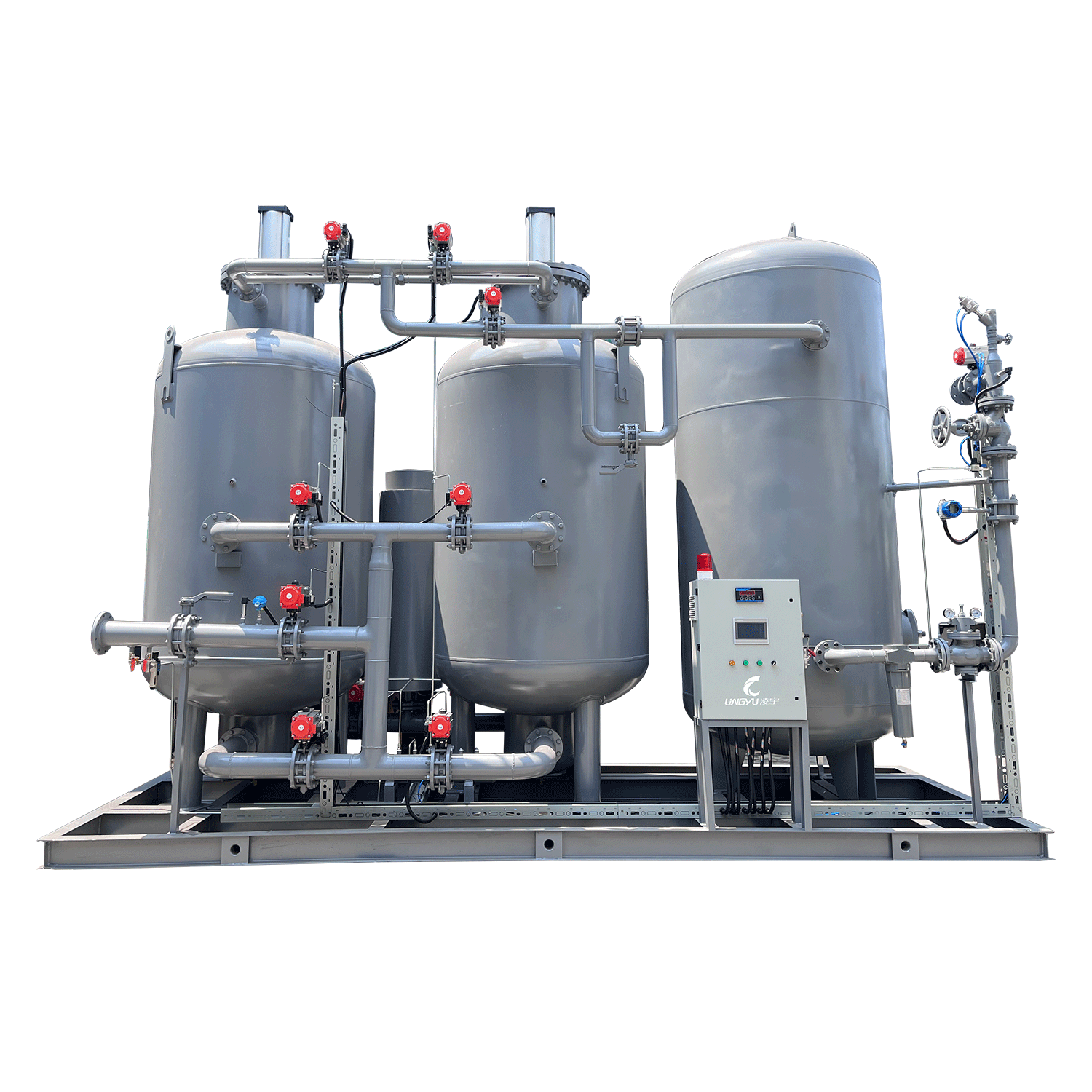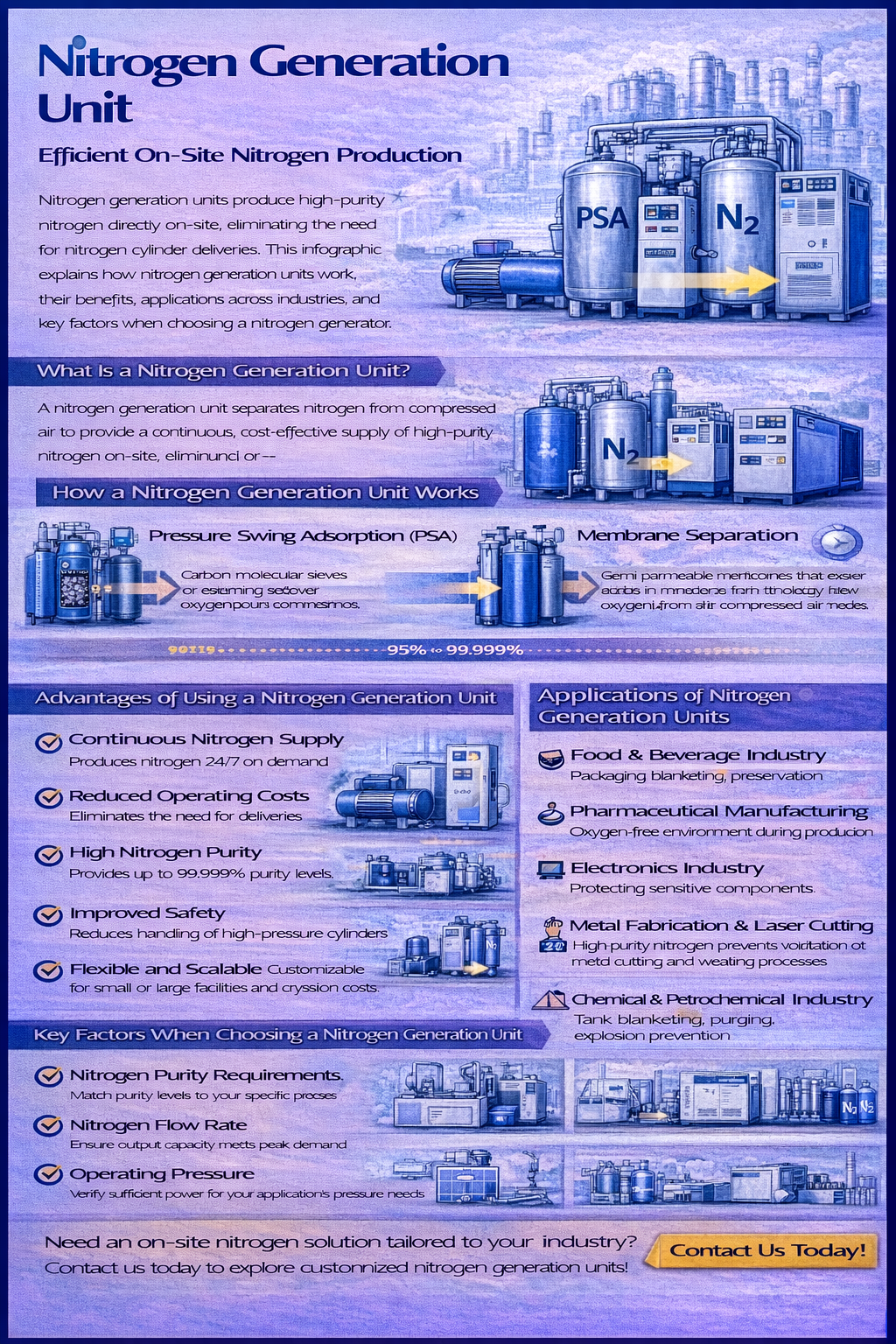
When people hear the word “gas,” they often associate it with fire, explosions, and flammability. So it’s natural to wonder: Is nitrogen flammable? Despite being all around us—making up 78% of the air we breathe—nitrogen remains one of the most misunderstood industrial gases.
Today, we’ll break down what nitrogen really is, whether it burns, and why it’s used so widely to prevent fires rather than start them.
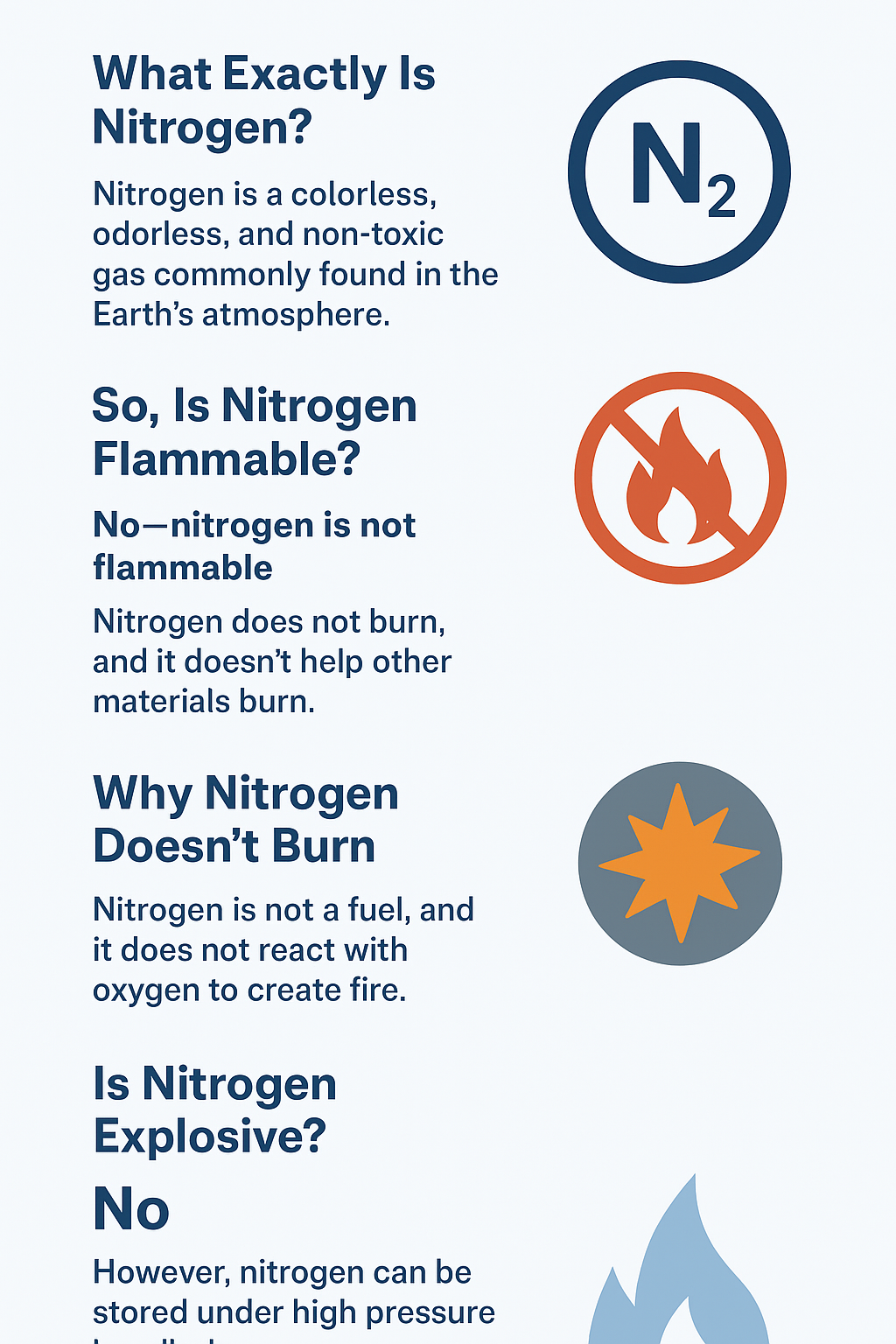
What Exactly Is Nitrogen?
Nitrogen (chemical symbol N₂) is a colorless, odorless, and non-toxic gas commonly found in the Earth’s atmosphere. In its natural state, nitrogen is very stable because its molecules are tightly bonded together. This stability is the main reason nitrogen does not support combustion.
So, Is Nitrogen Flammable?
The short answer: No—nitrogen is not flammable.
Nitrogen does not burn, and it doesn’t help other materials burn. It is actually classified as an inert gas, which means it does not chemically react under most normal conditions.
Why Nitrogen Doesn’t Burn
Flammability requires three elements:
Fuel
Oxygen
Heat (ignition source)
Nitrogen is not a fuel, and it does not react with oxygen to create fire. Instead, nitrogen dilutes oxygen, lowering the amount available for combustion. Without enough oxygen, flames cannot ignite or continue burning.
Is Nitrogen Explosive?
Pure nitrogen is not explosive, because explosions also require fuel. However, nitrogen can be stored under high pressure in cylinders. If a cylinder is damaged, the pressure could cause mechanical rupture—but this is not an explosion caused by combustion.
Why Nitrogen Is Used to Prevent Fires
Industries often use nitrogen because of its non-flammable, inert nature. Common applications include:
1. Fire Suppression Systems
Nitrogen displaces oxygen to stop combustion in sensitive areas like data centers and archives.
2. Chemical Manufacturing
Nitrogen blankets tanks and pipelines to prevent oxygen contact and unwanted reactions.
3. Food Packaging
It replaces oxygen in sealed bags to extend freshness and avoid oxidation.
4. Industrial Processes
Nitrogen is widely used in welding, electronics manufacturing, and pharmaceuticals for its stability and purity.
Are There Any Risks When Using Nitrogen?
While nitrogen is non-flammable, it can still be dangerous in enclosed spaces. Because it displaces oxygen, it can cause oxygen deficiency, leading to dizziness or unconsciousness. Proper ventilation and monitoring equipment are essential when working with nitrogen.
Myth vs. Reality: Nitrogen and Fire
| Myth | Reality |
|---|---|
| Nitrogen might catch fire under high heat. | False — nitrogen does not burn at any temperature. |
| Nitrogen can cause explosions. | Only if a pressurized storage cylinder ruptures mechanically, not from combustion. |
| Nitrogen makes fires stronger. | Opposite — nitrogen smothers fire by lowering oxygen levels. |
Conclusion: Nitrogen Is Non-Flammable and Very Safe When Used Properly
To sum it up: nitrogen is not flammable, not explosive, and not a fire risk. Instead, it plays a crucial role in preventing combustion and improving safety across many industries.
Whether used in manufacturing, food processing, fire suppression, or laboratory environments, nitrogen remains one of the safest and most reliable gases—when handled correctly.
If you’re now curious how nitrogen is produced or why industries choose nitrogen generators instead of cylinders, feel free to ask!