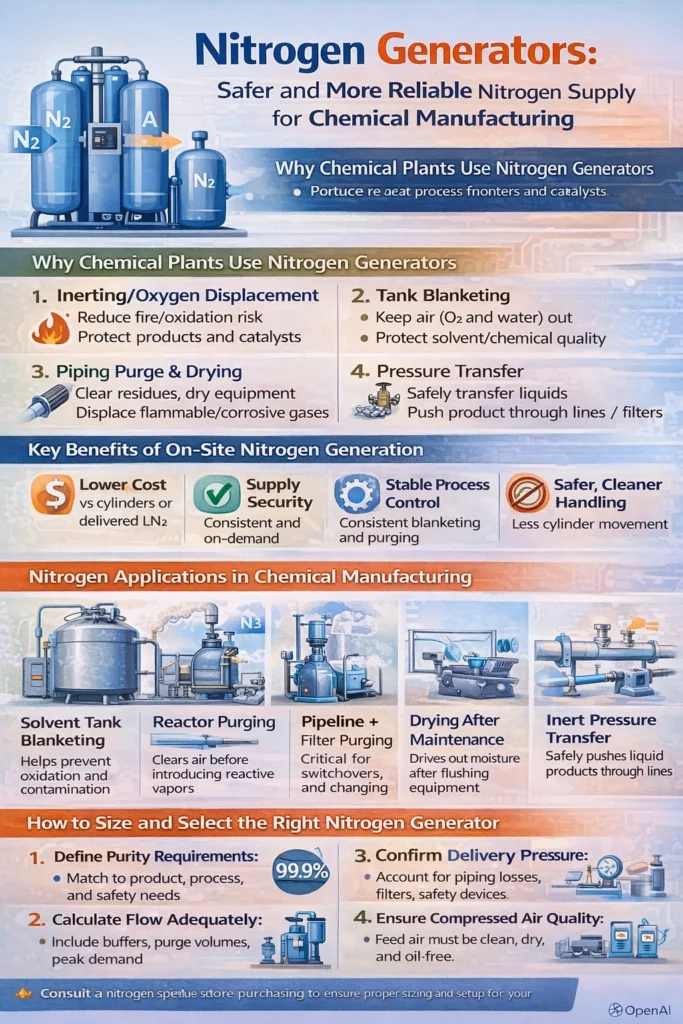
Nitrogen is an important utility in many chemical manufacturing plants. It can support tank blanketing, process inerting, pipeline and vessel purging, selected pressure-transfer operations, and other processes where oxygen exposure needs to be controlled.
For plants with regular nitrogen consumption, an on-site nitrogen generator for chemical manufacturing can reduce dependence on externally delivered cylinders or bulk liquid nitrogen while giving operators more direct control over gas availability.
However, the value of on-site generation is not simply that nitrogen can be produced inside the plant. A well-designed system should provide stable nitrogen quality, reliable supply under changing process demand, and a controllable total operating cost.
For a broader overview of compressed-air and gas applications in chemical processing, see Lingyu’s petrochemical and chemical processing solutions.
Where Nitrogen Supports Chemical Manufacturing
Chemical plants use nitrogen in different ways, and each application can create a different demand profile. Understanding these differences is important before selecting generator capacity, purity, storage, or pressure.
Tank Blanketing
Nitrogen can be maintained in the vapor space above stored materials where exposure to atmospheric oxygen needs to be limited.
Depending on the product and storage conditions, blanketing can help reduce oxidation or other unwanted reactions.
Because tank blanketing is often a relatively continuous, low-flow application, its demand pattern is different from short-duration purging.
Process Inerting
Nitrogen may be introduced into vessels, reactors, tanks, or other process equipment to reduce oxygen concentration to a defined level.
The required condition depends on factors including:
- Material properties
- Initial oxygen concentration
- Target oxygen concentration
- Equipment volume
- Gas distribution
- Operating temperature and pressure
- Process safety requirements
Nitrogen should therefore be treated as part of the overall process design rather than as a universal method of making equipment “safe.”
Pipeline and Vessel Purging
Nitrogen can also be used to displace air or residual process gases during startup, shutdown, maintenance, or product changeover.
From a nitrogen-system design perspective, purging is especially important because it can create a short-term flow requirement that is much higher than the plant’s normal continuous consumption.
Selected Pressure-Transfer Operations
Where appropriate for the chemical and equipment design, nitrogen can be used to apply controlled pressure for transferring liquids or supporting selected process operations without introducing atmospheric air.
These different applications should be considered together when defining total nitrogen demand.
Why On-Site Nitrogen Can Support More Stable Production
Delivered nitrogen can be suitable for facilities with low or irregular consumption.
For plants with continuous or predictable demand, however, on-site generation can turn nitrogen from a delivery-dependent consumable into a locally produced plant utility.
This can provide several practical advantages.
More Direct Control Over Supply
The plant can produce nitrogen according to its operating schedule instead of depending entirely on external delivery timing.
This can be particularly useful for continuous tank blanketing, regular batch production, or other processes that require predictable nitrogen availability.
Better Visibility Into Nitrogen Quality
An on-site system can continuously monitor important operating parameters.
Lingyu’s PSA nitrogen-generator design provides real-time monitoring of nitrogen purity and flow rate, while the touchscreen displays pressure, purity, flow, and operating status.
This makes it easier for operators to identify changes in gas quality or system performance.
Reduced Dependence on Supply Logistics
Delivered nitrogen may involve transportation, cylinder handling, storage, rental, or bulk-gas logistics.
Producing nitrogen from compressed air can reduce this dependence. The actual economic benefit, however, still depends on the plant’s nitrogen consumption, energy cost, operating schedule, and required gas quality.
How PSA Nitrogen Generation Works
Lingyu’s nitrogen generators use Pressure Swing Adsorption, or PSA, technology.
The system uses two adsorption towers filled with Carbon Molecular Sieve.
Compressed air enters one tower, where oxygen is preferentially adsorbed while nitrogen passes through the adsorption bed as product gas.
At the same time, the second tower is depressurized and regenerated.
The two towers continuously alternate between adsorption and regeneration under automatic PLC control, allowing continuous nitrogen production.
For more technical detail, see how PSA nitrogen generation works.
Select Nitrogen Purity According to the Process
One of the easiest ways to increase nitrogen-system operating cost unnecessarily is to specify a higher purity than the process actually requires.
Lingyu’s PSA nitrogen generator range covers nitrogen purity from approximately 95% to 99.999%, with available configurations including 99%, 99.5%, 99.9%, and 99.99%.
Chemical manufacturing does not have one universal nitrogen-purity requirement.
For example, tank blanketing may tolerate a different residual oxygen level from a sensitive reaction or another specialized process.
The specification should therefore be based on the maximum allowable residual oxygen for the application rather than automatically selecting the highest available nitrogen purity.
For one available configuration example, see the 99.5% nitrogen generator.
Use Very High Purity Only Where It Is Required
Some specialized chemical processes may require extremely low residual oxygen.
For these applications, Lingyu’s carbon-based deoxygenation purification system can upgrade approximately 99.9% PSA nitrogen to ≥99.999%, with oxygen ≤10 ppm, CO₂ ≤5 ppm, and atmospheric nitrogen dew point ≤−60°C.
This type of downstream purification should be applied where the process genuinely requires it.
If only one or a few users need extremely high-purity nitrogen, it may be more practical to provide additional purification at those demanding points rather than designing the entire plant nitrogen network around the highest specification.
Flow Stability Matters as Much as Purity
Correct nitrogen purity alone does not guarantee reliable operation.
The system must also be able to maintain the required flow when plant demand changes.
Chemical manufacturing often combines continuous and intermittent nitrogen users. For example:
- Tank blanketing may require continuous low flow.
- Reactor purging may create a short high-flow demand.
- Maintenance activities may temporarily increase consumption.
- Several production lines may use nitrogen at the same time.
Sizing the generator only from average consumption can therefore lead to pressure drops or inadequate purge performance during peak demand.
A more realistic design should consider:
Average flow + credible simultaneous peak demand + duration of that peak.
Use Buffer Storage to Manage Short-Term Peak Demand
A nitrogen buffer tank can help separate the generator’s production rate from short-term plant consumption.
Lingyu’s standard PSA configuration includes compressed-air and nitrogen buffer equipment as part of the complete system.
During periods of lower nitrogen consumption, the generator can replenish stored gas.
When a short-duration peak occurs, the nitrogen buffer can supplement generator output and help stabilize downstream pressure.
However, buffer storage should not be selected only by rule of thumb.
The required storage volume depends on:
- Generator production rate
- Peak consumption
- Peak duration
- Storage pressure
- Minimum allowable downstream pressure
- Required reserve
The generator and nitrogen buffer should therefore be sized as one coordinated system.
Separate Generator Feed Pressure From Process Pressure
Another common design mistake is treating compressed-air inlet pressure as if it were the nitrogen pressure available at the process.
Lingyu’s standard PSA system uses a compressed-air inlet pressure of 0.5–0.8 MPa.
This is the feed-air requirement for the nitrogen generator.
It does not mean that every downstream process will automatically receive nitrogen at the pressure it requires.
The plant should define pressure at the actual point of use and consider:
- Distribution-pipe pressure loss
- Regulators
- Filters
- Valves
- Long pipe runs
- Peak flow
- Individual higher-pressure consumers
If only one process requires substantially higher pressure, localized boosting or storage may be more efficient than designing the entire plant nitrogen network around that single user.
Feed-Air Quality Directly Affects Nitrogen-System Reliability
A PSA nitrogen generator should be considered part of the complete compressed-air treatment system rather than as an isolated machine.
Moisture, oil, and particles should be controlled before compressed air enters the adsorption section.
Lingyu’s standard configuration includes an air compressor, air receiver, refrigerated air dryer, buffer tank, PSA generator, nitrogen buffer, analyzer, and pressure-control equipment.
Stable feed-air conditions are important because contamination or poor air treatment can affect filters, valves, analyzers, CMS, and long-term nitrogen performance.
Depending on the required air-treatment level, a precision compressed air filter can form part of the upstream pretreatment package.
Include Dew Point in the Nitrogen Specification
Nitrogen quality should not be evaluated only by purity.
Moisture can also matter where the process involves moisture-sensitive products, equipment, or downstream instrumentation.
Lingyu’s standard PSA system provides a nitrogen dew point of ≤−40°C under the specified operating conditions.
If a process requires a different moisture level, the required dew point should be defined during system selection.
The specification should therefore come from the actual process requirement rather than assuming that every chemical application needs the same nitrogen dryness.
Monitoring Helps Maintain Stable Nitrogen Quality
Stable nitrogen production depends on identifying when gas quality moves outside the required operating range.
Lingyu’s PSA system continuously monitors nitrogen purity and flow.
If purity falls below the specified value, the system activates an alarm. If the off-spec condition continues for a preset period, the system can automatically shut down for protection.
For important chemical processes, the overall control philosophy may also include:
- Analyzer alarm thresholds
- Off-spec gas routing
- Interlocks
- Remote signals
- Calibration procedures
- Backup gas logic
These functions should complement the plant’s process-control and safety systems.
Reliability Depends on the Complete System
Long-term nitrogen reliability depends on more than the PSA adsorption towers.
The complete supply system may include:
- Compressor
- Air receiver
- Dryer
- Filters
- Automatic drains
- PSA valves
- CMS
- Analyzer
- Nitrogen buffer tank
- Pressure-control equipment
- Distribution piping
A failure in a critical upstream or downstream component can affect nitrogen production or delivery.
For processes that cannot tolerate loss of nitrogen, the plant should evaluate appropriate backup measures such as stored nitrogen, reserve generator capacity, standby equipment, or another defined contingency.
Maintenance Should Focus on Predictable Performance
Routine maintenance should cover the complete air-treatment and nitrogen-generation system rather than only the PSA unit.
Important areas include:
- Filter elements
- Automatic drains
- Dryer performance
- Pneumatic valves
- Analyzer calibration
- CMS condition
- Pressure trends
- Flow trends
Lingyu’s PSA design also includes an automatic CMS compaction system intended to maintain proper packing density and help reduce pulverization caused by adsorption-bed movement.
Tracking operating trends over time can help maintenance teams identify deterioration before it develops into a larger production problem.
Evaluate Total Nitrogen Cost, Not Only Purchase Price
The phrase “lower-cost nitrogen” should refer to total operating cost rather than only the price paid for gas.
A realistic comparison between delivered nitrogen and on-site generation should consider:
- Annual nitrogen consumption
- Required purity
- Compressed-air consumption
- Compressor electricity
- Dryer and filtration energy
- Maintenance
- Analyzer servicing
- Storage
- Backup supply
- Delivery and rental costs
- Operating hours
Lingyu’s optimized unequal-pressure equalization process improves nitrogen recovery efficiency and indirectly reduces overall energy consumption by approximately 5%.
Actual savings still depend on the operating conditions and economics of the individual plant.
For a more complete financial comparison, see the nitrogen generator cost and ROI guide.
Where Nitrogen-System Optimization Usually Comes From
For an existing chemical plant, improving nitrogen cost and reliability does not always mean installing a larger generator.
In many cases, better results come from reviewing the complete system.
Important areas include:
- Nitrogen purity
- Average and peak demand
- Buffer storage
- Distribution pressure
- Compressed-air consumption
- Air or nitrogen leakage
- Unnecessary high-pressure users
- Pretreatment condition
- Generator operating hours
The objective is to deliver the required nitrogen quality, flow, and pressure at the actual point of use rather than maximizing every equipment specification.
For a broader system-selection framework, see the PSA nitrogen generator selection guide.
FAQ
Is On-Site Nitrogen Suitable for Chemical Manufacturing?
It can be suitable where the plant has sufficient nitrogen demand to justify local production and the generator can meet the required purity, flow, pressure, dew point, and supply reliability.
The final decision should be based on actual process requirements and site economics.
What Nitrogen Purity Does a Chemical Plant Need?
There is no single purity value that applies to every chemical plant.
The required purity should be determined from allowable residual oxygen, process sensitivity, product-quality requirements, and applicable plant safety criteria.
Does a Chemical Plant Need a Nitrogen Buffer Tank?
Not always.
Buffer storage can be useful where demand fluctuates or where short-duration purge events exceed the generator’s steady production rate.
Its size should be calculated from actual flow, duration, pressure, and reserve requirements.
Is Higher Nitrogen Purity Always Better?
No.
Higher purity may be necessary for specific processes, but specifying it unnecessarily can affect nitrogen production capacity, compressed-air consumption, and operating cost.
What Should Be Checked if Nitrogen Supply Becomes Unstable?
Check measured nitrogen purity, flow, pressure, feed-air conditions, filters, dryer operation, valves, analyzer status, changes in nitrogen demand, and distribution pressure loss.
The complete system should be reviewed before assuming that one component is responsible.
Conclusion
A nitrogen generator for chemical manufacturing should be treated as part of the plant’s overall utility system rather than simply as a replacement for nitrogen cylinders or bulk deliveries.
For reliable and economical operation, the design should balance:
Process oxygen requirement → nitrogen purity → average and peak flow → point-of-use pressure → compressed-air treatment → storage → monitoring → maintenance → total operating cost.
When these factors are considered together, on-site PSA nitrogen can provide a more stable and controllable gas supply while reducing dependence on delivered nitrogen and potentially improving long-term operating economics.
Available equipment can be reviewed through Lingyu’s nitrogen generator range.