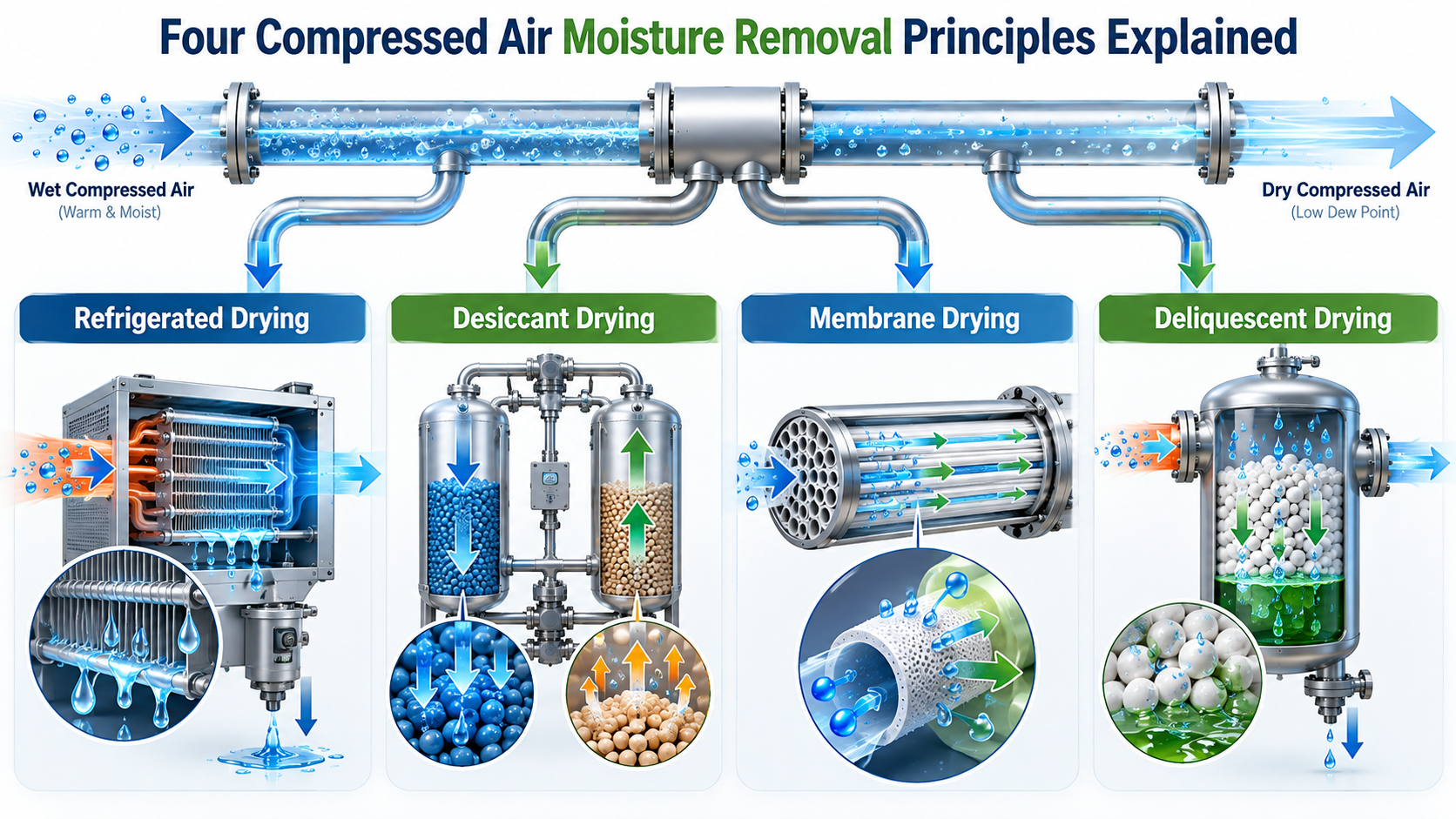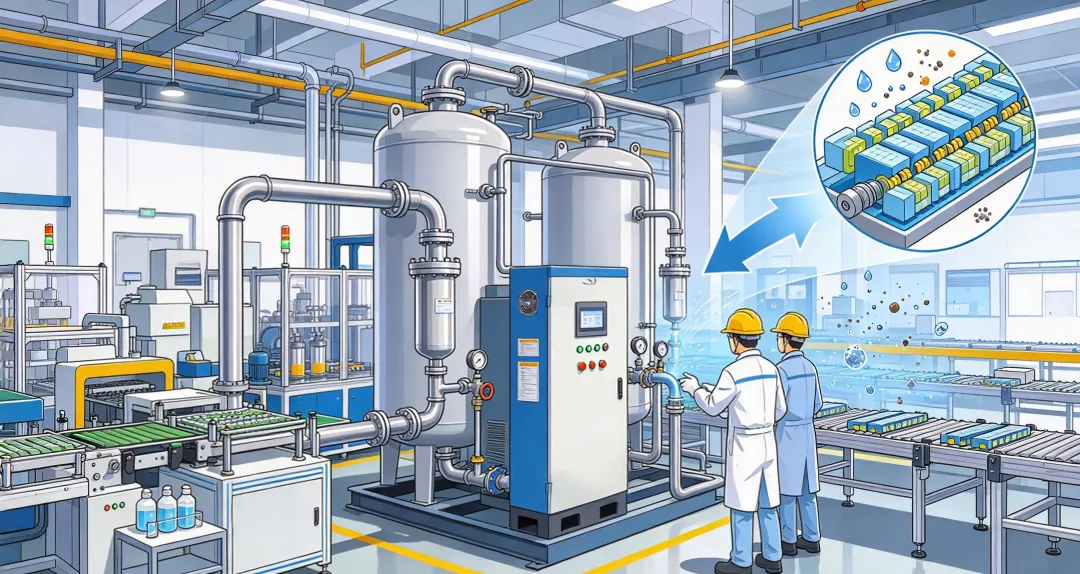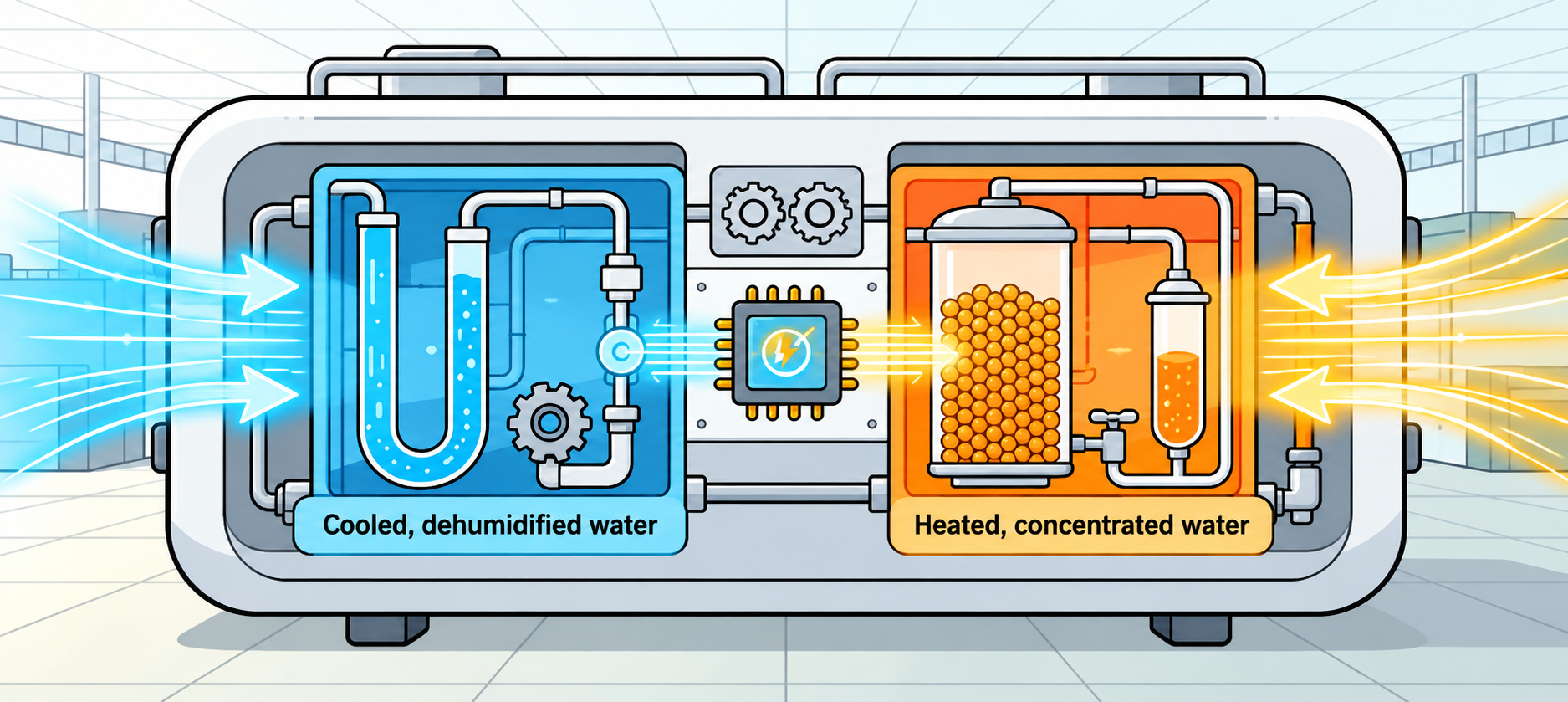
Clean and dry compressed air is essential for reliable pneumatic equipment, stable production processes, and consistent product quality. Among the different technologies used for compressed air treatment, refrigerated air dryers remain one of the most widely used solutions for general industrial moisture removal.
Within this category, heat exchanger design has an important influence on dryer size, thermal performance, pressure drop, drainage, and long-term reliability. A plate heat exchanger refrigerated air dryer uses a compact plate-type heat exchange structure rather than the conventional shell-and-tube arrangement.
The plate design offers a large heat-transfer area within a relatively small volume, making it particularly attractive where compact installation and efficient heat exchange are important. The original article highlights these advantages, especially its compact construction and thermal performance compared with traditional shell-and-tube designs.
However, plate heat exchangers are not automatically superior in every compressed air application. Selecting between plate and shell-and-tube refrigerated dryers should consider airflow, inlet temperature, operating environment, pressure conditions, maintenance requirements, and installation constraints.
What Is a Plate Heat Exchanger Refrigerated Air Dryer?
A plate heat exchanger refrigerated air dryer is a compressed air dryer that uses plate-type heat exchangers as part of its cooling and moisture-removal process.
Like other refrigerated dryers, its basic objective is straightforward:
Cool compressed air → condense water vapor → separate condensate → deliver dry compressed air downstream.
The difference lies largely in how heat transfer takes place.
A plate heat exchanger contains multiple thin metal plates arranged to create separate flow passages. This structure provides a large surface area for heat transfer while maintaining a compact overall size.
In a refrigerated air dryer, plate-type exchangers can be incorporated into the air-to-air precooling and refrigeration heat-exchange stages, depending on the specific dryer configuration.
For example, Lingyu’s 3-in-1 plate heat exchange refrigerated air dryer integrates the precooler, evaporator, and gas-water separator into a compact assembly.
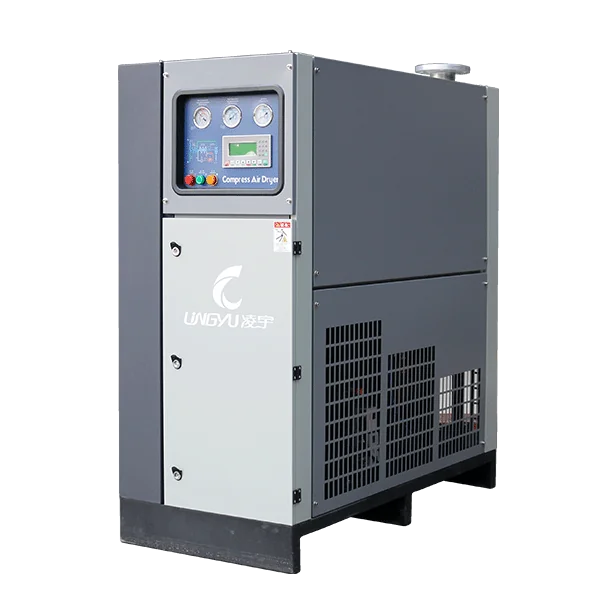
How Does a Plate Heat Exchanger Refrigerated Air Dryer Work?
Although internal layouts differ between manufacturers and models, the drying process generally involves several stages.
1. Warm Compressed Air Enters the Dryer
Compressed air entering the dryer contains water vapor.
The amount of moisture depends on ambient humidity, compressor conditions, inlet temperature, pressure, and the effectiveness of upstream condensate removal.
2. The Air Is Precooled
Incoming warm compressed air can first exchange heat with the colder dry air leaving the dryer.
This reduces the refrigeration load because part of the incoming heat is removed before the compressed air reaches the refrigeration section.
At the same time, the outgoing dry air is reheated. This helps prevent external pipe sweating and reduces the possibility of immediate downstream condensation under normal operating conditions.
3. Refrigeration Further Cools the Air
The precooled compressed air then passes through the refrigeration heat exchanger.
Its temperature is reduced until water vapor begins to condense into liquid water.
This is the core moisture-removal stage of the refrigerated air dryer process.
4. Condensed Water Is Separated
Cooling alone does not complete the drying process.
The condensed liquid water must be efficiently separated from the airflow and discharged. Separator performance and drainage reliability are therefore critical to actual dryer performance.
If condensate is not removed effectively, water can be re-entrained into the outgoing compressed air.
5. Dry Air Is Reheated
The cold, dried compressed air exchanges heat with the warmer incoming air before leaving the dryer.
This recovers cooling energy and raises the outlet temperature without requiring a separate heater.
The result is a continuous supply of compressed air with substantially less moisture than the untreated inlet air.
Plate Heat Exchanger vs. Shell-and-Tube Refrigerated Air Dryer
Both designs use refrigeration to remove moisture, so the fundamental drying principle is similar.
The main differences are related to heat exchanger construction and how that construction affects system performance.
| Factor | Plate Heat Exchanger | Shell-and-Tube Heat Exchanger |
|---|---|---|
| Heat-transfer surface | Multiple thin plates | Tubes inside a shell |
| Equipment footprint | Generally compact | Typically larger |
| Internal volume | Relatively low | Generally higher |
| Heat-transfer characteristics | High surface-area density | Robust conventional design |
| Construction | Often stainless-steel plate structure | Depends on shell and tube materials |
| Maintenance approach | Depends on plate design | Tubes may permit different cleaning methods |
| Best choice | Space-conscious, compact systems | Depends on capacity and operating environment |
The correct choice should be based on operating requirements rather than assuming that one heat exchanger architecture is universally better.
1. Compact Heat Exchanger Design
One of the clearest advantages of plate technology is its high heat-transfer surface area relative to physical volume.
Thin plates create numerous flow channels inside a compact package. This allows substantial heat exchange without requiring the same physical arrangement as a conventional shell-and-tube exchanger.
The compact structure can be valuable in:
- Compressor rooms with limited floor space
- Integrated compressed air packages
- Containerized compressor stations
- Production lines where equipment footprint must be minimized
- Retrofit projects with restricted installation space
This does not mean that every plate dryer is smaller than every shell-and-tube dryer. Actual dimensions still depend on airflow capacity, cooling method, refrigeration components, operating pressure, and equipment configuration.
2. Efficient Heat Transfer
Plate-type heat exchangers create a relatively large heat-transfer surface within a small volume.
Their internal passages can also promote turbulence, supporting effective heat transfer between fluids.
The original article attributes substantially higher heat-transfer performance to the plate arrangement because of its thin plates and turbulent flow characteristics.
In practical dryer operation, efficient heat exchange can help reduce the refrigeration load required to bring compressed air to the necessary temperature.
However, overall dryer energy consumption depends on more than the heat exchanger alone.
Refrigeration compressor efficiency, inlet temperature, ambient conditions, airflow, pressure drop, condenser performance, controls, and load variation all contribute to actual energy use.
3. Integrated Three-in-One Construction
Some modern plate refrigerated dryers go beyond simply replacing a shell-and-tube exchanger with plates.
An integrated design can combine several functions within one assembly.
Lingyu’s three-in-one configuration integrates:
Precooler + evaporator + gas-water separator
into the plate heat exchange structure.
This reduces the number of separate components and connecting pipes required inside the dryer.
Integration can provide several practical benefits:
- Reduced equipment footprint
- Shorter internal flow paths
- Fewer external connections
- Simplified internal arrangement
- More compact overall dryer construction
For users considering this specific architecture, the 3-in-1 plate heat exchange refrigerated air dryer performance guide provides additional detail without requiring the general refrigerated-dryer discussion to be repeated here.
4. Stainless-Steel Construction and Corrosion Resistance
Material selection is another important consideration.
Plate heat exchangers used in compressed air dryers are often manufactured from stainless steel, which can provide good corrosion resistance in contact with condensate.
This can be beneficial because moisture condensing inside a dryer may contain contaminants carried from the upstream compressed air system.
The original comparison particularly emphasizes stainless-steel plates as an advantage in environments where corrosion resistance and air cleanliness matter.
However, it is too broad to assume that all shell-and-tube exchangers necessarily suffer from corrosion or that every plate exchanger will have a longer service life.
Durability depends on:
- Material grade
- Condensate chemistry
- Compressor oil carryover
- Operating pressure
- Temperature
- Manufacturing quality
- Maintenance
- Water quality in water-cooled systems
Material specifications should therefore be checked for the actual dryer being evaluated.
5. Moisture Separation Matters as Much as Cooling
A common mistake when comparing refrigerated dryers is to focus entirely on heat-transfer efficiency.
The purpose of the dryer is not merely to cool the air—it is to remove water.
After moisture condenses, liquid droplets must be separated efficiently before the air exits the dryer.
Separator design is particularly important at changing airflow conditions. Poor separation can allow condensed water to become re-entrained into the airflow, reducing effective drying performance even when refrigeration temperature is correct.
An integrated plate dryer with a properly designed gas-water separation stage can therefore simplify the moisture-removal path.
The automatic drain should also be maintained because separated condensate still needs to leave the dryer reliably.
6. Pressure Drop Should Not Be Ignored
Heat exchanger performance should never be evaluated solely by cooling efficiency.
Compressed air must travel through the exchanger passages, separators, filters, and piping. Every restriction creates pressure drop.
Excessive pressure drop can increase compressor energy requirements because the compressor may need to operate at a higher discharge pressure to maintain the required pressure at the point of use.
Therefore, when comparing plate and shell-and-tube dryers, evaluate:
- Rated pressure drop
- Pressure drop at actual airflow
- Internal channel design
- Separator resistance
- Upstream and downstream filters
- Connection sizes
- Maximum system flow
A compact dryer is only beneficial if it can provide the required air quality without creating excessive system resistance.
7. Plate Heat Exchangers and Maintenance
Plate-type construction can simplify some aspects of dryer design, particularly where several functions are integrated into one assembly.
However, describing plate dryers as “maintenance-free” would be misleading.
A refrigerated dryer still contains components requiring inspection and maintenance, including:
- Refrigeration compressor
- Condenser
- Automatic drain
- Separator
- Temperature sensors
- Pressure sensors
- Refrigeration circuit
- Control system
For air-cooled models, the condenser should remain clean and adequately ventilated.
For water-cooled equipment, cooling-water temperature, flow, and water quality should be maintained within the manufacturer’s requirements.
The automatic drain should be checked periodically to ensure that condensate is discharged rather than accumulating inside the system.
Applications of Plate Heat Exchanger Refrigerated Air Dryers
Plate heat exchanger dryers can be used in many of the same industries as other refrigerated dryers.
The choice depends primarily on required compressed air quality and operating conditions.
Electronics and Precision Manufacturing
Compact equipment can be useful in production environments where utility space is limited.
Dry compressed air helps reduce moisture-related problems in pneumatic systems, instrumentation, and manufacturing equipment.
Food and Beverage Processing
Compressed air is used for automation, conveying, packaging, and other production operations.
A refrigerated dryer can provide general industrial moisture control, while filtration and other purification stages should be selected according to whether compressed air has direct or indirect product contact.
Pharmaceutical Manufacturing
Pharmaceutical facilities may use compressed air for equipment operation, instrumentation, packaging, and manufacturing processes.
The required air treatment depends on the specific application. Where extremely low pressure dew points are required, an adsorption dryer may be more appropriate than refrigeration drying.
Metal Fabrication
Dry compressed air supports pneumatic tools, automated equipment, and various production systems.
Where laser cutting requires specialized high-pressure compressed air treatment, a purpose-designed laser cutting refrigerated air dryer may be more appropriate than a general-purpose unit.
General Manufacturing
Plate refrigerated dryers can also serve automotive, machinery, packaging, plastics, textile, and other manufacturing facilities requiring reliable general-purpose compressed air drying.
When Is a Shell-and-Tube Refrigerated Dryer Still a Good Choice?
Plate technology should not be interpreted as making shell-and-tube dryers obsolete.
Shell-and-tube heat exchangers remain a practical industrial solution, particularly where the design is appropriately matched to airflow, temperature, operating environment, and maintenance strategy.
Lingyu also provides a dedicated shell-tube refrigerated air dryer configuration.
A shell-and-tube design may be considered where:
- The plant already has experience maintaining this exchanger type
- Specific operating conditions favor a conventional robust exchanger arrangement
- Equipment layout does not prioritize minimum footprint
- Large flow requirements match an available shell-and-tube configuration
- Maintenance procedures favor accessible tube-side service
The important point is to compare actual equipment specifications rather than heat exchanger names alone.
Plate Heat Exchanger vs. Shell-and-Tube: Which Should You Choose?
Start with the compressed air requirement.
If floor space is restricted and compact integration is a priority, a plate-type refrigerated dryer can be particularly attractive.
If the plant has established maintenance practices for shell-and-tube equipment or operates under conditions better suited to a conventional exchanger, shell-and-tube technology may remain appropriate.
Regardless of exchanger type, compare the following before making a decision:
Airflow capacity: The dryer must accommodate maximum actual demand.
Inlet temperature: Higher compressed-air temperature increases refrigeration load.
Ambient or cooling-water conditions: These directly affect condenser performance.
Operating pressure: Dryer capacity and pressure drop depend on actual system pressure.
Required pressure dew point: Refrigerated drying should only be selected if it can meet the process requirement.
Pressure drop: Lower system resistance can reduce unnecessary compressor energy consumption.
Drainage performance: Condensed water must be separated and discharged reliably.
Installation footprint: Consider not only dryer dimensions but also ventilation and maintenance clearance.
Lifecycle cost: Purchase price should be evaluated together with energy, maintenance, downtime, and expected operating life.
For a broader comparison of dryer technologies before choosing a particular heat exchanger design, see the compressed air dryer selection guide.
FAQ: Plate Heat Exchanger Refrigerated Air Dryer
What makes a plate heat exchanger suitable for a refrigerated air dryer?
Its thin plate structure provides a large heat-transfer area within a compact volume, allowing efficient heat exchange while helping reduce overall equipment size.
Is a plate heat exchanger dryer always more energy-efficient than a shell-and-tube dryer?
Not necessarily. Heat exchanger efficiency is important, but total dryer energy consumption also depends on refrigeration compressor efficiency, controls, airflow, inlet conditions, condenser performance, and pressure drop.
Are plate heat exchanger refrigerated dryers smaller?
They are generally well suited to compact equipment designs because plate exchangers provide high heat-transfer surface density. Actual dryer dimensions still depend on capacity and configuration.
Does stainless steel make the dryer maintenance-free?
No. Stainless steel can improve corrosion resistance, but drains, condensers, refrigeration components, sensors, separators, and other parts still require routine inspection.
Can a plate refrigerated dryer replace a shell-and-tube dryer?
Often it can, provided the replacement unit matches the required airflow, inlet temperature, pressure, pressure dew point, pressure drop, cooling conditions, and connection requirements. Replacement should be based on engineering specifications rather than physical size alone.
Is a plate heat exchanger dryer suitable for high humidity?
High ambient humidity increases the moisture load entering the compressor system, but dryer selection should be based on actual inlet conditions and rated capacity. A unit should not be assumed suitable simply because it uses a plate exchanger.
Can a plate refrigerated dryer achieve a −40°C pressure dew point?
A standard refrigerated dryer is generally not the appropriate technology when such a low pressure dew point is required. A desiccant air dryer should normally be evaluated for low-dew-point applications.
How often should the dryer be maintained?
There is no universal once- or twice-a-year interval for every dryer. Maintenance frequency depends on operating hours, environment, condenser cleanliness, drain condition, refrigeration performance, and the manufacturer’s service requirements.
Conclusion
A plate heat exchanger refrigerated air dryer combines conventional refrigeration drying with a compact heat exchange architecture.
Its principal advantages are high heat-transfer surface density, compact construction, potential for integrated component design, and the corrosion resistance available from stainless-steel plate construction. These characteristics can make plate technology especially useful where compressor-room space is limited and compact air treatment equipment is desirable.
However, the heat exchanger is only one part of dryer performance.
Effective condensate separation, low pressure drop, reliable drainage, refrigeration efficiency, correct sizing, and suitable operating conditions are equally important.
Rather than assuming that plate technology is always superior to shell-and-tube construction, industrial users should compare actual dryer specifications against their compressed air requirements. When correctly selected, both technologies can provide reliable moisture removal—the best choice is the one that delivers the required air quality, efficiency, and maintainability under the plant’s real operating conditions.