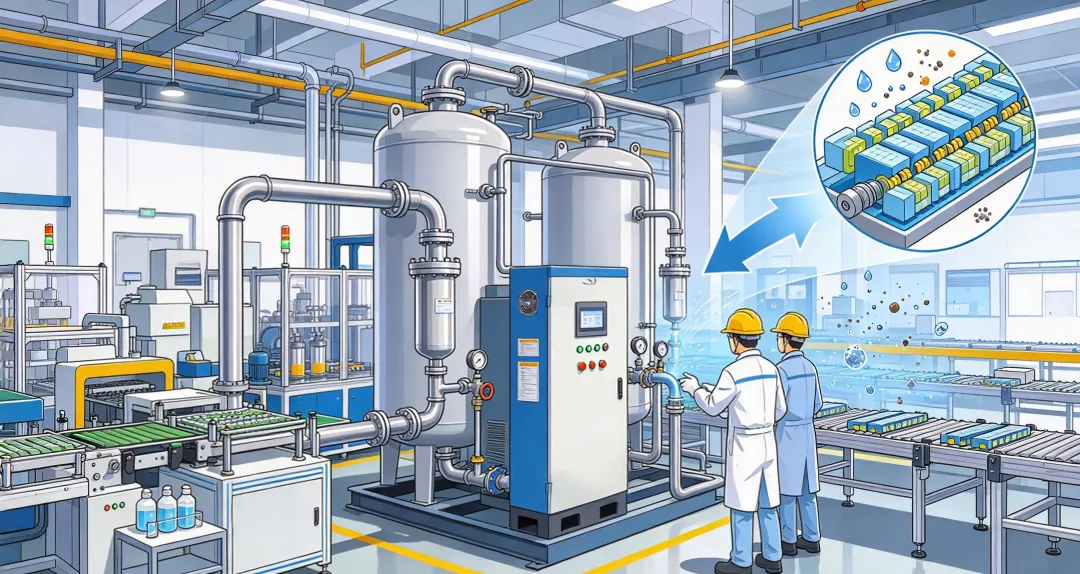
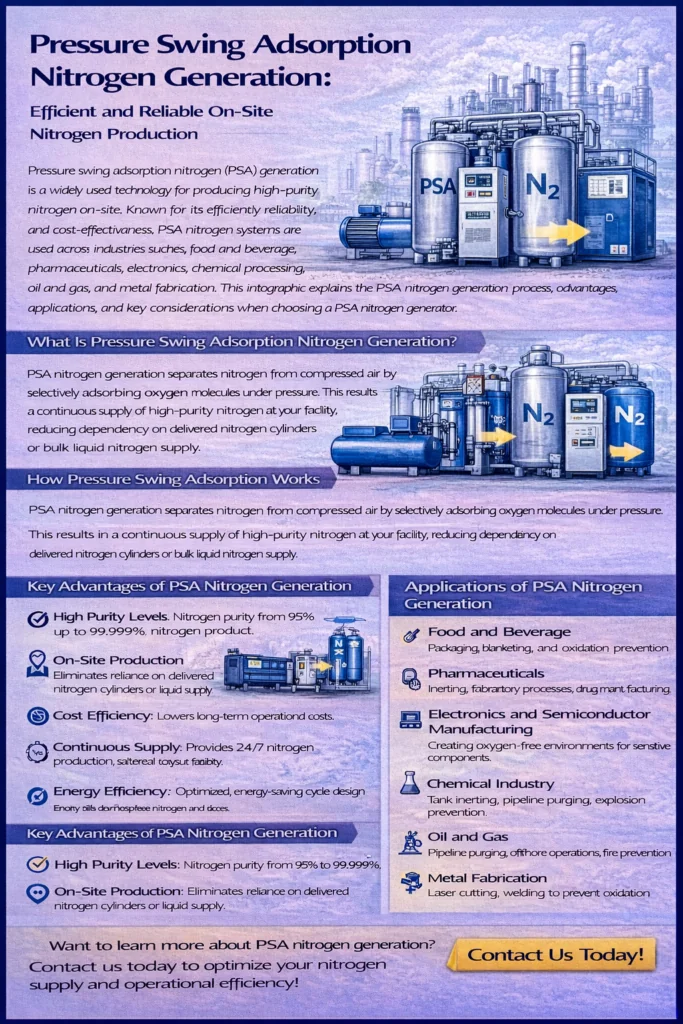
Pressure Swing Adsorption, or PSA, is a widely used method for producing nitrogen directly from compressed air.
For industrial facilities with regular nitrogen demand, pressure swing adsorption nitrogen generation provides an on-site alternative to depending entirely on compressed-gas cylinders or bulk liquid nitrogen deliveries. The technology can be configured around different requirements for nitrogen purity, flow rate, dew point, and operating conditions.
Lingyu’s PSA nitrogen generator range supports nitrogen purity from approximately 95% to 99.999% under the stated design conditions.
For available equipment configurations, see Lingyu’s nitrogen generator range.
What Is Pressure Swing Adsorption Nitrogen Generation?
Pressure Swing Adsorption nitrogen generation separates nitrogen from compressed air by using the different adsorption behavior of gas molecules under changing pressure conditions.
In Lingyu’s PSA system, each adsorption vessel is filled with Carbon Molecular Sieve, or CMS.
When compressed air enters the adsorption tower, oxygen molecules are preferentially adsorbed by the CMS, while nitrogen passes through the adsorption bed and is collected as product gas.
The process is called “pressure swing” adsorption because the adsorbent alternates between higher-pressure adsorption and lower-pressure regeneration.
This allows the CMS to be repeatedly used instead of being continuously replaced.
How a PSA Nitrogen Generator Works
A PSA nitrogen generator operates through a repeating adsorption and regeneration cycle.
1. Compressed-Air Preparation
Ambient air is first compressed and treated before entering the nitrogen generator.
A typical system can include an air compressor, air receiver, dryer, filtration stages, and buffer equipment.
Air quality matters because moisture, oil, and particles can affect the CMS, pneumatic valves, instrumentation, and long-term system performance.
Where appropriate, a precision compressed air filter can form part of the pretreatment system.
2. Oxygen Adsorption
The treated compressed air enters one adsorption tower.
Carbon Molecular Sieve preferentially adsorbs oxygen molecules while nitrogen passes through the bed and is collected as product gas.
3. Depressurization and Regeneration
While one tower is producing nitrogen, the second tower is depressurized.
The oxygen previously adsorbed by the CMS is released and discharged, allowing the adsorbent to regenerate for the next cycle.
4. Automatic Tower Switching
When the active tower reaches its predetermined adsorption condition, the system automatically changes operating roles.
The regenerated tower begins adsorption while the other tower enters regeneration.
Lingyu’s PSA system uses automatic PLC control to alternate the two towers continuously, maintaining nitrogen production at the specified purity.
For another detailed explanation of the adsorption mechanism, see how PSA nitrogen generation works and why it uses CMS.
What Equipment Is Included in a PSA Nitrogen System?
A complete PSA system involves more than the adsorption towers themselves.
Lingyu’s catalog system configuration shows equipment including:
- Air compressor
- Air receiver tank
- Refrigerated air dryer
- Buffer tank
- Nitrogen generator
- Nitrogen buffer tank
- Pressure-reducing equipment
- Nitrogen/oxygen analyzer
- Off-specification nitrogen outlet
- Final nitrogen supply control
This is important because nitrogen-system performance depends on the entire compressed-air and gas-treatment chain.
A properly sized generator connected to poorly treated compressed air may still experience reliability or gas-quality problems.
Nitrogen Purity: 95% to 99.999%
One of the main advantages of PSA technology is its ability to produce nitrogen at different purity levels.
Lingyu’s catalog specifies a PSA nitrogen purity range of approximately 95%–99.999%.
The product tables also include configurations for 99%, 99.5%, 99.9%, and 99.99% nitrogen.
However, higher purity should not automatically be treated as better.
The correct purity depends on the maximum acceptable oxygen concentration in the process.
For example, a blanketing application may have different requirements from a process involving electronics, pharmaceutical materials, or precision manufacturing.
Specifying unnecessarily high purity can influence nitrogen output, compressed-air requirements, and operating cost.
What If the Process Requires ≥99.999% Nitrogen?
Some applications require extremely low residual oxygen.
For these cases, Lingyu’s catalog includes a carbon-based deoxygenation purification system designed to further purify approximately 99.9% PSA nitrogen to ≥99.999%.
The catalog specifies residual oxygen reduction to very low ppm levels, followed by removal of CO₂ and moisture and precision filtration.
This type of downstream purification should be selected when the process genuinely requires it rather than added automatically to every PSA installation.
Readers focused specifically on very high gas quality can also see the high-purity nitrogen generator guide.
Flow Rate and Capacity
Nitrogen purity is only one part of PSA system selection.
The generator must also provide enough nitrogen to meet both average and peak process demand.
Capacity calculations should consider factors such as:
- Average nitrogen consumption
- Peak flow
- Number of simultaneous users
- Production shifts
- Batch demand
- Required reserve capacity
- Planned future expansion
The product data in Lingyu’s catalog show that nitrogen production capacity and effective compressed-air consumption vary by model and purity configuration. For example, the tables specify nitrogen production and air consumption together rather than treating generator size as an isolated number.
For this reason, two PSA generators should be compared at the same nitrogen purity and operating conditions.
Compressed-Air Consumption and Energy Efficiency
Compressed air is a major operating input for PSA nitrogen generation.
This means the total energy cost is influenced not only by the nitrogen generator itself but also by the compressor and air-treatment equipment.
Lingyu’s PSA design uses an optimized unequal-pressure equalization process. According to the catalog, this improves nitrogen recovery efficiency and indirectly reduces overall energy consumption by approximately 5%.
When evaluating efficiency, buyers should therefore compare:
- Nitrogen purity
- Nitrogen production rate
- Effective compressed-air consumption
- Compressor power
- Dryer and filtration losses
- Operating hours
A useful metric is not simply “generator power,” but the total energy required to produce the required volume of nitrogen at the specified purity.
Inlet Air, Dew Point, and Operating Conditions
Lingyu’s PSA catalog provides the following operating parameters:
- Inlet air temperature: ≤40°C
- Inlet air pressure: 0.5–0.8 MPa
- Nitrogen purity: 95%–99.999%
- Nitrogen dew point: ≤−40°C
- Ambient temperature: ≤40°C
- Switching cycle: 45–60 seconds
These values describe the manufacturer’s stated PSA operating conditions and should not be interpreted as universal specifications for every PSA generator on the market.
The nitrogen pressure required by downstream production equipment should also be distinguished from the generator’s compressed-air inlet pressure.
Automatic Control and Gas-Quality Monitoring
Modern PSA operation relies heavily on automatic sequencing.
Lingyu’s system provides automatic start/stop and operating-cycle switching, with pneumatic valves controlled by the PLC.
Nitrogen purity and flow are continuously monitored online.
The digital touchscreen displays key information including:
- Pressure
- Nitrogen purity
- Flow rate
- System operating status
If nitrogen purity falls below the specified value, the system activates an alarm. If the off-specification condition continues for the preset period, the system can automatically shut down for protection.
These features are important where downstream production depends on stable gas quality.
CMS Compaction and Long-Term Reliability
Carbon Molecular Sieve is a critical component in PSA nitrogen generation.
Movement of the adsorption bed over repeated cycles can affect packing density over time.
Lingyu’s PSA design therefore includes an automatic CMS compaction device intended to maintain proper packing density and help reduce CMS pulverization caused by bed movement.
Long-term reliability also depends on maintaining the rest of the system, including filters, drains, dryers, pneumatic valves, analyzers, and control components.
Where PSA Nitrogen Generation Is Used
PSA nitrogen technology can be configured for a broad range of industrial processes.
In the food and beverage industry, nitrogen can support packaging, flushing, and blanketing where oxygen control is important. Lingyu has dedicated food and beverage applications.
In chemical and petrochemical processing, nitrogen may be used for tank blanketing, purging, inerting, and selected transfer operations. More information is available through petrochemical and chemical processing applications.
In electronics and precision manufacturing, nitrogen can help create controlled low-oxygen process conditions. Readers in this sector can refer to electronics and precision manufacturing solutions.
PSA systems can also serve pharmaceutical, oil and gas, semiconductor, metal-fabrication, and other industrial processes where nitrogen quality and availability need to be controlled.
PSA Compared With Other Nitrogen Supply Methods
Different nitrogen supply methods have different investment, operating, storage, and logistics characteristics.
For industrial facilities considering PSA, a useful comparison is on-site generation versus externally delivered nitrogen.
On-site PSA can reduce dependence on cylinder or bulk-gas delivery schedules and provide direct control over production.
However, the total economics depend on:
- Nitrogen demand
- Required purity
- Electricity price
- Compressor efficiency
- Annual operating hours
- Pretreatment requirements
- Maintenance
- Local delivered-gas costs
For a detailed financial framework, see the nitrogen generator cost and ROI guide.
How to Select a PSA Nitrogen Generator
Before selecting a system, the buyer should define the process requirement first.
The most important parameters are nitrogen purity or allowable oxygen content, average and peak flow, required point-of-use pressure, dew point, compressed-air capacity, air quality, production schedule, installation conditions, and future expansion.
These parameters should then be used to size the air compressor, pretreatment equipment, PSA generator, nitrogen buffer storage, controls, and downstream distribution system together.
For a more detailed selection process, refer to the PSA nitrogen generator selection guide.
Conclusion
Pressure swing adsorption nitrogen generation provides a practical way to produce nitrogen directly from compressed air for industrial use.
Its effectiveness comes from the repeated adsorption and regeneration of Carbon Molecular Sieve in two alternating towers, combined with automatic control, compressed-air treatment, gas-quality monitoring, and correctly sized storage and distribution.
The right PSA system should not be selected by purity alone.
Nitrogen purity, flow rate, compressed-air consumption, pressure, dew point, pretreatment, monitoring, and operating cost all need to be considered together.
When these parameters are correctly matched to the process, PSA can provide a stable and controllable on-site nitrogen supply for a wide range of industrial applications.