Compressed air is widely used in manufacturing, automation, electronics, pharmaceuticals, and other industrial processes. However, residual moisture can cause corrosion, equipment problems, and product-quality issues.
A regenerative desiccant compressed air dryer provides a solution when significantly lower pressure dew points are required than refrigerated drying can normally provide. By combining adsorption with desiccant regeneration, these dryers can continuously supply very dry compressed air for moisture-sensitive applications.
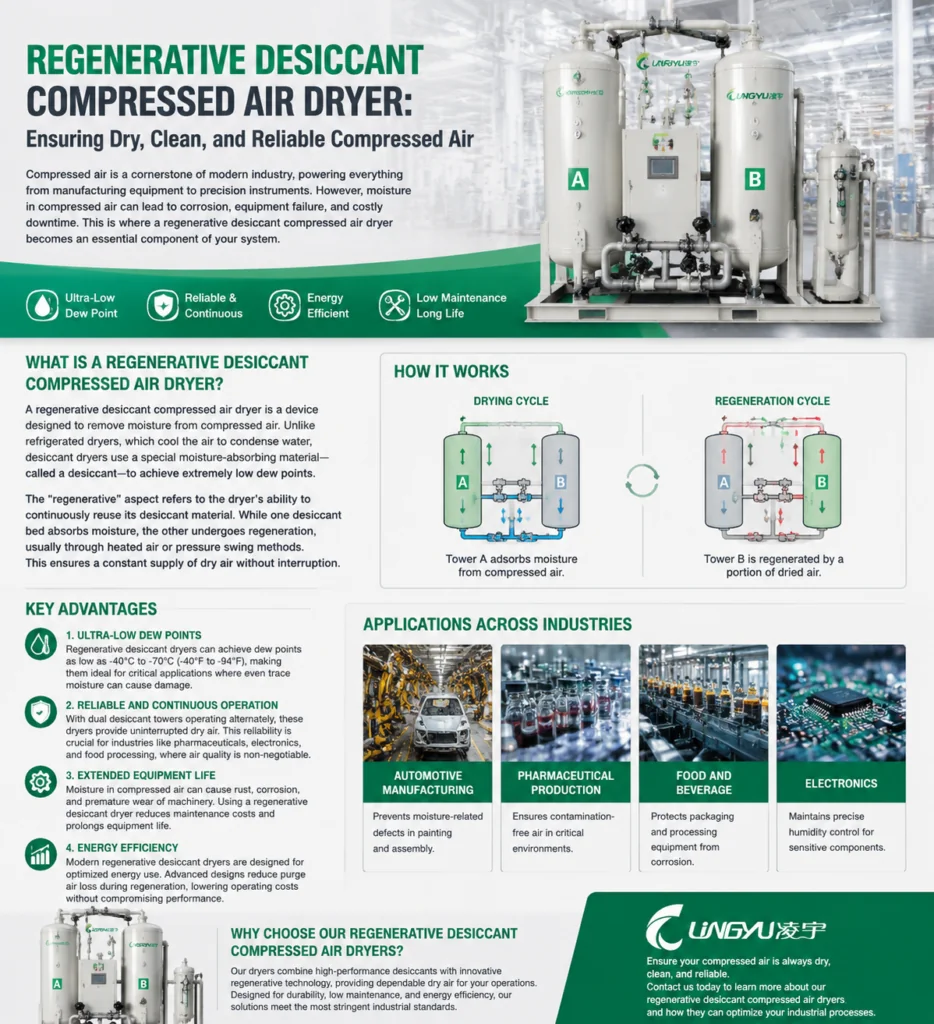
What Is a Regenerative Desiccant Compressed Air Dryer?
A regenerative desiccant compressed air dryer removes water vapor from compressed air by passing it through a bed of moisture-adsorbing desiccant.
Unlike refrigerated dryers, which cool compressed air so that moisture condenses, regenerative dryers adsorb residual water vapor directly from the compressed-air stream.
Most regenerative systems use two adsorption towers. While one tower dries the compressed air, the other regenerates its desiccant. The towers then switch roles, allowing continuous dry-air production.
For a closer look at this operating sequence, see how twin-tower adsorption drying maintains continuous operation.
How Does a Regenerative Desiccant Dryer Work?
The operating cycle can be divided into adsorption, regeneration, pressure equalization or repressurization as required by the dryer design, and tower switching.
1. Adsorption
Wet compressed air enters the active adsorption tower and passes through the desiccant bed.
Water vapor is adsorbed onto the desiccant surface while the dried compressed air continues downstream.
2. Regeneration
At the same time, the second tower is offline for regeneration.
The moisture accumulated during the previous adsorption cycle is removed from the desiccant. The regeneration method depends on the dryer design and can use dry purge air, heated purge air, blower air, or compression heat.
3. Tower Switching
After regeneration is completed and the required operating conditions are restored, the towers switch functions.
The regenerated tower begins adsorption while the previously active tower enters regeneration.
By repeating this sequence, the dryer can provide a continuous supply of dry compressed air while reusing the desiccant over many operating cycles.
Common Regeneration Methods
Different regenerative dryers restore the desiccant in different ways. The regeneration method has a major influence on purge-air consumption, system complexity, energy use, and operating cost.
Heatless Regeneration
Heatless regenerative dryers use a portion of the dry product air to purge moisture from the offline adsorption tower.
Lingyu heatless configurations use approximately 8–14% purge air, depending on the series and operating conditions.
Heatless dryers offer a relatively simple regeneration arrangement because they do not require an external heater or blower for desiccant regeneration.
However, the use of dry compressed air for regeneration should be included when calculating total compressor capacity and operating cost.
Heated Purge Regeneration
Heated purge regeneration adds heat to improve moisture desorption from the desiccant.
Because heating improves regeneration efficiency, less dry compressed air is required than with a conventional heatless system.
Lingyu heated configurations use approximately 4–8% purge air.
This approach can provide a useful balance between equipment complexity and compressed-air savings where continuous operation and lower purge demand are priorities.
Blower-Heated Regeneration
Blower-heated dryers use externally supplied air and heat for desiccant regeneration, reducing dependence on dry product compressed air.
Lingyu’s low-purge blower-heated configuration uses approximately 2% of system airflow for cooling purge.
Because compressed air is an energy-intensive utility, reducing the amount consumed during regeneration can be particularly valuable in continuously operating systems or larger installations.
For a more detailed explanation, see blower-heated adsorption dryer technology.
Zero-Purge Blower Regeneration
Zero-purge blower configurations are designed to avoid consuming dry product compressed air during regeneration.
This can reduce compressed-air losses compared with conventional heatless or heated-purge arrangements.
The overall energy balance should still consider blower power, heater demand, cooling strategy, operating cycle, and actual load conditions rather than evaluating regeneration efficiency from purge-air consumption alone.
Heat-of-Compression Regeneration
Heat-of-compression dryers recover thermal energy available in high-temperature compressor discharge air and use it for desiccant regeneration.
This approach can substantially reduce or eliminate the need to consume dry product air for regeneration, depending on the dryer configuration.
Its suitability depends on factors such as compressor type, discharge-air temperature, operating pattern, available heat, required pressure dew point, and system configuration.
Key Advantages of Regenerative Desiccant Dryers
1. Low Pressure Dew Point
Regenerative desiccant dryers are suitable for applications requiring significantly drier compressed air than conventional refrigerated drying normally provides.
Lingyu regenerative dryer configurations commonly provide a pressure dew point of ≤−40°C, while some series are specified within a −50°C to −20°C range.
The appropriate pressure dew point should be selected according to the actual process requirement rather than automatically specifying the lowest available value.
2. Continuous Operation
Twin adsorption towers alternate between drying and regeneration, allowing the system to maintain a continuous supply of dry compressed air.
This arrangement is useful in processes where moisture control must remain stable during continuous production.
3. Protection of Downstream Equipment
Lower moisture levels can help reduce problems associated with water in compressed-air systems, including:
- Internal pipe corrosion
- Water-related pneumatic equipment failures
- Moisture contamination
- Condensation in low-temperature environments
The actual air-quality requirement should still be determined by the downstream process and equipment.
4. Multiple Energy and Purge-Air Options
Energy performance depends strongly on the regeneration method.
Heatless dryers offer relatively simple operation but consume more dry compressed air for regeneration. Heated systems reduce purge demand, while blower-heated and zero-purge technologies can further reduce compressed-air losses.
Heat-of-compression systems provide another approach by recovering compressor discharge heat for regeneration.
This range of technologies allows dryer selection to balance capital cost, purge-air consumption, electrical energy, operating hours, and required pressure dew point.
Applications Across Industries
Regenerative desiccant dryers are commonly considered where processes require very dry compressed air.
Automotive Manufacturing
Dry compressed air can support painting, pneumatic controls, production equipment, and other moisture-sensitive manufacturing operations.
The required pressure dew point depends on the specific process and environmental conditions.
Pharmaceutical Production
Pharmaceutical processes can require tighter moisture control where compressed air affects sensitive production equipment or controlled processes.
Drying requirements should be determined according to the specific air-quality requirements of the application.
Electronics and Semiconductor Manufacturing
Electronics and semiconductor production often places greater emphasis on contamination and humidity control.
A low pressure dew point can help reduce the risk of moisture affecting sensitive pneumatic and manufacturing processes.
Food and Beverage Processing
Food and beverage facilities may also require controlled compressed-air quality depending on how the air interacts with equipment, packaging, processes, or products.
Dryer selection should therefore consider both the required moisture level and the complete air-treatment system.
How to Choose the Right Regenerative Dryer
The appropriate dryer depends on more than the target pressure dew point.
Required Pressure Dew Point
Start by determining how dry the compressed air actually needs to be.
Selecting a substantially lower pressure dew point than the process requires can increase equipment and operating costs without providing a practical benefit.
Airflow
The dryer must be sized for the actual compressed-air demand, including realistic peak operating conditions.
Sizing should also account for regeneration consumption where the dryer uses compressed air for purge or cooling.
Inlet Pressure
Dryer capacity and regeneration performance depend on operating pressure.
The equipment should therefore be selected according to actual inlet conditions rather than compressor nameplate information alone.
Inlet Temperature
Higher inlet temperatures increase the moisture load entering the dryer.
Actual inlet-air temperature should be considered during sizing, especially where the dryer operates downstream of high-temperature compressor systems.
Regeneration-Air Consumption
Purge-air requirements can differ substantially among regeneration technologies.
Lingyu configurations include approximately:
- 8–14% for heatless regeneration
- 4–8% for heated purge regeneration
- 2% of system airflow for cooling purge in the low-purge blower-heated configuration
- No dry product air during regeneration for the zero-purge blower configuration
These differences should be considered together with electrical energy use, heater requirements, blower operation, and total system cost.
Operating Hours and Energy Cost
A simple heatless dryer can be appropriate for some operating profiles, while the value of lower-purge or heat-recovery technology can become more significant in systems operating continuously or at larger airflow capacities.
The correct comparison should therefore consider annual operating conditions rather than equipment purchase price alone.
For more detailed sizing guidance, see the adsorption dryer sizing guide.
Which Regeneration Method Should You Choose?
Different regeneration methods are suited to different operating priorities.
Heatless regeneration can be appropriate where simple equipment configuration is a priority and purge-air consumption is acceptable.
Heated purge regeneration reduces purge-air demand by using heat to improve desorption.
Blower-heated regeneration further reduces reliance on dry compressed air by using externally supplied regeneration air.
Zero-purge blower regeneration is designed to avoid consuming dry product air during regeneration.
Heat-of-compression regeneration uses available compressor discharge heat and can be particularly attractive where operating conditions provide a suitable and consistent heat source.
The correct choice depends on required pressure dew point, airflow, compressor configuration, operating hours, purge-air cost, electrical energy cost, and site conditions.
Lingyu Regenerative Desiccant Dryer Options
Lingyu’s adsorption dryer range includes:
- Heatless regeneration dryers
- Heated regeneration dryers
- Modular adsorption dryers
- Blower-heated dryers
- Heat-of-compression dryers
Depending on the model, available functions include programmable controls, pneumatic valve systems, dew-point monitoring, RS-485 communication, and energy-saving regeneration strategies.
Users comparing these technologies can review the Lingyu adsorption dryer range.
Conclusion
A regenerative desiccant compressed air dryer is designed for applications that require consistently low moisture levels and continuous dry-air supply.
By alternating between adsorption and regeneration, twin-tower systems can maintain continuous operation while allowing the desiccant to be reused repeatedly.
Lingyu regenerative dryer configurations commonly provide a pressure dew point of ≤−40°C, while some series operate within a −50°C to −20°C range. Depending on regeneration technology, purge-air requirements can range from approximately 8–14% for heatless systems and 4–8% for heated systems to approximately 2% cooling purge for low-purge blower-heated configurations, while zero-purge blower designs avoid dry product air during regeneration.
The best regeneration method depends on required pressure dew point, airflow, purge-air consumption, compressor configuration, energy cost, operating hours, and actual operating conditions.
For project-specific selection, contact Lingyu for technical support.