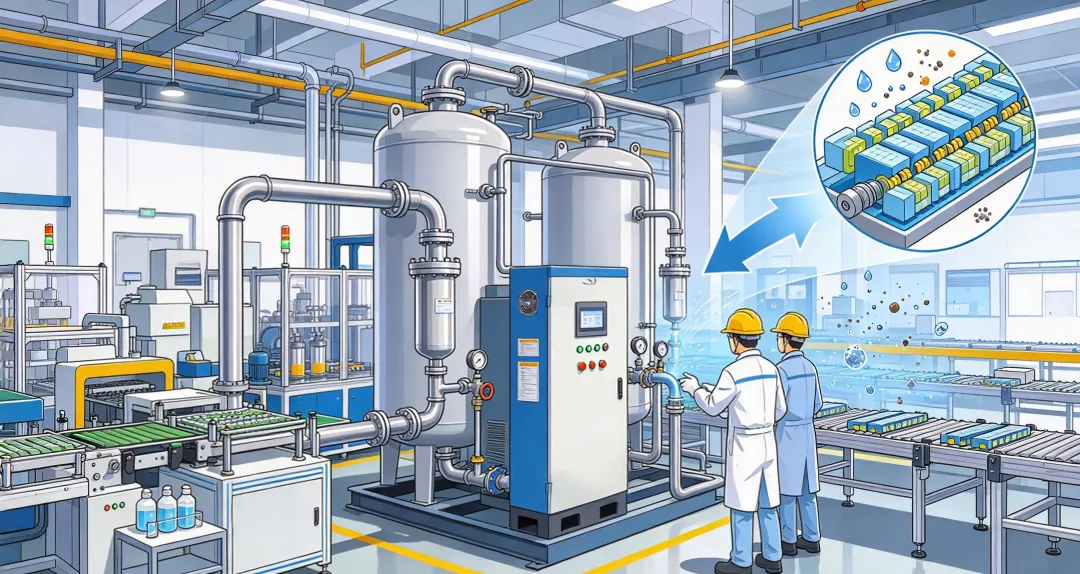
Compressed air is a critical utility in manufacturing, automotive production, electronics, food processing, pharmaceuticals, and many other industrial operations.
However, atmospheric air naturally contains water vapor. After compression and cooling, this moisture can condense inside receivers, pipelines, valves, pneumatic tools, and production equipment.
Choosing the best air dryer for compressor systems therefore means more than selecting the dryer with the lowest advertised dew point. The correct dryer should match the required air quality, airflow, pressure, inlet temperature, operating environment, energy target, and maintenance strategy of the complete compressed-air system.
For users comparing the main technologies, Lingyu provides both refrigerated air dryers and desiccant air dryers for different moisture-control requirements.
Why Does a Compressor Need an Air Dryer?
When air is compressed, the concentration of water vapor per unit volume increases.
As the compressed air travels through the system and cools, some of this vapor can condense into liquid water.
Without appropriate drying, moisture can contribute to corrosion, freezing, unstable pneumatic operation, product-quality problems, and higher maintenance requirements.
An air dryer reduces the moisture content of compressed air so that the system can maintain a pressure dew point appropriate for downstream equipment and production processes.
However, the dryer is only one part of compressed-air treatment. Oil aerosols and solid particles may also require appropriate filtration or separation.
For a broader system-level explanation, see the air compressor filters and dryers guide.
There Is No Single “Best” Air Dryer
The best dryer is the one that meets the required pressure dew point and air quality without creating unnecessary energy consumption, pressure loss, maintenance, or capital cost.
A general manufacturing plant may perform well with a refrigerated dryer.
A production process requiring a substantially lower pressure dew point may need a regenerative desiccant dryer.
A large continuously operating plant may justify a low-purge, zero-purge, or heat-of-compression adsorption system because regeneration-air consumption can become an important lifecycle-cost factor.
Some applications may benefit from a combined refrigerated and adsorption dryer.
The correct decision therefore starts with the process requirement—not the dryer model.
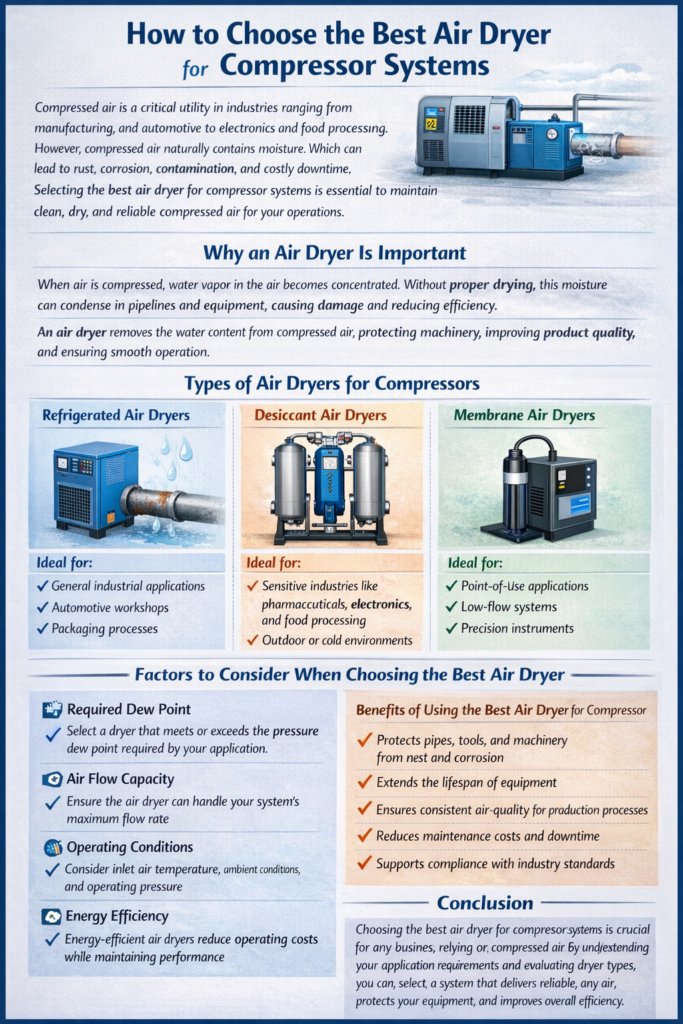
1. Refrigerated Air Dryers
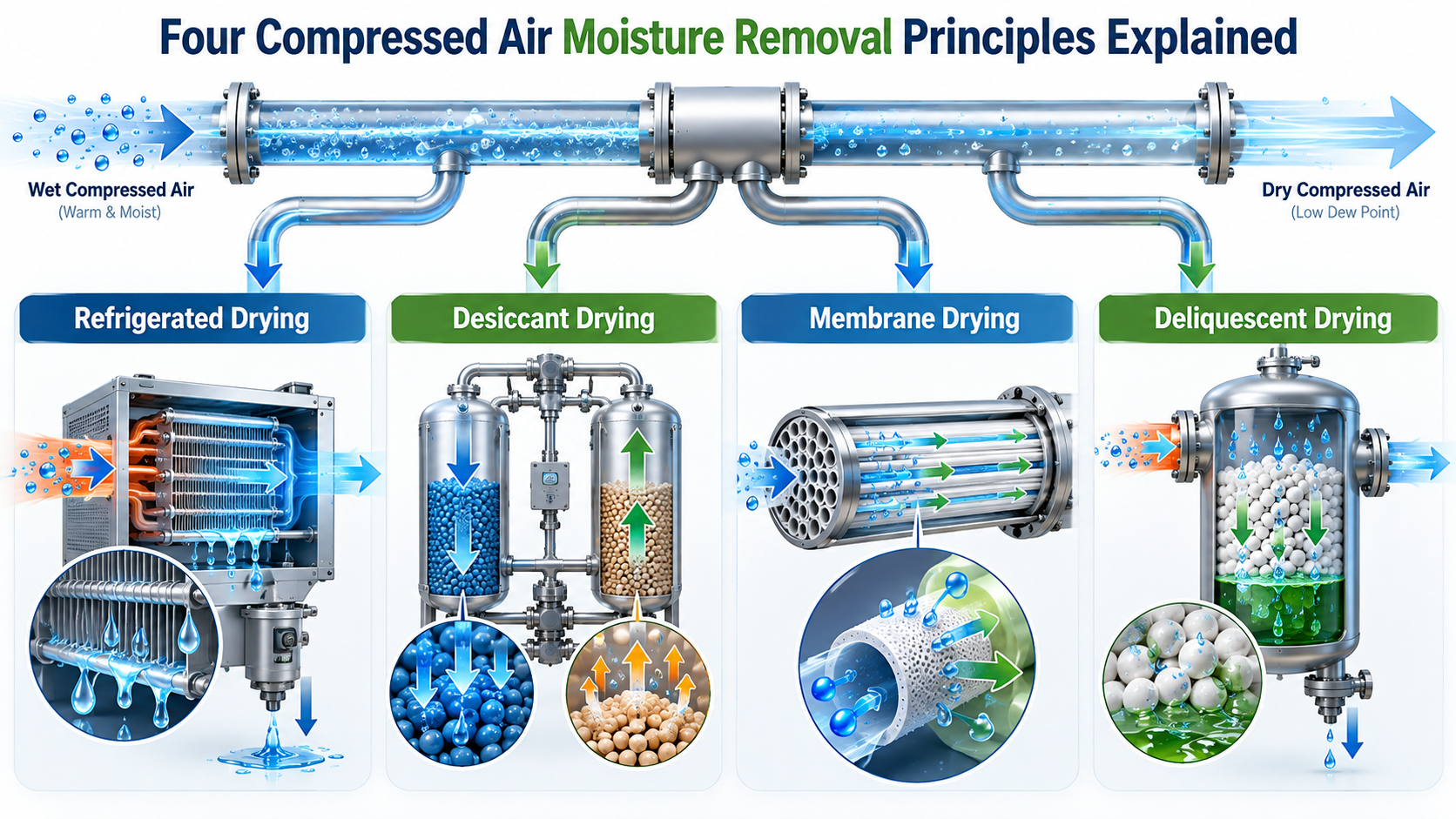
A refrigerated air dryer cools compressed air so that water vapor condenses into liquid water.
The condensate is separated and discharged, and the treated compressed air is then reheated toward ambient temperature before entering the downstream system.
Refrigerated drying is often the most practical choice when the application does not require an extremely low pressure dew point.
Lingyu’s refrigerated dryer portfolio includes air-cooled, water-cooled, plate heat exchanger, low-pressure-drop, and variable-frequency configurations.
Depending on the series and specified operating conditions, Lingyu refrigerated dryers generally provide an outlet pressure dew point of 2–10°C.
When Is a Refrigerated Dryer the Best Choice?
A refrigerated dryer is generally worth considering when:
- The application requires general plant-quality dry compressed air.
- Compressed-air piping will not routinely operate below freezing.
- An ultra-low pressure dew point is unnecessary.
- Straightforward operation is a priority.
- Energy efficiency and pressure-drop performance are important.
Typical applications include general manufacturing, automotive production, packaging, machinery, and many plant pneumatic systems.
For additional technical information, see how a refrigerated air dryer works.
2. Desiccant Air Dryers
A desiccant or adsorption dryer is designed for applications requiring substantially lower pressure dew points.
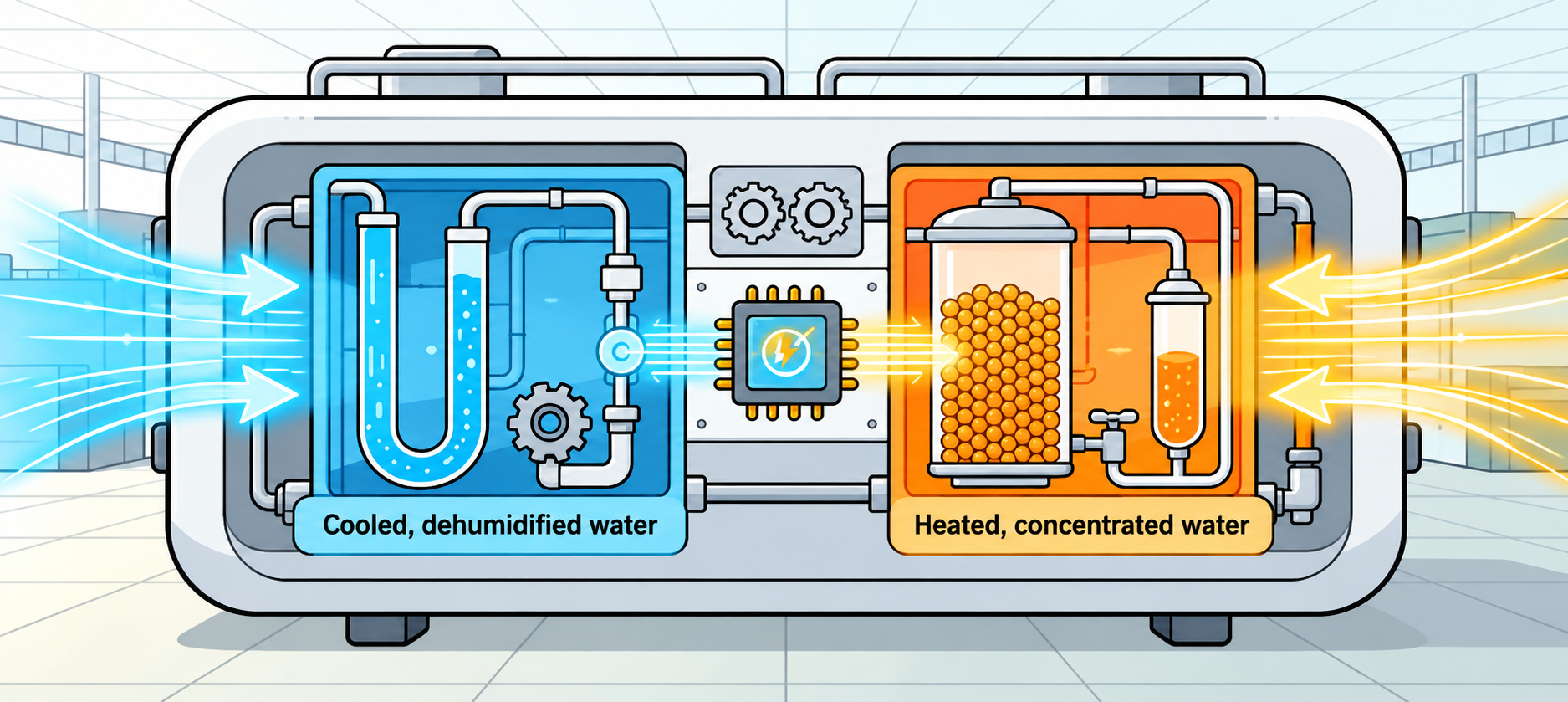
Instead of relying mainly on refrigeration and condensation, the dryer passes compressed air through an adsorption bed that captures residual water vapor.
Regenerative designs typically use two towers. One tower dries the compressed air while the other regenerates, allowing continuous operation.
Lingyu provides heatless, heated-purge, modular, blower-heated, zero-purge blower-heated, and heat-of-compression regenerative adsorption dryer configurations.
For the main regenerative dryer families, −40°C is a common pressure dew point target, while certain configurations provide −20°C / −40°C options.
The appropriate pressure dew point should be selected according to the actual downstream requirement rather than automatically specifying an unnecessarily low value.
For more detail on adsorption drying, see the desiccant air dryer working principle.
3. Combined Refrigerated and Desiccant Dryers
In some applications, combining both technologies can provide a better balance between moisture removal and adsorption-stage operating requirements.
The refrigerated stage first removes a substantial portion of the moisture load. The partially dried compressed air then passes to the adsorption stage for deeper drying.
This arrangement reduces the moisture load entering the adsorption stage and can reduce its regeneration burden while maintaining low-dew-point compressed air.
Lingyu’s DH Series combined dryer provides an outlet pressure dew point of ≤−40°C under its specified operating conditions.
Users considering an integrated system can review Lingyu’s DH Series combined compressed air dryer.
What About Membrane Air Dryers?
Membrane drying is an established technology in the wider compressed-air market.
Lingyu’s current dryer range, however, centers on refrigerated, regenerative adsorption, and combined drying technologies.
For a Lingyu-based equipment evaluation, these are therefore the primary dryer technologies to compare.
Factor 1: Required Pressure Dew Point
Pressure dew point should be one of the first technical requirements you define.
Do not automatically choose the lowest possible dew point.
If a 2–10°C pressure dew point satisfies the downstream process, a refrigerated dryer may be sufficient.
If the air lines may experience low temperatures or the production process requires substantially drier air, an adsorption dryer providing approximately −20°C or −40°C may be more appropriate.
The goal is to meet the actual process requirement with an appropriate engineering margin rather than unnecessarily over-drying the air.
Over-specifying pressure dew point can increase energy consumption, capital cost, and maintenance requirements without necessarily improving the process.
Factor 2: Actual and Peak Airflow
The dryer must be sized for the compressed-air flow it will actually experience.
Average consumption alone may not be enough.
If production creates short periods of high compressed-air demand, the dryer should still maintain the required pressure dew point during those peak periods.
Sizing should therefore be based on actual plant demand and operating conditions rather than simply compressor motor power or nameplate capacity.
Important values to determine include:
- Normal airflow
- Peak airflow
- Duration of peak demand
- Expected future demand
- Actual inlet pressure
- Actual inlet temperature
Factor 3: Inlet Pressure
Pressure affects dryer capacity, airflow velocity, regeneration behavior, and overall system performance.
Many Lingyu adsorption dryer configurations use:
Rated inlet pressure: 0.7 MPa
Operating pressure range: 0.6–1.0 MPa
Other pressure ratings may be available depending on the specific configuration.
The selected dryer should therefore be checked against the actual pressure at the dryer inlet, not only the compressor’s nominal discharge pressure.
Pressure losses through piping, filters, receivers, and other treatment equipment also need to be considered.
Factor 4: Inlet Air Temperature
High inlet temperature can increase the moisture load entering the dryer and affect drying performance.
Adsorption systems generally have defined inlet-temperature requirements.
For example, Lingyu’s HRB-E low-purge blower-heated regenerative desiccant dryer has:
Rated inlet temperature: 10–30°C
Maximum inlet temperature: ≤40°C
Other technologies are designed around very different inlet conditions.
Lingyu’s HOC-E and HOC-Z heat-of-compression configurations, for example, use:
Rated inlet temperature: 120°C
Allowable inlet temperature range: 110–180°C
This illustrates why dryer technology must be matched to the compressor configuration and treatment sequence.
Factor 5: Ambient Conditions
Ambient temperature and humidity matter, particularly for air-cooled equipment and installations in hot production environments.
Outdoor or low-temperature installations also require special attention because downstream compressed-air piping may reach temperatures low enough to create condensation or freezing if the selected pressure dew point is too high.
The same dryer should not automatically be expected to deliver identical effective performance under every environmental condition.
Factor 6: Energy Consumption
The purchase price is only one part of dryer cost.
For refrigerated dryers, energy consumption can be influenced by refrigeration compressor control, load variation, heat-exchanger performance, cooling conditions, and system pressure drop.
For adsorption dryers, regeneration method becomes particularly important.
For example:
| Regeneration Technology | Regeneration Air Consumption |
|---|---|
| HH Series heatless | 8–14% average |
| Heated-purge configuration | 4–8% |
| HRB-E low-purge blower-heated | 2–3% |
| HOC-E heat-of-compression | ≤3% |
| HOC-Z zero-purge heat-of-compression | 0% |
For high-flow plants operating continuously, these differences can materially affect lifecycle energy cost.
Factor 7: Pressure Drop
A dryer can consume energy indirectly even if its own electrical demand is relatively low.
Every unnecessary pressure drop requires the compressor system to maintain sufficient upstream pressure to achieve the required pressure at the point of use.
Dryer selection should therefore include full-load differential pressure rather than focusing only on pressure dew point and airflow.
For example, Lingyu’s DD Series low-pressure-drop refrigerated air dryer is specified at a full-load pressure drop of <0.01 MPa.
For a broader explanation, see the guide to compressed air pressure drop and system efficiency.
Factor 8: Filtration and Contamination Control
Dry air is not automatically clean air.
A dryer primarily addresses moisture.
Depending on the compressor and production process, the system may also need to control:
- Oil aerosols
- Oil vapor
- Dust
- Corrosion particles
- Desiccant particles
A complete compressed-air treatment train can therefore include appropriate upstream and downstream filters.
Lingyu’s precision compressed air filter can form part of this broader purification system.
This distinction is particularly important in food, pharmaceutical, electronics, and precision-manufacturing applications.
Factor 9: Regeneration Method
If you select a desiccant dryer, the next question is how the desiccant should be regenerated.
Heatless dryers use part of the dry compressed air for regeneration.
Heated-purge dryers add thermal energy and reduce purge-air demand.
Low-purge blower-heated dryers use ambient air for most of the regeneration process and require only a relatively small amount of dry product air.
Zero-purge systems are designed to avoid dry product-air consumption during regeneration.
Heat-of-compression dryers recover thermal energy from high-temperature compressor discharge air where suitable operating conditions are available.
Therefore, “desiccant dryer” does not represent one single energy-consumption profile.
The best regeneration strategy depends heavily on airflow, annual operating hours, compressor type, energy cost, operating conditions, and lifecycle economics.
Factor 10: Controls and Variable Demand
Industrial plants rarely operate at exactly the same compressed-air demand throughout the day.
Advanced controls can therefore be useful where load varies substantially.
Lingyu blower-heated dryer systems offer optional dew-point-based control.
Where this control is applied, the adsorption cycle can respond more closely to actual operating demand instead of relying only on a fixed timing sequence, helping reduce unnecessary regeneration under fluctuating-load conditions.
Which Dryer Is Best for Different Applications?
General Manufacturing and Automotive Production
A refrigerated dryer is often an appropriate starting point when a moderate pressure dew point is sufficient.
Lingyu’s automotive and general manufacturing solutions provide additional application context.
Electronics and Semiconductor Manufacturing
Lower-dew-point adsorption drying may be required where process moisture requirements are more demanding than general plant air.
For these applications, see Lingyu’s semiconductor and PCB manufacturing solutions.
Food and Beverage
Dryer selection should depend on where and how compressed air interacts with the production process.
Lingyu provides dedicated food and beverage compressed-air solutions.
Pharmaceutical Production
Moisture, oil, particles, filtration, process contact, and other air-quality requirements should be considered as a complete specification rather than selecting a dryer solely by industry name.
Lingyu’s pharmaceutical and biopharmaceutical solutions provide industry-specific context.
Refrigerated or Desiccant: A Simple Decision Rule
A useful starting point is:
If the required pressure dew point is within the range provided by refrigerated drying, do not automatically move to adsorption technology.
If the process requires a substantially lower pressure dew point, or downstream temperature conditions make condensation or freezing unacceptable, evaluate a desiccant dryer.
If you need a low pressure dew point at substantial airflow and high annual operating hours, compare regeneration technologies rather than choosing the simplest desiccant design by default.
For a direct technical comparison, see refrigerated air dryer vs. desiccant air dryer.
Do Not Choose an Air Dryer Only by Price
A lower purchase price does not necessarily produce the lowest total cost.
Lifecycle cost can include:
Electrical consumption + regeneration-air losses + compressor energy associated with pressure drop + maintenance + replacement desiccant + filters + spare parts + downtime
For a continuously operating plant, energy and pressure losses accumulated over several years can become more important than the original purchase-price difference.
The best air dryer should therefore be evaluated according to total system performance and lifecycle economics rather than equipment price alone.
A Practical Air Dryer Selection Checklist
Before requesting a quotation, define:
- Required pressure dew point
- Normal compressed-air flow
- Peak compressed-air flow
- Dryer inlet pressure
- Inlet temperature
- Ambient temperature
- Compressor type
- Cooling-water availability where relevant
- Annual operating hours
- Required filtration and contamination limits
- Acceptable regeneration-air consumption
- Acceptable pressure drop
- Electrical supply and control requirements
- Maintenance access
- Redundancy requirements
- Expected future capacity expansion
Providing these operating conditions makes equipment selection substantially more reliable than simply requesting a dryer based on compressor horsepower.
For a more detailed selection process, see Lingyu’s compressed air dryer buyer’s guide.
Conclusion
Choosing the best air dryer for compressor systems starts with understanding the actual compressed-air requirement.
For general industrial applications, a refrigerated dryer providing approximately 2–10°C pressure dew point may be sufficient.
Where the process requires substantially drier compressed air, regenerative desiccant dryers can provide lower pressure dew points, with −40°C being a common target and certain configurations offering −20°C / −40°C options.
For higher-flow or continuously operating installations, regeneration method becomes particularly important. Low-purge, zero-purge, and heat-of-compression technologies can reduce compressed-air regeneration losses when the operating conditions and lifecycle economics justify them.
The right choice should balance pressure dew point, airflow, pressure, inlet temperature, ambient conditions, filtration, pressure drop, regeneration air, electrical consumption, maintenance, and lifecycle cost.
There is no universally “best” air dryer. The best dryer is the one correctly engineered for the compressor system and downstream process.