An industrial air dryer dehumidifier is used to remove moisture from compressed air before the air reaches production equipment, pneumatic tools, instruments, or sensitive manufacturing processes.
In industrial compressed-air systems, moisture is unavoidable. Ambient air naturally contains water vapor, and when that air is compressed and later cooled, part of the moisture can condense into liquid water. If it is not properly removed, this moisture may contribute to pipeline corrosion, equipment problems, process instability, and reduced product quality.
For this reason, industrial drying equipment is an important part of modern compressed-air treatment.
What Is an Industrial Air Dryer Dehumidifier?
In compressed-air applications, the term industrial air dryer dehumidifier generally refers to equipment that reduces the moisture content of compressed air.
Rather than controlling the relative humidity of an entire building, these dryers treat a pressurized airflow produced by an air compressor.
Depending on the required pressure dew point and operating conditions, industrial compressed-air systems may use refrigeration, adsorption, or a combination of both technologies.
The two most common categories are refrigerated air dryers and desiccant air dryers.
Refrigerated dryers are commonly used for general industrial compressed-air treatment, while adsorption dryers are typically selected when significantly lower pressure dew points are required.
How an Industrial Air Dryer Dehumidifier Works
The working principle depends on the drying technology.
Refrigerated Air Drying
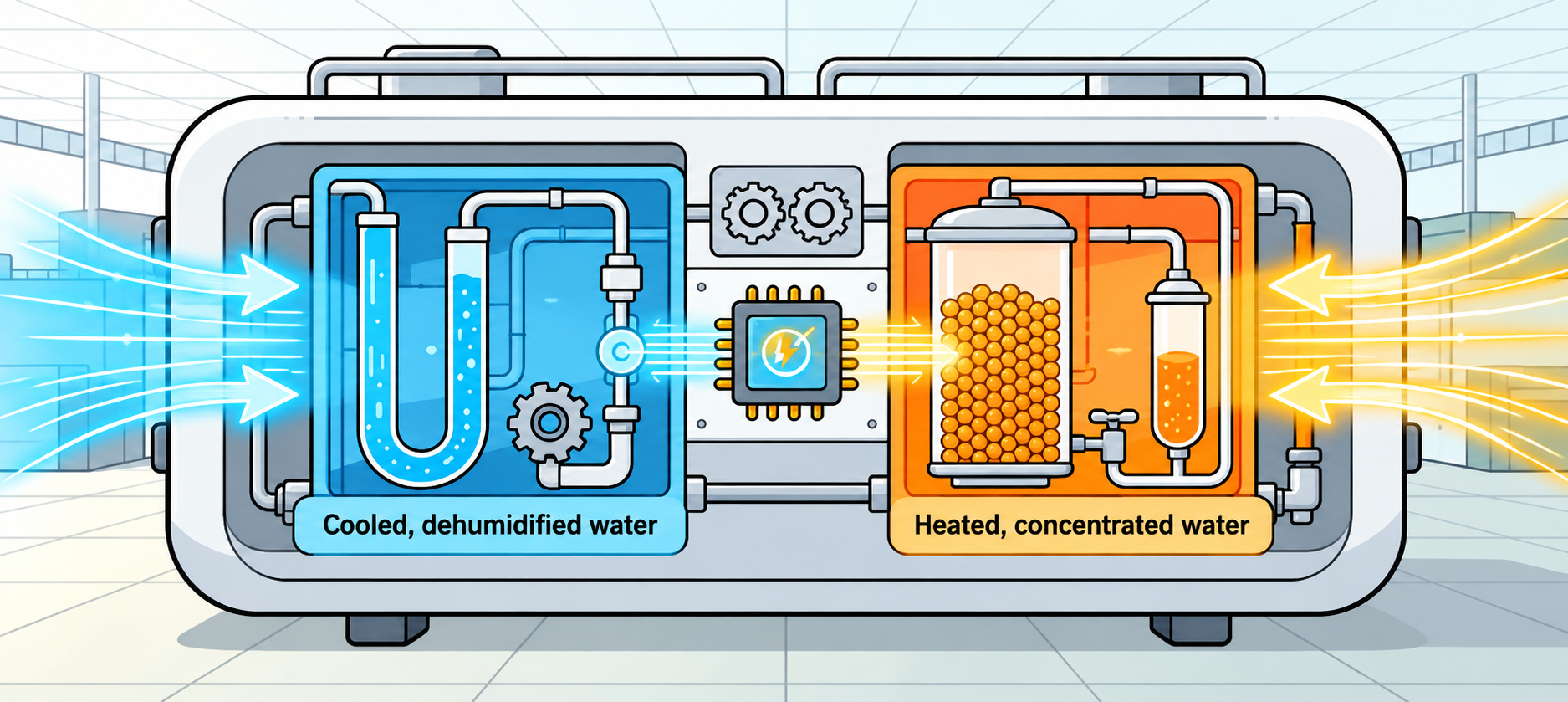
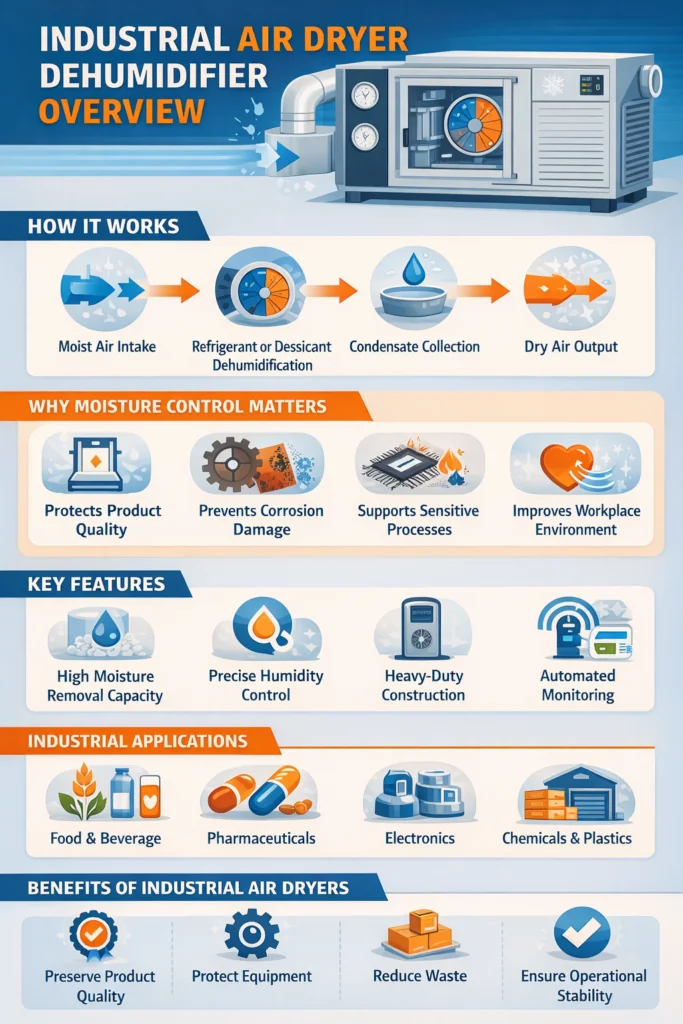
A refrigerated air dryer lowers the temperature of compressed air so that water vapor condenses into liquid water.
The condensate is then separated and discharged before the compressed air continues to downstream equipment.
In Lingyu’s AH Series, high-temperature compressed air first passes through an air-cooled pre-cooler and air-to-air heat exchanger. It then enters the refrigerant evaporator, where the compressed air is cooled to a 2–10°C pressure dew point.
During cooling, moisture, oil, and some impurities condense and are separated from the compressed air by the gas-liquid separator. The condensate is discharged through an automatic drain valve.
The dry compressed air then passes through the air-to-air heat exchanger and is reheated toward ambient temperature before leaving the dryer.
This technology is well suited to many manufacturing applications where extremely low pressure dew points are not necessary.
Desiccant or Adsorption Air Drying
Adsorption dryers use desiccant materials to capture water vapor from compressed air.
Two vessels or adsorption chambers are commonly used so that one side can dry compressed air while the other undergoes regeneration.
Depending on the system design, regeneration can be achieved through heatless purge air, external heating, blower-assisted regeneration, or heat recovered from the compression process.
Lingyu’s product range includes heatless regenerative, heated regenerative, modular, blower-heated, zero-purge blower-heated, and heat-of-compression adsorption dryers.
For applications requiring compact adsorption drying equipment, a modular adsorption air dryer may also be considered.
Why Moisture Control Matters in Compressed-Air Systems
Moisture may appear to be a minor issue, but its effects can spread throughout a compressed-air network.
When compressed air cools inside receivers, dryers, filters, and pipelines, water can condense. Excess moisture can contribute to pipeline corrosion, freezing, control-system problems, and reduced final-product quality.
Dry compressed air therefore helps protect pneumatic equipment, instruments, valves, pipelines, and production processes.
It can also improve process consistency. In sensitive manufacturing environments, unexpected moisture can affect finishing quality, electronics production, material handling, or downstream pneumatic equipment.
The goal is not necessarily to produce the driest possible air. Instead, the dryer should achieve the pressure dew point required by the actual application without unnecessary energy consumption or investment cost.
Refrigerated vs. Desiccant Industrial Air Dryers
Choosing between refrigerated and desiccant technology depends largely on the required pressure dew point and operating conditions.
A refrigerated dryer typically provides sufficient moisture control for general factories, workshops, pneumatic machinery, and many conventional production lines.
A desiccant dryer is better suited to applications requiring substantially lower pressure dew points or more demanding moisture control.
When buyers are uncertain which technology is appropriate, the guide to refrigerated air dryer vs. desiccant air dryer provides a useful starting point.
Some systems also combine the two technologies.
In a combined dryer, compressed air first passes through the refrigerated drying stage. This removes a substantial portion of the initial moisture load before the air enters the adsorption stage, reducing the moisture load on the desiccant and helping reduce regeneration demand.
For installations requiring this approach, the DC Series combined compressed air dryer integrates refrigeration and adsorption drying. The DC Series provides an outlet pressure dew point of ≤−40°C under its specified operating conditions.
Key Features to Evaluate
When comparing industrial air dryer dehumidifiers, it is better to evaluate the complete operating conditions rather than comparing rated airflow alone.
Pressure dew point: Determine how dry the compressed air actually needs to be.
Rated and actual airflow: Dryer capacity should match compressor output and peak production demand.
Inlet temperature: Higher compressed-air temperatures increase the thermal and moisture load entering the dryer.
Operating pressure: Dryer sizing and performance vary with system pressure.
Pressure drop: Excessive pressure loss can increase the energy required from the compressor.
Regeneration consumption: For adsorption dryers, purge-air and heating requirements affect lifecycle cost.
Controls and communication: PLC, Modbus, remote monitoring, and load-based control may be valuable in automated facilities.
Maintenance accessibility: Filters, drains, valves, refrigeration components, and desiccant should be accessible for inspection and service.
Lingyu’s AH Series air-cooled refrigerated dryers are specified with:
Rated inlet pressure: 0.7 MPa
Operating pressure range: 0.6–1.0 MPa
Rated inlet temperature: 50°C
Maximum inlet temperature: ≤80°C
Pressure dew point: 2–10°C
Pressure drop: ≤0.025 MPa
Cooling method: Air-cooled
Optional PLC control is available, while dry contacts, Modbus communication, IoT connectivity, and other functions can also be customized.
Energy Efficiency in Industrial Air Drying
Dryer efficiency should be evaluated as part of the entire compressed-air system.
Even if the dryer itself uses relatively little electricity, excessive pressure drop can require compressors to operate at a higher discharge pressure. Adsorption dryers may also consume compressed air during regeneration, depending on their design.
For facilities with changing compressed-air demand, a frequency-conversion refrigerated air dryer can adjust refrigeration operation according to changing system load.
Lingyu’s PD Series Plate Heat Exchanger Refrigerated Air Dryer uses an integrated 3-in-1 aluminum-alloy plate heat exchanger that combines the evaporator, air-to-air heat exchanger, and water separator.
Its operating specifications include a full-load pressure drop of ≤0.015 MPa and an outlet pressure dew point of 2–10°C.
For larger compressed-air stations, blower-heated or heat-of-compression technology may provide additional options for reducing compressed-air regeneration losses, depending on the available operating conditions.
Typical Industrial Applications
Industrial compressed-air dryers are used wherever moisture could negatively affect equipment or production quality.
In electronics and precision manufacturing, dry compressed air can support sensitive production equipment and processes.
In food and beverage manufacturing, air treatment should be selected according to how compressed air interacts with processing, packaging, or production equipment.
Pharmaceutical and biopharmaceutical operations can have particularly demanding air-quality requirements. Lingyu provides dedicated pharmaceutical and biopharmaceutical solutions for this application area.
Other common applications include automotive manufacturing, semiconductor production, metal fabrication, chemical processing, energy storage, power generation, and general industrial production.
The required dryer and filtration arrangement should always be selected from the actual process conditions rather than from the industry name alone.
Choosing the Right Industrial Air Dryer Dehumidifier
The first step is to define the actual compressed-air requirement rather than choosing a dryer by capacity alone.
For example, a general manufacturing facility may only require a refrigerated dryer. Installing an adsorption dryer in such a system could unnecessarily increase equipment cost, regeneration requirements, and maintenance.
Conversely, choosing a refrigerated dryer for a process that requires a much lower pressure dew point may result in inadequate moisture control.
Buyers should therefore provide the manufacturer with:
- Operating pressure
- Normal and maximum airflow
- Inlet temperature
- Ambient conditions
- Required pressure dew point
- Expected operating hours
- Load variation
- Downstream air-quality requirements
- Acceptable pressure drop
- Available cooling water where applicable
- Electrical and control requirements
A detailed compressed air dryer selection guide can help define these parameters before equipment selection.
Installation and System Integration
An industrial dryer should be considered as part of a complete compressed-air purification system.
A typical configuration may include an air compressor, receiver tank, condensate drainage, dryer, filters, and downstream distribution network.
The exact treatment sequence can vary according to the dryer technology, compressor configuration, required air quality, filtration arrangement, and site conditions.
Correct installation should also consider ventilation, service clearance, condensate drainage, piping diameter, bypass arrangements, and pressure loss.
Filters are particularly important because dryers are primarily intended to control moisture, while oil aerosols, oil vapor, particles, and other contaminants can require separate treatment.
For this purpose, a precision compressed air filter can form part of the broader purification system.
Maintenance and Long-Term Reliability
Routine maintenance helps industrial air dryers maintain stable pressure dew point and pressure performance.
For refrigerated dryers, maintenance typically involves checking heat exchangers, condensers, drains, refrigeration components, and filters.
For adsorption dryers, additional attention should be given to valves, silencers, control systems, adsorbent condition, and regeneration performance.
Long-term spare-parts availability should therefore be considered when evaluating a manufacturer.
Available replacement and service components can include compressors, condensers, evaporators, drain valves, adsorbents, diffusers, silencers, solenoid valves, check valves, and filter elements.
Selecting a Reliable Manufacturer
The equipment itself is only one part of the decision.
A capable industrial air dryer manufacturer should also provide system sizing, technical information, customization options, testing, installation guidance, and after-sales support.
Lingyu specializes in compressed-air purification and separation technologies and integrates R&D, manufacturing, sales, and service.
Its manufacturing operations cover approximately 40,000 m², with more than 300 employees and more than 40 sales and after-sales service locations.
Buyers evaluating the supplier can review the Lingyu company profile for additional information about its manufacturing and engineering capabilities.
Industrial project experience is also important, particularly for large-flow, low-dew-point, or energy-sensitive applications. When comparing manufacturers, buyers should consider not only equipment specifications but also system-engineering capability, manufacturing resources, service support, and experience with similar operating conditions.
Conclusion
An industrial air dryer dehumidifier plays an important role in removing moisture from compressed air and protecting downstream production processes.
The correct system depends on much more than airflow capacity. Pressure dew point, inlet temperature, operating pressure, pressure drop, energy consumption, regeneration method, controls, and maintenance requirements should all be considered.
Refrigerated dryers are suitable for many general industrial applications and can provide a 2–10°C pressure dew point, depending on the series and operating conditions.
Adsorption dryers provide substantially lower pressure dew points for more demanding applications, while combined drying systems can integrate bulk moisture removal with deeper adsorption drying.
For projects with specific airflow, pressure, temperature, pressure dew point, voltage, or control requirements, the operating conditions should be evaluated before equipment is selected.
The most appropriate industrial air dryer is therefore not simply the model with the lowest dew point or highest rated capacity. It is the system correctly matched to the actual flow, pressure, temperature, required dryness, air-quality requirements, energy objectives, and lifecycle operating conditions.