An inline air dryer is a compressed-air drying solution installed directly in or close to the air distribution line, often near the equipment or process that requires dry air.
Unlike a large central dryer that treats the entire compressed-air supply, an inline or point-of-use drying arrangement can serve a smaller branch line or individual production area. This can be useful where air demand is relatively limited, installation space is restricted, or a particular process requires additional moisture control close to the point of use.
Depending on the required pressure dew point, an inline drying setup may use compact refrigerated or adsorption drying technology together with appropriate filtration.
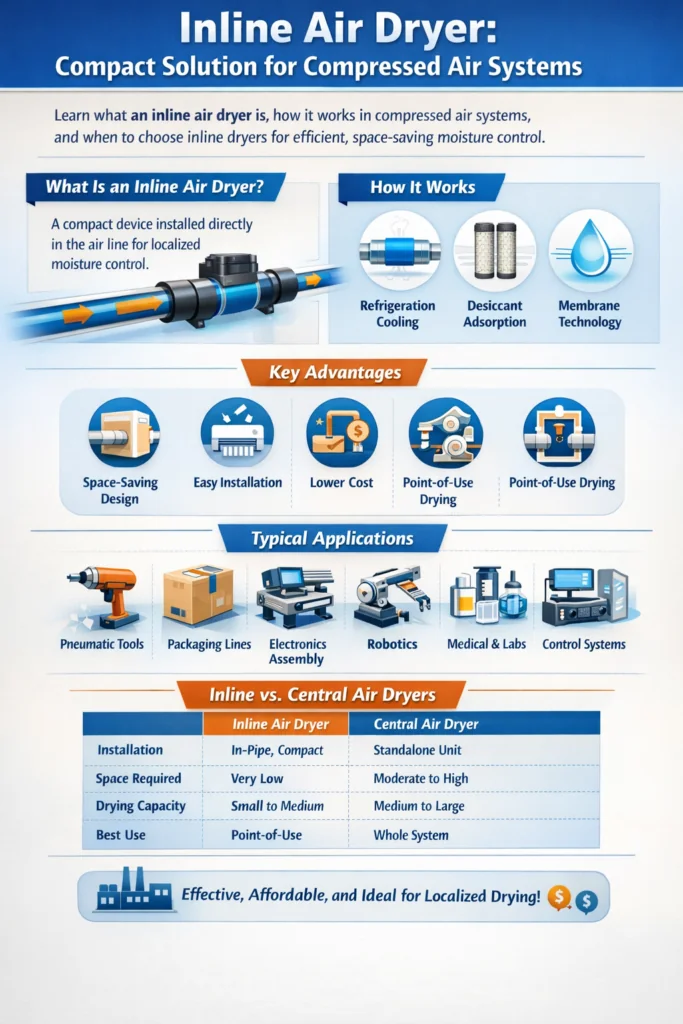
What Is an Inline Air Dryer?
The term inline air dryer usually describes the way the dryer is installed rather than one specific drying technology.
The unit is positioned within a compressed-air line so that air is treated before reaching downstream equipment.
Typical installations may include:
- A compact refrigerated dryer serving a small production line
- A small adsorption dryer for lower pressure dew point requirements
- A dryer combined with upstream or downstream compressed-air filters
- A localized drying system installed close to sensitive equipment
The main goal is to remove moisture before compressed air reaches the final application.
For relatively small compressed-air demands, Lingyu offers 25/35/50 CFM refrigerated air dryers as well as other compact-capacity refrigerated dryer configurations.
How Does an Inline Air Dryer Work?
The operating principle depends on the drying technology selected.
Refrigerated Inline Drying
A refrigerated air dryer cools compressed air until part of the water vapor condenses into liquid water.
The condensate is separated and discharged, and the dried compressed air is then delivered downstream.
This technology is commonly suitable where the objective is to prevent unwanted condensation in general industrial compressed-air applications.
Lingyu refrigerated dryers provide pressure dew points of approximately 2–10°C, depending on the series and specified operating conditions. The drying process combines refrigeration cooling, moisture separation, condensate drainage, and reheating of the treated compressed air before discharge.
For a broader overview, users can review the refrigerated air dryer product range.
Desiccant Inline Drying
Where a substantially lower pressure dew point is required, adsorption or desiccant drying may be more appropriate.
A desiccant dryer passes compressed air through an adsorption material that captures remaining water vapor.
Depending on the dryer design, the adsorbent can be regenerated using heatless purge air, heated purge air, blower-assisted regeneration, or heat-of-compression regeneration.
Lingyu provides multiple adsorption dryer technologies for applications requiring lower pressure dew points.
For these applications, users can review the desiccant air dryer range.
Why Use an Inline or Point-of-Use Air Dryer?
A point-of-use drying arrangement can be useful when only part of a compressed-air network requires additional moisture control.
For example, a plant may already have central air treatment but operate one production machine that requires better air quality than the rest of the facility.
Installing a localized dryer on that branch can allow the user to treat only the required airflow rather than upgrading the entire compressed-air station.
Other potential advantages include a smaller installation footprint, shorter treated-air piping distances, and easier separation of critical and non-critical air users.
However, an inline dryer should not automatically be considered better than central drying. The correct arrangement depends on total compressed-air demand, required pressure dew point, distribution piping, pressure loss, and the number of points that require dry air.
Inline Air Dryer vs. Central Air Dryer
The main difference is the scope of treatment.
An inline or point-of-use dryer normally treats one branch, machine, or localized production area. Its capacity is usually smaller, and it can be installed closer to the final air user.
A central dryer typically treats most or all of the compressed air supplied by the compressor station. This can be more practical where many production lines require the same pressure dew point and air-quality level.
A point-of-use solution makes the most sense when only a limited portion of the system requires a different level of moisture control.
If many production lines require the same pressure dew point, a properly sized central dryer may be simpler and more economical.
Relationship Between Inline and Refrigerated Air Dryers
A small refrigerated dryer can itself be installed close to a production line and function as a localized drying solution.
For example, Lingyu offers a 75 CFM refrigerated air dryer and a 100 CFM air-cooled refrigerated air dryer for relatively small compressed-air demands.
In a larger facility, such a unit could serve a separate branch line where the local airflow and operating conditions justify independent drying.
This is different from saying that every inline dryer must be installed downstream of another refrigerated dryer.
In many systems, one properly sized localized dryer may be sufficient. In others, central drying plus point-of-use treatment may be appropriate.
The system should therefore be designed according to actual air-quality requirements rather than automatically adding multiple dryers in series.
Relationship Between Inline and Desiccant Air Dryers
If the application requires a pressure dew point below what refrigerated drying can normally provide, adsorption drying becomes more relevant.
For example, electronics, instrumentation, or other moisture-sensitive operations may require substantially drier compressed air than general pneumatic applications.
A compact adsorption configuration can therefore serve a branch line or sensitive point of use.
Lingyu’s modular adsorption air dryer may be relevant where installation footprint and low-dew-point compressed air are both important.
The key point is to select the drying technology according to the required pressure dew point rather than simply choosing the smallest available unit.
Filtration Is Also Important
Moisture is only one type of contamination in compressed air.
Compressed air can also contain particles, liquid oil, oil aerosols, and oil vapor. A dryer alone may therefore not provide the complete air quality required by a sensitive process.
For this reason, localized treatment can include a precision compressed air filter in addition to the dryer.
Lingyu’s precision filtration range includes AO, AA, AX, and activated-carbon filtration configurations for different particulate and oil-removal requirements.
The dryer and filtration stages should be selected separately according to the moisture, oil, and particulate limits required by the final application.
Typical Applications of Inline Drying
Point-of-use drying arrangements can be useful where a specific machine or production area has more demanding compressed-air requirements than the main plant network.
Electronics and Precision Manufacturing
Sensitive manufacturing and test equipment may require controlled compressed-air quality.
For facilities in this sector, Lingyu’s electronics and precision manufacturing application provides additional context for compressed-air treatment requirements.
Automotive Manufacturing
Compressed air is widely used for pneumatic tools, assembly equipment, automation, and other manufacturing processes.
Where a particular production point requires additional moisture control, localized drying can provide a practical solution without necessarily changing the entire plant air-treatment system.
Lingyu’s automotive and general manufacturing application covers this type of industrial environment.
Laboratory and Analytical Equipment
Some laboratory and analytical equipment requires stable, dry compressed air.
Where the required airflow is relatively small, a localized dryer and filter combination may be more appropriate than a large central dryer.
Lingyu also provides a laboratory and analytical equipment application section.
Medical and Dental Applications
Compressed air used in medical or dental equipment can have application-specific air-quality requirements.
These requirements should be defined according to the equipment, intended use, and applicable standards rather than assuming that a standard inline dryer automatically produces medical-grade or sterile air.
Lingyu’s medical and dental application provides additional information for this sector.
How to Choose the Right Inline Air Dryer
The most important selection factor is the required pressure dew point.
If the purpose is primarily to prevent condensation in ordinary industrial piping, refrigerated drying may be sufficient.
If the application requires substantially drier compressed air, adsorption drying should be considered.
Flow capacity is equally important.
The dryer should be sized according to the actual maximum airflow through the branch line rather than average consumption alone. Operating pressure, inlet temperature, and ambient temperature can also influence effective dryer capacity.
Pressure drop should also be checked carefully, particularly for smaller point-of-use systems.
An undersized dryer or filter can create excessive restriction and reduce the pressure available to downstream equipment.
For users comparing dryer technologies, the refrigerated air dryer vs. desiccant air dryer guide provides a useful technical reference.
Where Should an Inline Dryer Be Installed?
The dryer should be positioned where it can effectively serve the required branch while still allowing safe maintenance and condensate drainage.
Installation planning should consider:
- Pipe size
- Airflow direction
- Inlet temperature
- Ventilation
- Condensate drainage
- Bypass piping
- Service access
- Pressure drop
- Downstream piping conditions
Locating treatment closer to the final application can shorten the length of piping carrying the final-quality air.
However, this does not completely eliminate the possibility of downstream moisture problems. The final result still depends on pressure dew point, pipe temperature, pressure changes, system leakage, and overall distribution design.
Dryer and filter placement can therefore vary according to the treatment technology and required air quality rather than following one universal layout.
Maintenance Considerations
Inline air-treatment equipment still requires routine maintenance even when the unit is relatively small.
For refrigerated dryers, maintenance may include inspection of condensers, evaporators, drains, refrigeration components, and filters.
For adsorption dryers, users should also monitor adsorbent condition, switching valves, regeneration performance, and downstream dust filtration.
Filters require periodic element replacement according to pressure drop, actual operating conditions, and equipment recommendations.
Common service components across compressed-air treatment equipment can include compressors, condensers, evaporators, valves, adsorbent, filter elements, silencers, and drain components.
When a Combined Dryer Makes More Sense
Some applications require both bulk moisture removal and a much lower final pressure dew point.
Instead of using separate refrigerated and adsorption dryers throughout the distribution network, an integrated drying system may be more practical for applications with higher or more continuous low-dew-point demand.
Lingyu’s DC Series combined compressed air dryer combines refrigerated drying with adsorption drying in one system.
The refrigerated stage removes a substantial portion of the initial moisture before the compressed air enters the adsorption stage. This reduces the moisture load entering the adsorption section and can reduce regeneration demand.
A combined dryer is therefore more relevant where low-dew-point air is required at a flow rate or operating profile that makes a larger integrated treatment system preferable to multiple localized dryers.
Conclusion
An inline air dryer is best understood as a localized compressed-air drying arrangement rather than one specific dryer technology.
Depending on the application, a compact refrigerated dryer may be suitable for general moisture removal, while an adsorption dryer may be required where a substantially lower pressure dew point is necessary.
The correct solution should be based on airflow, operating pressure, inlet temperature, required pressure dew point, pressure drop, filtration requirements, and the location of the final air user.
For small or localized compressed-air demands, compact refrigerated dryers can provide a practical solution. For sensitive low-dew-point applications, modular or other adsorption dryers may be more appropriate.
Where a large or continuously operating application requires both bulk moisture removal and deeper drying, a combined refrigerated and adsorption system may provide a more suitable system-level approach.
The most effective inline drying arrangement is therefore the one matched to the actual air-quality requirement, operating conditions, branch-line demand, and downstream equipment rather than simply the smallest available dryer.