When people hear the word “gas,” they often associate it with fire, explosions, and flammability. So it is natural to wonder: Is nitrogen flammable?
The short answer is no. Under normal industrial and atmospheric conditions, nitrogen gas does not burn and does not support combustion. In fact, nitrogen’s low reactivity is one of the reasons it is widely used to create inert atmospheres and reduce oxidation and fire risks in industrial processes.
Nitrogen is also remarkably common. It accounts for approximately 78% of Earth’s atmosphere and serves as an important industrial gas in applications ranging from food packaging and chemical processing to electronics and manufacturing.
Understanding why nitrogen behaves this way helps explain both its safety characteristics and why industries increasingly use on-site nitrogen generation systems instead of relying exclusively on delivered nitrogen.
What Exactly Is Nitrogen?
Nitrogen is a chemical element with the symbol N. Under normal atmospheric conditions, it exists primarily as molecular nitrogen (N₂), consisting of two nitrogen atoms joined by a very strong triple bond.
This molecular structure makes N₂ highly stable under ordinary conditions.
Nitrogen gas is:
- Colorless
- Odorless
- Non-flammable
- Relatively unreactive under normal conditions
- Naturally abundant in the atmosphere
These characteristics make nitrogen useful wherever manufacturers need to reduce oxygen exposure, limit oxidation, or maintain a controlled process atmosphere.
For a broader explanation of its industrial role, see how nitrogen is used across modern industry.
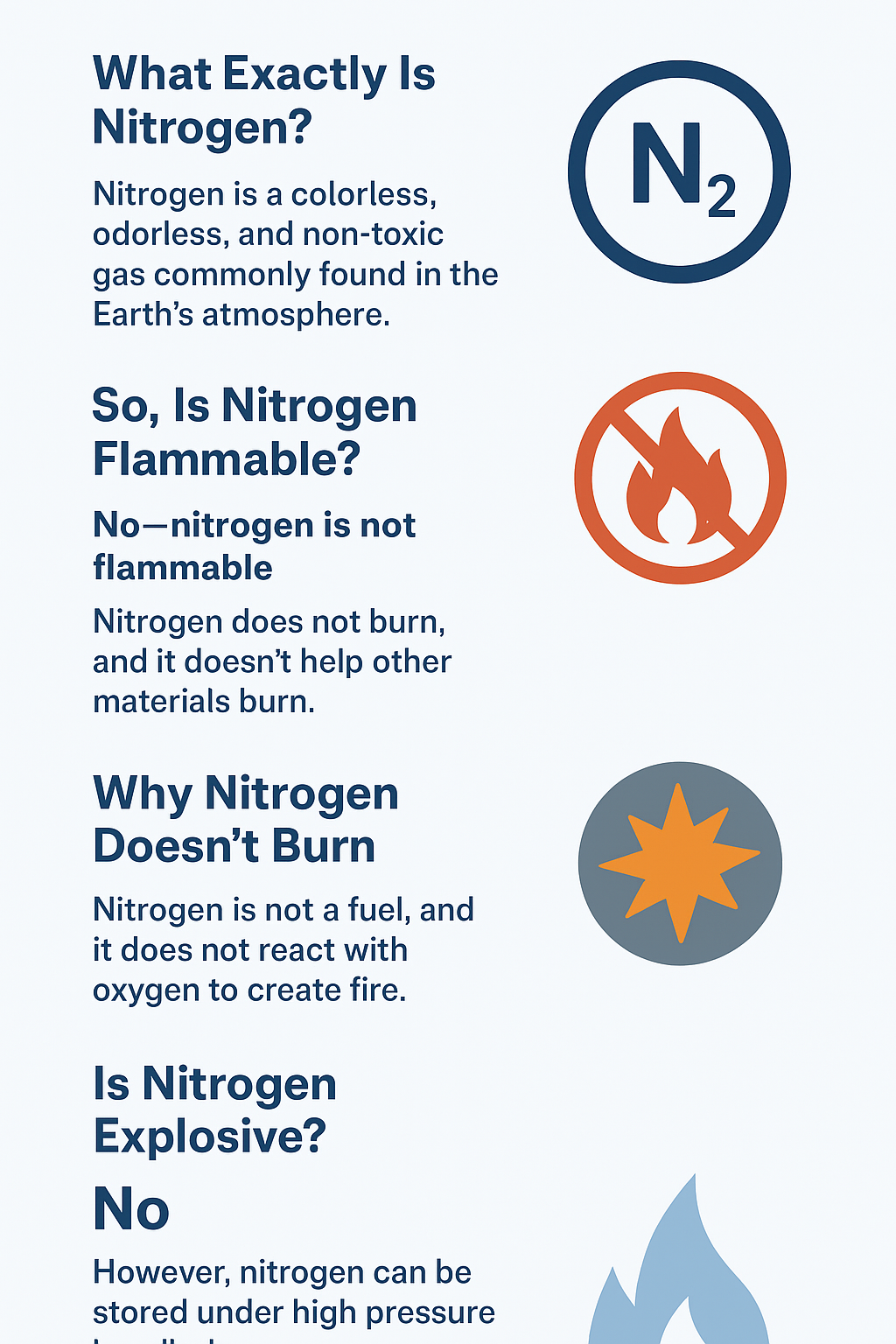
So, Is Nitrogen Flammable?
No. Nitrogen gas is not flammable under normal conditions.
A flammable substance must be capable of acting as a fuel and sustaining combustion under appropriate conditions. Molecular nitrogen does not behave as a fuel in ordinary industrial environments.
Nitrogen also does not support combustion in the way oxygen does. Instead, introducing nitrogen into an atmosphere can reduce the oxygen concentration available to a fire.
This distinction is important: nitrogen does not suppress combustion because it is a special fire-fighting chemical. It can suppress combustion by reducing the concentration of oxygen available to sustain the reaction.
Why Doesn’t Nitrogen Burn?
Fire is commonly explained using the fire triangle, which requires three elements:
- Fuel
- Oxygen or another suitable oxidizer
- Sufficient heat or an ignition source
Remove one of these elements and sustained combustion becomes impossible.
Nitrogen does not normally serve as a fuel, nor does it support ordinary combustion like oxygen.
When nitrogen is introduced into an enclosed process environment, it can dilute the oxygen concentration. If the oxygen concentration falls below the level required for a particular combustible material to sustain combustion, the fire cannot continue.
This principle is one reason nitrogen is valuable for inerting, blanketing, and purging industrial equipment.
However, saying nitrogen “never reacts at any temperature” would be inaccurate. Molecular nitrogen is extremely stable, but under sufficiently high temperatures or specialized chemical conditions, nitrogen can participate in reactions. That does not make N₂ a flammable gas under normal industrial conditions.
Is Nitrogen Explosive?
Nitrogen itself is not an explosive gas.
Pure N₂ does not undergo the type of rapid combustion reaction associated with explosions involving flammable gases.
However, this does not mean every nitrogen system is free from hazards.
Compressed nitrogen stored in a cylinder or pressure vessel contains significant physical energy. Severe damage, excessive heating, incorrect handling, or equipment failure can potentially result in a dangerous pressure release or vessel rupture.
That is a pressure-related mechanical hazard, not a combustion explosion caused by nitrogen.
This distinction also helps explain why some industrial facilities evaluate on-site nitrogen generation as an alternative to relying entirely on high-pressure cylinder deliveries.
Why Is Nitrogen Used to Reduce Fire and Oxidation Risks?
Because nitrogen is non-flammable and relatively inert under normal operating conditions, industries can use it to replace or dilute oxygen in controlled spaces.
1. Tank Blanketing and Chemical Processing
Storage tanks containing chemicals, solvents, oils, or other oxygen-sensitive materials may use a nitrogen blanket above the product.
Maintaining a nitrogen-rich headspace can reduce contact with atmospheric oxygen, helping control oxidation and, where appropriately engineered, reducing conditions that could support combustion.
This is one reason nitrogen generators are used in the chemical industry.
2. Food Packaging and Preservation
Nitrogen is widely used in modified-atmosphere food packaging.
Replacing part of the oxygen inside a package with nitrogen can help slow oxidation and preserve product quality. It is particularly useful for products where oxygen exposure contributes to rancidity, flavor deterioration, or other quality changes.
Users can learn more about nitrogen for food preservation.
3. Electronics and Manufacturing
Manufacturing processes may require controlled atmospheres to limit oxidation and contamination.
Nitrogen can provide a stable process environment for selected electronics, semiconductor, soldering, heat-treatment, and other manufacturing applications.
4. Laser Cutting
High-purity nitrogen is also used as an assist gas in certain laser-cutting applications, particularly where minimizing oxidation of the cut surface is important.
For these applications, the required nitrogen purity, pressure, and flow rate can differ significantly from those used for simple inerting. See the guide to nitrogen generation for laser cutting.
How Is Nitrogen Produced On-Site?
For facilities with regular nitrogen demand, producing nitrogen directly from compressed air can be an alternative to continuously purchasing cylinders or bulk gas.
One common technology is Pressure Swing Adsorption (PSA).
A PSA nitrogen generator uses compressed air as its feed source and passes it through adsorption vessels containing Carbon Molecular Sieve (CMS). The CMS preferentially adsorbs oxygen while allowing nitrogen-rich gas to pass through as the product stream.
Two adsorption towers alternate between adsorption and regeneration, enabling continuous nitrogen production.
Lingyu’s PSA nitrogen generator range uses this twin-tower CMS process and supports nitrogen purities from 95% up to 99.999%, depending on operating configuration and requirements.
For a more detailed technical explanation, read how a PSA nitrogen generator works and why it uses Carbon Molecular Sieve.
Does Nitrogen Purity Matter?
Yes. Not every industrial application requires 99.999% nitrogen.
Required purity depends on the process. Using a substantially higher purity than necessary can affect nitrogen-system sizing and operating economics, while insufficient purity may compromise the intended process.
Lingyu PSA nitrogen generator configurations cover 95%–99.999% nitrogen purity and provide an outlet nitrogen dew point of ≤−40°C under the applicable operating conditions. Configurations include 99%, 99.5%, 99.9%, 99.99%, and 99.999% nitrogen.
If you are selecting equipment rather than simply learning about nitrogen, refer to the PSA nitrogen generator selection guide.
Are There Any Risks When Using Nitrogen?
Yes. Non-flammable does not mean harmless.
The most important hazard associated with nitrogen is oxygen displacement.
Because nitrogen is colorless and odorless, a leak into an enclosed or poorly ventilated space can reduce the oxygen concentration without providing an obvious warning. An oxygen-deficient atmosphere can cause impaired judgment, loss of consciousness, asphyxiation, and potentially death.
Industrial nitrogen installations should therefore be designed and operated with appropriate measures such as:
- Adequate ventilation
- Oxygen monitoring where required
- Pressure relief and pressure-control equipment
- Appropriate piping and storage design
- Personnel training
- Confined-space procedures where applicable
- Routine inspection and maintenance
The exact safeguards should always be determined according to the installation, applicable regulations, and site-specific risk assessment.
Myth vs. Reality: Nitrogen and Fire
| Myth | Reality |
|---|---|
| Nitrogen will catch fire if it gets hot enough. | Under normal industrial conditions, N₂ is non-flammable. Extremely high temperatures can cause nitrogen to participate in certain chemical reactions, but that is not ordinary combustion of nitrogen as a fuel. |
| Nitrogen is explosive. | Nitrogen itself is not a combustible explosive gas. Pressurized nitrogen cylinders and vessels can, however, present serious mechanical pressure hazards. |
| Nitrogen makes fires stronger. | Generally the opposite: adding nitrogen can reduce available oxygen and is therefore used for inerting and blanketing applications. |
| Non-flammable means nitrogen is completely harmless. | False. Nitrogen can create an oxygen-deficient atmosphere and therefore presents an asphyxiation hazard in enclosed spaces. |
| All nitrogen applications require ultra-high purity. | False. Required nitrogen purity depends on the specific process and application. |
Conclusion: Nitrogen Is Non-Flammable, but It Must Still Be Handled Safely
So, is nitrogen flammable? No.
Under normal industrial conditions, molecular nitrogen does not burn and does not support combustion. Its stability and ability to reduce oxygen concentration are precisely why nitrogen is widely used for inerting, blanketing, food preservation, manufacturing, chemical processing, and other industrial applications.
However, nitrogen should not simply be described as “completely safe.” High-pressure gas systems present mechanical hazards, while nitrogen released into confined spaces can create a potentially life-threatening oxygen-deficient atmosphere.
For industrial users with continuous nitrogen demand, producing nitrogen on-site can also provide an alternative to cylinder or bulk-gas supply. Lingyu’s PSA systems use CMS adsorption and alternating adsorption/regeneration towers to produce nitrogen continuously at the required purity.
If you’re evaluating an on-site system, the next step is to understand how nitrogen is generated for industrial and laboratory use and determine the purity, flow rate, pressure, dew point, and operating conditions required by your application.