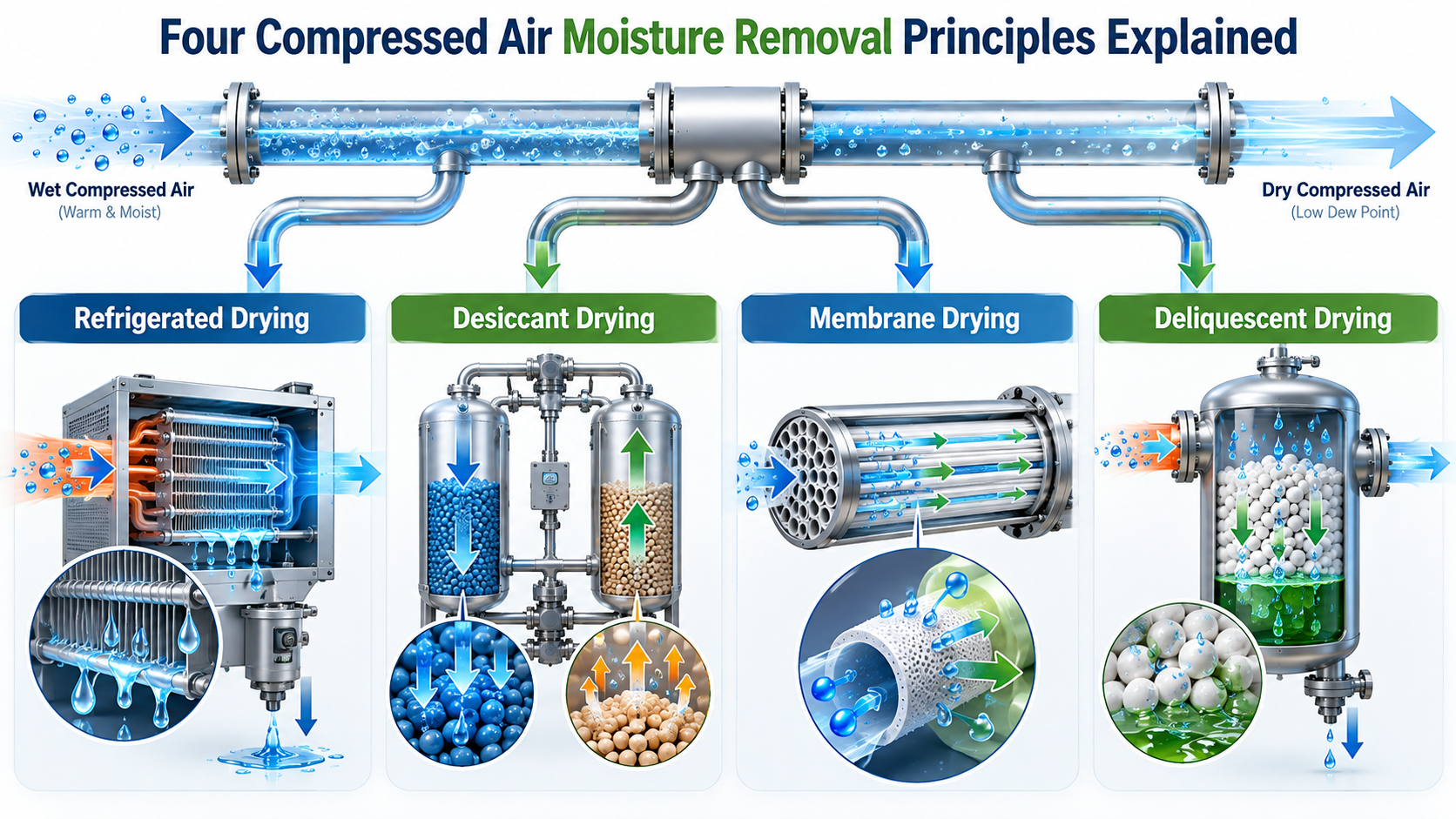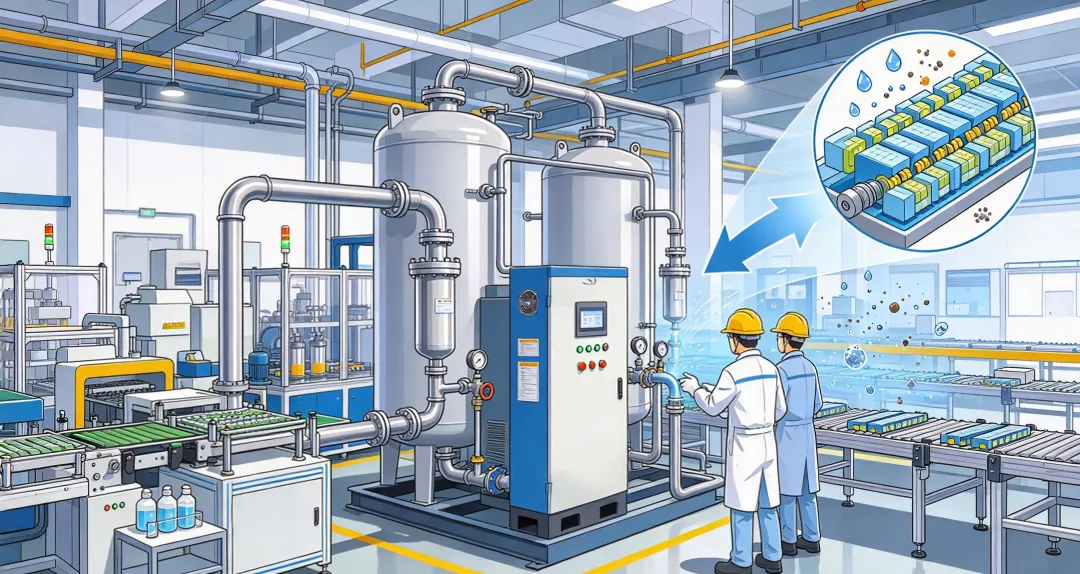
A mid size refrigerated air dryer is a practical solution for compressed air systems that require dependable moisture removal without installing unnecessarily oversized equipment. For workshops, manufacturing plants, and medium-scale production facilities, the right dryer can help maintain stable air quality while controlling equipment footprint and operating costs.
Moisture is naturally present in compressed air. As compressed air cools, water vapor can condense into liquid water, contributing to pipeline corrosion, equipment problems, and reduced product quality. A properly selected refrigerated air dryer removes much of this moisture before the compressed air reaches downstream equipment.
What Is a Mid Size Refrigerated Air Dryer?
A mid size refrigerated air dryer is a refrigeration-based drying unit selected to match the flow requirements of a medium-capacity compressed air system. Rather than defining “mid size” by one universal CFM range, the dryer should be sized according to actual air demand, inlet temperature, operating pressure, ambient conditions, and required pressure dew point.
This distinction is important because refrigerated dryers are available across a broad capacity range. For example, Lingyu’s AH Series includes multiple capacities from 1.5 m³/min upward, allowing the dryer to be matched more closely to actual operating requirements.
For facilities evaluating a moderate-capacity system, a 200 CFM refrigerated air dryer can also provide a useful reference point when comparing capacity and system requirements.
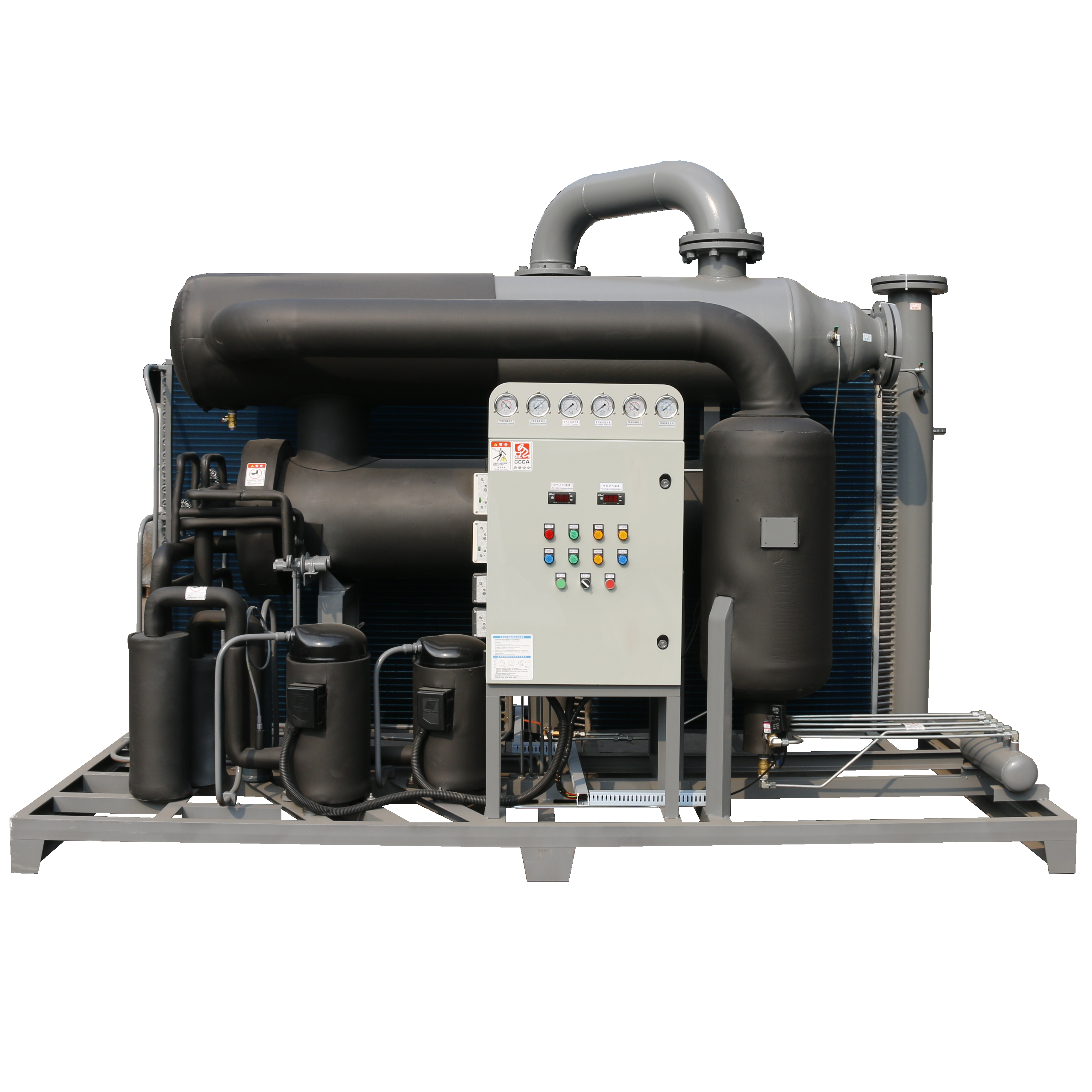
How Does a Mid Size Refrigerated Air Dryer Work?
The drying process is based on cooling compressed air so that water vapor condenses and can be separated. A typical operating cycle includes the following stages:
- Pre-cooling: Hot, moisture-laden compressed air enters the dryer and is initially cooled.
- Refrigeration cooling: The compressed air passes through the refrigeration heat exchanger or evaporator, where its temperature is reduced and moisture begins to condense.
- Moisture separation: Condensed water and oil droplets are separated from the compressed air and discharged through the drainage system.
- Reheating: The treated cold air exchanges heat with incoming compressed air, raising its outlet temperature before it enters downstream piping.
Lingyu’s AH Series, for example, is specified for a pressure dew point of 2–10°C under its stated operating conditions. Its process uses pre-cooling, refrigeration cooling, gas-liquid separation, automatic condensate drainage, and reheating before the treated compressed air leaves the dryer.
For a more detailed explanation of the refrigeration process, see how an air-cooled refrigerated air dryer works.
Why Choose a Mid Size Refrigerated Air Dryer?
Proper Capacity for Medium Air Demand
The main advantage is not simply physical size—it is matching dryer capacity to compressor output and actual plant demand. Undersizing can compromise drying performance, while excessive oversizing may increase initial investment without providing a meaningful operational benefit.
When selecting equipment, users should consider peak flow rather than average consumption alone. Inlet pressure, inlet temperature, ambient temperature, and installation conditions also affect the required capacity.
Stable Moisture Removal
A refrigerated dryer provides continuous moisture control for industrial applications that do not require the extremely low pressure dew points associated with adsorption drying.
Lingyu’s AH Series, for example, has a rated inlet pressure of 0.7 MPa, an operating pressure range of 0.6–1.0 MPa, a rated inlet temperature of 50°C, and a pressure dew point of 2–10°C under specified conditions.
Low Pressure Drop
Pressure loss across air-treatment equipment affects the efficiency of the entire compressed air system. A properly engineered refrigerated dryer should therefore remove moisture while keeping pressure drop under control.
The AH Series specifies a pressure drop of ≤0.025 MPa under its rated conditions. Facilities considering total system efficiency should evaluate filters, piping, dryers, and other treatment components together rather than assessing the dryer in isolation.
Options for Variable Air Demand
Not every medium-scale facility operates at a constant load. Production shifts, machine cycling, and seasonal demand can cause compressed air consumption to fluctuate substantially.
For these conditions, a variable frequency refrigerated air dryer can be worth considering. Lingyu’s PB Series regulates compressor speed according to actual treatment demand, allowing refrigeration output to follow changes in system load.
Flexible System Configuration
Air-cooled refrigeration is suitable for many installations, while facilities with appropriate cooling-water infrastructure may consider water-cooled refrigerated air dryers for their operating environment.
The correct choice depends on available utilities, ambient conditions, installation space, air demand, and the plant’s overall compressed air strategy.
Where Are Mid Size Refrigerated Air Dryers Used?
Mid size refrigerated air dryers can serve a wide range of industrial compressed air applications, including automotive manufacturing and workshops, machinery production, electronics, home appliances, metal processing, and general manufacturing.
The important consideration is the required air quality at the point of use. A refrigerated dryer is well suited to applications where reliable removal of condensed moisture is required and a moderate pressure dew point is sufficient.
Where significantly lower dew points are necessary, refrigerated drying alone may not meet the process requirement. In such cases, facilities can compare a refrigerated air dryer vs. desiccant air dryer before determining the appropriate treatment configuration.
How to Select the Right Mid Size Refrigerated Air Dryer
Start with the compressor’s maximum air delivery and expected peak demand rather than choosing equipment from a generic “medium-size” label. The following operating conditions should then be checked against the dryer’s rated specifications:
- Required air flow capacity
- Inlet compressed air temperature
- Operating pressure
- Ambient temperature
- Required pressure dew point
- Acceptable system pressure drop
- Air-cooled or water-cooled configuration
- Load variation and energy-efficiency requirements
- Available installation space
- Upstream and downstream filtration requirements
For facilities whose operating conditions fluctuate considerably, additional capacity margin or load-responsive refrigeration control may be appropriate. Conversely, unnecessarily oversizing the dryer should not be treated as a substitute for proper system calculation.
A broader compressed air dryer selection guide can help when comparing dryer technologies and operating requirements.
The Role of Filtration in a Complete Compressed Air System
A refrigerated dryer should be considered as part of the overall air-treatment system rather than as a standalone component.
Ambient air entering a compressor can contain moisture and solid particles, while oil-lubricated compressors may introduce additional oil contamination. Appropriate separation and filtration therefore help protect the dryer and downstream equipment.
Depending on the required air quality, a treatment train may include an air receiver, refrigerated dryer, moisture separation, and compressed air filters selected for the application.
This system-level approach helps control water, oil, and particulate contamination more effectively.
Maintenance Tips for Reliable Operation
Regular maintenance helps a mid size refrigerated air dryer maintain its cooling efficiency and pressure dew point. Operators should keep heat-transfer surfaces clean, verify that automatic drains discharge condensate correctly, inspect the air-water separator, and monitor refrigeration-system operating conditions.
Pressure dew point, inlet and outlet temperatures, and abnormal pressure changes can provide useful early indications of deteriorating performance. Refrigeration components and controls should be inspected according to the manufacturer’s recommended maintenance schedule.
Maintenance requirements also depend on the installation environment. Dusty conditions, high ambient temperatures, poor ventilation, or unusually high inlet temperatures can increase the load on the dryer and may require more frequent inspection.
FAQ
What capacity is considered a mid size refrigerated air dryer?
There is no single universal CFM range that defines a mid size refrigerated air dryer. Capacity should be selected according to actual compressed air flow and corrected for inlet temperature, pressure, ambient conditions, and other operating factors.
What pressure dew point can a refrigerated air dryer achieve?
It depends on the equipment and operating conditions. Lingyu’s AH Series specifies a pressure dew point of 2–10°C under its rated operating conditions.
Can a mid size refrigerated air dryer operate continuously?
Refrigerated air dryers are designed for industrial compressed air treatment, but the selected model must be correctly sized and operated within its specified pressure, temperature, airflow, and ambient limits.
Is an air-cooled or water-cooled dryer better?
Neither cooling method is universally better. Air-cooled systems can simplify installation where adequate ventilation is available, while water-cooled configurations may be appropriate where a reliable cooling-water supply exists. Selection should be based on site conditions and operating requirements.
Is a refrigerated dryer suitable when I need a −40°C pressure dew point?
Generally, a standard refrigerated dryer is intended for a considerably higher pressure dew point. When a process requires an outlet pressure dew point around −40°C, an adsorption dryer or an appropriate combined drying system should be evaluated.
Conclusion
A mid size refrigerated air dryer provides an effective balance of moisture removal, capacity, installation footprint, and operating efficiency for medium-scale compressed air systems. The best results come from selecting the dryer according to actual flow demand and site conditions rather than relying on a broad capacity label.
By considering air flow, inlet temperature, pressure, ambient conditions, pressure dew point, pressure drop, filtration, and load variation together, a facility can build a more reliable compressed air treatment system while avoiding unnecessary equipment oversizing.
For operations with fluctuating demand, energy-saving refrigeration technologies can provide additional efficiency opportunities, while applications requiring substantially lower dew points should consider adsorption or combined drying solutions.