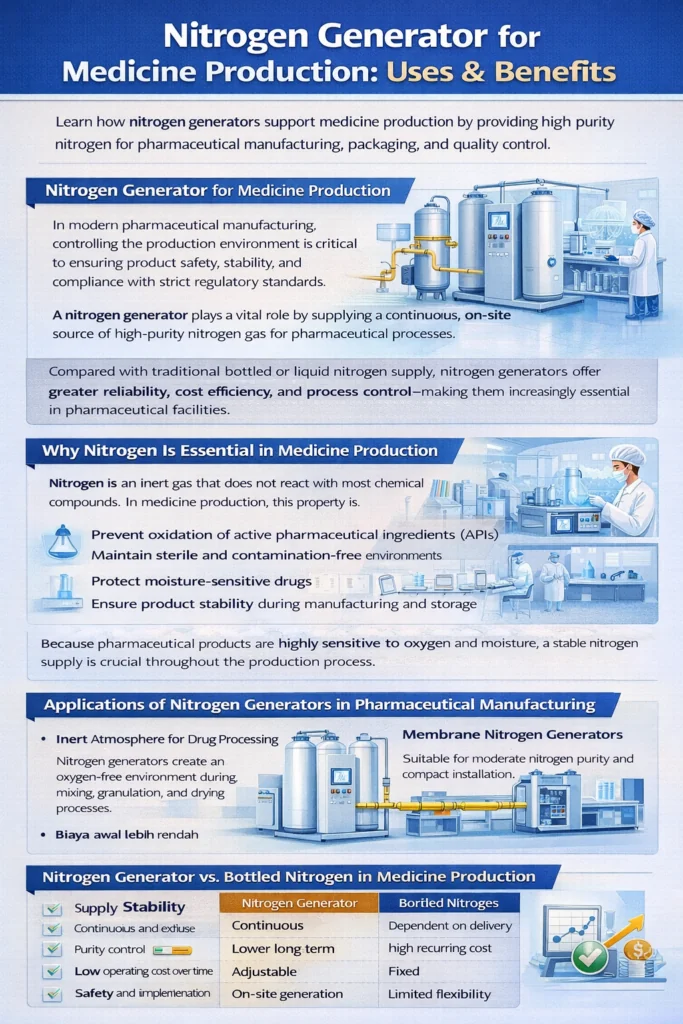
In modern pharmaceutical manufacturing, controlling oxygen, moisture, and process conditions can be important for maintaining product stability and consistent production.
A nitrogen generator for medicine production provides an on-site source of nitrogen for pharmaceutical processes that require inerting, purging, blanketing, packaging, or protection of oxygen-sensitive materials.
Instead of relying entirely on delivered cylinders or bulk nitrogen, an on-site system produces nitrogen from compressed air according to the required flow and purity. This can simplify gas-supply management while providing continuous nitrogen for production.
For pharmaceutical facilities evaluating on-site gas generation, understanding nitrogen purity, flow demand, pressure, compressed-air quality, dew point, and process requirements is essential before selecting a system.
Why Nitrogen Is Used in Medicine Production
Nitrogen is widely used where exposure to oxygen needs to be reduced.
In pharmaceutical production, oxygen can contribute to oxidation or unwanted changes in certain raw materials, intermediates, or finished products. Replacing oxygen-containing air with nitrogen can therefore help establish a controlled inert atmosphere around sensitive processes.
Typical uses include:
- Protecting oxygen-sensitive pharmaceutical materials
- Creating an inert atmosphere in processing vessels
- Purging pipelines and production equipment
- Blanketing storage tanks and containers
- Displacing oxygen during certain filling and packaging operations
- Supporting processes requiring controlled, dry nitrogen
The required nitrogen quality is not identical for every pharmaceutical application. Purity, pressure, flow rate, dew point, and filtration requirements should therefore be defined according to the actual process.
Lingyu provides dedicated pharmaceutical and biopharmaceutical solutions for applications involving compressed-air treatment and gas generation.
Key Applications of Nitrogen Generators in Pharmaceutical Manufacturing
Inerting During Pharmaceutical Processing
One of the most important functions of nitrogen is to reduce oxygen concentration around sensitive materials.
Nitrogen can be introduced into processing vessels, tanks, mixers, or other enclosed equipment to replace part of the oxygen-containing atmosphere.
This can be useful when pharmaceutical ingredients or process materials are susceptible to oxidation.
Rather than assuming that every pharmaceutical process requires the highest possible nitrogen purity, manufacturers should determine the acceptable residual oxygen level for the specific product and process.
Pharmaceutical Packaging and Filling
Nitrogen may also be used during selected packaging and filling operations.
By displacing oxygen from a container or package headspace, nitrogen can help protect oxygen-sensitive products during subsequent storage.
The actual nitrogen purity and flow requirement depend on factors such as packaging volume, production speed, acceptable residual oxygen concentration, and the method used to introduce nitrogen into the package.
Tank Blanketing
Storage vessels containing oxygen-sensitive pharmaceutical ingredients or process materials may require a controlled gas atmosphere above the product.
Nitrogen blanketing replaces or limits the amount of atmospheric air entering this headspace.
A stable on-site nitrogen supply can be particularly useful in facilities where blanketing is required continuously rather than only during individual production batches.
Equipment and Pipeline Purging
Nitrogen can be used to purge pipelines, vessels, and selected process equipment when oxygen-containing air needs to be displaced.
The required purge volume depends on equipment dimensions, initial oxygen concentration, target residual oxygen level, operating pressure, and the selected purging procedure.
This makes stable flow and purity important characteristics when selecting the nitrogen-generation system.
How a PSA Nitrogen Generator Works
Lingyu uses Pressure Swing Adsorption (PSA) technology for on-site nitrogen generation.
A PSA nitrogen generator uses compressed air as the feed gas.
The system contains two adsorption towers filled with Carbon Molecular Sieve (CMS). Oxygen is selectively adsorbed by the CMS while nitrogen passes through the adsorption bed and is collected as product gas.
While one tower is producing nitrogen, the second tower depressurizes and regenerates. The towers then alternate automatically, allowing continuous nitrogen production.
A PLC controls the adsorption, regeneration, pressure equalization, and switching sequence automatically.
Readers who want a more detailed explanation can review the PSA nitrogen generator working principle.
Nitrogen Purity for Medicine Production
There is no single nitrogen purity that is automatically correct for every pharmaceutical process.
The appropriate specification should be determined by the process itself.
Lingyu PSA nitrogen generators operate across the following general conditions:
Nitrogen purity: 95%–99.999%
Nitrogen dew point: ≤−40°C
Inlet air pressure: 0.5–0.8 MPa
Inlet air temperature: ≤40°C
Ambient temperature: ≤40°C
Switching cycle: 45–60 s
Power supply: 220 V / 50 Hz
Noise level: ≤75 dB
Available PSA purity configurations include 99.0%, 99.5%, 99.9%, 99.99%, and 99.999%, depending on system configuration.
For example, facilities requiring 99.99% nitrogen can review the dedicated 99.99% nitrogen generator configuration.
The important principle is not simply to specify the highest purity available. Higher nitrogen purity generally affects nitrogen recovery, feed-air demand, system sizing, and operating economics.
The target purity should therefore match the actual pharmaceutical process requirement.
When Ultra-High-Purity Nitrogen Is Required
Some pharmaceutical processes may require additional purification beyond the selected PSA generation stage.
Lingyu’s carbon-based deoxygenation purification system can further purify approximately 99.9% feed nitrogen to ≥99.999% nitrogen purity.
Key specifications include:
Nitrogen capacity: 10–800 m³/h
Nitrogen purity: ≥99.999%
Oxygen content: ≤10 ppm
CO₂ content: ≤5 ppm
Nitrogen atmospheric dew point: ≤−60°C
Pressure drop: ≤0.1 MPa
Power supply: 380 V / 50 Hz
The purification process uses a carbon-based catalyst to react with residual oxygen and form CO₂. The gas then undergoes CO₂ removal, deep dehydration, and precision filtration.
The formal technical specification for the finished gas gives an oxygen content of ≤10 ppm.
This type of additional purification should be selected only where the process actually requires it, because ultra-high-purity nitrogen involves additional equipment, energy, maintenance, and system-design considerations.
Important Features of a Pharmaceutical Nitrogen Generator
When nitrogen supports a production-critical pharmaceutical process, gas quality should be monitored rather than assumed.
Lingyu PSA systems provide several relevant control functions.
Real-Time Nitrogen Monitoring
Nitrogen purity and flow rate are continuously monitored during operation.
Off-Spec Nitrogen Protection
An alarm is activated when nitrogen purity falls below the specified value. If an off-spec condition persists for a preset period, the system can shut down automatically for protection.
PLC-Controlled Operation
Pneumatic valve switching and the adsorption/regeneration operating cycle are automatically controlled by the PLC.
Automatic CMS Compaction
An automatic CMS compaction device helps maintain the required packing density and reduce pulverization associated with adsorbent-bed movement.
Digital Touchscreen Monitoring
The touchscreen displays operating parameters including pressure, nitrogen purity, flow rate, and system status.
For pharmaceutical users, these monitoring and protection functions can be more valuable than selecting a generator based only on nominal purity.
Why Compressed-Air Quality Matters
A PSA nitrogen generator cannot be considered separately from its compressed-air supply.
The feed air must be properly treated before entering the CMS adsorption towers.
A practical nitrogen-generation system can include:
Air compressor → air receiver → refrigerated air dryer → filtration → PSA nitrogen generator → nitrogen buffer/storage → pressure control → nitrogen analyzer
Proper compressed-air treatment helps control moisture, oil, and particulate contamination before the feed air reaches the nitrogen generator.
Where additional filtration is required, a precision compressed air filter can be incorporated into the upstream treatment system.
This is particularly important because nitrogen purity alone does not describe every aspect of gas quality.
Advantages of On-Site Nitrogen Generation
For pharmaceutical plants with regular nitrogen demand, on-site generation can provide several operational advantages.
A nitrogen generator can produce gas continuously whenever the required compressed air and utilities are available, reducing routine dependence on cylinder replacement or bulk-gas deliveries.
The system can also be sized according to the plant’s required nitrogen purity and flow.
Automatic operation reduces routine handling, while online nitrogen monitoring provides direct visibility into production conditions.
For facilities comparing different supply strategies, the economic question is not simply “generator versus cylinder price.” A meaningful lifecycle comparison should consider:
- Nitrogen consumption
- Required purity
- Required pressure
- Operating hours
- Compressed-air energy consumption
- Booster energy where applicable
- Maintenance
- Cylinder or bulk-gas delivery costs
- Storage requirements
- Expected equipment life
For additional economic considerations, buyers can review the nitrogen generator cost guide.
Nitrogen Generator vs. Bottled Nitrogen
Neither on-site generation nor bottled nitrogen is automatically the best choice for every pharmaceutical facility.
An on-site PSA system produces nitrogen continuously according to the selected system configuration and requires compressed air, utilities, equipment maintenance, and appropriate storage or backup arrangements.
Bottled nitrogen provides a purchased gas grade but requires cylinder inventory, delivery, handling, storage, and replacement.
Very small or infrequent nitrogen users may find delivered gas practical. Facilities with continuous or substantial nitrogen consumption may obtain greater operational value from on-site generation.
The comparison should therefore be based on actual consumption, purity, pressure, operating hours, logistics, energy cost, reliability requirements, and lifecycle economics.
Choosing the Right Nitrogen Generator for Medicine Production
A pharmaceutical manufacturer should define its nitrogen requirement before selecting equipment.
Nitrogen Purity
Specify the required nitrogen concentration or permissible residual oxygen level according to the actual process.
Flow Rate
Consider both normal consumption and peak demand. Where several processes use nitrogen simultaneously, the combined peak requirement should be evaluated.
Outlet Pressure
Confirm the required pressure at the point of use. The PSA generation stage should not automatically be assumed to provide every downstream pressure requirement; additional regulation or boosting may be necessary.
Nitrogen Dew Point
Dryness can be important in moisture-sensitive pharmaceutical processes. Lingyu’s PSA nitrogen generator specification includes a nitrogen dew point of ≤−40°C.
Feed-Air Conditions
Compressor pressure, air temperature, moisture, oil, and particulate contamination can influence PSA performance and system reliability.
Monitoring Requirements
Determine whether online purity measurement, flow monitoring, alarms, remote communication, or integration with plant controls is necessary.
Redundancy Requirements
Production-critical pharmaceutical facilities may require nitrogen buffer storage, backup supply, redundant equipment, or other arrangements to maintain gas availability during maintenance or unexpected shutdowns.
Lingyu’s PSA operating range includes an inlet air pressure of 0.5–0.8 MPa, inlet temperature ≤40°C, nitrogen purity of 95%–99.999%, and nitrogen dew point ≤−40°C.
For broader sizing considerations, see the PSA nitrogen generator selection guide.
Pharmaceutical Quality and Compliance Considerations
A nitrogen generator should be selected as part of the facility’s overall quality and process-control system.
Gas purity, moisture, particulates, piping materials, point-of-use filtration, monitoring, validation requirements, documentation, and applicable standards may all need to be considered according to the specific pharmaceutical process.
A particular nitrogen purity alone does not make a system automatically “pharmaceutical compliant.”
Likewise, company management-system certifications should not be interpreted as product-specific pharmaceutical approval.
The equipment specification should instead be developed around the user’s actual quality requirements, validation approach, process requirements, and applicable regulatory framework.
For additional application-specific considerations, see Lingyu’s nitrogen generator for pharmaceutical industry guide.
Choosing a Nitrogen Generator Manufacturer
The generator itself is only one part of an on-site nitrogen system.
The supplier should also understand compressed-air treatment, CMS selection, flow and purity sizing, nitrogen storage, monitoring, control, pressure requirements, and downstream purification where necessary.
Lingyu PSA nitrogen generators use automatic twin-tower operation together with PLC-controlled pneumatic valves, real-time flow and purity monitoring, off-spec protection, and automatic CMS compaction.
Because PSA nitrogen generation depends directly on properly treated compressed air, the feed-air treatment and gas-generation stages should be evaluated as one integrated system.
Buyers can review the Lingyu nitrogen generator configuration when evaluating available PSA solutions.
Conclusion
A nitrogen generator for medicine production can provide a continuous on-site nitrogen source for pharmaceutical inerting, blanketing, purging, packaging, and other oxygen-sensitive processes.
Lingyu PSA technology uses Carbon Molecular Sieve and alternating adsorption towers to separate nitrogen from compressed air, with nitrogen purity configurations ranging from 95% to 99.999% and a specified nitrogen dew point of ≤−40°C.
Where additional purification is required, a carbon-based deoxygenation stage can upgrade approximately 99.9% nitrogen to ≥99.999%, with a formal oxygen-content specification of ≤10 ppm.
The right system should be selected according to required purity, allowable residual oxygen, flow rate, point-of-use pressure, nitrogen dew point, feed-air quality, monitoring requirements, redundancy, and actual pharmaceutical process conditions, rather than selecting the highest-purity generator by default.
For pharmaceutical projects, the most appropriate nitrogen system is the one engineered around the actual process and quality requirements while providing stable gas supply, appropriate monitoring, and manageable lifecycle cost.