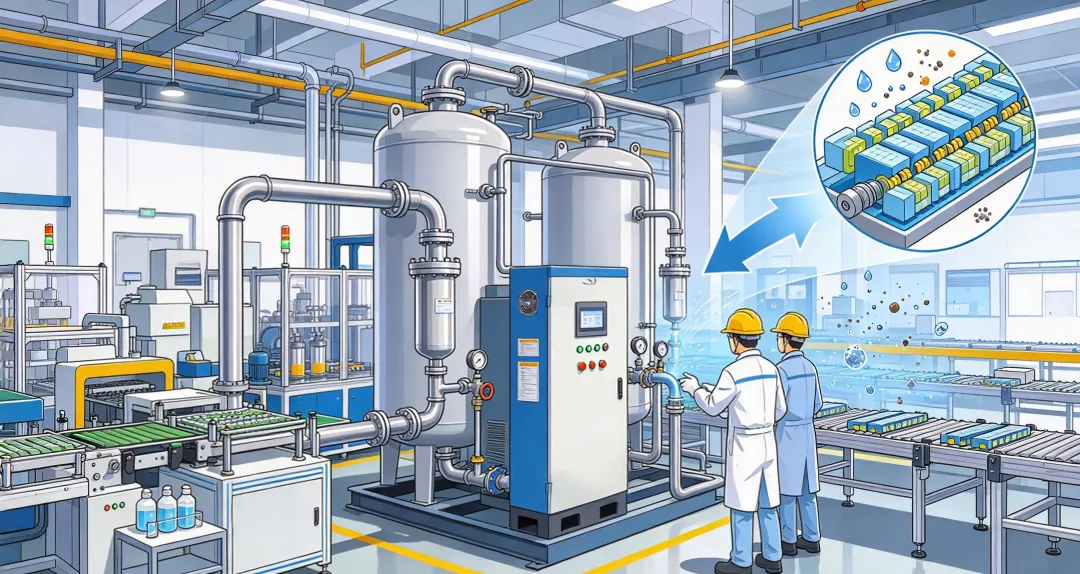
Nitrogen is widely used in industries such as food processing, electronics, pharmaceuticals, metalworking, chemical production, and other applications that require a controlled gas atmosphere.
Traditionally, nitrogen may be supplied through cylinders or bulk deliveries. For facilities with regular demand, however, an on-site nitrogen generator provides another option by separating nitrogen directly from compressed ambient air.
So, how does a nitrogen generator work?
For Lingyu’s industrial systems, the key technology is Pressure Swing Adsorption (PSA). A PSA nitrogen generator uses compressed air, filtration, Carbon Molecular Sieve (CMS), alternating adsorption towers, and automated controls to continuously produce nitrogen at the required purity. Lingyu’s PSA systems operate with an inlet air pressure of 0.5–0.8 MPa, an inlet air temperature of ≤40°C, and a nitrogen purity range of 95%–99.999%.
What Is a Nitrogen Generator?
A nitrogen generator is a system that separates nitrogen from compressed air and supplies it directly to the user’s process.
Ambient air naturally contains a high proportion of nitrogen along with oxygen, moisture, carbon dioxide, and other gases. Rather than creating nitrogen chemically, an on-site generator separates the nitrogen-rich stream from the other components of compressed air.
For industrial facilities, this can reduce dependence on delivered nitrogen and provide gas production directly at the point of use.
For a broader overview, see this guide to industrial nitrogen generation systems.
What Is PSA Nitrogen Generation?
PSA stands for Pressure Swing Adsorption.
A PSA nitrogen generator uses an adsorbent called Carbon Molecular Sieve (CMS) to selectively remove oxygen from compressed air.
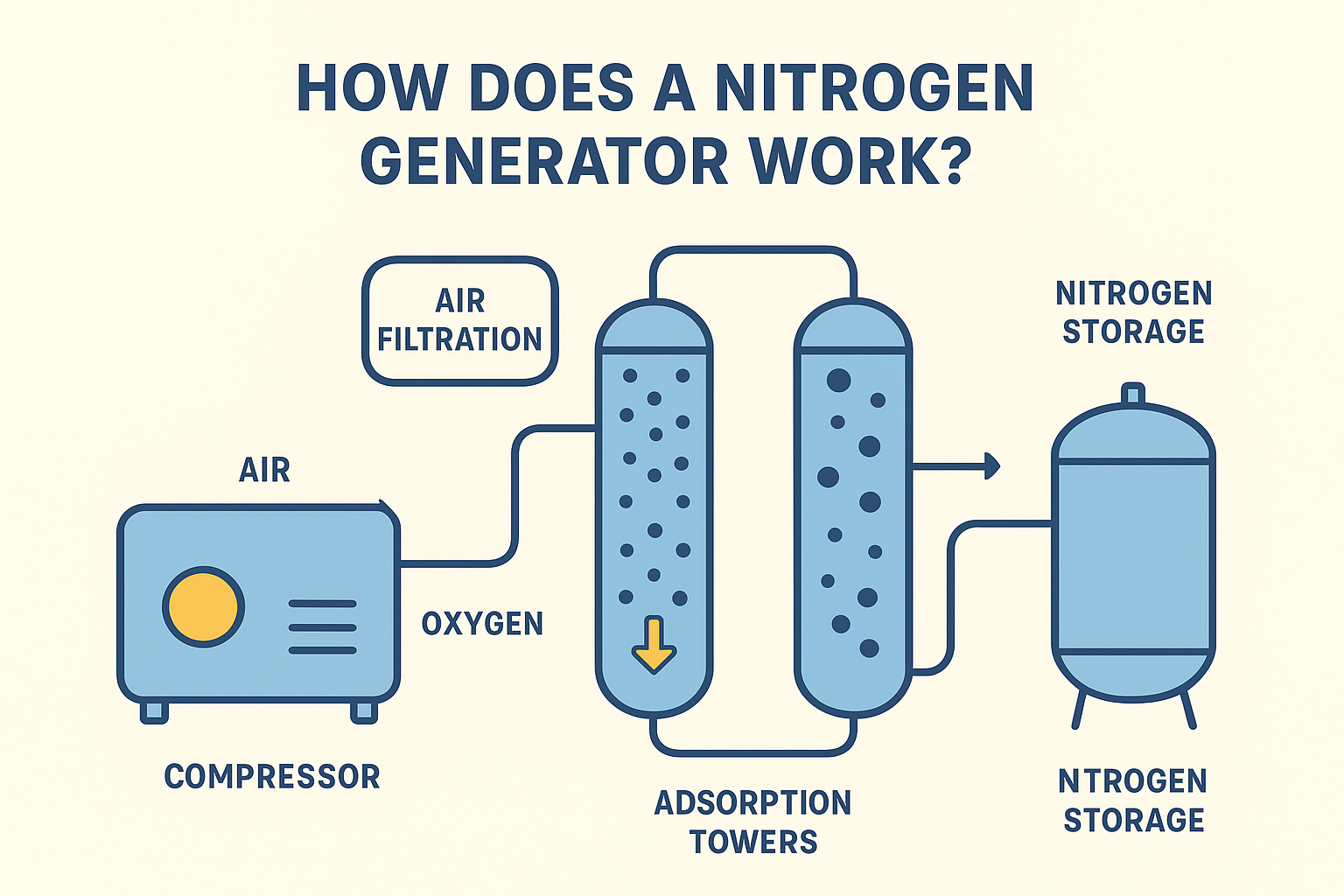
Lingyu’s nitrogen generator uses two pressure vessels, or adsorption towers, filled with CMS. While one tower is producing nitrogen, the other is regenerating. The towers then switch roles automatically, allowing nitrogen production to continue without stopping.
This alternating adsorption-and-regeneration process is the basis of PSA nitrogen generation. The two towers operate under automatic PLC control to maintain a continuous nitrogen supply at the specified purity.
For a more technical explanation of the adsorbent itself, see how a PSA nitrogen generator uses Carbon Molecular Sieve.
How Does a Nitrogen Generator Work? Step by Step
1. Ambient Air Is Compressed
The process starts with an air compressor.
Ambient air is drawn into the compressor and compressed to the pressure required by the nitrogen generation system.
Lingyu’s PSA nitrogen generator is designed for an inlet air pressure of approximately 0.5–0.8 MPa, with an inlet air temperature of ≤40°C under the stated operating conditions.
The compressed air then moves into the air-treatment section.
2. The Compressed Air Is Treated
Before compressed air enters the adsorption towers, contaminants must be controlled.
Compressed air can contain moisture, oil aerosols, dust, and other particles. These contaminants can affect the stability and service life of downstream air-treatment and adsorption equipment.
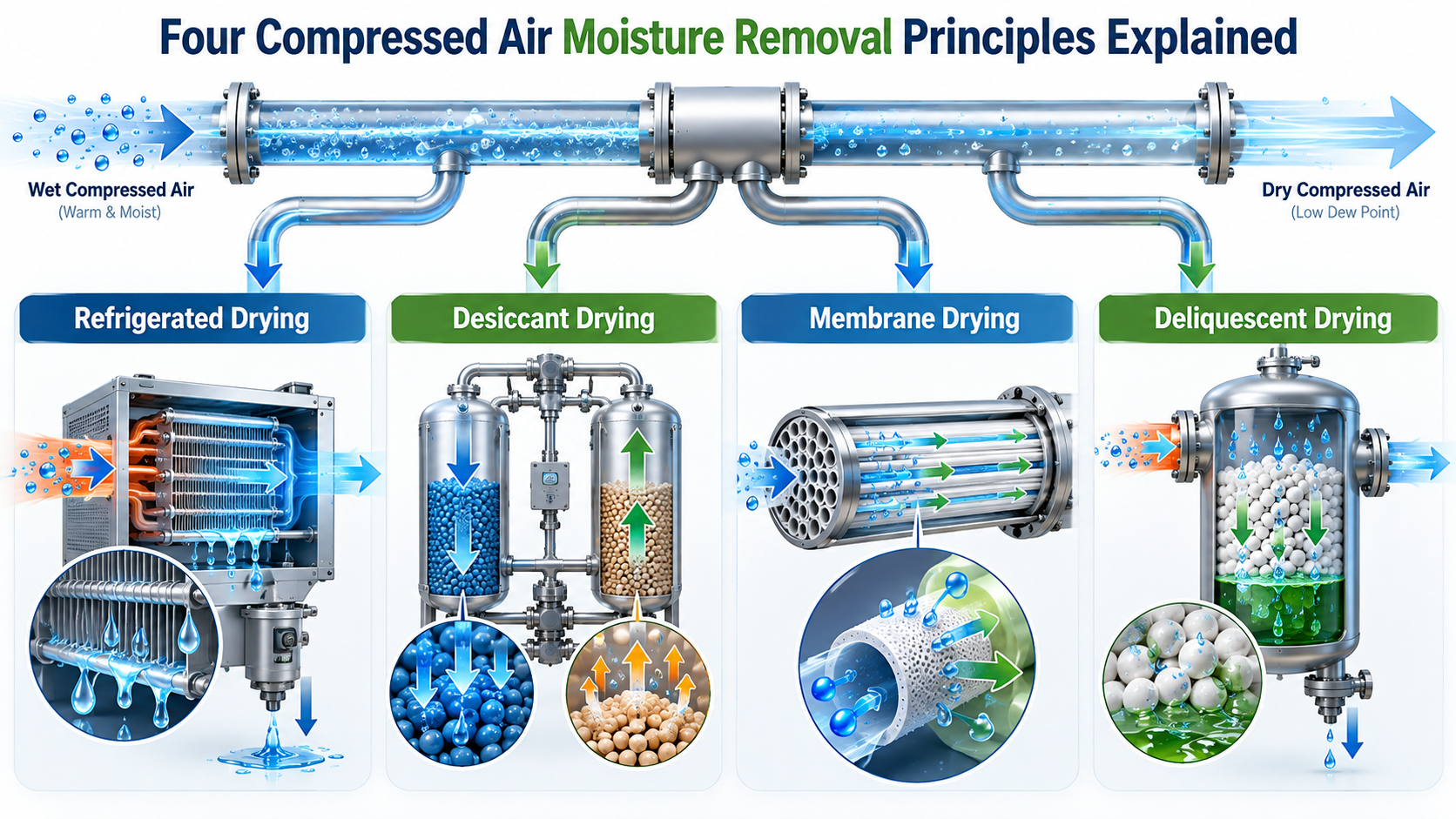
Lingyu’s PSA system configuration includes an air receiver tank, refrigerated air dryer, buffer tank, and associated air-treatment equipment before the nitrogen separation stage.
This is why a nitrogen generator should normally be considered as part of a complete compressed air treatment and gas separation system rather than simply as two adsorption vessels.
For more background, see why compressed air requires drying.
3. Compressed Air Enters the First Adsorption Tower
The treated compressed air enters one of the two CMS-filled towers.
Inside the tower, oxygen molecules are preferentially adsorbed by the Carbon Molecular Sieve, while nitrogen passes through the adsorption bed and continues toward the product outlet.
Compressed air entering Tower A therefore produces a nitrogen-rich product stream as oxygen is preferentially retained by the CMS.
4. The Second Tower Regenerates
While one tower is adsorbing oxygen, the other tower is being regenerated.
During regeneration, the pressure in the saturated tower is reduced. The oxygen previously captured by the CMS is desorbed and discharged.
This pressure change is the “pressure swing” in Pressure Swing Adsorption.
Once regeneration is complete, the regenerated tower is ready to begin adsorption again.
5. The Towers Switch Automatically
When the active adsorption tower reaches its predetermined operating point, the control system switches the process.
The regenerated tower begins producing nitrogen while the previously active tower depressurizes and regenerates. The system continuously alternates between the two towers under automatic PLC control.
The switching cycle is approximately 45–60 seconds under the specified operating conditions.
How Is Nitrogen Purity Controlled?
Nitrogen purity is one of the most important parameters in a PSA system.
Lingyu’s PSA nitrogen generator is specified for nitrogen purity ranging from approximately 95% to 99.999%, depending on the required configuration.
Available purity configurations include:
- 99.0%
- 99.5%
- 99.9%
- 99.99%
- 99.999%
These purity levels are included within Lingyu’s PSA nitrogen generator range.
Higher purity is not automatically better for every application. The appropriate purity should be based on the actual process requirement because nitrogen purity influences generator sizing, compressed-air demand, and operating efficiency.
If you are comparing equipment, see this PSA nitrogen generator selection guide.
What Happens If Even Higher Nitrogen Purity Is Required?
For applications that require extremely low residual oxygen levels, an additional purification stage can be installed after the PSA nitrogen generator.
Lingyu’s Carbon-Based Deoxygenation Purification System is designed to take nitrogen at approximately 99.9% purity and further purify it to ≥99.999%.
In this system, residual oxygen reacts with the carbon-based deoxygenation material to form CO₂. The gas then undergoes additional treatment to remove CO₂ and moisture, followed by precision filtration.
Key technical parameters include:
- Nitrogen purity: ≥99.999%
- Oxygen content: ≤10 ppm
- CO₂ content: ≤5 ppm
- Atmospheric dew point: ≤−60°C
These are specified operating parameters for the Carbon-Based Deoxygenation Purification System.
This additional purification stage is particularly relevant where standard PSA purity is not sufficient.
For related applications, see high-purity nitrogen generation.
What Components Are Typically Included in a PSA Nitrogen Generation System?
A nitrogen generator is usually only one part of the complete system.
A complete Lingyu PSA nitrogen generation configuration can include an energy-efficient air compressor, air receiver tank, refrigerated air dryer, buffer tank, PSA adsorption towers, nitrogen buffer tank, pressure-reducing valve, nitrogen/oxygen analyzer, off-spec nitrogen outlet, control valve, and nitrogen supply outlet.
The exact configuration depends on required purity, pressure, flow rate, dew point, and operating conditions.
This is why selecting a nitrogen generator based only on nominal nitrogen output can be misleading.
Why Is Carbon Molecular Sieve Important?
CMS is the key separation material inside a PSA nitrogen generator.
Its function is to preferentially adsorb oxygen from compressed air while allowing a nitrogen-rich stream to pass through the adsorption bed.
Maintaining the adsorption bed is therefore important for long-term performance.
Lingyu’s PSA generator includes an automatic CMS compaction system designed to maintain proper packing density and help prevent CMS pulverization caused by movement of the adsorption bed.
For troubleshooting related to adsorbent condition, see PSA nitrogen generator adsorbent powdering causes and prevention.
How Is Nitrogen Quality Monitored?
Industrial nitrogen generators should not rely only on the adsorption process itself.
Lingyu’s PSA system continuously monitors nitrogen purity and flow rate online. If nitrogen purity falls below the specified value, the system can activate an alarm. If the off-spec condition continues for a preset period, the system automatically shuts down for protection.
The system configuration also includes a nitrogen/oxygen analyzer and a separate off-spec nitrogen outlet.
This allows off-spec nitrogen to be separated from the normal product nitrogen supply.
Why Use an On-Site Nitrogen Generator?
An on-site system can provide several practical benefits for facilities with recurring nitrogen demand.
It can reduce dependence on cylinder handling and scheduled deliveries, provide nitrogen on demand, and allow the system to be selected according to the required purity and flow rate.
However, whether an on-site nitrogen generator reduces overall cost depends on factors such as nitrogen consumption, required purity, electricity cost, compressor efficiency, maintenance requirements, utilization rate, and the price of the alternative delivered-gas supply. It should therefore be evaluated according to the actual operating conditions rather than assuming a fixed payback result.
If cost is part of the purchasing decision, see this nitrogen generator cost and ROI guide.
Where Are Nitrogen Generators Used?
Nitrogen requirements differ considerably by industry.
Typical applications may include food and beverage processing, pharmaceutical manufacturing, electronics, metal processing, chemical production, laser cutting, and other processes where oxygen reduction or a controlled nitrogen atmosphere is required.
For application-specific information, see nitrogen generators for food production and PSA nitrogen generators for electronics and semiconductor manufacturing.
Lingyu has also supplied nitrogen-generation equipment as part of industrial projects, including a 350 m³/h nitrogen generator for a new-energy-materials project and refrigerated-air-dryer-plus-nitrogen-generator configurations for overseas markets.
PSA vs. Other Nitrogen Production Technologies
PSA is the primary nitrogen-generation technology covered here because it matches Lingyu’s industrial nitrogen generator configuration and operating principle.
Other nitrogen separation technologies exist, but they use different separation mechanisms and system configurations. When comparing nitrogen-generation technologies for an industrial application, the selection should be based on required nitrogen purity, capacity, operating conditions, energy requirements, and the overall process.
For a comparison with another nitrogen-production method, see cryogenic nitrogen generator vs. PSA nitrogen generator.
Final Thoughts
So, how does a nitrogen generator work?
In a PSA system, compressed air is first treated to control unwanted contaminants. It then enters alternating adsorption towers filled with Carbon Molecular Sieve.
The CMS preferentially adsorbs oxygen while nitrogen passes through as the product gas. One tower produces nitrogen while the other regenerates through depressurization, and the two towers switch automatically to maintain continuous operation.
For Lingyu’s PSA nitrogen generator, nitrogen purity ranges from 95% to 99.999%, with an inlet air pressure of 0.5–0.8 MPa, an inlet air temperature of ≤40°C, and a switching cycle of 45–60 seconds. The system also provides online purity and flow monitoring, automatic tower switching, PLC control, and off-spec gas protection.
The right nitrogen generator should therefore be selected according to required purity, nitrogen flow, pressure, dew point, feed-air conditions, and operating pattern rather than purity alone.
For the next step, users evaluating equipment can read the detailed nitrogen generator specifications guide.