Oil and gas vessels, offshore facilities, and marine energy operations often require controlled low-oxygen environments for tank inerting, pipeline purging, blanketing, maintenance, and selected transfer operations.
For vessels with regular nitrogen demand, a nitrogen generator for oil and gas ships can produce nitrogen onboard from compressed air, reducing dependence on stored cylinders or shore-based gas deliveries.
However, a marine nitrogen system should not be selected by purity alone. Nitrogen flow, residual oxygen, point-of-use pressure, compressed-air quality, buffer storage, redundancy, installation environment, and vessel-specific requirements all need to be considered together.
For a broader overview of this sector, see Lingyu’s oil, gas, offshore and marine solutions.
Why Nitrogen Is Used on Oil and Gas Ships
Nitrogen does not support combustion and is relatively unreactive under many normal operating conditions.
In marine oil and gas operations, it can be used to reduce oxygen concentration inside tanks, pipelines, vessels, and selected process equipment. This can help establish the controlled atmosphere required by a particular cargo or operating procedure.
Nitrogen itself does not automatically make every operation safe. Effective inerting depends on factors such as the initial oxygen concentration, target oxygen level, vessel or tank volume, gas distribution, purging method, nitrogen flow, monitoring, and the properties of the material being handled.
For this reason, the nitrogen-generation system should be integrated into the vessel’s broader process-safety and operating procedures.
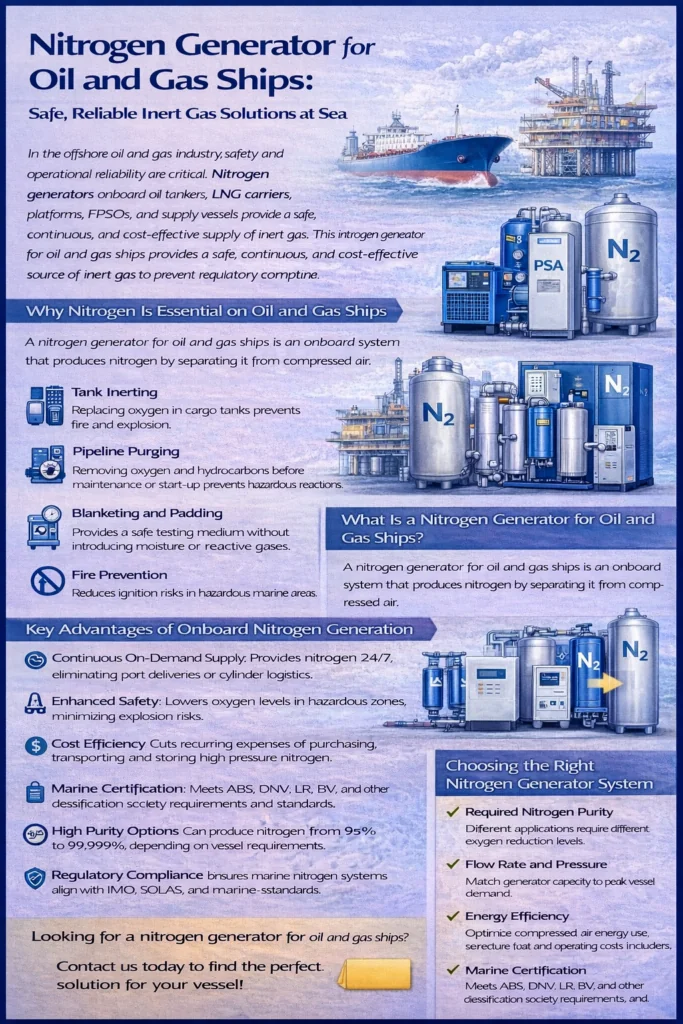
Common Marine Oil and Gas Applications
Nitrogen can support several different onboard operations.
Cargo or storage tank inerting uses nitrogen to reduce oxygen concentration inside a tank before or during selected operations.
Tank blanketing maintains a controlled gas space above stored liquids where limiting exposure to atmospheric oxygen is required.
Pipeline and equipment purging can displace air or process gases before startup, shutdown, maintenance, or product changeover.
Selected pressure and leak-testing procedures may also use nitrogen where the relevant engineering procedure specifies an inert test medium.
In offshore production systems and FPSO-type operations, nitrogen may additionally be distributed to process equipment requiring a controlled low-oxygen atmosphere.
Each application should be designed according to the actual vessel, cargo, process, and operating procedure rather than assuming one nitrogen specification is suitable for every marine installation.
What Is an Onboard Nitrogen Generator?
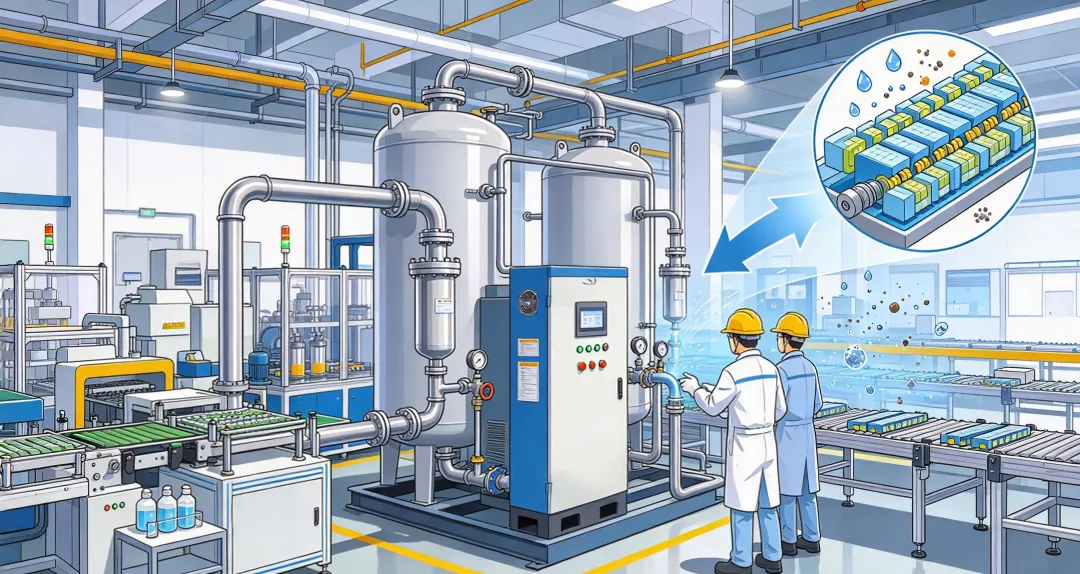
An onboard nitrogen generator uses compressed air as its feed source and separates nitrogen for distribution to the vessel’s nitrogen consumers.
Lingyu’s supplied product catalog documents Pressure Swing Adsorption, or PSA, nitrogen generation.
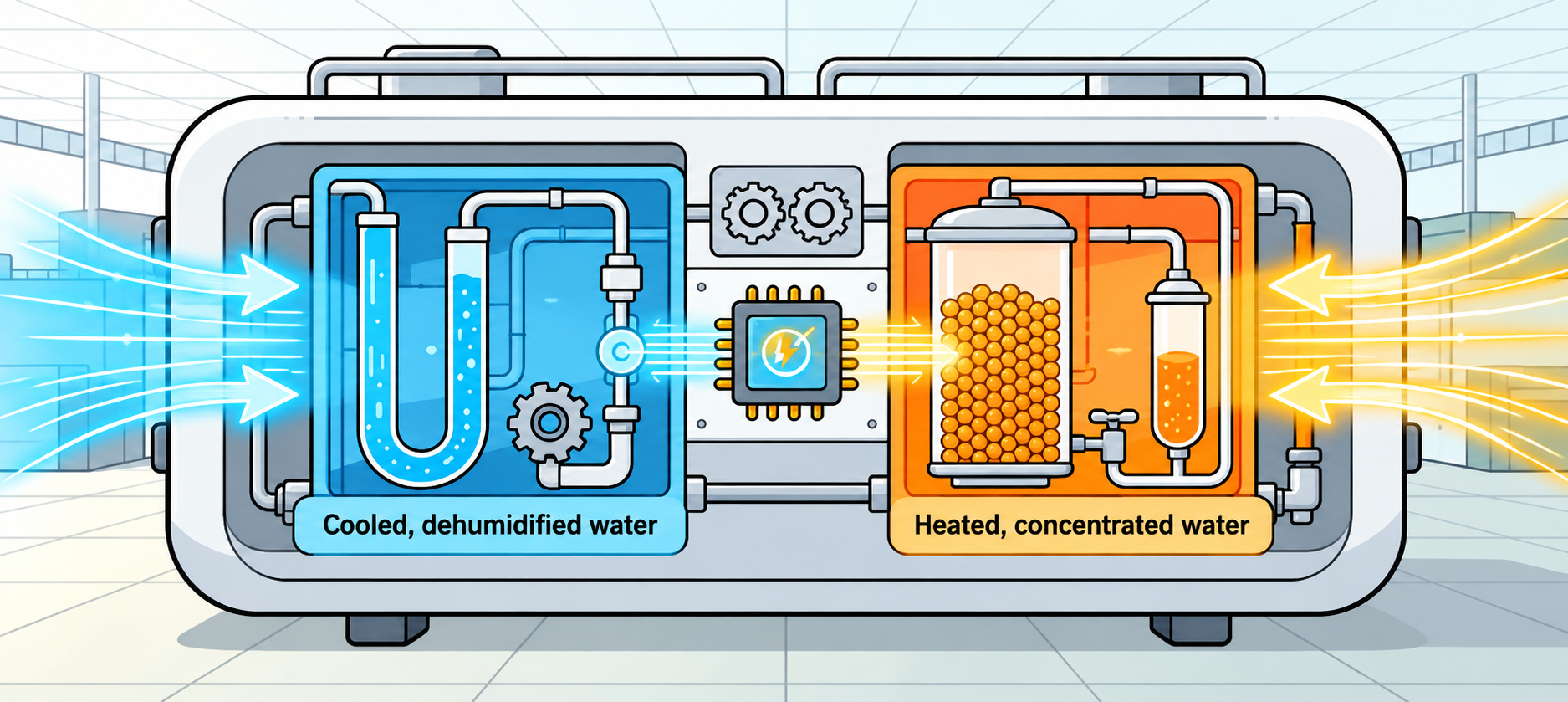
The system uses two adsorption towers filled with Carbon Molecular Sieve. Oxygen is preferentially adsorbed from the compressed-air stream, while nitrogen passes through as product gas. As one tower produces nitrogen, the other regenerates. The towers alternate automatically under PLC control to maintain continuous production.
Available configurations can be explored through Lingyu’s nitrogen generator range.
For readers who need a more detailed technical explanation, see how PSA nitrogen generation works.
The Complete Onboard Nitrogen System
The PSA generator is only one part of the complete nitrogen supply system.
Lingyu’s standard system diagram includes an air compressor, air receiver, refrigerated air dryer, buffer tank, nitrogen buffer tank, pressure-reducing equipment, nitrogen/oxygen analyzer, off-spec nitrogen outlet, and final nitrogen supply control.
For a marine installation, additional engineering may be necessary around piping, storage, pressure control, ventilation, electrical installation, drainage, equipment access, vibration, environmental exposure, and redundancy.
The final configuration should therefore be developed around the vessel rather than treating the nitrogen generator as a standalone machine.
How Pure Should Nitrogen Be for Marine Oil and Gas Operations?
There is no single correct nitrogen purity for all oil and gas vessels.
Lingyu’s PSA catalog specifies nitrogen purity from approximately 95% to 99.999%, while product configurations include values such as 99%, 99.5%, 99.9%, and 99.99%.
The required purity should instead be determined from the maximum allowable oxygen concentration for the particular operation.
For example, the requirements for continuous tank blanketing may differ from those for initial tank inerting, pipeline purging, or a process involving an oxygen-sensitive material.
A 99.5% nitrogen generator is therefore one configuration that can be evaluated, but it should not be described as the standard marine requirement.
Selecting unnecessarily high purity can affect nitrogen recovery, compressed-air demand, available flow, and operating cost.
Flow Rate and Inerting Time
For marine applications, flow capacity can be as important as purity.
A generator intended mainly for continuous blanketing may have a relatively stable demand profile. Tank inerting or pipeline purging, by contrast, can create much larger short-term nitrogen requirements.
System sizing should therefore consider tank and vessel volumes, initial and target oxygen concentration, required inerting or purging time, simultaneous nitrogen consumers, loading or unloading operations, continuous blanketing demand, and required reserve capacity.
A nitrogen buffer tank can help manage short-duration variations between generator output and process demand.
For larger or time-sensitive inerting operations, sizing only from average daily nitrogen consumption can result in an undersized system.
Point-of-Use Pressure Must Be Defined Separately
The required nitrogen pressure at a tank, pipeline, or process connection should be defined independently from the PSA generator feed-air pressure.
Lingyu’s catalog specifies a standard PSA inlet compressed-air pressure of 0.5–0.8 MPa.
That figure is an operating condition for compressed air entering the generator. It does not establish the nitrogen pressure available at every downstream marine application.
If the vessel requires higher downstream nitrogen pressure, suitable storage, pressure-control, or boosting equipment may be required.
Readers evaluating this type of arrangement can refer to the high-pressure nitrogen generator guide.
Compressed-Air Quality Matters Onboard
PSA performance also depends on the quality of the compressed air supplied to the generator.
Moisture, oil, and particulate contamination can affect filters, pneumatic valves, analyzers, and Carbon Molecular Sieve over long-term operation.
The standard Lingyu PSA operating data include an inlet-air temperature of ≤40°C and nitrogen dew point of ≤−40°C under the catalog’s stated conditions.
Appropriate drying and filtration should therefore be included in the complete system. Depending on the air-treatment arrangement, a precision compressed air filter can form part of the pretreatment system.
Nitrogen Monitoring and Off-Spec Protection
Gas-quality monitoring is especially important where the downstream operation depends on maintaining a specified oxygen concentration.
Lingyu’s PSA design provides real-time nitrogen purity and flow monitoring. Its touchscreen can display pressure, nitrogen purity, flow rate, and operating status.
If nitrogen purity falls below the specified value, an alarm is activated. If the off-spec condition persists for the preset period, the system can automatically shut down for protection.
The system diagram also includes a nitrogen/oxygen analyzer and an off-specification nitrogen outlet.
For marine applications, these generator functions should be integrated appropriately with the vessel’s overall operating and safety-control strategy.
Reliability, Storage, and Redundancy
Some onboard nitrogen consumers may be operationally important enough that loss of nitrogen cannot be treated as a routine interruption.
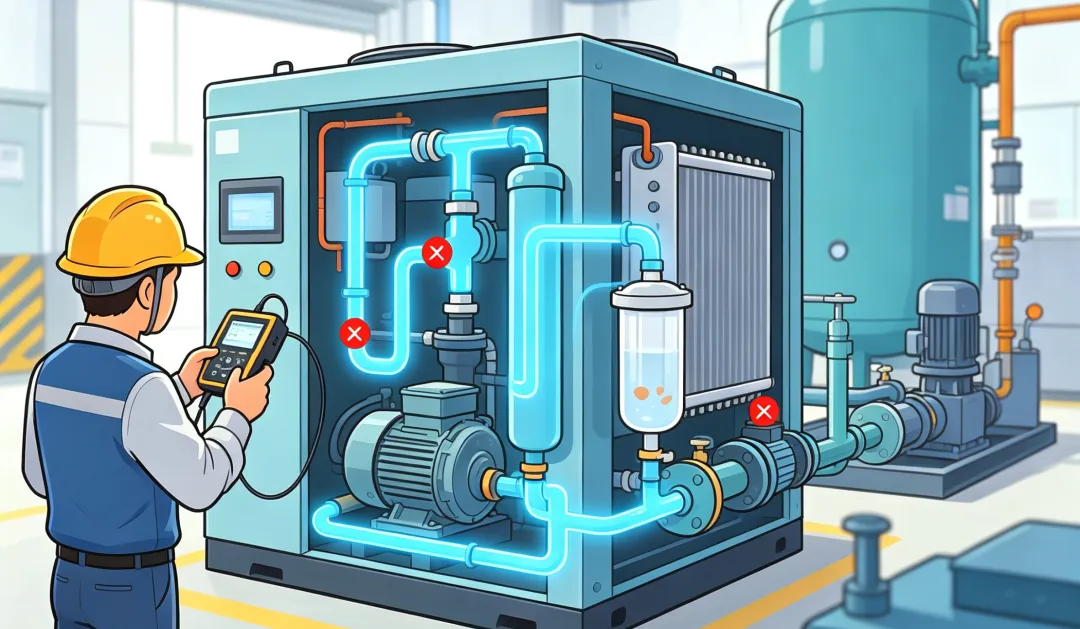
In these cases, system design should evaluate buffer-storage capacity, standby gas supply, reserve generator capacity, maintenance access, spare parts, alarm strategy, and the consequences of losing compressed air or electrical power.
The correct redundancy philosophy depends on the vessel and the criticality of the nitrogen consumers.
It should therefore be established during system engineering rather than assuming every vessel either requires or does not require a redundant generator.
Marine Installation Conditions
A marine project should evaluate:
- Available machinery-space footprint and maintenance access
- Ambient temperature and ventilation
- Humidity and corrosion exposure
- Vessel motion and vibration
- Electrical requirements
- Piping and drainage
- Control-system integration
- Noise requirements
- Redundancy and backup supply
- Vessel-, class-, flag-, and project-specific technical requirements
Lingyu’s standard PSA catalog gives an ambient-temperature limit of ≤40°C, so actual vessel conditions should be checked against the selected configuration.
Marine Certification and Regulatory Requirements
For marine installation, applicable vessel, flag-state, classification-society, cargo, hazardous-area, and project-specific requirements should be confirmed during system design and equipment selection.
If the nitrogen system will be installed in a classified hazardous area, the required protection concept and certification of the actual equipment supplied should likewise be confirmed for that project.
Nitrogen Safety Onboard
Although nitrogen does not support combustion, it can create an asphyxiation hazard by displacing breathable oxygen in enclosed spaces.
This is particularly important onboard vessels, where machinery rooms, enclosed compartments, tanks, and other confined areas may have limited ventilation.
System engineering may therefore need to consider ventilation, oxygen monitoring, controlled venting, alarms, access procedures, and vessel-specific safety requirements.
For additional background, see the site’s guide to nitrogen flammability and industrial safety.
Onboard Generation vs. Stored or Delivered Nitrogen
Producing nitrogen onboard can reduce dependence on cylinder logistics or external gas supply, particularly where nitrogen demand is regular.
But it should not automatically be described as the lowest-cost option.
A realistic comparison should include nitrogen consumption, required purity, compressed-air demand, compressor energy or fuel impact, operating hours, air-treatment requirements, maintenance, storage, backup supply, machinery-space requirements, and availability of nitrogen at operating ports.
The best solution depends on the vessel’s operating profile.
What to Define Before Selecting a Marine Nitrogen System
Before equipment selection, the project should define the required nitrogen purity or maximum oxygen concentration, average and peak flow, tank or pipeline volumes, allowable inerting or purging time, required point-of-use pressure, dew point requirement, available compressed-air capacity, machinery-space conditions, nitrogen storage requirements, redundancy philosophy, electrical conditions, hazardous-area classification where applicable, and relevant vessel or project requirements.
These parameters allow the compressed-air treatment, PSA generator, nitrogen buffer, analyzer, pressure-control equipment, and downstream distribution system to be engineered as one complete solution.
A useful general reference is the nitrogen generator specification guide.
Conclusion
A nitrogen generator for oil and gas ships can provide an onboard source of nitrogen for tank inerting, blanketing, pipeline purging, and other operations requiring controlled oxygen conditions.
The correct system is not defined by nitrogen purity alone.
Flow rate, residual oxygen, point-of-use pressure, compressed-air quality, buffer storage, gas monitoring, redundancy, marine installation conditions, and applicable vessel or project requirements should all be evaluated together.
When properly engineered around the actual vessel and operating duty, an onboard PSA nitrogen system can provide a stable and controllable nitrogen supply without depending entirely on stored or externally delivered gas.