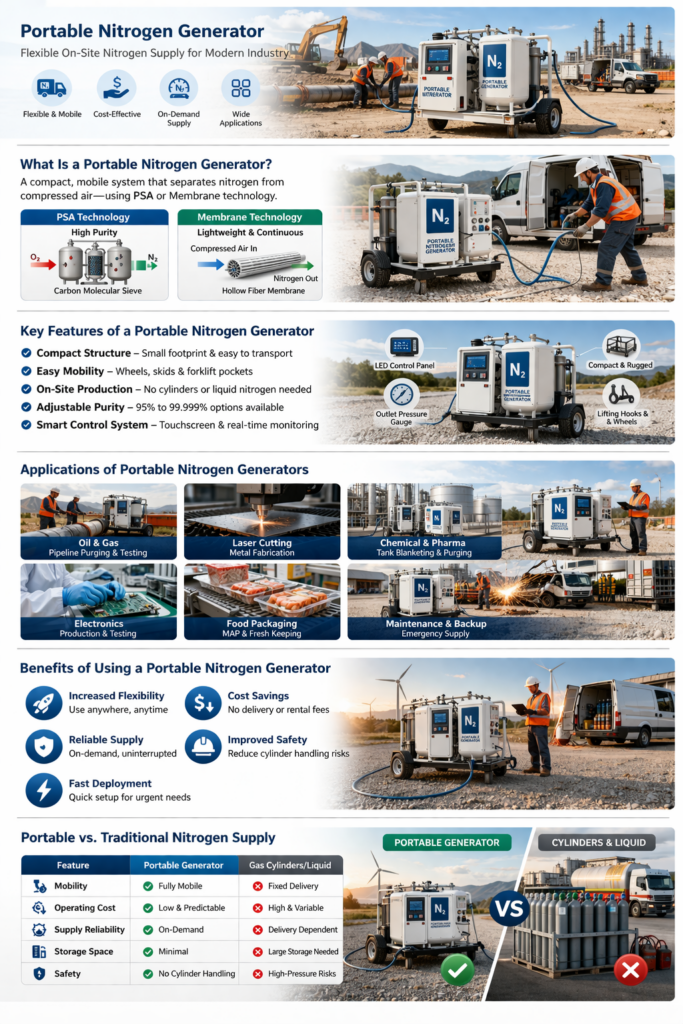
Industrial users sometimes require nitrogen at locations where permanent gas infrastructure is unavailable, inconvenient, or unnecessary.
Temporary projects, changing production areas, field operations, and backup requirements can create demand for a more flexible nitrogen supply solution.
A portable nitrogen generator is an on-site nitrogen production system designed for applications where deployment flexibility is important. Depending on the project requirements, the system may be configured as a compact skid-mounted package, integrated unit, containerized system, or another relocatable solution.
The level of portability depends on the overall system design, including packaging, supporting equipment, installation method, and mobility requirements.
What Is a Portable Nitrogen Generator?
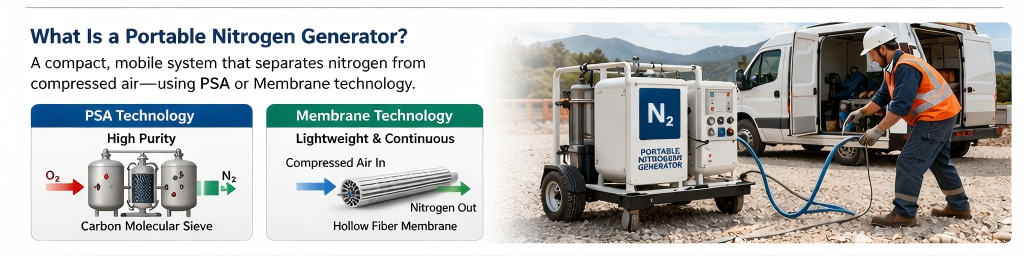
A portable nitrogen generator produces nitrogen on site from compressed air and is designed for applications where the equipment may need to be relocated or deployed temporarily.
Like a conventional nitrogen generation system, it requires a suitable compressed-air source and appropriate air treatment before nitrogen separation.
Lingyu’s PSA nitrogen generator uses two adsorption towers filled with Carbon Molecular Sieve (CMS). Oxygen is preferentially adsorbed by the CMS while nitrogen passes through the adsorption bed as product gas.
The two towers alternate between adsorption and regeneration cycles, allowing continuous nitrogen production.
The difference between fixed and portable nitrogen systems is mainly related to packaging, installation, supporting equipment, and mobility rather than the nitrogen separation principle itself.
Why Consider Flexible On-Site Nitrogen Generation?
On-site nitrogen generation can reduce dependence on externally supplied cylinders or bulk nitrogen deliveries when nitrogen demand is regular enough to justify a generation system.
For temporary or changing operating locations, a relocatable nitrogen system can provide additional flexibility by allowing nitrogen production closer to the point of use.
Potential advantages include:
- Reduced dependence on gas delivery schedules
- Nitrogen production according to actual operating demand
- Reduced cylinder handling requirements
- Greater control over nitrogen availability
- Flexible deployment for changing locations
However, the economic benefit depends on the actual operating conditions.
Important factors include nitrogen consumption, required purity, compressed-air cost, operating hours, maintenance requirements, transportation, site preparation, and the cost of alternative nitrogen supply methods.
How a PSA Nitrogen Generator Works
A PSA nitrogen generator separates nitrogen from compressed air through repeated adsorption and regeneration cycles.
The process begins with compressed air that meets the required inlet pressure, temperature, and air-quality conditions.
Conditioned compressed air enters one CMS adsorption tower. Oxygen is preferentially adsorbed by the Carbon Molecular Sieve, while nitrogen passes through the adsorption bed as product gas.
At the same time, the second tower depressurizes and regenerates. The towers then switch functions automatically, allowing continuous nitrogen production.
Depending on the system configuration, control and monitoring functions may include:
- Automatic cycle switching
- Nitrogen purity monitoring
- Flow monitoring
- Pressure monitoring
- Alarm functions
- Off-spec nitrogen handling
For more information about PSA separation technology, see how PSA nitrogen generation works.
PSA vs. Membrane Nitrogen Generation
PSA and membrane separation are two common technologies used for on-site nitrogen production.
PSA systems use Carbon Molecular Sieve to selectively adsorb oxygen from compressed air. This technology can support a wide range of nitrogen purity requirements.
Membrane systems use selective gas permeation to separate nitrogen from other air components. Depending on the application, membrane systems may provide advantages related to footprint, simplicity, flow requirements, or nitrogen purity.
Lingyu’s nitrogen generator range is based on PSA technology. Therefore, PSA systems should be evaluated according to the required purity, flow, pressure, and operating conditions.
The appropriate technology depends on the actual application requirements rather than the generation method alone.
Nitrogen Purity Options
A portable nitrogen generator should not automatically be selected at the highest available purity.
The required nitrogen purity depends on the process requirement.
Lingyu PSA nitrogen generator configurations support different purity levels, including applications requiring 99% nitrogen and higher-purity nitrogen.
Higher purity should only be selected when the process requires it because increasing purity can affect:
- Nitrogen recovery
- Compressed-air consumption
- Equipment sizing
- Operating efficiency
Nitrogen purity should therefore be treated as an engineering requirement rather than simply choosing the highest available specification.
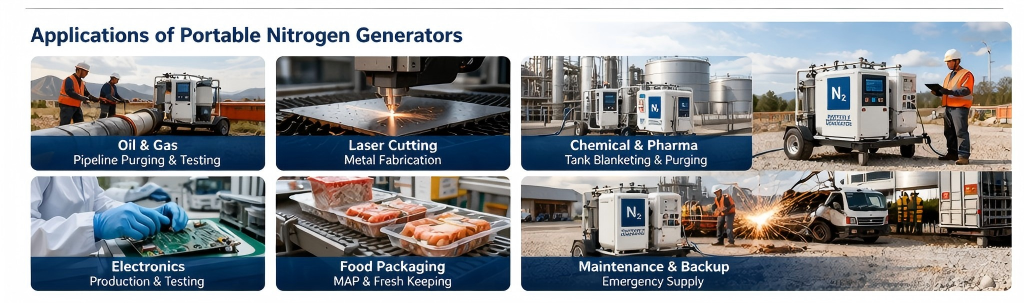
Applications for Flexible Nitrogen Supply
A portable or relocatable nitrogen system can be useful where nitrogen demand is temporary, distributed across different locations, or required as a backup source.
Potential applications include:
- Field maintenance
- Temporary process operations
- Equipment commissioning
- Selected purging operations
- Selected inerting operations
- Backup nitrogen supply
- Mobile industrial projects
Industries using nitrogen solutions include laser processing, food packaging, chemical processing, electronics, oil and gas, and other industrial applications.
However, each application has different requirements. The suitability of a portable nitrogen system depends on:
- Required nitrogen flow
- Nitrogen purity
- Delivery pressure
- Operating duration
- Available compressed air
- Site utilities
Portable Nitrogen for Oil and Gas Operations
Remote oil and gas operations may require flexible nitrogen supply for selected purging, inerting, maintenance, and process-support applications.
However, nitrogen demand in oil and gas operations can vary significantly.
High-volume purging, pressure-related operations, and other demanding applications may require specialized system sizing, storage capacity, boosting equipment, or additional supporting infrastructure.
Important design factors include:
- Required nitrogen flow
- Nitrogen purity
- Delivery pressure
- Operating duration
- Ambient conditions
- Available compressed air
- Site utilities
- Supporting storage or boosting equipment
For vessel-related applications, see nitrogen generator for oil and gas ships.
Portable Nitrogen for Laser Cutting
Nitrogen is widely used as an assist gas in laser-cutting applications.
However, laser cutting can require high nitrogen flow and delivery pressure. A portable nitrogen generator may therefore need to be integrated with additional nitrogen storage or pressure-boosting equipment depending on the cutting system requirements.
The complete solution should be evaluated according to:
- Required nitrogen purity
- Cutting speed
- Gas consumption
- Machine pressure requirement
- Operating schedule
For laser-cutting applications, see nitrogen generation for laser cutting.
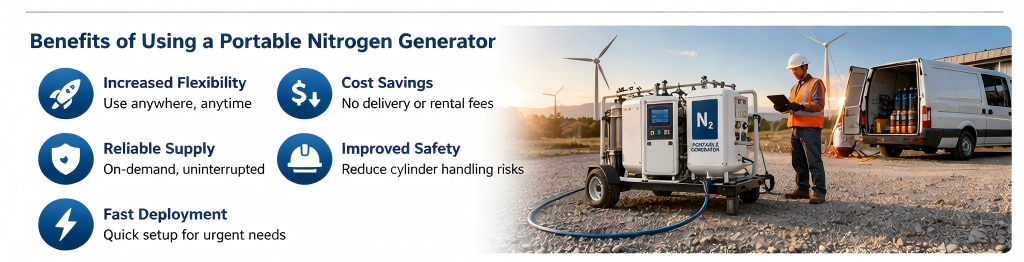
What Makes a Nitrogen System Portable?
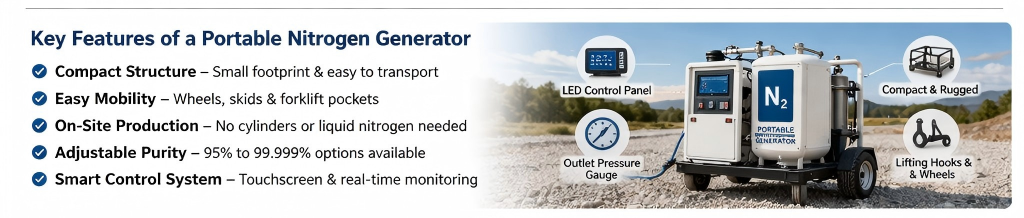
The term “portable” can describe different levels of mobility.
A portable nitrogen system may be designed for:
- Movement within a production facility
- Periodic relocation between sites
- Skid-mounted installation
- Temporary outdoor operation
- Containerized deployment
- Vehicle-based installation
These are packaging and engineering decisions separate from the PSA nitrogen separation process.
Important considerations include:
- Overall dimensions and weight
- Lifting and handling requirements
- Compressed-air source
- Electrical supply
- Ventilation
- Ambient temperature
- Air filtration and drying
- Nitrogen buffer capacity
- Outlet pressure
- Deployment and connection time
- Environmental protection
- Relocation frequency
Portable construction should therefore be defined according to the project requirements.
Features such as wheels, lifting frames, skid bases, trailers, containers, weather protection, or integrated compressor packages should be selected according to the actual system configuration.
Complete System Requirements
A nitrogen generator operates as part of a complete compressed-air and gas-treatment system.
Depending on the project design, a PSA nitrogen generation system may include:
- Air compressor
- Air receiver
- Compressed-air dryer
- Filtration system
- PSA nitrogen generator
- Nitrogen buffer tank
- Pressure-control equipment
- Nitrogen or oxygen analyzer
- Off-spec gas handling
- Distribution piping
This is especially important for portable systems because engineers must determine which components move with the nitrogen generator and which utilities are already available at the installation location.
A portable PSA generator supplied with an external compressor and air-treatment system is different from a fully integrated nitrogen package.
Control and Monitoring
Flexible deployment should not reduce nitrogen quality control.
A PSA nitrogen system may include:
- Nitrogen purity monitoring
- Flow monitoring
- Pressure monitoring
- Automatic cycle control
- Alarm functions
- Off-spec gas handling
These functions help operators verify that nitrogen remains within the required process range.
They are particularly useful when equipment is relocated because different sites may have different operating conditions, compressed-air quality, or nitrogen demand.
How to Choose a Portable Nitrogen Generator
Selection should begin with the actual nitrogen requirement rather than portability alone.
Important factors include:
- Required nitrogen purity
- Continuous nitrogen flow
- Peak nitrogen demand
- Required outlet pressure
- Operating duration
- Compressed-air availability
- Feed-air quality
- Electrical supply
- Nitrogen buffer requirements
- Physical size and weight
- Relocation frequency
- Indoor or outdoor operating conditions
- Environmental protection
- Monitoring requirements
- Supporting equipment
- Lifecycle cost
Portability should then be defined according to the operating scenario.
A system moved occasionally within a factory requires a different design from equipment transported frequently between remote field locations.
For broader system selection guidance, see PSA nitrogen generator selection guide.
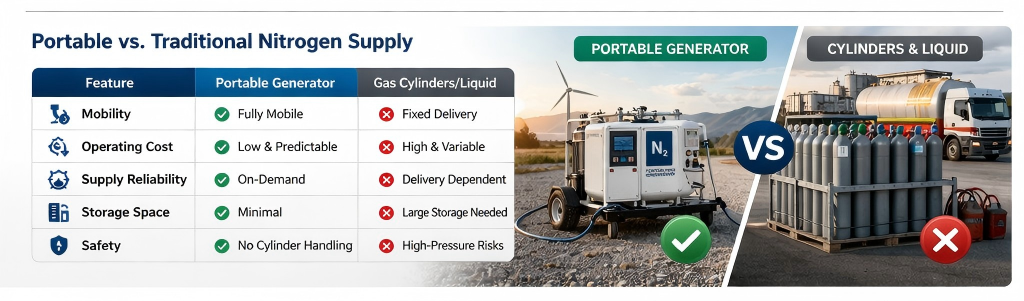
Portable Generation vs. Cylinders and Bulk Nitrogen Supply
No nitrogen supply method is suitable for every application.
Nitrogen cylinders may remain practical for low-volume or occasional demand.
Bulk nitrogen supply may be appropriate for facilities with large consumption and suitable storage infrastructure.
On-site PSA nitrogen generation can be beneficial where nitrogen demand is regular and compressed-air and electrical infrastructure are available.
A portable PSA system adds another consideration: whether mobility provides enough operational value to justify additional packaging, transportation, connection, and site-preparation requirements.
A complete comparison should consider:
- Actual nitrogen consumption
- Required purity
- Delivery pressure
- Operating hours
- Compressed-air and electricity cost
- Gas delivery cost
- Transportation requirements
- Maintenance
- Supporting equipment
- Expected service life
- Relocation frequency
Conclusion
A portable nitrogen generator provides a flexible method for producing nitrogen close to the point of use when permanent gas infrastructure is unavailable, inconvenient, or unnecessary.
The nitrogen-generation principle remains based on PSA separation using Carbon Molecular Sieve and alternating adsorption and regeneration cycles.
The correct system configuration depends on:
- Nitrogen purity
- Nitrogen flow
- Delivery pressure
- Operating duration
- Available compressed air
- Site utilities
- Environmental conditions
- Required level of portability
Portable features such as skid mounting, wheels, containerization, trailers, lifting systems, outdoor protection, or integrated compressor packages should be defined according to the project requirements.
For nitrogen generation solutions, explore Lingyu’s nitrogen generator range or contact Lingyu to discuss purity, capacity, pressure, supporting equipment, and portability requirements.