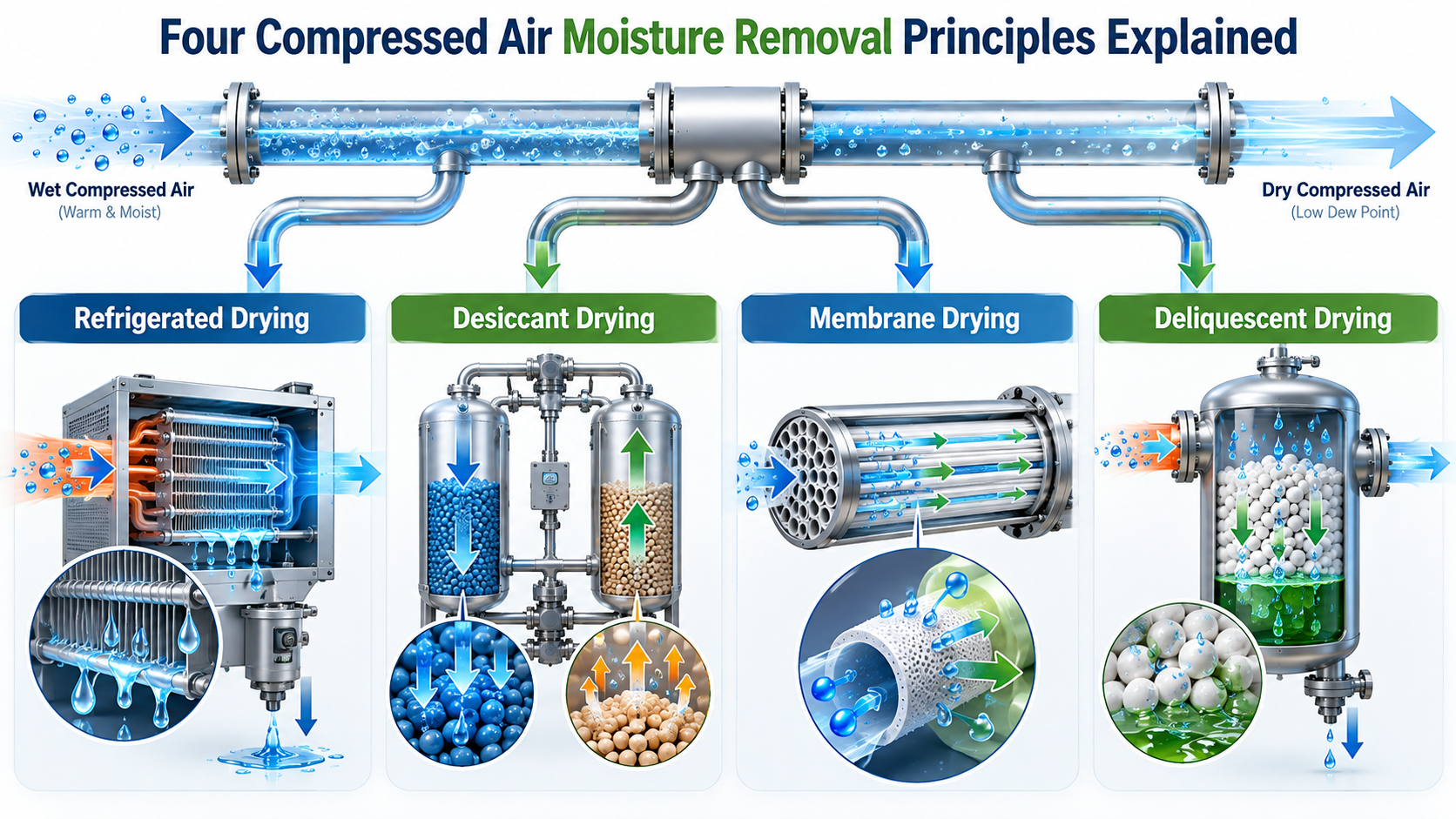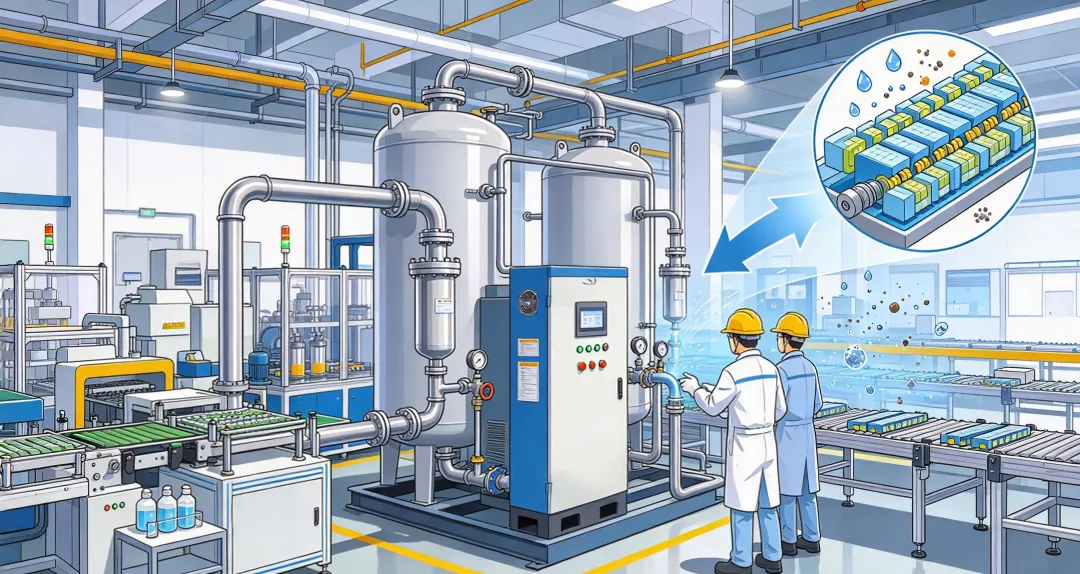
Moisture is one of the main contaminants that must be controlled in a compressed-air system.
Ambient air naturally contains water vapor. After the air is compressed and subsequently cooled, part of this moisture can condense into liquid water. If it is not properly removed, the result may include pipeline corrosion, equipment problems, production interruptions, and reduced product quality.
A refrigerant air dryer, more commonly called a refrigerated air dryer in industrial compressed-air applications, removes this moisture by cooling the compressed air and separating the resulting condensate.
For many general industrial applications, this technology offers a practical balance of moisture removal, energy consumption, installation complexity, and maintenance.
Users exploring available configurations can begin with Lingyu’s refrigerated air dryer product range.
What Is a Refrigerated Air Dryer?
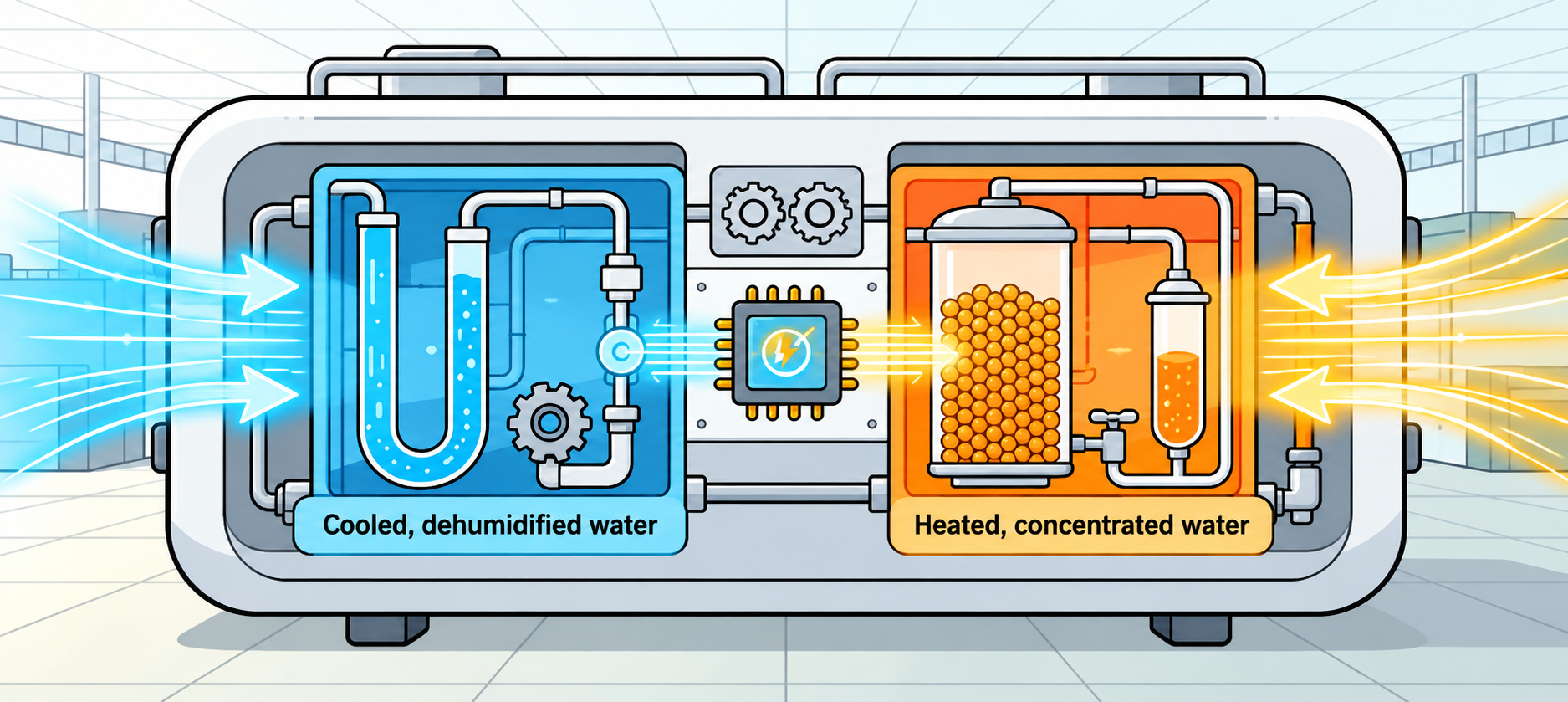
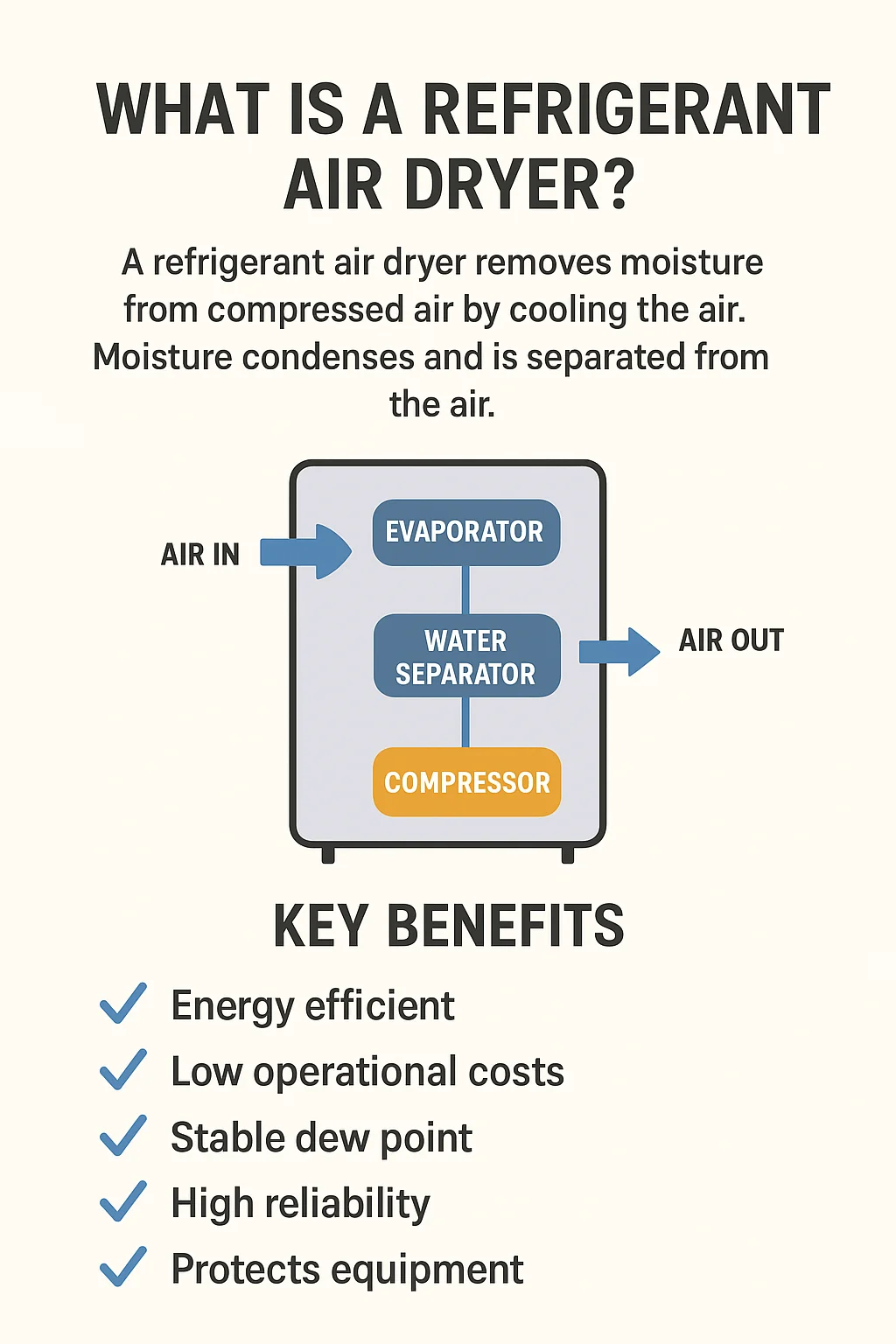
A refrigerated air dryer removes water vapor by lowering the temperature of compressed air.
As the air cools, its ability to retain water vapor decreases. Moisture condenses into liquid water, which is separated from the compressed air and discharged through a drain system.
The dried air is then normally reheated before leaving the dryer.
Lingyu’s standard air-cooled refrigerated dryers provide a pressure dew point of approximately 2–10°C under their specified operating conditions.
This pressure dew point is suitable for many general industrial compressed-air applications where extremely low dew points are not required.
How Does a Refrigerated Air Dryer Work?
The complete process involves more than simply passing compressed air across a cold surface.
1. Warm, Moist Compressed Air Enters the Dryer
Compressed air entering the dryer contains water vapor and may also carry oil and other contaminants from the upstream compressed-air system.
In a typical refrigerated dryer, the incoming air first passes through a pre-cooling or air-to-air heat exchange section.
This reduces the thermal load on the refrigeration system.
2. The Compressed Air Is Further Cooled
The pre-cooled air enters the evaporator, where it exchanges heat with the refrigeration circuit.
The compressed-air temperature decreases until water vapor begins to condense.
For Lingyu’s standard refrigerated dryer configurations, the resulting pressure dew point is approximately 2–10°C under the specified operating conditions.
3. Condensed Moisture Is Separated
As the compressed air cools, water, together with some oil and impurities, forms liquid condensate.
A gas-liquid or air-water separator removes this condensate from the compressed-air stream.
An automatic drain then discharges the collected liquid from the system.
This separation stage is critical. Cooling the air without effectively removing the condensed liquid would not provide reliable moisture control.
4. The Dry Air Is Reheated
Before leaving the dryer, the cool dried air passes back through the air-to-air heat exchanger.
It absorbs heat from the incoming compressed air and is reheated toward ambient temperature.
This improves internal heat recovery and helps reduce undesirable condensation associated with cold outlet air.
The complete process therefore follows a pre-cooling, refrigeration cooling, condensation, separation, drainage, and reheating sequence.
Main Components of a Refrigerated Air Dryer
Although designs vary, the principal functions generally include pre-cooling, refrigeration, moisture separation, drainage, reheating, and automatic control.
Heat exchanger design can have a significant influence on energy efficiency and pressure drop.
For example, Lingyu’s 3-in-1 plate heat exchange refrigerated air dryer integrates the evaporator, air-to-air heat exchanger, and water separator into a compact aluminum-alloy plate heat exchanger.
For the PD Series, pressure drop at full load is ≤0.015 MPa, while the pressure dew point is 2–10°C under the specified operating conditions. The 3-in-1 design can also reduce overall energy consumption by approximately 20–30% compared with the referenced conventional heat-exchange configuration. These figures apply to the relevant series rather than to every refrigerated dryer.
Types of Refrigerated Air Dryers
Industrial refrigerated dryers can be configured in several ways according to cooling method, heat exchanger design, pressure-drop requirements, and load profile.
| Configuration | Main Characteristic | Typical Selection Consideration |
|---|---|---|
| Standard air-cooled refrigerated dryer | Uses ambient air to reject refrigeration heat | General industrial installations |
| Water-cooled refrigerated dryer | Uses cooling water for heat rejection | Larger systems or sites with suitable cooling water |
| Plate heat exchanger dryer | Compact integrated heat exchanger | Low pressure drop and energy efficiency |
| Variable-frequency dryer | Adjusts compressor speed with load | Variable compressed-air demand |
| Low-pressure-differential dryer | Designed to reduce system resistance | Energy-sensitive compressed-air stations |
The right configuration depends on actual operating conditions rather than one type being universally superior.
Air-Cooled vs. Water-Cooled Refrigerated Dryers
Cooling method is one important design difference.
Air-cooled units reject refrigeration heat to ambient air. They are generally convenient where sufficient ventilation is available and a cooling-water circuit is not desired.
Water-cooled designs use cooling water to remove heat from the refrigeration system and can be appropriate for larger installations or facilities where suitable cooling water is already available.
Lingyu offers both configurations within its refrigerated air dryer range.
For installations where heat exchanger construction is a primary consideration, users can also review the shell-and-tube refrigerated air dryer.
Variable-Frequency Refrigerated Air Dryers
Compressed-air demand is rarely constant in every factory.
When production load drops, the actual air-treatment requirement may be significantly lower than the system’s peak design condition.
Variable-frequency technology addresses this by adjusting refrigeration compressor speed according to the treatment load.
Lingyu’s PB Series automatically regulates compressor operating frequency according to actual air-treatment demand. The control system monitors parameters including inlet and outlet air temperatures, pressure dew point, compressed-air pressure, refrigeration temperatures, and refrigeration pressures. RS-485 communication is standard for the series.
Facilities with significantly changing compressed-air loads can therefore evaluate a frequency conversion refrigerated air dryer.
This type of load-responsive control allows refrigeration output to follow changing operating demand rather than relying on a fixed full-load operating approach.
Why Pressure Drop Matters
Dryer energy efficiency is not only about electrical consumption.
Compressed air must also pass through heat exchangers, separators, piping, and other components inside the dryer. These components create resistance.
If pressure drop becomes excessive, the compressor may need to operate at a higher discharge pressure to maintain the required downstream pressure.
That can increase overall compressed-air system energy consumption.
For applications where this is particularly important, a low-pressure-differential refrigerated dryer may be relevant.
In one installation, four 85 m³/min refrigerated dryers combined low-pressure-drop and variable-frequency technologies. Terminal pressure increased from 6.45 bar to 6.8 bar, while overall energy savings were approximately 39% under the specific project conditions.
This project result should not be treated as a guaranteed saving for other installations because actual performance depends on the complete compressed-air system and operating conditions.
Key Benefits of a Refrigerated Air Dryer
The main advantage is practical moisture removal for applications that do not require extremely low pressure dew points.
A properly selected refrigerated dryer can help reduce liquid water in downstream piping, protect pneumatic equipment, improve production stability, and reduce moisture-related maintenance problems.
Another advantage is that refrigerated dryers do not require periodic desiccant regeneration.
This makes their operating principle relatively straightforward compared with regenerative adsorption drying.
However, refrigerated dryers should not automatically be assumed to consume less energy than desiccant dryers in every application. Total energy consumption depends on dryer design, required pressure dew point, airflow, pressure drop, regeneration method, loading pattern, and operating hours.
Refrigerated Air Dryer vs. Desiccant Air Dryer
The required pressure dew point is usually the most important distinction between these two technologies.
Lingyu refrigerated dryers generally provide pressure dew points around 2–10°C, depending on the series and operating conditions.
Adsorption dryers are designed for substantially lower pressure dew points, with many Lingyu desiccant systems offering −20°C or −40°C, depending on the model and configuration.
A refrigerated dryer is therefore usually appropriate when the objective is general industrial moisture control, while adsorption drying becomes more relevant when the process requires substantially drier compressed air.
For a detailed comparison, users can read the refrigerated air dryer vs. desiccant air dryer guide.
Choosing a lower pressure dew point than the process actually requires can add unnecessary capital and operating cost.
Where Are Refrigerated Air Dryers Used?
Refrigerated dryers can serve a broad range of general industrial compressed-air applications.
In automotive and general manufacturing, compressed air may support assembly equipment, pneumatic tools, automation, and general production processes.
They are also relevant in food and beverage manufacturing, although the required compressed-air quality should always be determined by where and how the air contacts the process or product.
Electronics manufacturing can also use refrigerated drying for appropriate general-purpose compressed-air loads, while more moisture-sensitive processes may require adsorption drying instead.
Refrigerated dryers are used in industrial environments including semiconductor, electrical appliance, energy-storage, photovoltaic, foundry, and aluminum production.
A Refrigerated Dryer Does Not Replace Filtration
Removing moisture is not the same as removing every contaminant from compressed air.
Compressed air can contain liquid water, water vapor, oil, and solid particles. A complete treatment system therefore often combines drying with filtration.
For applications with defined oil and particle requirements, a precision compressed air filter may be installed as part of the overall purification system.
This distinction is important because a refrigerated dryer should not automatically be described as producing “high-purity” or “contamination-free” compressed air on its own.
How to Choose the Right Refrigerated Air Dryer
Selection should be based on actual operating conditions, not simply compressor nameplate capacity.
The key parameters are maximum required airflow, operating pressure, inlet air temperature, ambient or cooling-water conditions, required pressure dew point, allowable pressure drop, cooling method, load variation, drainage requirements, and future system demand.
For example, Lingyu’s standard air-cooled AH Series is rated at 0.7 MPa inlet pressure, with an operating range of 0.6–1.0 MPa, a rated inlet temperature of 50°C, a maximum inlet temperature of ≤80°C, and a pressure dew point of 2–10°C.
These operating conditions demonstrate why simply selecting a dryer “slightly above compressor output” is not a sufficient sizing method.
A dryer that appears large enough by CFM alone can still be incorrectly sized if actual inlet temperature, pressure, or ambient conditions differ substantially from the rated conditions.
Energy Efficiency and Controls
Modern refrigerated air dryers can use several approaches to improve efficiency.
These may include high-efficiency heat exchangers, reduced pressure drop, automatic drainage, multiple refrigeration compressors, automatic capacity control, or variable-frequency operation.
For example, Lingyu standard refrigerated dryer models from 5 to 180 m³/min use a 1+1 dual-compressor configuration. The second refrigeration compressor automatically starts or stops according to system load. Optional PLC control is available, while dry contacts, Modbus communication, IoT connectivity, and other functions can also be configured according to requirements.
The PB Series takes load matching further by continuously adjusting refrigeration compressor speed according to actual air-treatment demand.
Users evaluating lifecycle energy cost should therefore compare not only rated electrical power but also load profile, pressure drop, control strategy, and annual operating hours.
Maintenance Considerations
Refrigerated dryers still require regular maintenance even though they do not use regenerating desiccant beds.
Typical service items can include refrigeration compressors, condensers, evaporators, filter driers, expansion devices, fans, pressure instruments, and condensate drains.
Keeping heat exchangers clean and condensate drains operating correctly is particularly important for maintaining reliable moisture removal.
Maintenance intervals should be based on the specific dryer configuration, operating environment, loading conditions, and condition of the compressed-air system.
Conclusion
A refrigerant air dryer, or more precisely a refrigerated air dryer, removes moisture from compressed air through a controlled cooling, condensation, separation, drainage, and reheating process.
For many industrial applications, a pressure dew point around 2–10°C provides an effective balance between moisture control and operating efficiency.
Available designs include standard air-cooled and water-cooled units, plate heat exchanger systems, low-pressure-drop configurations, and variable-frequency dryers designed to adapt to changing compressed-air demand.
The best dryer is not simply the largest available model. It should be selected according to airflow, operating pressure, inlet temperature, ambient conditions, pressure dew point, allowable pressure drop, load profile, cooling method, and overall compressed-air quality requirements.
For a specific application, users can contact Lingyu with their operating parameters for appropriate equipment selection.