Nitrogen is one of the most widely used gases in modern industry. From food packaging and pharmaceutical production to electronics, laser cutting, and chemical processing, nitrogen helps manufacturers create controlled atmospheres, limit oxidation, protect sensitive materials, and support consistent production.
Because nitrogen is naturally abundant in air, many industrial facilities do not need to depend entirely on cylinders or bulk gaseous nitrogen deliveries. An on-site nitrogen generation system can separate nitrogen from compressed air and produce it according to the purity and flow requirements of the application.
For businesses with regular gaseous nitrogen demand, understanding what nitrogen is, how industrial nitrogen is produced, and how to select the right nitrogen generator can help improve process control and operating efficiency.
What Is Nitrogen?
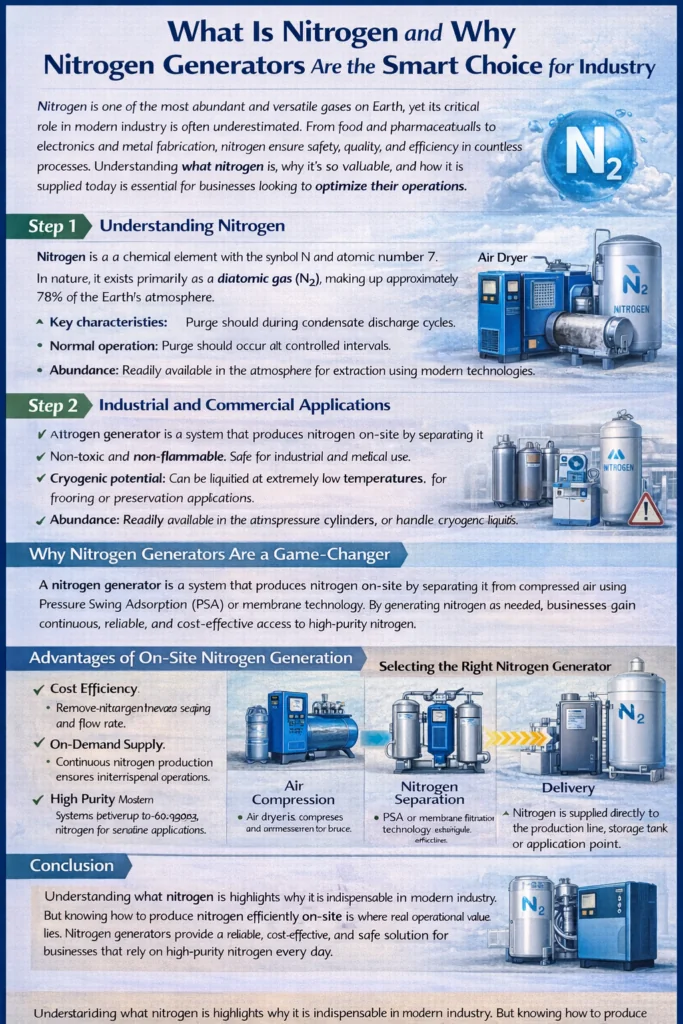
Nitrogen is the chemical element with the symbol N and atomic number 7. Under ordinary atmospheric conditions, it is primarily present as molecular nitrogen, N₂.
Nitrogen makes up roughly 78% of Earth’s atmosphere, making ambient air an abundant feed source for industrial nitrogen generation.
One of nitrogen’s most useful industrial characteristics is its relatively low reactivity under normal conditions. This allows nitrogen to be used where manufacturers need to reduce exposure to oxygen or maintain a controlled gas atmosphere.
Important characteristics include:
- Low reactivity under normal conditions: useful for inerting, blanketing, and atmosphere control.
- Non-flammable: nitrogen does not burn or support ordinary combustion.
- Available from ambient air: industrial systems can separate nitrogen from compressed air on-site.
- Available at different purity levels: nitrogen quality can be selected according to the actual process requirement.
For a more detailed discussion of its safety properties, see nitrogen flammability and industrial applications.
Nitrogen should not, however, be described as completely safe. Large releases can displace oxygen in enclosed or poorly ventilated areas, creating an asphyxiation hazard. Suitable ventilation, monitoring, operating procedures, and risk assessment remain important.
Why Nitrogen Is So Valuable in Industry
The main industrial value of nitrogen comes from its ability to reduce oxygen exposure.
When nitrogen is introduced into a process vessel, package, pipeline, or production environment, it can lower oxygen concentration and establish a more controlled atmosphere.
Depending on the application, this can help reduce oxidation, protect sensitive materials, improve process consistency, or support specific process conditions.
This is why nitrogen is used across many otherwise very different industries.
Food and Beverage Applications
Nitrogen is widely used in food and beverage production for packaging, tank blanketing, and selected processing operations.
In packaging applications, nitrogen can replace part of the oxygen in the package atmosphere. This can help limit oxidation and support preservation of characteristics such as flavor, appearance, and freshness when combined with appropriate packaging.
For facilities evaluating compressed-air and gas requirements for food production, Lingyu provides dedicated food and beverage industry solutions.
The required nitrogen purity should still be based on the actual product and process rather than automatically selecting the highest available grade.
Pharmaceutical and Biopharmaceutical Applications
Nitrogen can be used in pharmaceutical manufacturing for blanketing, purging, packaging, atmosphere control, and selected laboratory or production processes.
Different pharmaceutical operations may require different specifications for nitrogen purity, pressure, dew point, and other gas-quality parameters.
For this sector, Lingyu provides dedicated pharmaceutical and biopharmaceutical solutions and a more specific nitrogen generator for pharmaceutical industry guide.
Liquid nitrogen used for cryogenic storage should be distinguished from gaseous nitrogen produced by a conventional PSA nitrogen generator. A standard PSA system produces gaseous nitrogen; it is not a liquid-nitrogen production system.
Electronics and Semiconductor Manufacturing
Electronics and semiconductor processes often require controlled atmospheres to reduce oxidation and protect sensitive manufacturing operations.
Depending on the process, nitrogen may be used for soldering, component production, purging, storage, semiconductor processing, or other precision-manufacturing steps.
Nitrogen purity requirements can vary significantly, so the generator should be selected according to the actual process specification rather than a universal purity target.
Metal Fabrication and Laser Cutting
Nitrogen is commonly used as an assist gas in laser cutting, particularly where reducing oxidation on the cut surface is important.
Gas consumption in laser cutting can be substantial, making on-site nitrogen generation worth evaluating for facilities with predictable and recurring demand.
Required nitrogen purity, flow, and delivery pressure depend on factors such as material type, thickness, laser power, nozzle design, and cutting conditions.
For this sector, Lingyu provides dedicated metal fabrication and laser cutting solutions.
Users with elevated pressure requirements should also distinguish between nitrogen generation and nitrogen compression. A PSA generator produces nitrogen, while additional booster compression may be required where the process requires significantly higher delivery pressure.
Chemical and Petrochemical Applications
Nitrogen is widely used in chemical and petrochemical processes for tank blanketing, purging, inerting, material transfer, and atmosphere control.
By reducing oxygen concentration in a controlled system, nitrogen can help limit unwanted oxidation and reactions involving oxygen-sensitive materials.
Lingyu provides dedicated petrochemical and chemical processing solutions for this sector.
Actual inerting requirements should always be determined according to the chemical process, materials involved, required oxygen concentration, vessel design, process conditions, and applicable safety requirements.
How Does a Nitrogen Generator Work?
Lingyu nitrogen-generation equipment uses Pressure Swing Adsorption (PSA) technology.
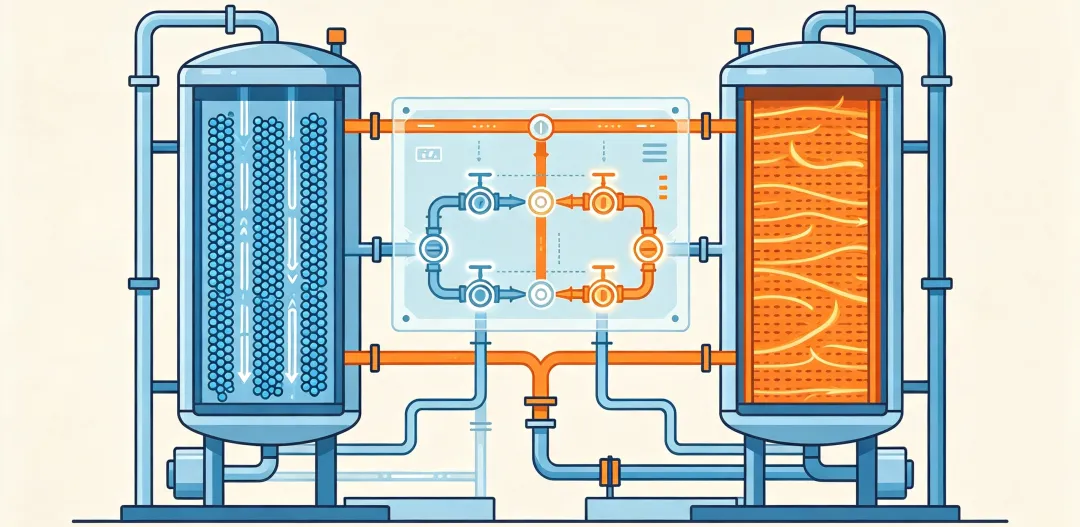
The PSA system contains two adsorption vessels filled with Carbon Molecular Sieve (CMS).
Compressed air enters one adsorption tower. Oxygen molecules are preferentially adsorbed by the CMS, while nitrogen passes through the adsorption bed and is collected as product gas.
At the same time, the second adsorption tower undergoes depressurization and regeneration. Once the operating cycle is complete, the towers automatically switch roles.
By continuously alternating between adsorption and regeneration under automatic control, the system can provide a continuous nitrogen supply.
For a more detailed explanation, see how a PSA nitrogen generator works.
What Equipment Is Included in an On-Site Nitrogen System?
A nitrogen generator does not operate entirely by itself.
A complete PSA system depends on a properly designed compressed-air supply and appropriate air-treatment and gas-handling components.
Depending on the installation, a complete system can include an air compressor, air receiver, compressed-air dryer, filtration, PSA nitrogen generator, nitrogen buffer tank, pressure-control components, nitrogen/oxygen analyzer, off-spec gas outlet, and product nitrogen distribution.
A simplified arrangement is:
Air compressor → air receiver → compressed-air treatment → PSA nitrogen generator → nitrogen buffer → gas-quality monitoring → point of use
This illustrates an important engineering principle: nitrogen-generator performance depends not only on the adsorption towers but also on the quality and stability of the compressed-air feed.
Where more demanding moisture control is required, an appropriate desiccant air dryer may need to be evaluated as part of the upstream treatment system.
What Nitrogen Purity Can a PSA Generator Produce?
The correct nitrogen purity depends on the process.
Lingyu’s PSA nitrogen generator supports a nitrogen purity range of 95% to 99.999%, with a nitrogen dew point of ≤−40°C under the specified operating conditions.
Available configurations include:
99.0% → 99.5% → 99.9% → 99.99% → 99.999%
This range demonstrates why nitrogen purity should be selected according to actual operating requirements rather than treating one maximum purity level as appropriate for every application.
Users evaluating higher-purity applications can review Lingyu’s 99.99% nitrogen generator configuration.
For applications requiring additional purification beyond the base PSA configuration, a carbon-based deoxygenation purification system can upgrade approximately 99.9% nitrogen to ≥99.999%.
Why Generate Nitrogen On-Site?
Traditionally, many companies obtain nitrogen through high-pressure cylinders or bulk liquid nitrogen supply.
These methods remain appropriate for some facilities, particularly where gaseous nitrogen consumption is low or irregular, or where liquid nitrogen itself is required.
For plants with continuous gaseous nitrogen demand, however, on-site PSA generation can provide several operational advantages.
Continuous Production
The twin-tower PSA design alternates automatically between adsorption and regeneration, allowing continuous nitrogen generation at the specified purity.
This can reduce dependence on delivery schedules for routine gaseous nitrogen consumption.
Purity Matched to the Application
On-site generators can be configured according to the nitrogen purity actually required by the process.
This matters because unnecessarily specifying maximum purity can affect compressed-air demand, usable nitrogen capacity, system sizing, and operating efficiency.
Automated Monitoring
The PSA system includes online monitoring of nitrogen purity and flow rate.
If nitrogen purity falls below the specified value, the system can provide an alarm. If the off-spec condition continues for a preset period, the equipment can shut down automatically for protection.
Automated Operation
PLC-controlled pneumatic valves manage the adsorption and regeneration sequence, while the touchscreen displays important operating parameters such as pressure, nitrogen purity, flow rate, and system status.
Reduced Dependence on Cylinder Handling
On-site generation can reduce routine cylinder replacement and associated handling requirements where gaseous nitrogen is consumed continuously.
It does not automatically eliminate every storage or pressure-system requirement because buffer tanks and downstream pressure equipment may still form part of the installation.
Is an On-Site Nitrogen Generator Always Cheaper?
Not necessarily.
The economic advantage depends on the facility’s actual nitrogen demand and operating conditions.
A proper comparison should consider nitrogen consumption, required purity, operating hours, electricity cost, compressed-air efficiency, equipment investment, maintenance, filters, adsorbent, installation, and any downstream compression or storage required.
Cylinder or bulk-supply costs should also include delivery, rental, logistics, storage, handling, and losses.
For facilities evaluating the business case, the nitrogen generator cost and ROI guide provides a more appropriate next step than assuming on-site generation is always the lowest-cost option.
Nitrogen Generator Safety
Generating nitrogen on-site can reduce some of the handling associated with delivered cylinders and cryogenic liquids, but it does not eliminate the need for appropriate safety engineering.
Nitrogen can displace oxygen in enclosed areas, creating an asphyxiation hazard.
Compressed-air systems, nitrogen receivers, piping, valves, and other pressure-containing components must also operate within their specified pressure and operating limits.
Suitable ventilation, leak management, operating procedures, pressure protection, and oxygen monitoring where justified by the site-specific risk assessment should therefore form part of the installation.
For a broader safety discussion, see nitrogen flammability and industrial safety.
How to Select the Right Nitrogen Generator
Choosing the correct nitrogen generator starts with understanding the application rather than selecting equipment solely by maximum purity or nominal capacity.
Important factors include nitrogen purity, average and peak flow rate, operating pressure, nitrogen dew point, daily operating hours, feed-air capacity, compressed-air quality, future expansion, buffer-storage requirements, monitoring needs, and maintenance access.
The system should also be sized according to simultaneous and peak demand rather than average consumption alone. Short periods of high nitrogen consumption can influence generator capacity and buffer-tank sizing.
Lingyu’s PSA nitrogen generator specifies an inlet air pressure of 0.5–0.8 MPa and nitrogen purity from 95% to 99.999% under its specified operating conditions.
For a more detailed selection process, see the PSA nitrogen generator selection guide.
Why a PSA Nitrogen Generator Can Be a Smart Industrial Choice
For companies with regular demand for gaseous nitrogen, one of the main advantages of an on-site PSA system is greater control over nitrogen production.
Instead of treating nitrogen entirely as a delivered consumable, the facility can generate it from compressed air according to its production schedule.
Nitrogen purity can be matched to the process, production capacity can be selected around actual consumption, and online monitoring can provide direct visibility into gas quality and system status.
Lingyu’s PSA nitrogen generator incorporates continuous twin-tower operation, automatic PLC control, real-time purity and flow monitoring, off-spec protection, and an optimized pressure-equalization process.
This optimized unequal-pressure equalization process improves nitrogen recovery efficiency and indirectly reduces overall energy consumption by approximately 5% under the specified system design.
Facilities considering on-site production can review Lingyu’s main industrial nitrogen generator product page for available configurations.
Conclusion
Understanding what nitrogen is helps explain why the gas has become so important across modern industry.
Its relatively low reactivity and non-flammable nature make nitrogen useful for controlled atmospheres, blanketing, purging, packaging, laser cutting, electronics manufacturing, pharmaceutical production, and chemical processing.
For businesses with steady gaseous nitrogen demand, on-site PSA generation can provide a practical alternative to relying entirely on delivered cylinders or bulk gaseous nitrogen.
A PSA nitrogen generator separates oxygen from compressed air using Carbon Molecular Sieve and alternating adsorption towers, allowing nitrogen to be generated continuously.
Lingyu’s PSA system supports 95% to 99.999% nitrogen purity, together with automatic PLC control, online nitrogen purity and flow monitoring, and off-spec protection.
The best nitrogen-generation system is not simply the one with the highest purity. It is the system that correctly matches purity, flow, pressure, dew point, feed-air quality, operating schedule, monitoring requirements, and future production demand.
When these parameters are properly defined, on-site nitrogen generation can provide manufacturers with greater control over nitrogen availability while reducing dependence on external gaseous-nitrogen supply.