In automotive refinishing, industrial coating, spray finishing, and other painting operations, compressed-air quality can directly affect the consistency of the finishing process.
Water vapor entering with ambient air can later condense inside a compressed-air system. Oil from an oil-lubricated compressor and solid particles from the air supply or piping can create additional contamination risks.
An air compressor dryer for painting therefore plays an important role in moisture control—but the dryer should normally be considered as one part of a complete compressed-air treatment system that may also include filters, separators, drains, receivers, and point-of-use treatment.
For painting operations, this distinction matters because dry compressed air can still contain oil or particles if filtration is inadequate.
Why Compressed-Air Quality Matters for Painting
A spray-painting system depends on compressed air to atomize coating material and deliver it through the spray gun.
If excessive moisture, oil, or particles reach the painting process, they can contribute to finish defects, unstable spraying, contamination, equipment fouling, and additional rework.
Moisture-related problems may become more noticeable when compressed air cools in downstream piping or hoses and liquid condensate forms close to the point of use.
Oil contamination creates a separate challenge because it can affect production equipment, coating quality, and overall process reliability.
For this reason, a painting system should not focus only on “removing water.”
It should control moisture, oil, and particles according to the actual coating process.
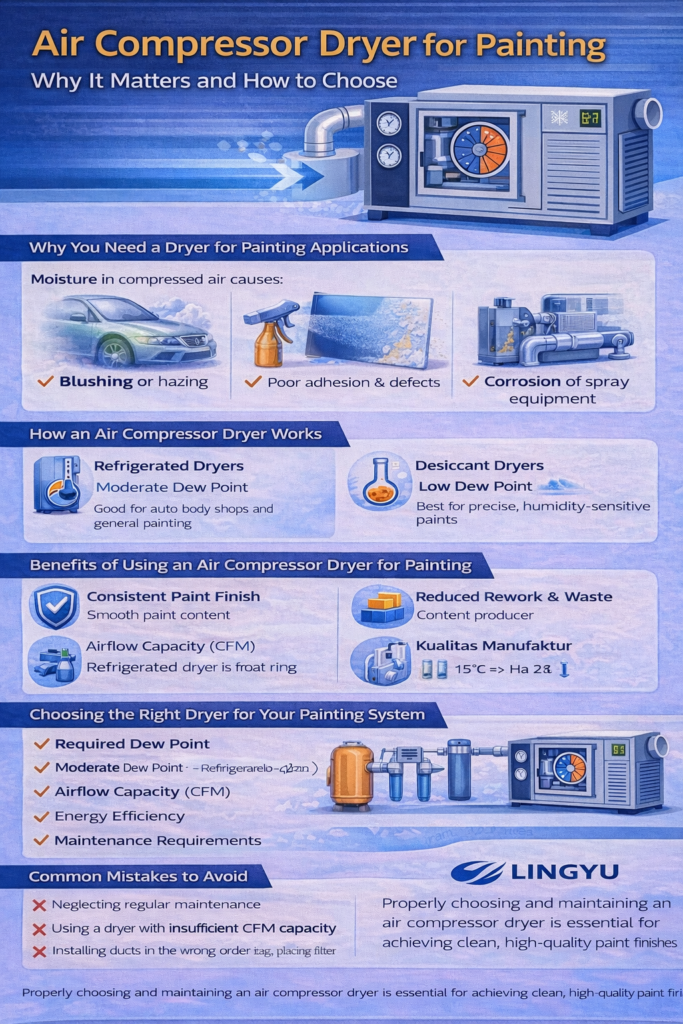
How Moisture Enters a Painting Air System
Every compressor draws in atmospheric air containing water vapor.
When that air is compressed, the concentration of water vapor increases. The compressed air is also heated during compression.
As the air later cools in the aftercooler, receiver, piping, or treatment equipment, its capacity to retain water vapor decreases. Once saturation conditions are reached, part of the water vapor condenses into liquid water.
Liquid water and water vapor can contribute to problems such as corrosion, freezing, pneumatic-control issues, and reduced product quality.
An air dryer reduces the remaining water vapor so that downstream compressed air maintains a pressure dew point appropriate for the application.
Refrigerated Air Dryers for Painting
For many general painting and industrial finishing systems, a refrigerated air dryer is a practical starting point.
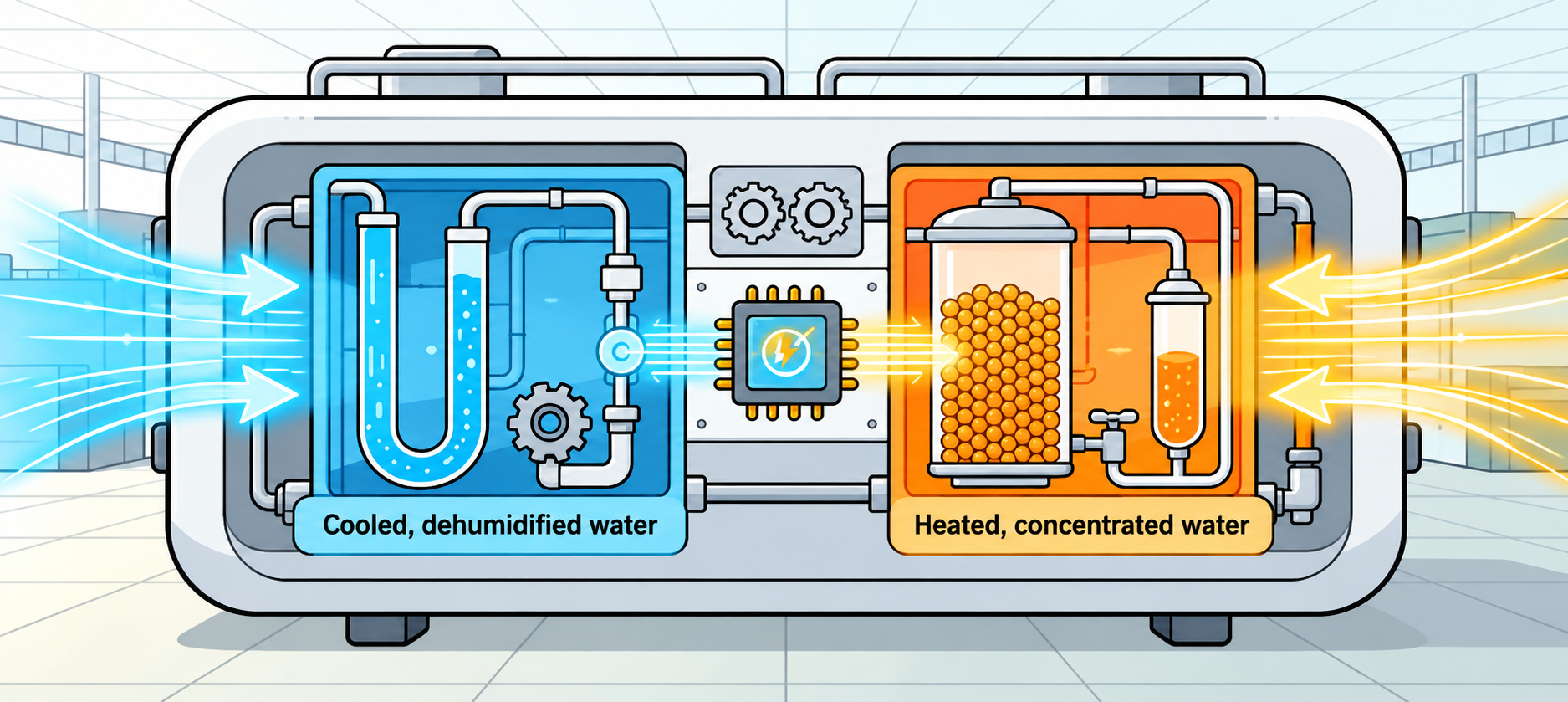
A refrigerated dryer cools compressed air so that water vapor condenses. The liquid condensate is separated and discharged, and the treated compressed air is then reheated toward ambient temperature before continuing downstream.
Depending on the series and operating conditions, Lingyu refrigerated dryers generally provide a 2–10°C pressure dew point.
This level of drying can be appropriate for many indoor automotive and general industrial painting applications when downstream temperatures remain safely above the selected pressure dew point.
However, a refrigerated dryer does not automatically make compressed air suitable for painting. Appropriate oil and particulate filtration must still be considered.
For additional technical detail, see how a refrigerated air dryer works.
When Should You Consider a Desiccant Dryer?
A desiccant air dryer may be more appropriate when the painting process requires substantially lower moisture levels than a refrigerated dryer can provide.
This may include demanding coating processes, very low downstream temperatures, or production environments where condensation risk must be minimized more aggressively.
Adsorption dryers remove residual water vapor using desiccant material. In regenerative designs, one adsorption bed dries the compressed air while another regenerates, allowing continuous operation.
Lingyu provides heatless, heated-purge, modular, blower-heated, zero-purge, and heat-of-compression regenerative adsorption dryer configurations.
Depending on the series, pressure dew point configurations around −20°C and −40°C are available.
This does not mean every high-quality painting process requires a −40°C pressure dew point.
The correct target should come from the coating specification, environmental conditions, downstream piping temperature, and actual production requirements.
Refrigerated or Desiccant: Which Is Better for Painting?
Neither technology is universally better.
For an indoor auto body shop or general industrial finishing line, a refrigerated dryer can often provide sufficient moisture control if the required pressure dew point is moderate.
Where substantially drier compressed air is required, or where piping and hoses may encounter temperatures low enough to create condensation, adsorption drying may be justified.
The important question is whether the selected pressure dew point prevents unwanted downstream condensation under actual operating conditions.
For a broader comparison, see refrigerated air dryer vs. desiccant air dryer.
A Dryer Does Not Remove Every Painting Contaminant
A dryer primarily controls moisture.
A painting air system may also need to control:
- Oil aerosols
- Oil vapor
- Dust
- Rust particles
- Other solid contamination
These contaminants require appropriate treatment in addition to drying.
Lingyu’s precision compressed air filter provides filtration options for different particulate and oil-removal requirements.
A more accurate treatment concept for painting is therefore:
Appropriate dryer + appropriate filtration + correct drainage + suitable piping + point-of-use treatment where required
Simply installing a dryer does not automatically make the compressed air clean enough for every painting process.
Why Oil Control Is Especially Important for Painting
Oil contamination deserves separate attention because even well-dried compressed air can still contain oil aerosols or oil vapor.
Potential sources include oil-lubricated compressors as well as contaminants entering with the surrounding atmospheric air.
Depending on the compressor system and required air quality, oil-control equipment can include appropriate coalescing filtration, oil-removal treatment, and other purification stages.
For painting applications, the required filtration level should be determined from the coating process and spray-equipment specifications.
If oil contamination is the main problem, purchasing a dryer with a lower pressure dew point alone will not solve it.
Select the Dryer by Pressure Dew Point
Pressure dew point is one of the most useful parameters when selecting a painting air dryer.
It indicates the temperature at which moisture will begin to condense from the compressed air at the operating pressure.
For general indoor painting where temperatures remain moderate, a refrigerated dryer’s 2–10°C pressure dew point may be sufficient.
If downstream piping could become colder than the expected pressure dew point, condensation may still occur.
In that case, a lower-dew-point drying technology may be required.
Do not select a desiccant dryer simply because “lower is better.” Deeper drying involves different equipment, regeneration requirements, energy consumption, and maintenance.
The target should be dry enough for the process without unnecessary over-drying.
Size the Dryer for Actual Airflow
Dryer capacity should be matched to the compressed-air flow the painting system can actually demand.
Do not size solely from average spray-gun consumption.
The calculation should consider:
- Compressor output
- Number of spray stations
- Simultaneous spray-gun use
- Other pneumatic equipment sharing the system
- Normal airflow
- Peak production demand
- Inlet pressure
- Inlet temperature
- Expected future demand
If the dryer is undersized, it may not maintain its rated pressure dew point during high-load periods.
Inlet pressure and temperature also matter because dryer capacity changes when actual operating conditions differ from rated conditions.
For broader selection guidance, see Lingyu’s compressed air dryer buyer’s guide.
Consider Inlet Temperature and Ambient Conditions
Hot compressed air can carry a greater moisture load into the drying system.
A dryer sized correctly at one inlet temperature may perform differently if it receives substantially hotter compressed air.
Ambient conditions also influence air-cooled equipment.
A painting shop operating in a cool, climate-controlled environment has different conditions from a coating plant operating in a hot production area.
Actual inlet-air temperature, ambient temperature, operating pressure, and airflow should therefore be considered before selecting the dryer.
Pressure Drop Also Affects Painting-System Efficiency
Painting systems need sufficient pressure at the point of use to maintain stable equipment operation.
Every filter, dryer, hose, regulator, valve, and section of piping introduces some resistance.
Excessive pressure drop can require higher upstream compressor pressure and increase energy consumption.
A dryer should therefore be evaluated not only by pressure dew point but also by its pressure drop at the required airflow.
For example, Lingyu’s DD Series low-pressure-drop refrigerated dryer is specified at a full-load pressure drop of <0.01 MPa.
For additional information, see the guide to compressed-air pressure drop and system efficiency.
A Typical Painting Air-Treatment Arrangement
A painting compressed-air system may include:
Air compressor → aftercooling where applicable → air receiver → condensate drainage → appropriate pre-filtration → dryer → downstream filtration → distribution piping → point-of-use regulation or filtration
The exact sequence should be adjusted according to the compressor configuration, dryer requirements, filtration design, piping layout, and painting process.
The dryer should therefore not be assumed to belong in one universal position for every compressed-air installation.
Final equipment placement should follow the dryer’s installation requirements and the actual compressor-station design.
Do You Need Point-of-Use Filtration?
In painting applications, the distance between the compressor room and spray booth can matter.
Even when central treatment is effective, downstream piping can introduce rust, scale, or other particles.
Where the coating process is especially sensitive, additional treatment close to the spray equipment may be appropriate.
This does not mean every facility should install the same filter configuration.
Point-of-use filtration, regulator arrangement, pressure requirements, and acceptable contaminant levels should be matched to the painting system and spray-equipment requirements.
Common Selection and Installation Mistakes
Several mistakes can reduce painting-air quality:
- Choosing a dryer only by compressor horsepower instead of corrected airflow and inlet conditions
- Assuming dry air is automatically oil-free and particle-free
- Selecting an unnecessarily low pressure dew point without a process requirement
- Ignoring pressure drop through filters and dryers
- Failing to maintain automatic condensate drains
- Using saturated or damaged filter elements
- Placing treatment equipment without considering downstream piping contamination
- Ignoring peak simultaneous demand from multiple spray stations
These are often system-design or maintenance problems rather than failures of the dryer itself.
Painting in Automotive Manufacturing and Refinishing
Automotive painting is a natural application for high-quality compressed-air treatment, but it is useful to distinguish between a small repair shop and a large manufacturing coating line.
A body shop may operate intermittently with only a few spray tools.
A production facility may have multiple booths, continuous compressed-air demand, automated controls, and substantially greater airflow.
The dryer and filtration system should therefore be sized according to actual production conditions rather than simply being labelled an “automotive air dryer.”
Lingyu’s automotive and general manufacturing solutions provide additional context for plant-scale compressed-air treatment.
Maintenance Matters as Much as Dryer Selection
Even a correctly sized dryer cannot maintain performance indefinitely without appropriate maintenance.
For refrigerated dryers, maintenance may involve:
- Condensate drains
- Heat exchangers
- Condensers
- Refrigeration components
- Controls
For desiccant systems, maintenance may also involve:
- Valves
- Silencers
- Desiccant
- Controls
- Associated filters
- Heaters or blowers where fitted
Filters are particularly important in painting systems because excessive differential pressure or exhausted elements can restrict airflow or reduce contamination-control performance.
Maintenance intervals should follow actual operating conditions and equipment requirements rather than relying on one universal replacement schedule.
How to Choose an Air Compressor Dryer for Painting
Before purchasing a dryer, define the actual painting-system requirements.
Key information should include:
- Maximum compressed-air flow
- Operating pressure
- Inlet temperature
- Ambient conditions
- Lowest downstream temperature
- Required pressure dew point
- Acceptable oil level
- Acceptable particle level
- Compressor type
- Number of spray stations
- Operating hours
- Acceptable pressure drop
- Maintenance requirements
Then determine whether refrigerated drying provides sufficient moisture control or whether a lower-dew-point adsorption system is justified.
Finally, select the necessary upstream and downstream filtration separately rather than expecting the dryer alone to solve all contamination problems.
For a broader system-level explanation, see the air compressor filters and dryers guide.
Conclusion
An air compressor dryer for painting is an important part of maintaining stable compressed-air quality in automotive refinishing, industrial coating, and precision finishing applications.
Its primary function is moisture control.
For many general painting systems, a refrigerated dryer providing approximately 2–10°C pressure dew point can be a practical solution when downstream conditions allow it.
Where substantially lower moisture levels are required, a desiccant dryer providing pressure dew points such as −20°C or −40°C, depending on the selected series, may be more appropriate.
However, successful painting-air treatment requires more than a low pressure dew point. Oil and particulate contamination must also be controlled with appropriate filtration and separation equipment.
The best solution therefore combines the correct dryer, filtration, drainage, piping arrangement, pressure control, and maintenance strategy according to the actual painting process.
Rather than asking only, “Which dryer is best for painting?”, the more useful question is:
What combination of pressure dew point, oil control, particle filtration, airflow, and pressure stability does the painting process actually require?