Moisture is one of the most common contaminants in a compressed air system. Ambient air naturally contains water vapor, and once that air is compressed and subsequently cooled, part of the moisture can condense into liquid water. If it is not properly removed, the result may include pipeline corrosion, control-system problems, freezing, equipment damage, and reduced product quality.
That is why an air dryer assembly can be such an important part of a reliable compressed air installation.
Rather than thinking of it as one individual component, it is more useful to think of an air dryer assembly as an integrated air-treatment arrangement built around a compressed air dryer, together with the filtration, separation, drainage, piping, and controls required for the application.
Understanding how these elements work together can help you design a more reliable compressed air dryer system and avoid treating the dryer as an isolated piece of equipment.
What Is an Air Dryer Assembly?
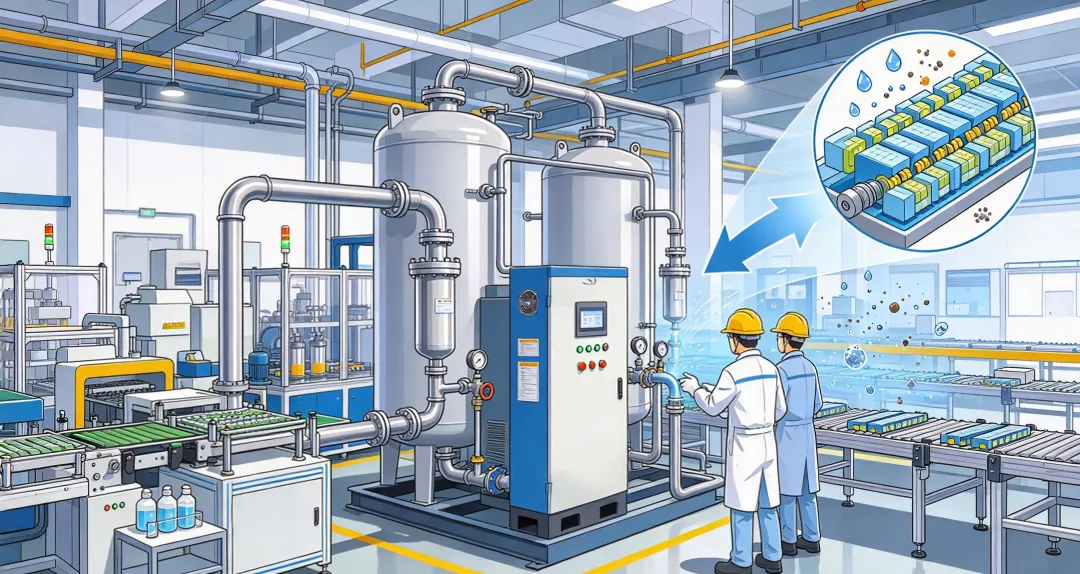
An air dryer assembly is a group of compressed air treatment components configured to reduce moisture and, where required, remove oil aerosols and solid contaminants before the compressed air reaches downstream equipment.
The exact configuration is not universal. Depending on air quality requirements and operating conditions, the system may incorporate an air receiver, pre-filtration, a refrigerated or desiccant air dryer, air-water separation, automatic condensate drainage, downstream filtration, gauges, valves, sensors, and control equipment.
This distinction matters because a dryer alone does not remove every type of compressed air contamination.
Water, oil, and solid particles may all be present in the compressed air stream. Filters and dryers therefore perform different but complementary functions, which is why many installations combine compressed air filters and dryers rather than depending on one treatment device.
Industrial compressed air treatment systems can use air receivers, refrigerated dryers, desiccant dryers, and different grades of filtration according to the required air quality.
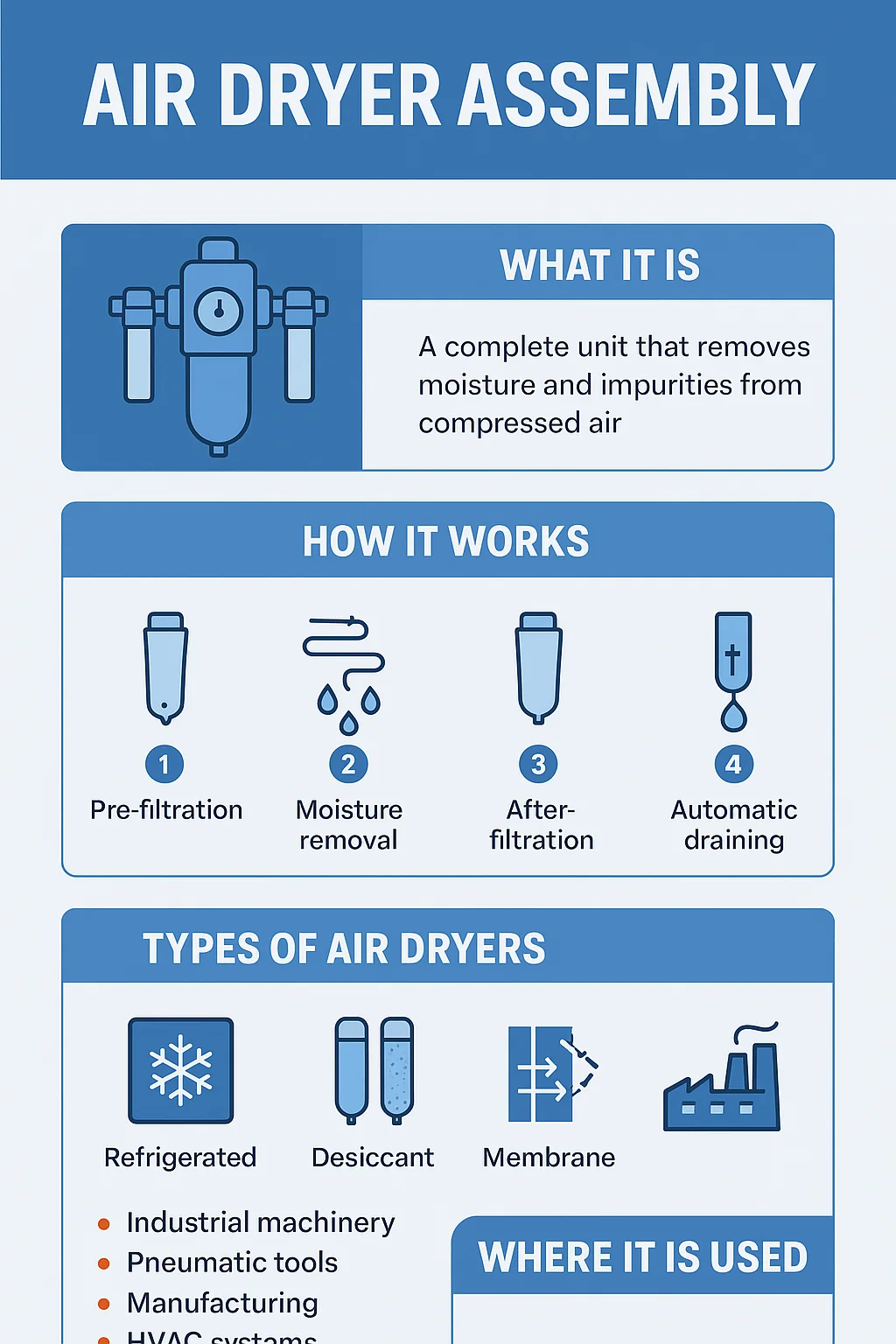
Typical Components of an Air Dryer Assembly
Although the final arrangement depends on the application, a typical industrial assembly can include an air dryer, pre-filter, downstream filter, air-water separator, automatic drain, isolation or control valves, pressure instrumentation, piping connections, and an electronic control system.
Each component has a different job.
The dryer primarily controls moisture and pressure dew point. Upstream filtration can help reduce oil and particulates before they reach sensitive drying components, while downstream filtration can capture remaining solid particles or desiccant dust where applicable. Condensate separators and automatic drains remove collected liquid water from the system.
The filtration arrangement should therefore be selected as part of the complete compressed air treatment system rather than added as an afterthought.
Why Moisture Control Is Critical
Compressed air does not become “wet” simply because a compressor creates water. The compressor takes in atmospheric air that already contains water vapor.
Compression increases the amount of water contained in a given volume of air. As the compressed air subsequently cools and reaches saturation, part of that vapor can condense into liquid water.
That moisture can become particularly troublesome in piping, pneumatic components, instruments, and production processes. Potential consequences include pipeline corrosion, reduced product quality, control-system failures, and freezing.
A correctly designed air dryer assembly therefore does more than simply “remove water.” Its purpose is to achieve a sufficiently low pressure dew point, control contaminants, and deliver compressed air of an appropriate quality to the point of use.
How Does an Air Dryer Assembly Work?
The exact process depends on the dryer technology, but a typical industrial system follows several treatment stages.
Stage 1: Initial Separation and Filtration
Compressed air first passes through the upstream treatment equipment required by the system design.
Filters may remove particles and oil aerosols, while separators and drains remove accumulated liquid condensate. This helps protect the dryer and downstream equipment.
Filter selection matters because excessive oil or particulate contamination can affect both air quality and dryer performance. For systems where filters are already installed, regular air dryer filter replacement should form part of the maintenance plan.
Stage 2: Moisture Removal
The compressed air then enters the dryer.
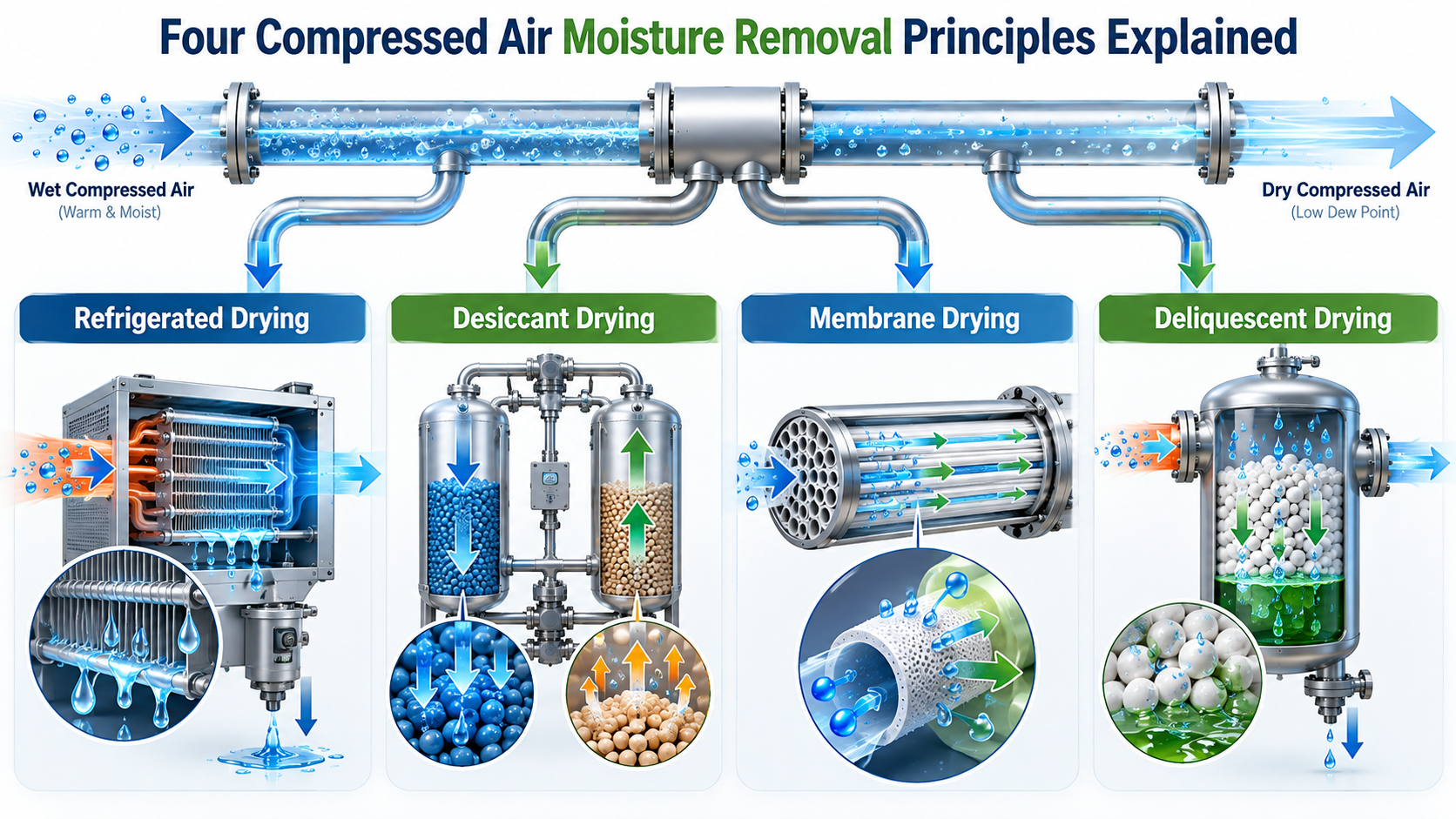
In a refrigerated air dryer, the air is cooled until moisture condenses. The liquid is separated and discharged, after which the treated air is typically reheated before leaving the dryer.
Lingyu’s AH Series, for example, cools compressed air to a pressure dew point of approximately 2–10°C, separates the resulting condensate through a gas-liquid separation process, and then reheats the dried compressed air through an air-to-air heat exchanger.
For a more detailed explanation of the refrigeration cycle, see what a refrigerant air dryer is and how it works.
In a desiccant air dryer, moisture is adsorbed onto a desiccant material. Regenerative systems typically use multiple vessels so that one vessel can dry compressed air while another undergoes regeneration.
This allows significantly lower pressure dew points than conventional refrigerated drying. Lingyu’s adsorption dryer range includes systems designed for outlet pressure dew points such as −20°C and −40°C, depending on configuration.
You can explore the process in more detail in this desiccant air dryer working principle guide.
Stage 3: Final Filtration
After drying, the compressed air may pass through downstream filtration.
This is especially relevant for adsorption dryers, where an appropriate particulate filter can help capture desiccant dust or other solid particles before the air reaches production equipment.
In combined drying systems, filtration can be positioned between and after different drying stages to control oil contamination and residual particulates.
Stage 4: Condensate Drainage
Any liquid water separated during treatment must leave the system.
Automatic drains are commonly used at separators, filters, receivers, and other condensate collection points. The correct drain arrangement depends on system pressure, condensate volume, energy-efficiency requirements, and maintenance strategy.
A dryer can operate correctly while the overall system still experiences moisture problems if condensate is not being discharged reliably.
Stage 5: Monitoring and Control
Modern industrial dryers may monitor parameters such as pressure, temperature, pressure dew point, and operating status.
Depending on the dryer design, controls can manage refrigeration capacity, adsorption and regeneration cycles, alarms, valve switching, and remote communications.
For example, selected Lingyu adsorption dryer configurations support RS-485 communication, touchscreen monitoring, and optional dew-point-based control.
Refrigerated vs. Desiccant Air Dryer Assemblies
The two main drying technologies are refrigerated and adsorption/desiccant drying, while combined systems can integrate both technologies.
| Factor | Refrigerated Dryer Assembly | Desiccant Dryer Assembly |
|---|---|---|
| Drying method | Cools compressed air so moisture condenses | Adsorbs water vapor onto desiccant |
| Typical dew-point requirement | Suitable for general industrial compressed air | Suitable where very low dew points are required |
| Lingyu reference performance | Approximately 2–10°C PDP on standard AH Series | −20°C / −40°C available on selected adsorption systems |
| Common strengths | Straightforward operation and general industrial drying | Deep drying and low-dew-point capability |
| Typical consideration | Refrigeration load and condensate removal | Regeneration method, purge consumption, and desiccant condition |
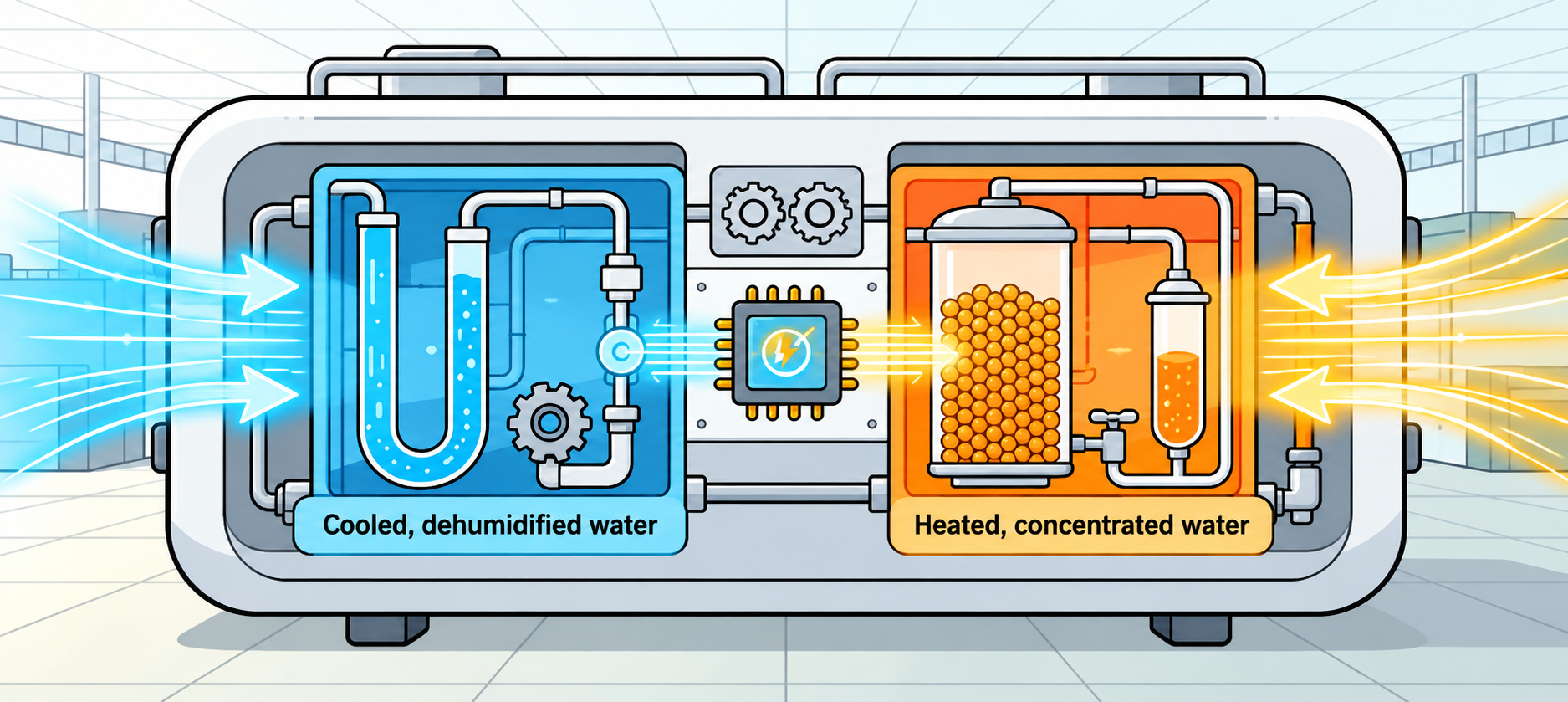
Lingyu also manufactures combined compressed air dryers, integrating refrigerated and adsorption drying in one system. In the combined process, refrigerated drying removes a large portion of the moisture first, reducing the moisture load placed on the adsorption stage.
DC and DH combined dryers can provide outlet pressure dew points of ≤−40°C, with different refrigerated, heatless-regeneration, and heated-purge configurations available.
Where Are Air Dryer Assemblies Used?
Air treatment requirements vary considerably between industries, so there is no single assembly suitable for every facility.
Industrial dryer systems may be used in manufacturing, machining, electronics, food and beverage operations, pharmaceutical production, petrochemical processing, automotive production, and other processes that rely on clean and controlled compressed air.
Compressed air treatment systems are also used in semiconductor, energy-storage, photovoltaic, pharmaceutical, food, petrochemical, new-energy, and other industrial applications.
Vehicle compressed-air systems are a separate design category. If the intended application is specifically a truck or trailer braking system, an industrial plant dryer should not automatically be treated as interchangeable with an automotive air brake dryer.
How to Choose the Right Air Dryer Assembly
Selection should begin with the required air quality and actual operating conditions, rather than simply choosing a dryer based on nominal compressor horsepower.
Important parameters include airflow, inlet pressure, inlet temperature, ambient conditions, required pressure dew point, contaminant load, allowable pressure drop, available installation space, regeneration method, and expected load variation.
Pressure drop deserves particular attention because every unnecessary restriction between the compressor and point of use can affect system efficiency. For a deeper explanation, see how compressed air pressure drop affects system efficiency.
For example, Lingyu’s AH refrigerated dryer has a rated inlet pressure of 0.7 MPa, an operating pressure range of 0.6–1.0 MPa, a rated inlet temperature of 50°C, and a pressure dew point of 2–10°C under its specified operating conditions.
These values illustrate why dryer selection should be based on the actual inlet and environmental conditions rather than flow capacity alone.
If you are comparing technologies and capacities, the compressed air dryer selection guide is a relevant next step.
Maintenance Matters as Much as Dryer Selection
Even a correctly sized assembly will not maintain design performance indefinitely without proper maintenance.
Filters can become restricted, drains can malfunction, heat exchangers can become contaminated, refrigeration components can lose performance, and desiccant can gradually degrade. These conditions may increase pressure drop, raise the outlet dew point, or reduce system reliability.
Maintenance should therefore consider the entire treatment train, not only the dryer itself.
When planning a new installation, it is also useful to consider the relationship among the compressor, air receiver, dryer, filtration, and distribution system. This air compressor and dryer setup guide covers that broader system perspective.
Benefits of a Properly Designed Air Dryer Assembly
A correctly selected and maintained system can reduce moisture-related corrosion, protect pneumatic equipment, improve process consistency, reduce contamination risk, and help maintain the required compressed-air dew point.
It can also reduce avoidable downtime, but this depends on proper sizing, installation, and maintenance. A dryer should therefore not be assumed to reduce operating costs simply because it is installed; the result depends on whether the complete compressed air treatment system matches the application’s actual requirements.
Final Thoughts
An air dryer assembly is more than an air dryer alone. In an industrial compressed air system, it is better understood as a coordinated group of drying, filtration, condensate-removal, and control components designed to deliver compressed air at the required moisture and cleanliness level.
For general industrial applications, refrigerated drying may provide the required pressure dew point with relatively straightforward operation. Processes that demand much drier air may require a regenerative desiccant dryer, while some installations can benefit from an integrated refrigerated-plus-adsorption configuration.
The key is not to choose the largest or most sophisticated dryer available. It is to match airflow, inlet temperature, pressure, required pressure dew point, contaminant level, pressure drop, and operating pattern to the actual process.