A reliable air compressor dryer setup is not defined by one universal equipment sequence. The correct arrangement depends on the required pressure dew point, air flow, operating pressure, compressor discharge temperature, contamination level, demand pattern, and point-of-use air-quality requirement.
A typical industrial installation may include a compressor, cooling and separation equipment, receiver capacity, filtration, an air dryer, condensate drainage, and downstream distribution. The important part is not simply installing these components—it is making sure they work together under the actual operating conditions.
This guide explains how to plan an air compressor dryer setup, where the main components fit into the system, and which installation mistakes can reduce drying performance or increase pressure loss.
What Is an Air Compressor Dryer Setup?
An air compressor dryer setup is the complete arrangement used to generate, cool, store, clean, dry, and distribute compressed air.
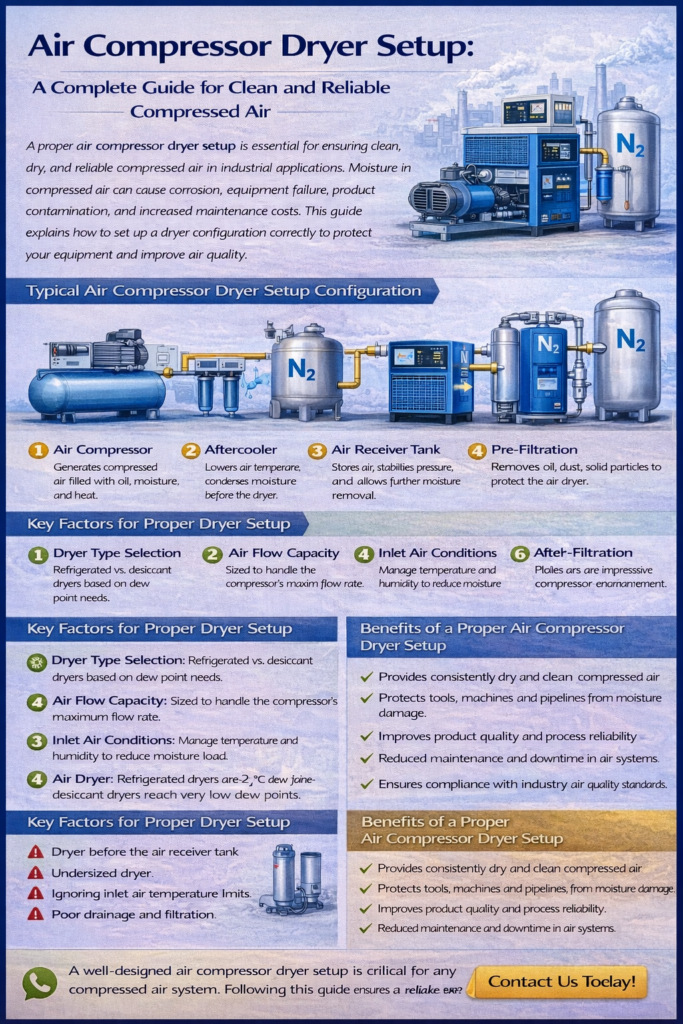
Depending on the application, the system may include:
- Air compressor
- Aftercooler or other cooling stage
- Air-water separator
- Air receiver tank
- Pre-filtration
- Refrigerated or desiccant air dryer
- Downstream filtration
- Condensate drains
- Piping, valves, and controls
Not every system requires every component in exactly the same location. The appropriate layout should start with the process requirements and then configure the treatment train around the required air quality and actual operating conditions.
Step 1: Start With the Compressor Operating Conditions
Before selecting or locating the dryer, determine what air the compressor will actually send into the treatment system.
Important parameters include:
- Actual maximum and normal air flow
- Compressor discharge pressure
- Discharge temperature
- Compressor operating profile
- Oil carryover risk
- Ambient temperature and humidity
- Expected future expansion
Compression increases the concentration of moisture in the air. As compressed air cools, excess water vapor can condense into liquid water. Water, oil, and solid particles are separate compressed-air contamination problems and require appropriate treatment methods.
The dryer should therefore be selected and installed based on the real inlet conditions rather than compressor nameplate flow alone.
For a broader explanation of compressor–dryer matching, see compressor and dryer system design.
Step 2: Remove Bulk Liquid Before Deep Drying
Compressed air leaving the compressor can contain significant heat and moisture. As the air cools, liquid condensate forms.
Cooling equipment, separators, drains, and receiver arrangements can help remove this bulk liquid before the air reaches sensitive treatment components. This is especially important for adsorption dryers, which are intended primarily to remove water vapor rather than handle large amounts of incoming liquid water.
A practical treatment sequence is:
Cool the air appropriately → separate condensed liquid → drain it reliably → perform deeper drying.
A failed separator or drain can make a correctly sized dryer appear undersized because the dryer is receiving a much higher moisture load than intended.
Step 3: Decide Where Receiver Capacity Is Needed
An air receiver provides compressed-air storage and can help stabilize short-term flow and pressure fluctuations. However, there is no universal rule that the receiver must always be upstream of the dryer.
A receiver before the dryer may help provide storage and stabilize conditions entering the air-treatment system. A receiver after the dryer can store already-treated compressed air and help satisfy short-duration downstream demand peaks. Some systems may use storage on both sides.
The correct arrangement depends on compressor control, demand profile, condensate-management strategy, required air quality, and available installation space.
For a more detailed explanation, see whether an air receiver tank should be used with an air dryer.
Step 4: Install Appropriate Pre-Filtration
Dryers should not be expected to remove every contaminant from compressed air. Oil, solid particles, and moisture are separate treatment problems.
Upstream filters can help protect dryer internals, valves, adsorbent, heat exchangers, and downstream equipment from contamination. The required filter arrangement depends on compressor type and final air-quality requirement.
Oil-removal and particulate filtration can therefore form part of the complete compressed-air purification system, including applications where oil-removal filtration is required ahead of an adsorption stage.
A precision compressed air filter can be incorporated into the dryer setup where the specified filtration level requires it.
Step 5: Choose the Dryer From the Required Dew Point
Dryer type should be selected according to the pressure dew point required by the downstream process.
Refrigerated Air Dryer
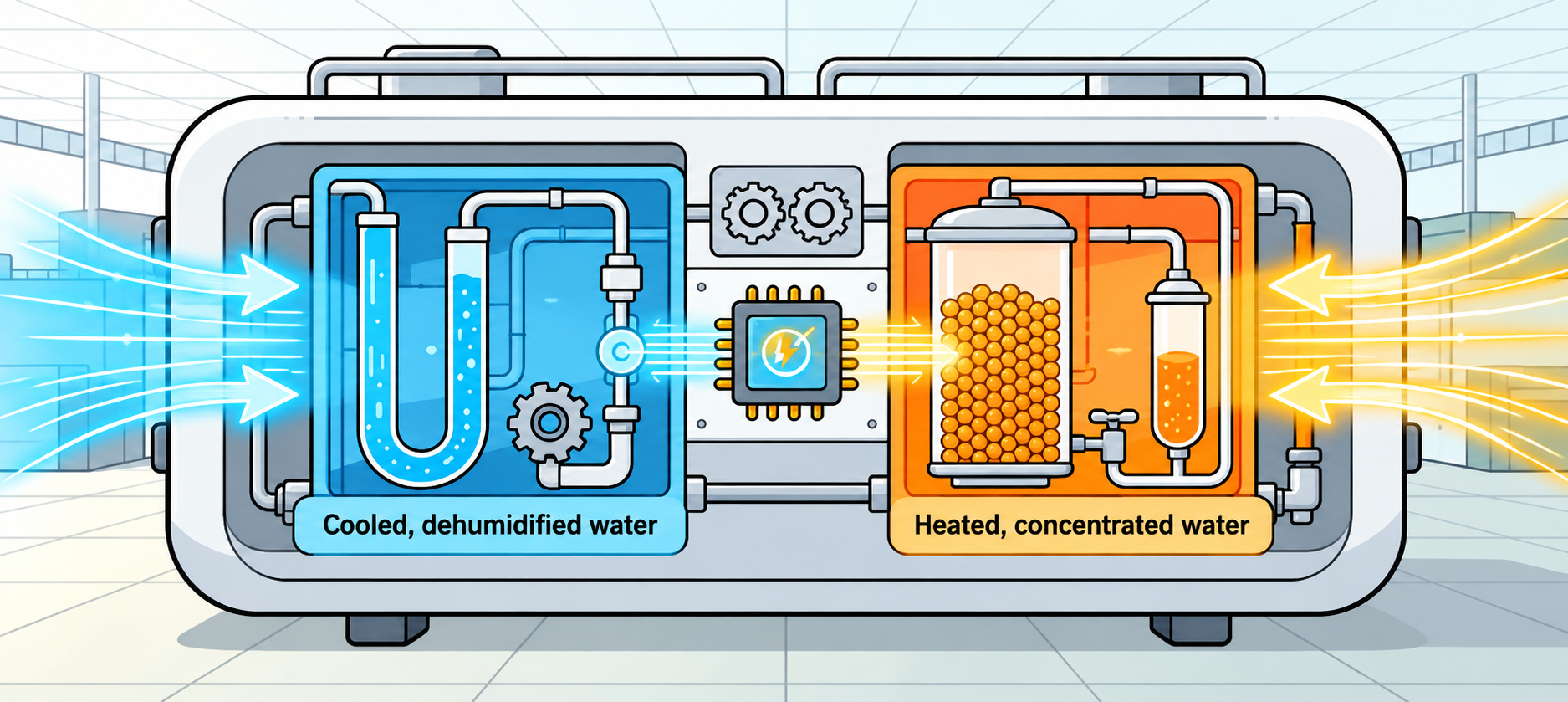
A refrigerated air dryer cools compressed air so that moisture condenses and can be separated.
Lingyu refrigerated drying systems can operate with a pressure dew point of approximately 2–10°C, depending on the system and operating conditions. This type of dryer is suitable where moderate moisture removal meets the process requirement.
Desiccant Air Dryer
A desiccant air dryer removes water vapor through adsorption and can achieve substantially lower pressure dew points.
For example, Lingyu’s HH heatless regenerative series specifies an outlet pressure dew point of ≤−40°C under its stated operating conditions. Other Lingyu adsorption dryer families provide different dew-point configurations.
The correct dryer should therefore be selected from the actual process requirement rather than choosing desiccant drying simply because the application appears to require more advanced treatment.
Step 6: Match Dryer Capacity to Real Operating Conditions
A dryer should not be sized only from the compressor’s nominal flow.
Actual dryer capacity can be affected by:
- Inlet temperature
- Inlet pressure
- Actual flow
- Moisture load
- Ambient conditions
- Required dew point
For example, Lingyu’s HRB-E low-purge blower-heated dryer has a rated inlet pressure of 0.7 MPa, an operating pressure range of 0.6–1.0 MPa, a rated inlet temperature of 10–30°C, and a maximum inlet temperature of ≤40°C.
These figures are operating conditions for that model family rather than universal values for every dryer.
When designing the setup, compare the intended compressor output and site conditions with the rating basis of the actual dryer being selected.
Step 7: Consider Combined Drying When the Process Justifies It
Some systems use refrigerated and adsorption drying in sequence.
In a combined drying system, the compressed air is first precooled and refrigerated, reducing its moisture content before it enters the adsorption stage. This reduces the moisture load on the adsorption system, lowers regeneration-air consumption, and helps extend desiccant service life.
This does not mean every compressed-air system should install two dryers. Combined drying is appropriate only when the required dew point, operating conditions, energy balance, and lifecycle cost justify the additional treatment stage.
Step 8: Install Downstream Filtration Where Required
After the dryer, filtration may still be required depending on the application and dryer type.
For example, an adsorption dryer can generate fine desiccant particles over time, so downstream particulate filtration may be used to prevent carryover into the distribution system. In combined drying systems, a high-efficiency particulate filter after the adsorption stage can remove residual dust and desiccant particles.
The required downstream filter grade should be selected according to the actual air-quality specification. A single generic afterfilter configuration should not be assumed to be suitable for every process.
Step 9: Design Condensate Drainage as Part of the Setup
Condensate removal is an integral part of the compressed-air treatment system.
Water collected in separators, receivers, filters, or dryers must be discharged reliably. If drains fail, liquid water can move downstream and increase dryer moisture load or contaminate the compressed-air system.
Drain selection should account for condensate volume, system pressure, operating hours, and maintenance requirements.
Select a drain system that reliably removes condensate while minimizing unnecessary compressed-air loss.
Step 10: Control Pressure Drop Through the Entire System
A dryer setup can meet the required dew point and still perform poorly if the system creates too much pressure loss.
Pressure drop can occur across:
- Separators
- Filters
- Dryers
- Valves
- Piping
- Fittings
- Contaminated filter elements
The design should therefore be based on the pressure required at the final point of use, not only on compressor discharge pressure.
Undersized piping or excessive treatment pressure drop may encourage operators to increase compressor pressure unnecessarily, increasing operating cost.
For more detail, see compressed air pressure drop and system efficiency.
Step 11: Leave Enough Space for Cooling and Maintenance
Installation layout should support both equipment performance and maintainability.
The dryer should have sufficient access for filter replacement, valve service, drain maintenance, electrical work, heat-exchanger cleaning where applicable, and desiccant service where required.
Cooling requirements also depend on the dryer type. Air-cooled equipment requires adequate ventilation around the heat-rejection surfaces, while water-cooled designs require the specified cooling-water conditions.
Do not place equipment solely according to the shortest piping route if doing so makes routine service difficult or restricts required airflow.
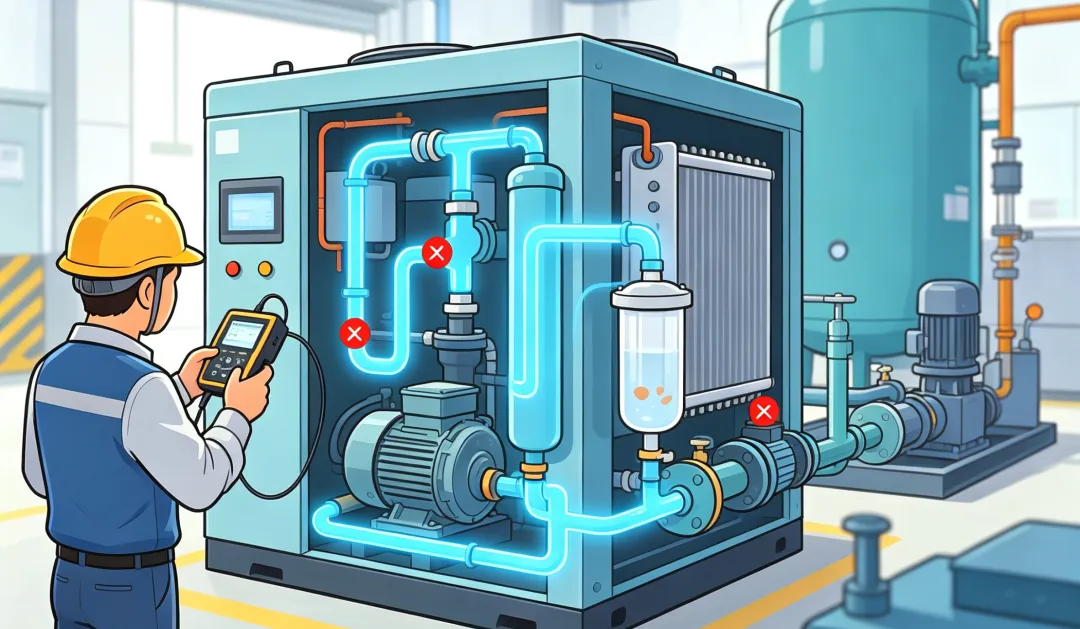
Step 12: Verify the Setup Before Commissioning
Before normal operation, verify that the installation matches the equipment design conditions.
Check:
- Airflow direction
- Piping and valve positions
- Compressor pressure and flow
- Dryer inlet pressure and temperature
- Separator and drain operation
- Filter installation
- Dryer operating sequence
- Outlet dew point
- Differential pressure
- Alarm and protection settings
- Bypass configuration
- Downstream pressure
Record the baseline values during commissioning. These readings provide useful references when troubleshooting future increases in dew point or pressure drop.
If the dryer later develops repeated high-dew-point problems, see the desiccant air dryer troubleshooting guide for a more focused diagnostic approach.
Common Air Compressor Dryer Setup Mistakes
Several installation and selection problems can reduce the performance of an otherwise suitable compressed-air treatment system.
Sizing Only by Compressor Nameplate Flow
Actual inlet temperature, pressure, flow, moisture load, and site conditions can change dryer performance. Dryer selection should be based on real operating conditions.
Allowing Liquid Water to Reach an Adsorption Dryer
Failed separation or drainage can substantially increase the moisture load entering the adsorption stage and reduce drying performance.
Using the Wrong Dryer for the Required Dew Point
A lower pressure dew point should be specified because the process requires it, not simply because a desiccant dryer appears more advanced.
Ignoring Pressure Drop
A clean-air system cannot perform its intended function if production equipment does not receive the required operating pressure.
Poor Filtration
Oil and solid particles can contaminate valves, dryers, adsorbent, and downstream equipment. Filtration should therefore be selected as part of the complete air-treatment system.
Treating Receiver Position as Universal
Receiver location should be determined by system function, compressor control, demand characteristics, and condensate-management requirements rather than by following one fixed piping diagram.
Ignoring Maintenance Access and Ventilation
A good piping layout should not make the dryer, filters, drains, or other treatment equipment difficult to service or restrict the airflow required by air-cooled equipment.
How to Select the Final Air Compressor Dryer Setup
A practical system-design sequence is:
Process air-quality requirement → required dew point → flow and peak demand → point-of-use pressure → compressor operating conditions → cooling and separation → receiver strategy → filtration → dryer type and capacity → condensate drainage → distribution → monitoring
If you are still deciding between dryer technologies, use the compressed air dryer selection guide before finalizing the installation layout.
Conclusion
A reliable air compressor dryer setup is not created by following one fixed piping diagram. It comes from matching the compressor, cooling and separation equipment, receiver capacity, filters, dryer, drains, and distribution system to the actual operating requirements.
The most important factors are:
Flow → pressure → inlet temperature → moisture load → required dew point → filtration → receiver strategy → pressure drop → drainage → maintenance access
When these variables are considered together, the compressed-air system is more likely to deliver stable air quality and dependable performance without unnecessary treatment or avoidable operating losses.