Nitrogen is widely used in industrial production, laboratories, food processing, electronics, chemical processing, metal fabrication, and other applications where oxygen concentration or atmospheric conditions must be controlled.
For facilities that consume nitrogen regularly, generating nitrogen onsite can reduce dependence on delivered cylinders or bulk liquid supply while providing gas when production requires it.
There is no single best nitrogen-generation method for every application. The correct solution depends on required purity, nitrogen flow, operating pressure, available utilities, installation space, and usage pattern.
What Is Nitrogen?
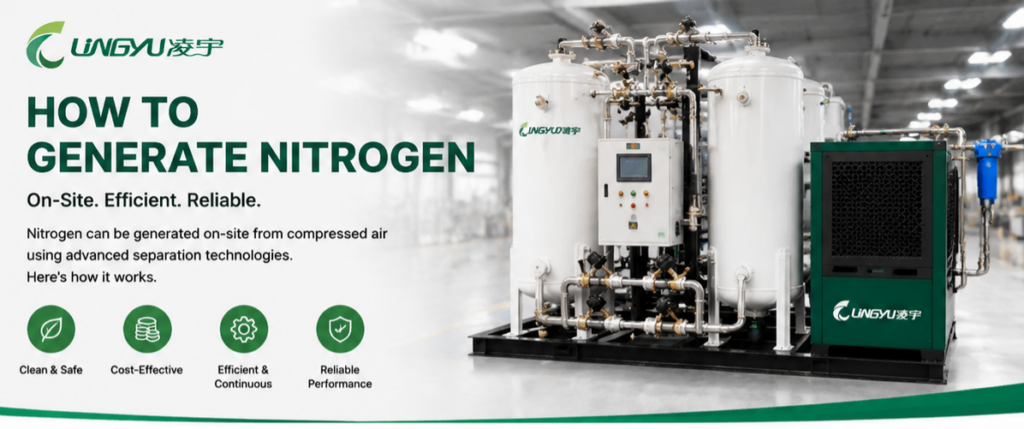
Nitrogen, or N₂, is the major component of atmospheric air.
It is commonly used where reducing oxygen exposure can help control oxidation, combustion risk, product deterioration, or process conditions.
Typical uses include:
- Inerting
- Blanketing
- Purging
- Food packaging
- Electronics manufacturing
- Chemical processing
- Laser cutting
- Pharmaceutical production
- Storage protection
- Controlled-atmosphere processes
The required nitrogen quality varies significantly between applications.
Some processes need only moderate nitrogen purity, while others require extremely low residual oxygen. Producing unnecessarily high purity can increase system size and operating demand, so purity should be selected according to the actual process requirement.
How Is Nitrogen Generated?
Industrial nitrogen is generally produced by separating nitrogen from atmospheric air.
Three commonly used technologies are:
- Pressure Swing Adsorption
- Membrane separation
- Cryogenic air separation
These technologies operate differently and are suited to different flow, purity, installation, and operating requirements.
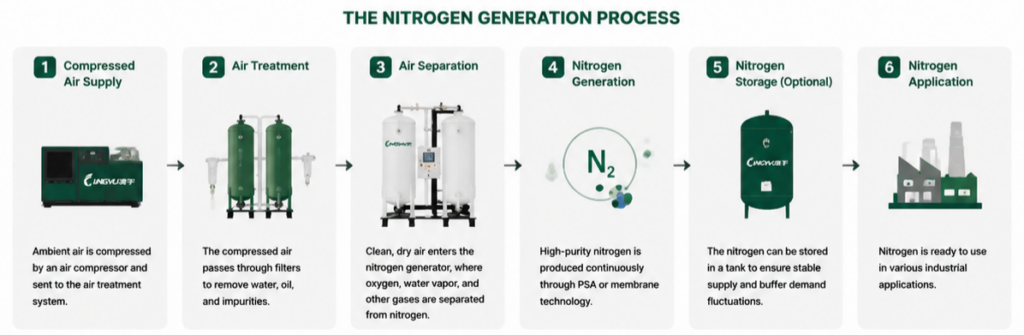
1. Pressure Swing Adsorption Nitrogen Generation
Pressure Swing Adsorption, or PSA, produces nitrogen from compressed air using Carbon Molecular Sieve, commonly abbreviated CMS.
Lingyu’s PSA system uses two adsorption vessels that alternate between nitrogen production and regeneration.
Step 1: Produce and Treat Compressed Air
Ambient air first enters an air compressor.
Before reaching the PSA adsorption vessels, the compressed air must be properly treated so that excessive moisture, oil, and particulate contaminants do not interfere with the adsorption system.
Typical pretreatment can include:
- Moisture separation
- Compressed-air drying
- Oil removal
- Precision filtration
- Condensate drainage
For a broader explanation of this stage, see the compressed air purification system components.
Step 2: Oxygen Is Adsorbed by Carbon Molecular Sieve
Treated compressed air enters the first adsorption tower.
The tower contains Carbon Molecular Sieve, which preferentially adsorbs oxygen under operating pressure while nitrogen passes through the adsorption bed and exits as product gas.
For a more detailed explanation of the separation process, see how PSA nitrogen generation uses Carbon Molecular Sieve.
Step 3: The Second Tower Regenerates
While one vessel produces nitrogen, the second vessel is depressurized.
As pressure falls, previously adsorbed oxygen is released from the Carbon Molecular Sieve and discharged.
A small quantity of nitrogen purge gas assists regeneration in the PSA process.
Step 4: The Towers Switch
When the active adsorption tower reaches its predetermined capacity, the control system switches the airflow.
The regenerated tower begins producing nitrogen while the saturated tower begins regeneration.
This alternating twin-tower operation allows continuous nitrogen production.
What Nitrogen Purity Can PSA Provide?
The required purity should be established before sizing the generator.
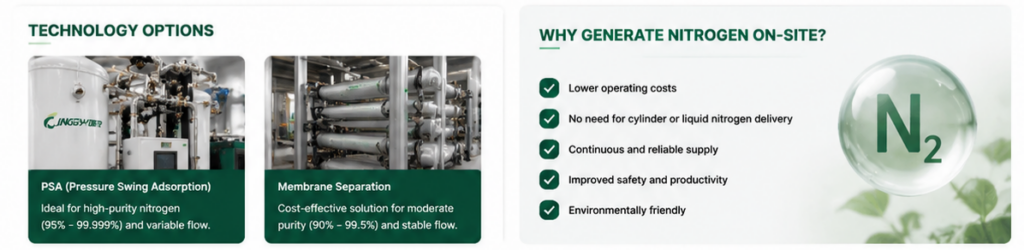
Lingyu’s PSA nitrogen-generator range provides nitrogen purity from 95% to 99.999%. Standard operating conditions include:
- Inlet air pressure: 0.5–0.8 MPa
- Inlet air temperature: ≤40°C
Product configurations are also available for specific purity levels, including 99%, 99.5%, and 99.99%.
The key point is that higher purity is not automatically better.
As nitrogen purity rises, oxygen removal becomes more demanding and nitrogen recovery can decrease. The correct operating point should therefore balance:
- Required residual oxygen
- Nitrogen demand
- Feed-air capacity
- Energy use
- Equipment size
- Operating cost
For users comparing these factors, the PSA nitrogen generator selection guide provides a more focused selection reference.
High-Purity Nitrogen Beyond Standard PSA Separation
Very high nitrogen purity may also be achieved through additional downstream purification rather than relying only on the primary PSA stage.
Lingyu’s carbon-based deoxygenation purification system is designed to take nitrogen at approximately 99.9% purity and further purify it to ≥99.999%.
In this process, residual oxygen reacts with a carbon-based material to form CO₂. The gas then undergoes additional adsorption purification and filtration to remove carbon dioxide, moisture, and particles.
This distinction is important because an application requiring ≥99.999% nitrogen does not necessarily need to achieve the entire purity increase through the primary PSA stage alone.
The complete generation and purification process should be selected according to required final gas quality, capacity, and operating conditions.
PSA vs. Membrane vs. Cryogenic Nitrogen Generation
The three main nitrogen-generation methods differ significantly in separation principle and system configuration.
| Factor | PSA | Membrane | Cryogenic |
|---|---|---|---|
| Separation principle | Adsorption using CMS | Selective membrane permeation | Low-temperature air separation |
| Typical installation | Onsite industrial systems | Compact onsite systems | Large industrial gas plants |
| Continuous production | Yes | Yes | Yes |
| High-purity capability | High, depending on configuration | Generally more suited to moderate purity | Very high purity possible |
| System complexity | Moderate | Relatively simple | High |
Membrane Nitrogen Generation
Membrane systems separate gases according to differences in permeation rates through specialized membrane fibers.
They can offer compact equipment arrangements and continuous operation, making them suitable for applications where moderate nitrogen purity and relatively simple system architecture are priorities.
Cryogenic Nitrogen Generation
Cryogenic air separation cools air to very low temperatures and separates its components according to their different boiling points.
The technology is generally associated with large-scale gas-production infrastructure and can achieve very high gas purity.
For onsite industrial users, the appropriate comparison should consider not only achievable purity but also nitrogen demand, utilities, installation complexity, operating pattern, and total cost.
Why Compressed-Air Quality Matters
A PSA nitrogen generator does not operate independently of the compressed-air system.
Feed-air quality has a direct effect on adsorption performance, valve reliability, CMS condition, and nitrogen quality.
Important factors include:
- Inlet pressure
- Inlet temperature
- Moisture content
- Oil contamination
- Particle contamination
- Flow stability
Lingyu’s PSA operating conditions specify an inlet pressure of 0.5–0.8 MPa and an inlet temperature of ≤40°C.
The nitrogen generator specification also provides a nitrogen dew point of ≤−40°C.
Correct upstream filtration and drying are therefore integral parts of the nitrogen-generation system.
Applications of Onsite Nitrogen Generation
The appropriate nitrogen system depends heavily on where the gas will be used.
Food and Beverage Processing
Nitrogen can be used in controlled-atmosphere and packaging processes where limiting oxygen exposure is important.
The required purity and flow should be selected according to the actual process rather than applying one universal nitrogen specification.
Pharmaceutical Production
Nitrogen can support controlled production environments, blanketing, purging, and other manufacturing processes.
Where residual oxygen limits are particularly strict, high-purity PSA or additional purification may be required.
Electronics Manufacturing
Nitrogen is commonly used in controlled manufacturing processes where oxidation must be limited.
Purity, flow, pressure, and gas quality should be selected according to the specific production process.
Chemical and Petrochemical Processing
Nitrogen can provide an inert atmosphere for storage, process equipment, purging, and other applications where oxygen control is important.
Oil, Gas, Offshore, and Marine Applications
Onsite nitrogen can reduce reliance on stored cylinders in installations that require regular purging or inerting.
For marine-specific operating considerations, see nitrogen generation for dual engine vessels.
Laser Cutting and Metal Fabrication
Nitrogen may be used as an assist or shielding gas in selected metal-processing applications.
For this application, see nitrogen supply for laser cutting.
Benefits of Onsite PSA Nitrogen Generation
Reduced Dependence on Delivered Nitrogen
Facilities that regularly consume nitrogen can generate gas as needed rather than relying entirely on cylinder deliveries.
This can simplify nitrogen supply where consumption is continuous or predictable.
Continuous Production
The twin-tower PSA process alternates adsorption and regeneration to maintain a continuous nitrogen supply.
Selectable Purity
Instead of producing the same gas purity for every process, PSA systems can be configured according to actual requirements.
Lingyu’s PSA range provides purity levels from 95% to 99.999%.
Automated Monitoring
Lingyu’s PSA design can incorporate:
- PLC-controlled pneumatic valves
- Online nitrogen-purity monitoring
- Flow monitoring
- Off-spec alarms
- Automatic protection
- CMS compaction
- Touchscreen monitoring
These functions support stable automatic operation and allow important system conditions to be monitored in real time.
Integration With Existing Compressed-Air Infrastructure
Where a facility already operates a suitable compressed-air system, PSA nitrogen generation can be incorporated into the broader air-treatment infrastructure.
The available compressor capacity and air-treatment system should still be checked to ensure that the generator receives sufficient clean, dry compressed air without negatively affecting other plant users.
How to Choose the Right Nitrogen Generation System
Selection should start with the process requirement rather than simply choosing the highest purity available.
Required Nitrogen Purity
Determine the maximum acceptable oxygen concentration at the point of use.
Do not specify 99.999% nitrogen unless the process genuinely requires it.
Nitrogen Flow Demand
Evaluate:
- Normal consumption
- Peak consumption
- Simultaneous users
- Purging demand
- Future capacity growth
The generator should be sized according to realistic operating demand rather than average consumption alone.
Feed-Air Availability
For PSA, determine whether the compressed-air system can provide enough treated air at the required pressure and temperature.
The standard Lingyu PSA operating conditions include 0.5–0.8 MPa inlet pressure and ≤40°C inlet air temperature.
Operating Conditions
Temperature, humidity, ventilation, and installation environment can all affect system performance.
Equipment should be selected and installed according to actual site conditions.
Usage Pattern
A laboratory with intermittent, low-volume use has very different requirements from a factory consuming nitrogen continuously.
For very small or irregular demand, onsite generation should be compared economically with delivered nitrogen rather than automatically assuming onsite production is the best option.
Total Operating Cost
Consider more than equipment purchase price.
Relevant factors include:
- Compressor energy
- Feed-air consumption
- Nitrogen recovery
- Filtration
- Dryer operation
- CMS maintenance
- Replacement parts
- Nitrogen storage
- Operating hours
A system that matches the actual purity and flow requirement can often avoid unnecessary compressed-air consumption and oversized equipment.
Which Nitrogen Generation Method Is Best?
There is no universal answer.
PSA is a practical onsite solution where industrial users need continuous nitrogen with selectable purity and have, or can provide, suitable compressed air.
Membrane separation may be appropriate where compact construction and moderate purity are priorities.
Cryogenic separation is generally suited to a different scale of nitrogen production and infrastructure, particularly where very large gas volumes or cryogenic gas-production capabilities are required.
The correct choice should therefore be based on required purity, flow, pressure, operating hours, utilities, installation conditions, and total cost rather than selecting a technology by name alone.
For users evaluating Lingyu equipment, the industrial PSA nitrogen generator range provides the relevant product entry point.
Conclusion
Understanding how to generate nitrogen begins with defining the required purity, flow rate, operating pressure, usage pattern, and available utilities.
PSA, membrane separation, and cryogenic air separation are different approaches to nitrogen production, and each serves different operating requirements.
For onsite industrial generation, Lingyu uses Pressure Swing Adsorption with Carbon Molecular Sieve and twin adsorption towers. The PSA system automatically alternates between adsorption and regeneration to provide a continuous nitrogen supply.
Lingyu’s PSA range supports nitrogen purity from 95% to 99.999%, with an inlet pressure of 0.5–0.8 MPa and inlet air temperature of ≤40°C.
Where exceptionally high purity is required, additional purification can also be considered rather than automatically oversizing the primary PSA stage.
For project-specific purity, capacity, and feed-air requirements, contact Lingyu for system selection and technical support.