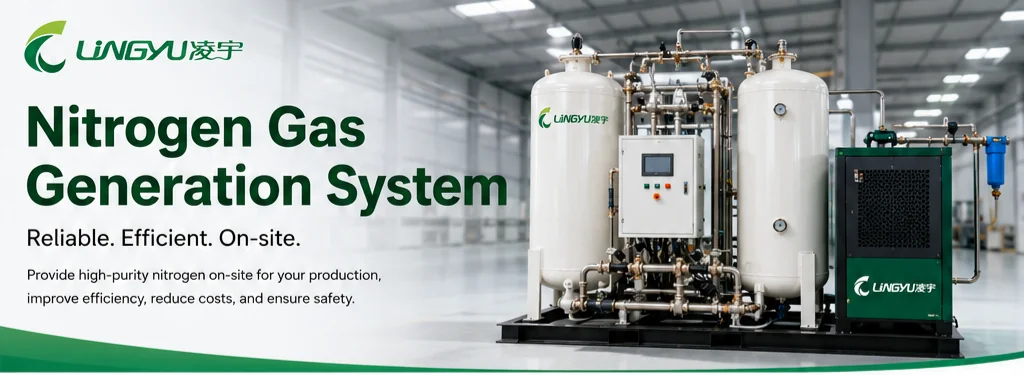
A stable nitrogen supply is important in many industrial processes where oxygen exposure must be controlled, products need protection from oxidation, or a reliable inert gas source is required.
A nitrogen gas generation system allows industrial users to produce nitrogen onsite from compressed air instead of relying entirely on cylinders or bulk liquid deliveries.
For facilities with regular nitrogen demand, onsite generation can improve supply independence and operating flexibility. However, the correct system should be selected according to required nitrogen purity, flow rate, feed-air conditions, operating hours, and actual process requirements.
What Is a Nitrogen Gas Generation System?
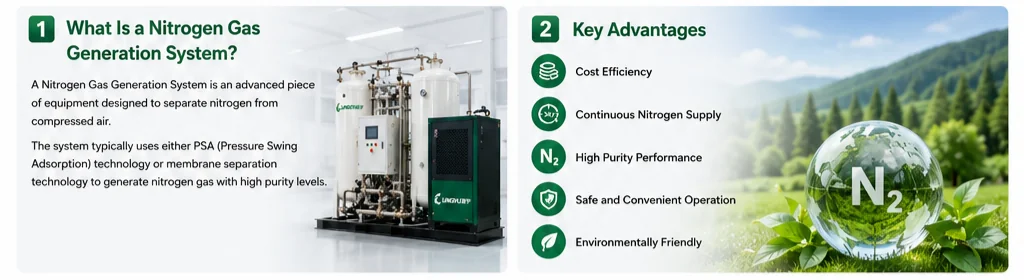
A nitrogen gas generation system separates nitrogen from atmospheric air to provide a controlled nitrogen supply at the point of use.
Lingyu uses Pressure Swing Adsorption, or PSA, for its industrial nitrogen-generation systems.
The PSA system contains two adsorption vessels filled with Carbon Molecular Sieve, or CMS. The towers alternate between adsorption and regeneration, allowing nitrogen to be generated continuously.
The generator can be integrated with compressors, dryers, filters, nitrogen receivers, controls, and downstream distribution equipment to form a complete onsite nitrogen supply system.
For a detailed explanation of the separation process, see how PSA nitrogen generation works.
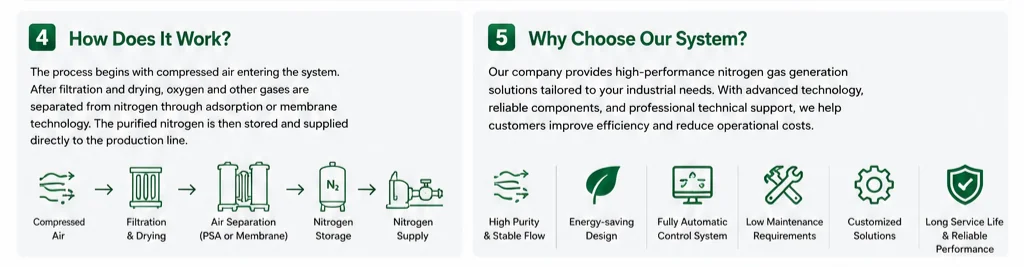
How Does a Nitrogen Gas Generation System Work?
The nitrogen-generation process begins with ambient air and includes compression, air treatment, adsorption, regeneration, and automatic tower switching.
1. Compressed-Air Supply
Ambient air is first compressed to the pressure required by the PSA system.
Lingyu’s PSA nitrogen generator operates with:
- Inlet-air pressure: 0.5–0.8 MPa
- Inlet-air temperature: ≤40°C
Stable feed-air pressure and temperature are important because changes in inlet conditions can affect nitrogen-production capacity and separation performance.
2. Compressed-Air Treatment
The compressed air should be cleaned and dried before entering the adsorption towers.
Typical pretreatment can include:
- Moisture separation
- Compressed-air drying
- Oil-removal filtration
- Particulate filtration
- Condensate drainage
Proper feed-air treatment helps protect the Carbon Molecular Sieve, pneumatic valves, and other system components.
For a broader explanation of this stage, see compressed air purification system components.
3. Oxygen Adsorption
Treated compressed air enters one of the two adsorption vessels.
The Carbon Molecular Sieve preferentially adsorbs oxygen molecules, while nitrogen passes through the adsorption bed and is collected as product gas.
4. Regeneration
While one tower produces nitrogen, the second tower depressurizes and releases previously adsorbed oxygen.
In the PSA process, a small amount of nitrogen purge gas assists regeneration.
5. Automatic Tower Switching
When the active adsorption tower reaches its predetermined adsorption capacity, the system automatically switches operating modes.
The regenerated tower begins producing nitrogen while the saturated tower enters regeneration.
This alternating process allows continuous nitrogen production under PLC control.
What Nitrogen Purity Can the System Provide?
Nitrogen purity should always be selected according to the actual process requirement.
Lingyu’s PSA nitrogen-generator range supports nitrogen purity from 95% to 99.999%, depending on system configuration.
Higher purity is not automatically the most economical choice.
As purity requirements become more demanding, the system generally needs to remove more oxygen, which affects feed-air requirements, nitrogen recovery, equipment sizing, and operating economics.
A good selection process should therefore begin with the maximum allowable oxygen concentration rather than simply requesting the highest available nitrogen purity.
For a more detailed comparison of purity, capacity, and sizing considerations, see the PSA nitrogen generator selection guide.
High-Purity Nitrogen Purification
Where a process requires exceptionally low residual oxygen, additional purification can be used after the primary PSA stage.
Lingyu’s carbon-based deoxygenation purification system is designed to upgrade approximately 99.9% nitrogen to ≥99.999%.
Residual oxygen is removed through a carbon-based deoxygenation reaction, followed by additional CO₂ removal, deep dehydration, and precision filtration.
This provides a technically appropriate route for applications requiring very high nitrogen purity without assuming that every nitrogen generator should simply operate at the maximum available purity.
The complete nitrogen-generation and purification route should be selected according to required final gas quality, flow, operating conditions, and process requirements.
Key Advantages of Onsite Nitrogen Generation
Continuous Nitrogen Production
Twin adsorption towers alternate between production and regeneration, enabling a continuous gas supply.
Automatic control coordinates the tower cycles to maintain nitrogen output at the required operating condition.
Reduced Dependence on Delivered Gas
Onsite production can reduce reliance on regular cylinder replacement or external nitrogen deliveries.
This can be particularly useful for plants with steady or high nitrogen consumption.
Selectable Nitrogen Purity
The system can be configured according to actual process needs rather than supplying the same purity for every application.
Lingyu’s PSA range covers 95%–99.999% nitrogen purity.
Automatic Monitoring and Protection
Lingyu’s PSA nitrogen generator includes:
- Automatic start and stop
- PLC-controlled pneumatic valves
- Online nitrogen-purity monitoring
- Online flow monitoring
- Off-spec nitrogen alarms
- Automatic shutdown protection
- CMS compaction
- Digital touchscreen monitoring
These functions support automatic operation while allowing important system conditions to be monitored.
Integration With Existing Compressed-Air Infrastructure
Where a plant already has sufficient treated compressed air, a PSA nitrogen generator can be integrated into the existing utility system.
The complete installation should still be evaluated to ensure adequate feed-air pressure, flow, drying, filtration, and storage.
Applications of Nitrogen Gas Generation Systems
Nitrogen generation can support a wide range of industrial applications.
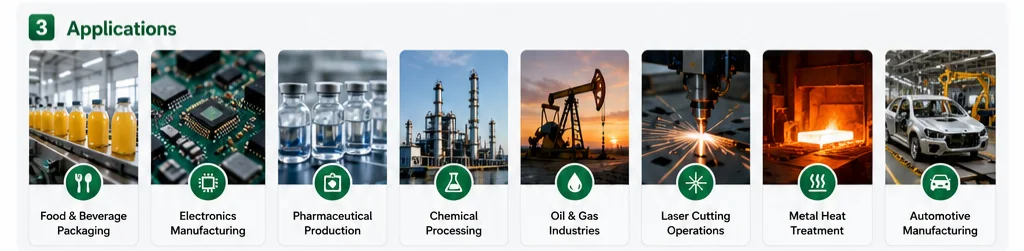
Food and Beverage
Nitrogen can be used where reducing oxygen exposure helps protect products or maintain a controlled atmosphere.
Purity and flow should be selected according to the specific packaging or production requirement.
Electronics and Semiconductor Manufacturing
Nitrogen can be used in production environments where oxidation control or controlled atmospheres are important.
The required gas quality depends on the specific process and allowable residual oxygen level.
Pharmaceutical Production
Nitrogen can support blanketing, purging, controlled production environments, and other manufacturing requirements.
Processes requiring exceptionally low residual oxygen may need high-purity PSA nitrogen or an additional purification stage.
Chemical and Petrochemical Processing
Nitrogen is widely used where an inert atmosphere is required for storage, reaction control, purging, or process protection.
The system should be selected according to the actual process pressure, purity, flow, and safety requirements.
Oil, Gas, Offshore, and Marine
Nitrogen can be used in inerting, blanketing, purging, and related operations.
System configuration should account for the specific operating environment, available utilities, applicable requirements, and nitrogen-consumption profile.
Laser Cutting and Metal Fabrication
Nitrogen can serve as an assist gas in selected cutting processes where oxidation needs to be controlled.
For this application, see nitrogen supply for laser cutting.
Automotive and General Manufacturing
Nitrogen can be used in selected heat-treatment, manufacturing, testing, and controlled-atmosphere processes.
Purity and capacity should be matched to the specific production requirement rather than applying one specification across all manufacturing processes.
What Makes a Nitrogen Generation System Efficient?
Efficiency depends on more than generator power consumption.
Important factors include:
- Required nitrogen purity
- Nitrogen recovery
- Feed-air consumption
- Compressor energy use
- Pressure drop
- Dryer and filtration energy
- System control strategy
- Nitrogen storage
- Actual operating load
For example, specifying a substantially higher nitrogen purity than the process requires can increase feed-air demand and affect nitrogen recovery.
Likewise, excessive pressure drop in upstream treatment equipment can increase the pressure the compressor must produce to maintain the required PSA inlet condition.
System-level efficiency should therefore be evaluated across the compressor, air-treatment equipment, nitrogen generator, receiver, controls, and actual demand profile.

How to Choose the Right Nitrogen Gas Generation System
The right system depends on the application rather than one universal specification.
Nitrogen Purity
Determine the acceptable oxygen concentration first.
Avoid specifying higher purity than the process requires.
Nitrogen Flow Rate
Calculate normal and peak consumption, including:
- Normal operating demand
- Peak demand
- Simultaneous users
- Purging requirements
- Future capacity growth
The generator should be sized for realistic operating conditions rather than nominal demand alone.
Feed-Air Capacity
The compressed-air system must provide sufficient treated air without compromising other plant operations.
Feed-air availability should therefore be checked against both generator demand and other compressed-air consumers.
Operating Pressure and Temperature
Lingyu’s PSA operating conditions include:
- Inlet pressure: 0.5–0.8 MPa
- Inlet-air temperature: ≤40°C
Actual site conditions should be evaluated when selecting system capacity.
Nitrogen Storage
Receiver size should reflect demand fluctuations, generator control strategy, peak consumption, and operating pattern.
A universal receiver size should not be applied to every nitrogen system.
Controls and Monitoring
Purity, flow, pressure, alarms, and system status should be visible and monitored during operation.
The required communication and remote-monitoring functions should be selected according to the plant automation system.
Total Cost of Ownership
Consider more than equipment purchase price.
Relevant factors include:
- Compressor energy
- Feed-air treatment
- CMS condition
- Filters
- Maintenance
- Storage
- Replacement parts
- Operating hours
A correctly sized system that produces only the purity actually required can provide better long-term economics than an oversized system designed around unnecessarily high purity.
Why Consider Lingyu PSA Nitrogen Generation?
Lingyu’s PSA nitrogen system uses:
- Twin adsorption towers
- Carbon Molecular Sieve
- Automatic PLC control
- Online nitrogen-purity monitoring
- Flow monitoring
- Off-spec nitrogen protection
- Automatic CMS compaction
- Touchscreen operating display
The system supports nitrogen purity from 95% to 99.999%, with an inlet-air pressure range of 0.5–0.8 MPa and inlet-air temperature of ≤40°C.
These features allow the nitrogen generator to be configured according to required gas purity, capacity, feed-air conditions, and process demand.
Conclusion
A nitrogen gas generation system provides an onsite source of nitrogen for industrial processes that require a reliable and controlled gas supply.
Lingyu’s nitrogen-generation technology uses Pressure Swing Adsorption with Carbon Molecular Sieve and twin adsorption towers.
The system automatically alternates between adsorption and regeneration, allowing continuous nitrogen production while monitoring purity, flow, pressure, and operating status.
Lingyu’s PSA range supports nitrogen purity from 95% to 99.999%, with an inlet-air pressure of 0.5–0.8 MPa and inlet-air temperature of ≤40°C.
Where very high nitrogen purity is required, additional purification can upgrade approximately 99.9% nitrogen to ≥99.999% rather than relying solely on the primary PSA separation stage.
The correct system should ultimately be selected according to required nitrogen purity, flow rate, feed-air capacity, operating conditions, storage requirements, control needs, and long-term operating cost.
For project-specific purity, capacity, and system configuration, contact Lingyu for technical support.