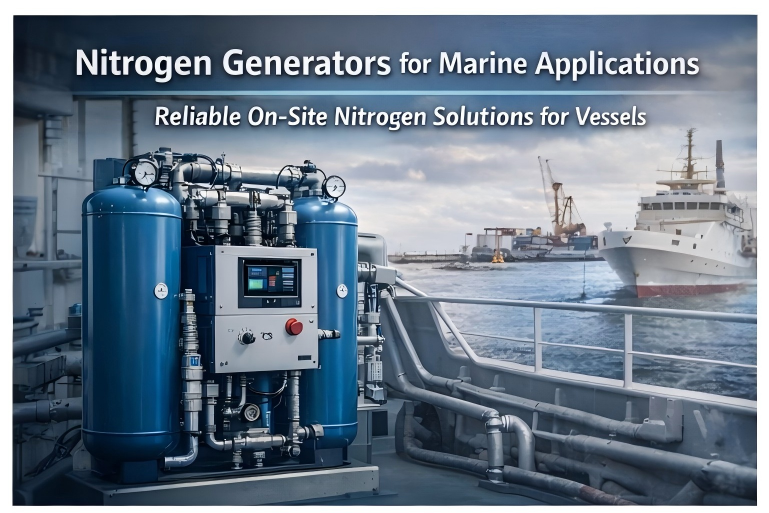
Marine and offshore operations often require a dependable nitrogen supply in environments where storage space, logistics, and access to shore-based gas suppliers may be limited.
For vessels with regular nitrogen demand, an on-site nitrogen generation system can reduce dependence on stored cylinders or externally supplied nitrogen. Nitrogen is commonly used in selected shipboard and offshore processes where oxygen levels must be reduced or a controlled inert atmosphere must be maintained.
A nitrogen generator for marine applications produces nitrogen from compressed air directly on board a vessel or at an offshore facility. The appropriate system depends on the required nitrogen purity, flow rate, delivery pressure, available utilities, installation space, and the requirements of the specific marine process.
What Is a Marine Nitrogen Generator?
A marine nitrogen generator is an on-site gas generation system configured to supply nitrogen for vessel or offshore operations.
The system uses compressed air as its feed source and separates nitrogen from the other major components of air.
Lingyu’s PSA nitrogen generator uses Pressure Swing Adsorption technology with two adsorption towers filled with Carbon Molecular Sieve (CMS).
During operation, oxygen is preferentially adsorbed by the CMS while nitrogen passes through the adsorption bed as product gas. One tower performs adsorption while the other depressurizes and regenerates. The towers switch automatically under PLC control.
This alternating adsorption and regeneration cycle enables continuous nitrogen production at the specified purity.
How a PSA Nitrogen Generator Works on Board
A PSA nitrogen generator depends on a properly designed and conditioned compressed-air supply.
The basic process is:
- Compressed air is supplied to the nitrogen generation system.
- Air-treatment equipment removes moisture, oil, particles, and other contaminants as required.
- Conditioned compressed air enters one CMS adsorption tower.
- Oxygen is preferentially adsorbed by the Carbon Molecular Sieve.
- Nitrogen passes through the adsorption bed as product gas.
- The second tower regenerates through depressurization.
- The towers alternate automatically to maintain continuous nitrogen production.
- Product nitrogen is monitored before being delivered to a buffer tank or the point of use.
Lingyu PSA nitrogen generators are designed for different nitrogen purity requirements, with available configurations ranging from 95% to 99.999% purity.
For a deeper technical explanation, see how PSA nitrogen generation works.
Why Nitrogen Is Used in Marine Operations
Nitrogen is relatively inert under normal operating conditions. In marine and offshore processes, it can therefore be used when oxygen concentration needs to be reduced or a controlled atmosphere must be maintained.
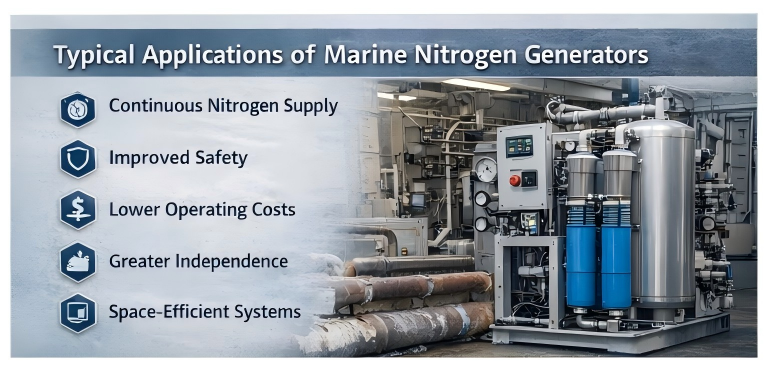
Depending on vessel type and operating requirements, nitrogen applications may include tank inerting, pipeline and equipment purging, gas blanketing, pressure maintenance, selected cargo-handling operations, and offshore process support.
The required nitrogen purity, flow rate, pressure, and operating procedure can vary substantially between these applications.
For this reason, a marine nitrogen generator should be specified according to the actual process requirements rather than assuming that a single nitrogen specification is suitable for every vessel.
For a broader overview of Lingyu solutions for this sector, see its oil, gas, offshore, and marine applications.
Tank Inerting
Tank inerting is one of the most established uses of nitrogen in marine and process operations.
Nitrogen can be introduced into a tank or vessel headspace to reduce oxygen concentration and maintain a controlled atmosphere. This may be required when stored materials or cargoes are sensitive to oxygen or when operating procedures require an inert environment.
The nitrogen flow and purity required for tank inerting depend on tank volume, initial oxygen concentration, target oxygen concentration, operating pressure, filling and discharge procedures, purging method, and vessel and cargo requirements.
Nitrogen requirements can be particularly important on vessels carrying chemical cargoes, where tank atmosphere control may form part of cargo-handling procedures.
More specific considerations are covered in Lingyu’s guide to nitrogen generators for chemical tankers.
Pipeline Purging and Gas Blanketing
Nitrogen can also be used to displace air from selected piping, tanks, and process equipment.
During purging, nitrogen is introduced to reduce the concentration of oxygen or other unwanted gases before startup, maintenance, cargo transfer, or other operating procedures.
Nitrogen blanketing, meanwhile, maintains a controlled gas space above certain stored liquids or materials. Depending on the application, this can help limit contact between the product and atmospheric oxygen.
When sizing a nitrogen generator for purging, engineers should consider the total purge volume and the required completion time—not only the vessel’s average daily nitrogen consumption.
Peak nitrogen demand can be significantly higher than normal continuous consumption.
Why On-Site Nitrogen Generation Can Be Useful at Sea
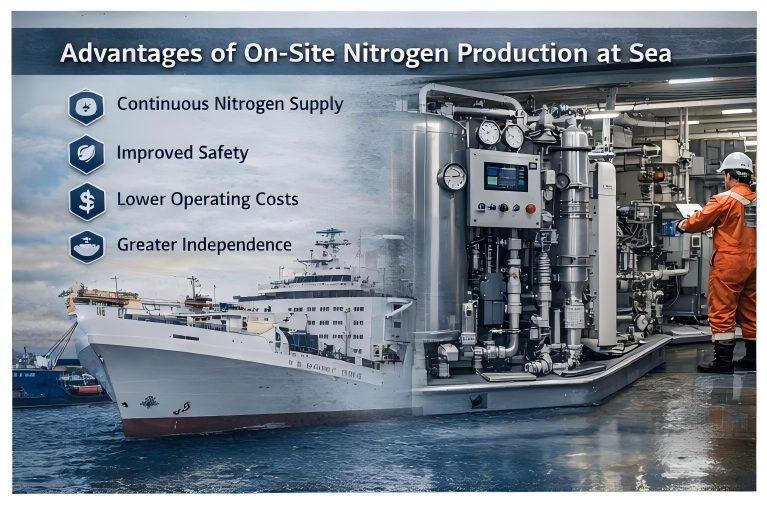
One of the main advantages of on-site nitrogen generation is greater control over gas availability.
A vessel with regular nitrogen demand can produce nitrogen on board instead of relying entirely on cylinder replacement or external nitrogen deliveries.
This can be particularly valuable when a vessel operates for extended periods away from shore-based gas suppliers.
An appropriately sized PSA system can produce nitrogen according to operating demand, subject to the capacity of the installed compressed-air and nitrogen-generation equipment.
Automated operation, nitrogen purity monitoring, flow monitoring, alarms, and off-spec gas management can also help integrate the nitrogen generator into a larger onboard process-control system.
PSA vs. Membrane Nitrogen Generation for Marine Applications
PSA and membrane separation are two commonly used technologies for on-site nitrogen generation.
PSA nitrogen generators use Carbon Molecular Sieve to preferentially adsorb oxygen from compressed air. They can be configured for a wide range of nitrogen purity requirements, including high-purity applications.
Membrane nitrogen generators use selective gas-permeation membranes. Depending on the operating requirement, membrane technology can offer a different balance between footprint, simplicity, flow rate, and nitrogen purity.
Lingyu’s current nitrogen generator range is based on PSA technology. Therefore, when evaluating Lingyu equipment for marine applications, the required nitrogen purity, capacity, pressure, compressed-air supply, and installation conditions should be assessed against the available PSA configurations.
Marine Installation Requirements
Industrial nitrogen generation technology can be applied to many operating environments, but a standard land-based nitrogen generator should not automatically be assumed to be suitable for shipboard installation without engineering evaluation.
Marine and offshore installations may introduce additional requirements related to available footprint, vibration and vessel movement, ambient temperature and humidity, salt-laden or corrosive environments, ventilation, cooling, electrical supply, condensate drainage, maintenance access, hazardous-area requirements, classification and regulatory requirements, and integration with vessel control systems.
General product specifications for a PSA nitrogen generator do not, by themselves, establish compliance with a particular marine classification society, vessel class notation, hazardous-area standard, or project-specific certification requirement.
These requirements should be confirmed during project engineering and equipment selection.
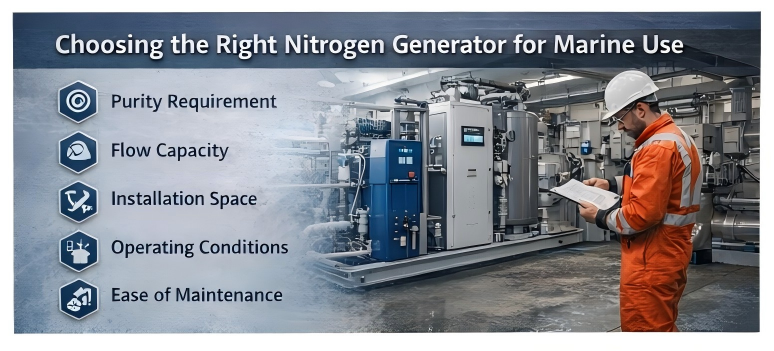
Choosing the Right Nitrogen Generator for Marine Use
Selection should begin with the nitrogen requirement at the point of use.
Important factors include required nitrogen purity, continuous nitrogen flow, peak flow demand, required delivery pressure, duty cycle, available compressed-air capacity, feed-air temperature and quality, installation space, nitrogen buffer-storage requirements, automation and monitoring, off-spec gas handling, electrical power availability, maintenance access, marine environmental conditions, and applicable classification or regulatory requirements.
Lingyu’s PSA nitrogen systems can accommodate different purity requirements, so the generator should be selected according to the actual process rather than automatically specifying the highest possible nitrogen purity.
Higher purity is not inherently better for every application. Increasing nitrogen purity can affect compressed-air consumption, nitrogen recovery, equipment sizing, and overall operating efficiency.
For a broader engineering approach to purity, capacity, pressure, and system configuration, see the PSA nitrogen generator selection guide.
A Complete On-Board Nitrogen Generation System
The nitrogen generator itself is only one part of an on-site nitrogen supply system.
Depending on the project design, a complete arrangement may include an air compressor, air receiver, compressed-air dryer, precision filtration, PSA nitrogen generator, nitrogen buffer tank, nitrogen or oxygen analyzer, pressure-control equipment, off-spec gas handling, and distribution piping.
Feed-air treatment is especially important because PSA performance depends on the condition of the compressed air entering the adsorption towers.
Moisture, oil, particles, and other contaminants should therefore be controlled according to the requirements of the nitrogen generator and the overall system design.
A suitable precision compressed-air filter can form part of the upstream air-treatment system before the PSA generator.
Monitoring Nitrogen Quality
For marine and offshore processes, nitrogen quality should be monitored against the requirements of the actual application.
Rather than relying only on a nominal generator purity specification, the system should provide a suitable method for verifying product-gas quality and responding when nitrogen falls outside the required specification.
Depending on the system configuration, monitoring and control may include nitrogen purity measurement, flow monitoring, alarms, automatic control, and off-spec gas handling.
These functions are particularly important when the nitrogen supply forms part of a larger automated process or when downstream equipment depends on maintaining a specified nitrogen quality.
Nitrogen Requirements for Different Vessel Types
Marine nitrogen requirements vary according to vessel type, onboard process, operating conditions, and the purpose for which nitrogen is being used.
Chemical tankers, for example, may require nitrogen for cargo-related tank atmosphere control and associated operations. Oil and gas vessels can have different process requirements involving inert gas supply, purging, or offshore operational support.
For more specific vessel applications, see Lingyu’s guide to nitrogen generators for oil and gas ships.
Nitrogen requirements can also differ according to vessel machinery and system configuration. Lingyu separately covers nitrogen generators for dual-engine vessels.
These vessel-specific applications should be evaluated individually rather than assuming that the same nitrogen purity, flow, pressure, or system configuration is appropriate for every marine installation.
Conclusion
Nitrogen generators for marine applications provide an on-site gas supply option for vessels and offshore facilities with regular nitrogen demand.
Lingyu nitrogen generators use PSA technology with Carbon Molecular Sieve to separate nitrogen from compressed air. Different system configurations can provide nitrogen purity ranging from 95% to 99.999%, allowing the nitrogen supply to be matched to different process requirements.
Marine nitrogen can be used for applications such as tank inerting, pipeline purging, gas blanketing, cargo-related operations, and offshore process support. However, the correct nitrogen generation system depends on the vessel’s actual purity, flow, pressure, duty cycle, installation environment, compressed-air supply, and applicable regulatory or classification requirements.
For this reason, selecting a marine nitrogen generator should not be based on generator capacity alone. The complete system—including compressed-air generation, air treatment, PSA nitrogen generation, storage, monitoring, controls, and distribution—should be matched to the vessel’s operating requirements.
Explore Lingyu’s nitrogen generator range or contact Lingyu to discuss the nitrogen purity, flow, pressure, and installation requirements for your marine or offshore project.