Moisture in compressed air can create serious problems in industrial production. Water vapor and condensate may contribute to corrosion, freezing, pneumatic-system failures, unstable processes, and contamination of downstream equipment or products.
When a conventional refrigerated dryer cannot achieve the required pressure dew point, a regenerative air dryer, also known as a regenerative desiccant air dryer, provides a deeper level of moisture removal.
By using desiccant adsorption and alternating regeneration cycles, regenerative dryers can continuously supply low-dew-point compressed air for demanding industrial applications.
Lingyu’s product portfolio includes multiple regenerative drying technologies, ranging from heatless and heated-purge systems to blower-heated and heat-of-compression configurations. For an overview of this product family, see Lingyu’s desiccant air dryer solutions.
What Is a Regenerative Air Dryer?
A regenerative air dryer is a type of adsorption dryer designed to remove water vapor from compressed air.
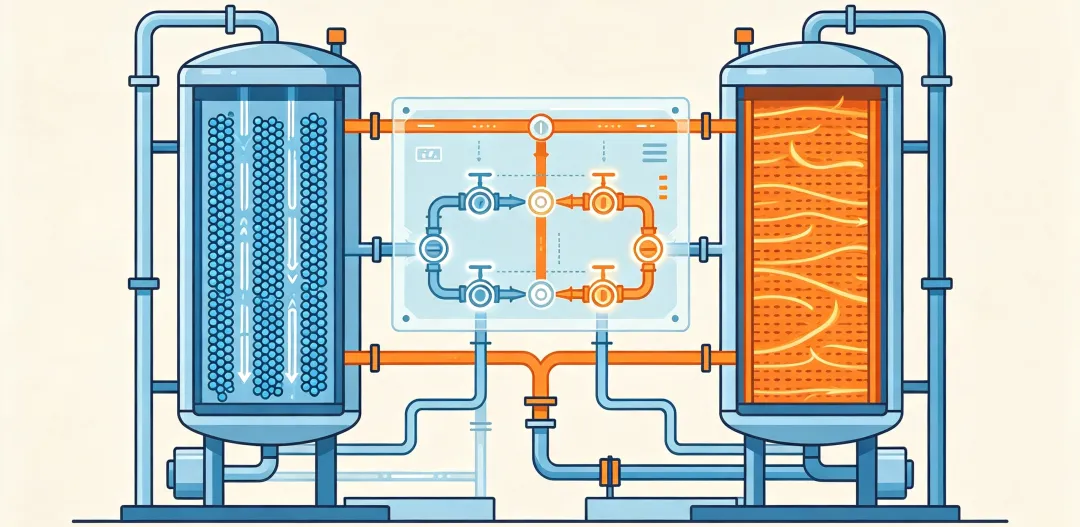
The system typically uses two adsorption vessels or towers containing desiccant. While one tower removes moisture from the compressed-air stream, the other tower regenerates so that its adsorption capacity can be restored.
After a defined operating period, the towers change roles.
This alternating adsorption-and-regeneration process allows the dryer to provide a continuous supply of dry compressed air without requiring the complete system to stop whenever the desiccant needs regeneration.
Regenerative dryer configurations include heatless, heated-purge, modular, blower-heated, and heat-of-compression technologies.
For a broader technical introduction, see the regenerative desiccant air dryer guide.
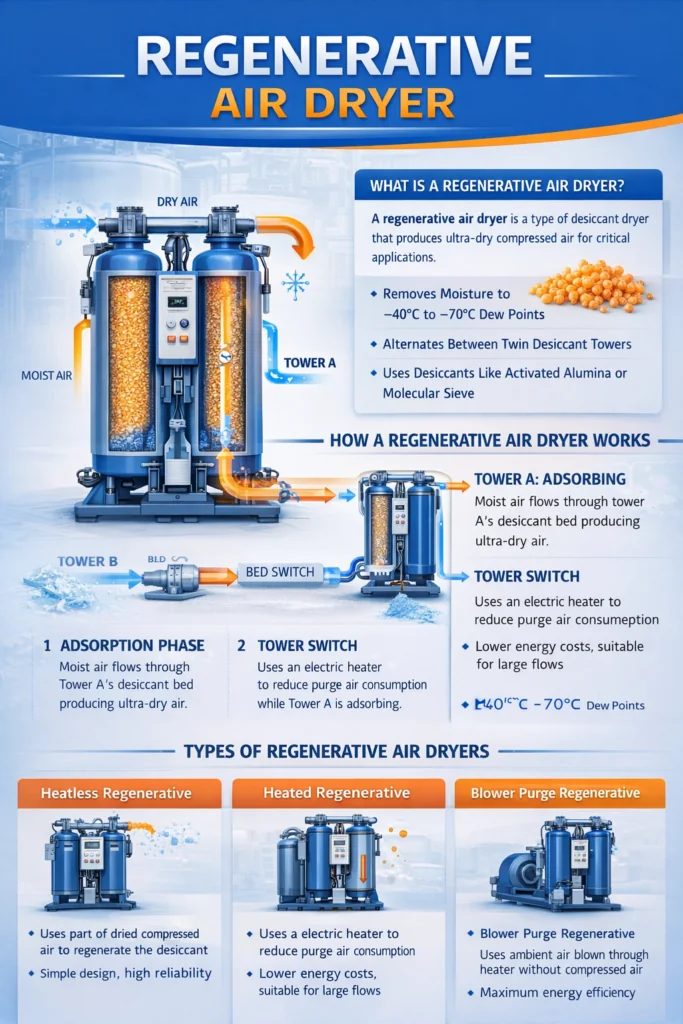
How Does a Regenerative Air Dryer Work?
The basic process consists of adsorption, regeneration, cooling where required, repressurization, and tower switching.
During the adsorption phase, wet compressed air passes through the active desiccant bed. Water vapor is adsorbed onto the desiccant, and low-dew-point compressed air leaves the dryer.
During regeneration, moisture accumulated in the offline desiccant bed is removed.
The regeneration method depends on dryer design:
- Heatless systems use a portion of dry product air.
- Heated-purge systems add external heat while using dry purge air as the regeneration carrier.
- Blower-heated systems use heated ambient air for regeneration.
- Heat-of-compression systems recover thermal energy from high-temperature compressor discharge air.
Before the regenerated tower returns to adsorption duty, its pressure and temperature must be restored to suitable operating conditions. The dryer then switches towers and repeats the cycle.
The regeneration method has a major effect on compressed-air consumption, electricity demand, system complexity, initial investment, and lifecycle operating cost.
Heatless Regenerative Air Dryers
A heatless regenerative air dryer uses a portion of the already dried compressed air to regenerate the offline desiccant bed.
Because no external regeneration heater is required, the system can have a relatively straightforward design. This makes heatless technology attractive where simplicity, reliability, and suitable system capacity are priorities.
Lingyu offers dedicated heatless regenerative adsorption air dryers, including configurations designed for continuous low-dew-point compressed-air production.
The primary engineering trade-off is regeneration air consumption.
Because part of the dry product air is diverted to regenerate the offline tower, the compressor and dryer system must be sized with this additional air demand in mind.
For more technical context, see the heatless desiccant air dryer guide.
Heated-Purge Regenerative Air Dryers
Heated regenerative dryers add thermal energy to the regeneration process.
A heated-purge regenerative desiccant air dryer operates according to Temperature Swing Adsorption principles. An external heat source supplies energy to desorb moisture, while part of the dry product air serves as the regeneration carrier gas.
An important technical point is that heating the desiccant and releasing moisture does not by itself complete the regeneration process.
The desiccant must subsequently cool toward a suitable adsorption temperature before its adsorption capacity can be effectively restored.
Under the specified operating conditions, the heated-purge configuration has:
Average purge-air consumption: 4–8%
Outlet pressure dew point: ≤−40°C
Desiccant: Activated alumina + high-performance molecular sieve
Users evaluating this technology can review Lingyu’s heated regeneration adsorption air dryer.
Low-Purge Blower-Heated Regenerative Air Dryers
For larger compressed-air systems, blower-assisted regeneration can substantially reduce the amount of compressed product air consumed during regeneration.
Lingyu’s HRB-E low-purge blower-heated regenerative desiccant dryer uses an independent blower to draw in ambient air. The air is heated and passed through the regeneration tower to desorb accumulated moisture.
During cooling, only a relatively small amount of dry product air is used.
Under the specified operating conditions, the HRB-E Series provides:
Rated inlet pressure: 0.7 MPa
Operating pressure range: 0.6–1.0 MPa
Rated inlet temperature: 10–30°C
Maximum inlet temperature: ≤40°C
Inlet air dew point: ≤25°C
Regeneration air consumption: 2–3%
Outlet pressure dew point: −20°C / −40°C optional
Rated ambient temperature: 35°C
Ambient operating range: 2–40°C
This configuration is particularly relevant for larger plants where compressed-air purge loss has a significant impact on lifecycle operating cost.
For additional technical information, see Lingyu’s blower-heated regeneration adsorption air dryer.
Zero-Purge Blower-Heated Regenerative Air Dryers
A zero-purge blower-heated dryer goes a step further by avoiding the use of dry product air during regeneration.
In a zero-purge blower-heated configuration, ambient air is heated by a blower and heater during desorption. During cooling, air can be circulated through the cooling and regeneration circuit instead of consuming dry product air.
This distinction is important because “blower-heated dryer” and “zero-purge dryer” are not interchangeable terms.
A low-purge blower-heated system can still consume a small amount of compressed product air, while a zero-purge configuration is specifically engineered to avoid this regeneration loss.
Plants evaluating this technology can review Lingyu’s blower zero-purge adsorption dryer range.
Heat-of-Compression Regenerative Air Dryers
Heat-of-compression, or HOC, dryers use thermal energy already present in high-temperature compressed air discharged from the compressor.
Instead of relying entirely on an independent electric heater, the system uses compressor discharge heat to regenerate the desiccant.
HOC-E Low-Purge Configuration
Lingyu’s HOC-E system uses high-temperature compressed air to heat and regenerate the desiccant.
No compressed air is consumed during the heating stage, although a small amount of dry product air is required during cooling.
Key operating parameters include:
Rated inlet pressure: 0.7 MPa
Operating pressure range: 0.6–1.0 MPa
Rated inlet temperature: 120°C
Allowable inlet temperature range: 110–180°C
Regeneration air consumption: ≤3%
Outlet pressure dew point: −20°C / −40°C optional
Cooling water temperature: ≤32°C
Cooling water pressure: 0.2–0.6 MPa
HOC-Z Zero-Purge Configuration
The HOC-Z configuration eliminates dry product-air consumption during both heating and cooling.
Key operating parameters include:
Rated inlet pressure: 0.7 MPa
Operating pressure range: 0.6–1.0 MPa
Rated inlet temperature: 120°C
Allowable inlet temperature range: 110–180°C
Regeneration air consumption: 0%
Outlet pressure dew point: −20°C / −40°C optional
Cooling water temperature: ≤32°C
Cooling water pressure: 0.2–0.6 MPa
Facilities with suitable high-temperature compressor discharge conditions can explore Lingyu’s heat-of-compression regenerative adsorption air dryer.
What Pressure Dew Point Can a Regenerative Air Dryer Achieve?
Pressure dew point is one of the most important specifications when selecting a compressed-air dryer.
A refrigerated dryer is generally intended for moderate moisture removal, whereas a regenerative adsorption dryer is used where substantially lower pressure dew points are required.
For Lingyu regenerative adsorption dryer configurations, −40°C pressure dew point is a common design target, while some series provide −20°C / −40°C optional configurations.
For example:
- Heated-purge configuration: ≤−40°C
- HRB-E blower-heated configuration: −20°C / −40°C optional
- HOC-E configuration: −20°C / −40°C optional
- HOC-Z configuration: −20°C / −40°C optional
The appropriate dew point should be selected according to actual downstream moisture requirements rather than automatically specifying the lowest available value.
Regenerative Dryer vs. Refrigerated Air Dryer
The two technologies solve different moisture-control requirements.
A refrigerated air dryer cools compressed air so that water vapor condenses and can be separated. It is widely used for general industrial compressed air where a moderate pressure dew point is sufficient.
A regenerative desiccant dryer removes residual water vapor through adsorption and is therefore suitable when much drier compressed air is required.
The two technologies can also be integrated into a combined drying system.
In Lingyu’s DC Series combined compressed air dryer, the refrigerated stage first removes a substantial portion of the moisture load. The adsorption stage then performs deeper drying to achieve a much lower pressure dew point.
This arrangement reduces the moisture load entering the adsorption stage and can reduce its regeneration burden.
If you are still determining which technology fits a particular plant, see the compressed air dryer selection guide.
Why Use a Regenerative Air Dryer?
The primary objective is not simply to produce “drier air,” but to maintain a pressure dew point appropriate for the downstream process.
In low-temperature piping or outdoor installations, excessive moisture can condense or freeze.
In sensitive production processes, moisture can interfere with product quality or equipment operation.
In pneumatic systems, controlling moisture can help reduce corrosion and moisture-related failures.
Regenerative dryers therefore become valuable where moisture tolerance is substantially lower than what a conventional refrigerated dryer can provide.
The appropriate system should still be selected according to actual air-quality requirements rather than specifying the lowest possible dew point by default.
Applications in Pharmaceutical and Food Production
Compressed-air quality can be particularly important where air is used near sensitive processes, packaging, instruments, or production equipment.
Regenerative adsorption dryers can be applied where the required pressure dew point and air-quality specifications justify deeper moisture removal.
For pharmaceutical applications, Lingyu’s pharmaceutical and biopharmaceutical compressed-air solutions provide a more relevant industry-level reference.
The actual dew point, oil, particulate, filtration, and process requirements should be determined for the specific production line rather than assuming that every pharmaceutical or food facility requires the same dryer configuration.
Electronics and Semiconductor Manufacturing
Electronics and semiconductor manufacturing can involve compressed-air applications with demanding moisture-control requirements.
Dryer selection should account for required pressure dew point, contamination limits, system redundancy, load changes, and integration with the broader compressed-air purification system.
For facilities in this sector, Lingyu’s semiconductor and PCB manufacturing solutions provide industry-specific context.
Chemical and Petrochemical Processing
Chemical and petrochemical facilities can require low-dew-point compressed air for instrumentation and process-related applications.
The required dryer construction, controls, pressure rating, dew point, regeneration strategy, and safety configuration should be selected according to actual plant conditions.
Lingyu’s petrochemical and chemical processing solutions provide additional application-level information.
Energy Efficiency: Look Beyond the Dryer Purchase Price
Energy efficiency is one of the most important differences between regenerative dryer technologies.
A heatless dryer has a relatively straightforward regeneration method but consumes dry compressed air.
Heated-purge systems add heat to reduce regeneration-air requirements.
Low-purge blower-heated systems use ambient air for most of the regeneration process and can reduce product-air consumption to approximately 2–3% under the specified HRB-E operating conditions.
Zero-purge configurations are designed to eliminate compressed-air regeneration loss, while HOC systems recover thermal energy from compressor discharge where suitable operating conditions are available.
The correct economic comparison should therefore consider:
Electricity + purge-air loss + compressor loading + heating + cooling + maintenance + operating hours + actual airflow
rather than comparing dryer purchase prices alone.
Intelligent Dew-Point Control
Another factor to consider is how the dryer determines when to switch or regenerate.
A fixed-cycle dryer follows predetermined operating times regardless of actual moisture load.
Where available, dew-point-based control can allow the adsorption cycle to respond more closely to real operating demand.
Lingyu blower-heated systems offer optional dew-point-based control. Under fluctuating-load conditions, this can extend the adsorption cycle according to actual demand and reduce unnecessary regeneration.
This type of control can be particularly useful where compressed-air demand varies substantially throughout the day.
How to Choose the Right Regenerative Air Dryer
The correct dryer should be selected around the operating conditions and required air quality of the complete compressed-air system.
Important parameters include:
- Required pressure dew point
- Actual and peak airflow
- Inlet pressure
- Inlet temperature
- Inlet moisture load
- Compressor type
- Operating schedule
- Available cooling water
- Regeneration method
- Acceptable purge-air consumption
- Energy cost
- Control requirements
- Maintenance access
- Redundancy
- Future expansion
For smaller systems or applications where simplicity is a priority, heatless technology may provide a practical solution.
As airflow and operating hours increase, heated or blower-assisted systems may offer better lifecycle economics by reducing compressed-air regeneration losses.
Where suitable high-temperature compressor discharge heat is available, an HOC configuration can provide another energy-efficient regeneration approach.
Users comparing several technologies can also review the industrial desiccant air dryer guide.
Conclusion
A regenerative air dryer is an effective solution for compressed-air systems requiring consistently low pressure dew points beyond the typical capability of refrigerated drying alone.
Its twin-bed adsorption design allows one desiccant bed to dry compressed air while the other regenerates, enabling continuous operation.
The most important decision is not simply whether to use a regenerative dryer, but which regeneration method best matches the plant.
Heatless systems emphasize simplicity. Heated-purge dryers add thermal energy to reduce regeneration demand. Low-purge blower-heated dryers substantially reduce product-air consumption. Zero-purge blower systems are designed to eliminate compressed-air consumption during regeneration, while heat-of-compression systems reuse compressor discharge heat where operating conditions permit.
Across these configurations, pressure dew points around −40°C are available for multiple product families, with certain series offering −20°C / −40°C options.
By matching dew point, airflow, pressure, temperature, regeneration strategy, purge loss, energy consumption, and controls to the actual process, users can build a compressed-air drying system that provides reliable low-dew-point performance without unnecessary complexity or operating cost.