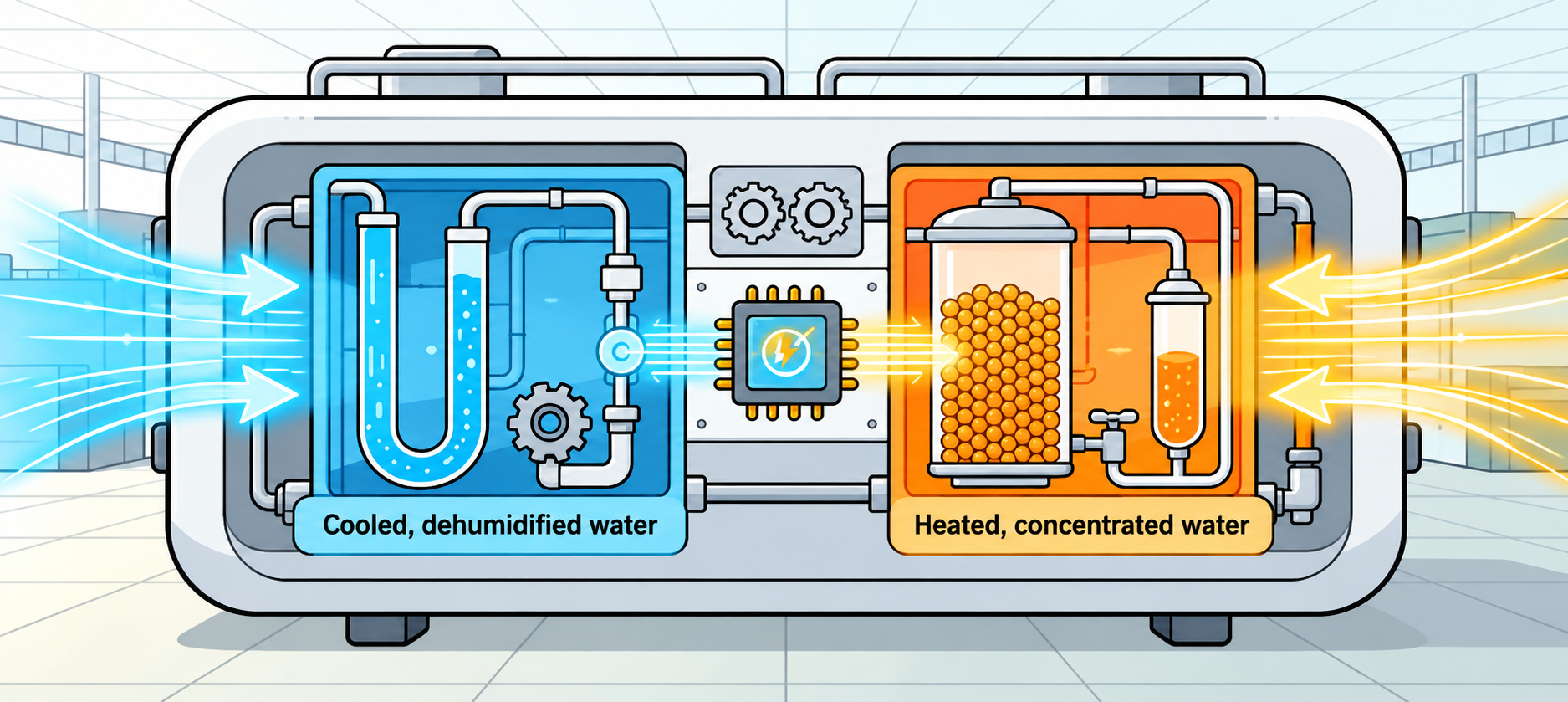
An industrial air dryer is an important part of many compressed-air systems because the compressor itself does not control the moisture level required by downstream production equipment.
Ambient air contains water vapor. After compression and subsequent cooling, part of that moisture can condense into liquid water inside receivers, pipelines, filters, valves, tools, and production equipment. If moisture is not controlled appropriately, it can contribute to corrosion, freezing, control-system problems, reduced product quality, and unplanned maintenance.
The purpose of an industrial air dryer for a compressor system is therefore not simply to remove water. It is to achieve the required pressure dew point at the required air flow, pressure, temperature, and operating conditions.
What Is an Industrial Air Dryer?
An industrial air dryer is compressed-air treatment equipment designed primarily to reduce water vapor in compressed air.
The dryer should be considered as one part of a broader air-treatment system. Moisture, oil, and particles are different contamination problems and may require different treatment equipment.
A complete compressed-air purification system can therefore include:
- Cooling and condensate separation
- Air receivers
- Oil-removal filtration
- Particle filtration
- Refrigerated or adsorption drying
- Condensate drainage
- Downstream filtration where required
The exact arrangement depends on the required air quality and actual operating conditions rather than one fixed equipment sequence.
For a complete system-layout discussion, see the air compressor dryer setup guide.

Why Does Compressed Air Need Drying?
Compression increases the amount of moisture contained per unit volume of air. As compressed air subsequently cools, the air can no longer hold the same amount of water vapor, so excess moisture may condense.
This moisture can contribute to pipeline corrosion, control-system failures, freezing, reduced product quality, and other production problems.
However, the amount of drying required depends on the application. Not every industrial process needs the lowest possible dew point.
The correct design objective is to achieve the required moisture level for the process while avoiding unnecessary treatment, pressure loss, energy consumption, and equipment complexity.
Main Types of Industrial Air Dryers
For industrial compressed-air applications, two major drying technologies are refrigerated dryers and adsorption, or desiccant, dryers.
Refrigerated Air Dryers
A refrigerated air dryer cools compressed air so that water vapor condenses into liquid. The condensate is then separated and discharged before the treated air continues downstream.
Lingyu refrigerated air dryer configurations are available with pressure dew points of approximately 2–10°C, depending on the model and operating conditions.
Refrigerated drying is suitable where moderate moisture control meets the process requirement and substantially lower pressure dew points are not necessary.
Its suitability still depends on inlet temperature, operating pressure, flow, ambient conditions, pressure drop, cooling method, and the actual required dew point.
Desiccant / Adsorption Air Dryers
A desiccant air dryer removes water vapor through adsorption. These systems are used when substantially lower pressure dew points are required.
Different adsorption dryers use different regeneration methods, including heatless regeneration, heated purge, blower regeneration, and heat-of-compression technology.
For example, Lingyu’s HRB-E Series Low-Purge Blower-Heated Regenerative Desiccant Air Dryer provides optional outlet pressure dew points of −20°C or −40°C. Its rated inlet pressure is 0.7 MPa, with an operating range of 0.6–1.0 MPa, while its rated inlet temperature is 10–30°C with a maximum of ≤40°C. Regeneration-air consumption is 2–3%.
The important point is that “desiccant dryer” describes a family of technologies rather than one single operating design.
Refrigerated or Desiccant: Which Is Better?
Neither technology is universally better.
The correct choice depends first on the pressure dew point required by the downstream process.
If the plant requires moderate moisture control, refrigerated drying may provide an appropriate and comparatively straightforward solution. If the process or installation environment requires substantially drier compressed air, adsorption drying may be necessary.
A practical decision sequence is:
Required dew point → operating conditions → flow → pressure → energy profile → maintenance → lifecycle cost
For a dedicated comparison, see refrigerated air dryer vs desiccant air dryer.
Do Not Select a Dryer Only by Industry Name
It is common to see broad recommendations such as:
“Electronics needs a desiccant dryer.”
“Food processing uses refrigerated dryers.”
“Pharmaceutical applications always require an ultra-low dew point.”
These statements are too general to serve as engineering selection rules.
Two factories in the same industry may require very different compressed-air quality because the air is used for different equipment, products, or process stages.
Dryer selection should therefore start from:
- Required pressure dew point
- Oil requirement
- Particle requirement
- Point-of-use pressure
- Air flow
- Environmental exposure
- Process sensitivity
Industry type can provide context, but it should not replace the actual compressed-air specification.
Match Dryer Capacity to Actual Compressor Flow
Air flow is one of the most important dryer selection parameters.
The dryer must be able to process the actual maximum compressed-air flow expected under site operating conditions.
Do not match the dryer solely by comparing compressor nameplate flow with nominal dryer capacity. Dryer performance can also be affected by inlet temperature, operating pressure, ambient conditions, moisture load, and required pressure dew point.
A system that appears correctly sized at one design point can become overloaded if the dryer receives hotter air, higher flow, or different pressure than the conditions on which its rating is based.
For purchasing and system design, use the actual expected operating envelope rather than one nominal flow value.
Inlet Temperature Matters
Dryer performance depends strongly on inlet conditions.
For conventional regenerative dryers, increased inlet temperature can increase the moisture load entering the adsorption system and affect drying performance.
The HRB-E low-purge blower-heated series, for example, has a rated inlet temperature of 10–30°C and a maximum inlet temperature of ≤40°C.
Other dryer technologies are intentionally designed for very different inlet conditions.
Heat-of-Compression Dryers Operate Differently
Lingyu’s HOC-E Heat-of-Compression Regenerative Desiccant Air Dryer has a rated inlet temperature of 120°C and an allowable inlet-temperature range of 110–180°C. Its rated inlet pressure is 0.7 MPa, with an operating range of 0.6–1.0 MPa, and its optional outlet pressure dew points are −20°C or −40°C. Regeneration-air consumption is specified as ≤3%.
This type of dryer uses heat from the compressed air as part of the regeneration process.
For this reason, a general statement such as “all industrial air dryers should receive cool air” is technically incorrect. The required inlet temperature depends on the dryer technology and overall compressor-system architecture.
Operating Pressure Also Affects Dryer Selection
Industrial dryers are designed around specified pressure conditions.
Several Lingyu regenerative dryer families use a rated inlet pressure of 0.7 MPa and an operating range of 0.6–1.0 MPa, with other pressure ratings available for specific requirements.
These values are product-family operating conditions rather than universal pressure requirements for all industrial dryers.
When comparing equipment, confirm:
- Normal operating pressure
- Minimum operating pressure
- Maximum operating pressure
- Required downstream pressure
The complete treatment system must maintain the required air quality without creating excessive pressure loss.
Pressure Drop Is Part of Dryer Performance
A dryer that achieves the required dew point can still create system problems if its pressure drop is excessive.
Pressure losses through filters, dryers, valves, piping, separators, and other components reduce the pressure available to production equipment.
If downstream pressure becomes insufficient, operators may compensate by increasing compressor discharge pressure, increasing the overall energy demand of the compressed-air system.
Dryer evaluation should therefore consider:
Air-quality performance + pressure-loss performance
For further system optimization, see compressed air pressure drop and system efficiency.
Energy Efficiency Depends on Dryer Technology and Load Profile
It is not technically accurate to state that one dryer family is always the most energy-efficient.
Different dryer technologies use different energy strategies.
Refrigerated Dryers
Refrigerated dryers use electrical energy for the refrigeration system. Actual energy performance depends on dryer design, system load, ambient conditions, cooling method, pressure drop, and control strategy.
Heatless Adsorption Dryers
Heatless dryers use a portion of dried compressed air to regenerate the desiccant. The amount of purge air depends on the particular design and operating conditions.
Heated-Purge Dryers
Heated-purge systems use thermal energy together with regeneration air.
Low-Purge Blower-Heated Dryers
Blower-heated systems can reduce the amount of compressed air required for regeneration.
The HRB-E series, for example, specifies 2–3% regeneration-air consumption.
Zero-Purge and Heat-of-Compression Systems
Zero-purge and heat-of-compression dryers use different regeneration strategies again.
For example, Lingyu’s HOC-Z Series Zero-Purge Heat-of-Compression Regenerative Desiccant Air Dryer specifies 0% regeneration-air consumption, a rated inlet temperature of 120°C, an allowable inlet-temperature range of 110–180°C, and optional outlet pressure dew points of −20°C or −40°C. Cooling-water temperature is specified as ≤32°C, with cooling-water pressure of 0.2–0.6 MPa.
A 0% regeneration compressed-air figure does not by itself mean that a dryer will have the lowest total operating cost in every installation. Electrical demand, cooling requirements, operating hours, available compressor heat, capital cost, maintenance, and system load profile also need to be considered.
Combined Drying Can Be Appropriate for Some Systems
Some compressed-air systems use refrigerated drying before adsorption drying.
In Lingyu combined drying systems, wet compressed air first enters the refrigerated drying stage. The air is precooled and then further cooled in the evaporator to a pressure dew point of approximately 2–10°C.
Most moisture and oil, together with some impurities, condense during this stage and are separated by the air-water separator. The partially dried air then passes through oil-removal filtration before entering the adsorption stage, where residual moisture is removed by the desiccant. Downstream particulate filtration removes residual dust and desiccant particles.
Lingyu combined dryer configurations can provide an outlet pressure dew point of ≤−40°C under their specified operating conditions.
This multi-stage arrangement reduces the moisture load entering the adsorption section and can reduce the regeneration burden on that stage.
Combined drying is not required for every compressed-air installation. It should be considered where the required dew point, inlet conditions, energy use, and lifecycle requirements justify a multi-stage treatment system.
Filtration Still Matters
An industrial air dryer does not replace compressed-air filtration.
Oil and particles can contaminate valves, heat exchangers, adsorbent, instruments, and downstream production equipment.
Upstream filtration may therefore be required to protect the dryer, while downstream filtration can be required to control particulate or desiccant carryover.
The appropriate filter grades and sequence should be selected according to the compressor type, dryer technology, and point-of-use air-quality requirement.
For broader filter selection information, see the compressed air filters selection and maintenance guide.
How to Choose an Industrial Air Dryer for a Compressor
Before selecting a dryer, define the actual operating requirements.
Important information includes:
- Actual normal and peak air flow
- Normal and maximum inlet temperature
- Normal, minimum, and maximum pressure
- Required pressure dew point
- Required oil and particle limits
- Ambient temperature
- Compressor type
- Compressor loading profile
- Cooling-water availability where applicable
- Allowable pressure drop
- Operating hours
- Future expansion
- Redundancy requirements
- Maintenance and service requirements
Once these inputs are known, the appropriate dryer technology and capacity can be selected.
If you need a more detailed selection process, see the compressed air dryer buyer’s guide.
Maintenance Should Be Considered During Selection
An industrial dryer should not be evaluated only by purchase price and rated pressure dew point.
Maintenance requirements differ substantially between dryer technologies.
Refrigerated systems may require attention to condensate drains, heat exchangers, condensers, refrigeration components, sensors, electrical controls, and associated filtration.
Adsorption dryers may additionally require maintenance of switching valves, silencers, heaters or blowers where installed, desiccant condition, filters, and regeneration controls.
Maintenance access, replacement-parts availability, monitoring capability, and service requirements should therefore be considered before finalizing equipment selection.
What Does Reliable Compressed Air Actually Mean?
Reliable compressed air is not simply very dry air.
A reliable system consistently provides the air quality and pressure required by the process without excessive pressure loss, unstable dew point, unnecessary energy consumption, or recurring maintenance problems.
The dryer should therefore be evaluated as part of the complete compressed-air treatment system:
Compressor → cooling and separation → storage → filtration → drying → distribution → point of use
The exact configuration depends on the installation, required pressure dew point, air-quality specification, compressor characteristics, operating conditions, and process requirements.
Conclusion
An industrial air dryer for a compressor system should be selected from the actual process requirement rather than from a generic industry recommendation.
The most important questions are:
- How much compressed air must be treated?
- At what pressure and inlet temperature?
- What pressure dew point is required?
- What oil and particle limits apply?
- What pressure drop is acceptable?
- Which refrigeration or regeneration strategy fits the operating profile?
Refrigerated dryers can provide effective moisture control for many general industrial compressed-air systems, while adsorption dryers are appropriate where substantially lower pressure dew points are required. Combined systems can also be used when multi-stage drying provides a technical or economic advantage.
The right dryer is therefore not simply the model with the lowest dew point or the largest nominal capacity. It is the dryer that delivers the required compressed-air quality reliably under the actual operating conditions.