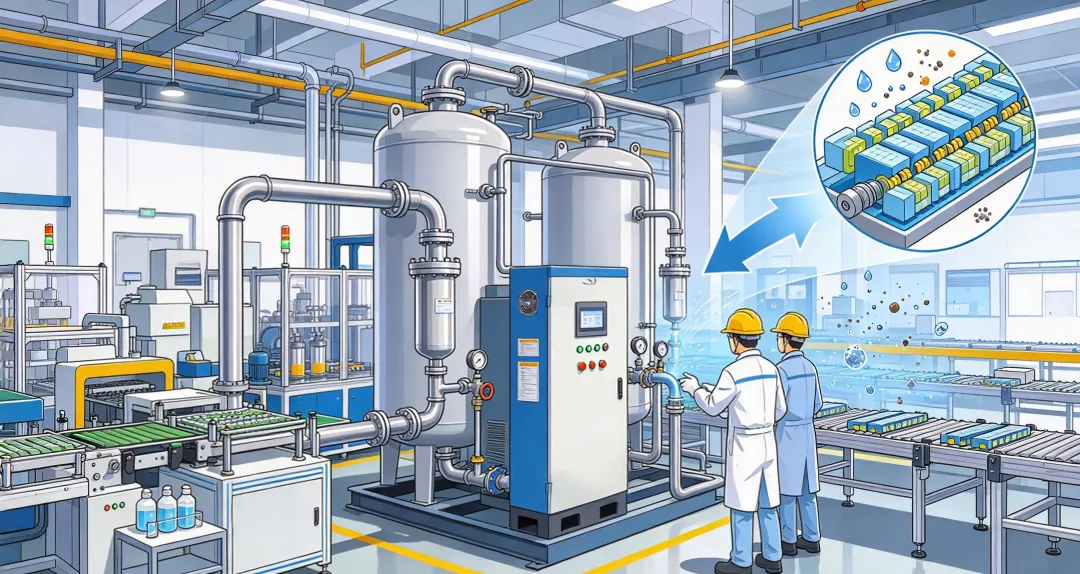
Clean, dry compressed air is an important part of a reliable plasma cutting setup. Whether you operate a handheld plasma cutter in a workshop or a CNC plasma table in a production environment, moisture, oil aerosols, and particles in the compressed air supply can interfere with consistent operation and increase the burden on downstream components.
The problem begins before the air ever reaches the plasma cutter. Ambient air naturally contains water vapor, and compression concentrates that moisture. As compressed air cools, some of the water vapor can condense into liquid water.
Water, oil, and solid particles are three major categories of contamination that need to be managed in industrial compressed air systems.
That is why a properly designed air dryer for a plasma cutter should usually be considered together with filtration and condensate management rather than as a standalone accessory.
Why Plasma Cutters Need Clean, Dry Compressed Air
A plasma cutter depends on a controlled supply of compressed gas to support the cutting process. When compressed air is used as the plasma or assist gas, the quality and stability of that air supply matter.
Untreated compressed air may contain moisture, oil aerosols, rust, dust, and other particles. These contaminants can contribute to unstable process conditions and may increase maintenance requirements.
For the compressed air system itself, excessive moisture can contribute to pipeline corrosion, reduced product quality, control-system failures, and freezing.
In a plasma cutting installation, maintaining a stable supply of dry, filtered air can therefore help support more consistent cutting conditions and protect downstream equipment.
For a broader explanation of why dryers and filters work together, see compressed air filters and dryers.
What Does an Air Dryer Do for a Plasma Cutter?
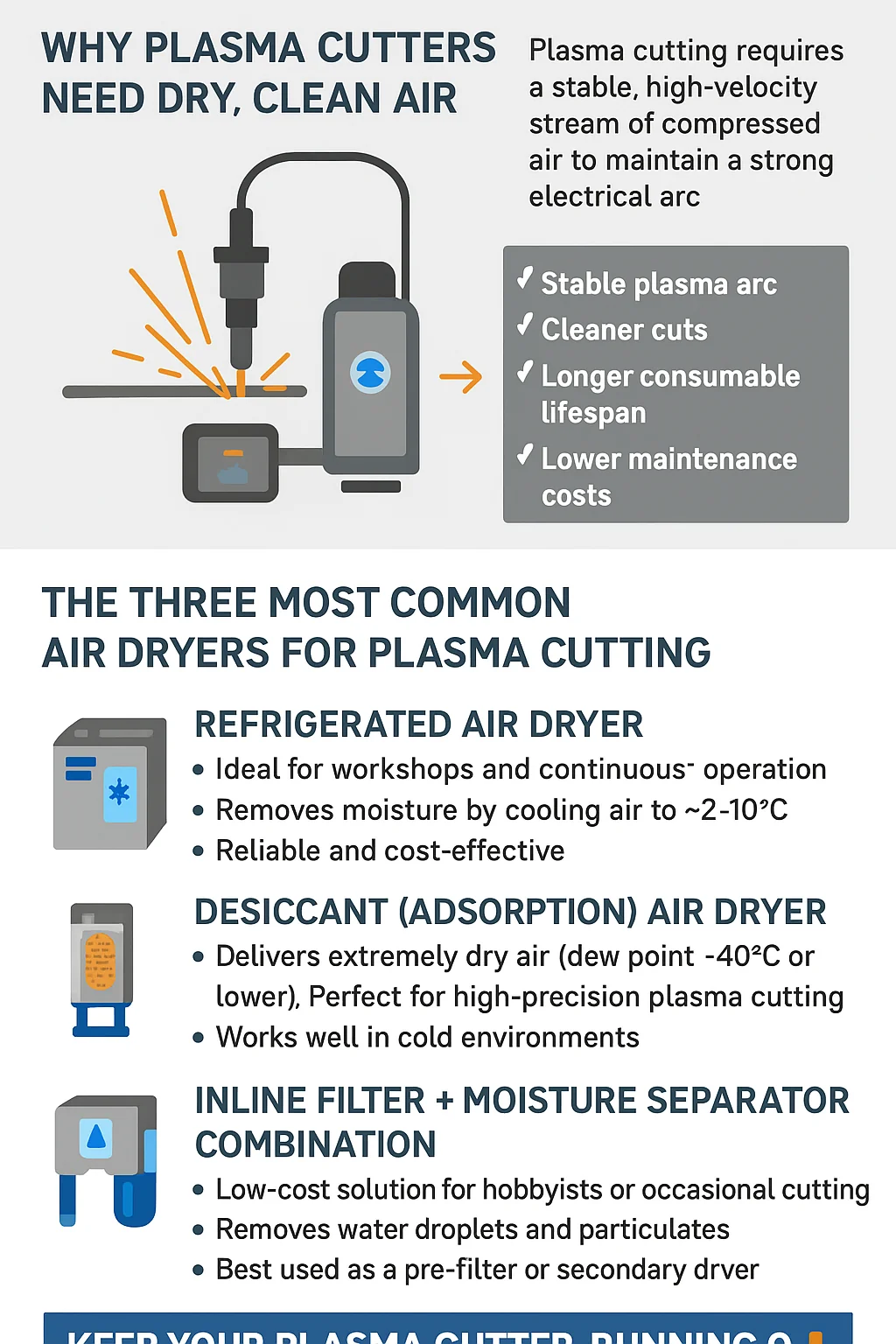
An air dryer reduces the water vapor content of the compressed air before it reaches the plasma cutter.
However, drying and filtration are not the same process.
A dryer is primarily responsible for moisture control and pressure dew point, while filters are selected to deal with contaminants such as oil aerosols and solid particles. A complete treatment arrangement may therefore include moisture separation, filtration, drying, condensate drainage, and final filtration according to the required air quality.
Refrigerated or adsorption dryers can be combined with different filtration stages depending on operating requirements.
For plasma cutting, the objective is not simply to buy “the driest dryer available.” It is to supply air at the flow, pressure, cleanliness, and dew point required by the cutting equipment.
Refrigerated Air Dryer for Plasma Cutting
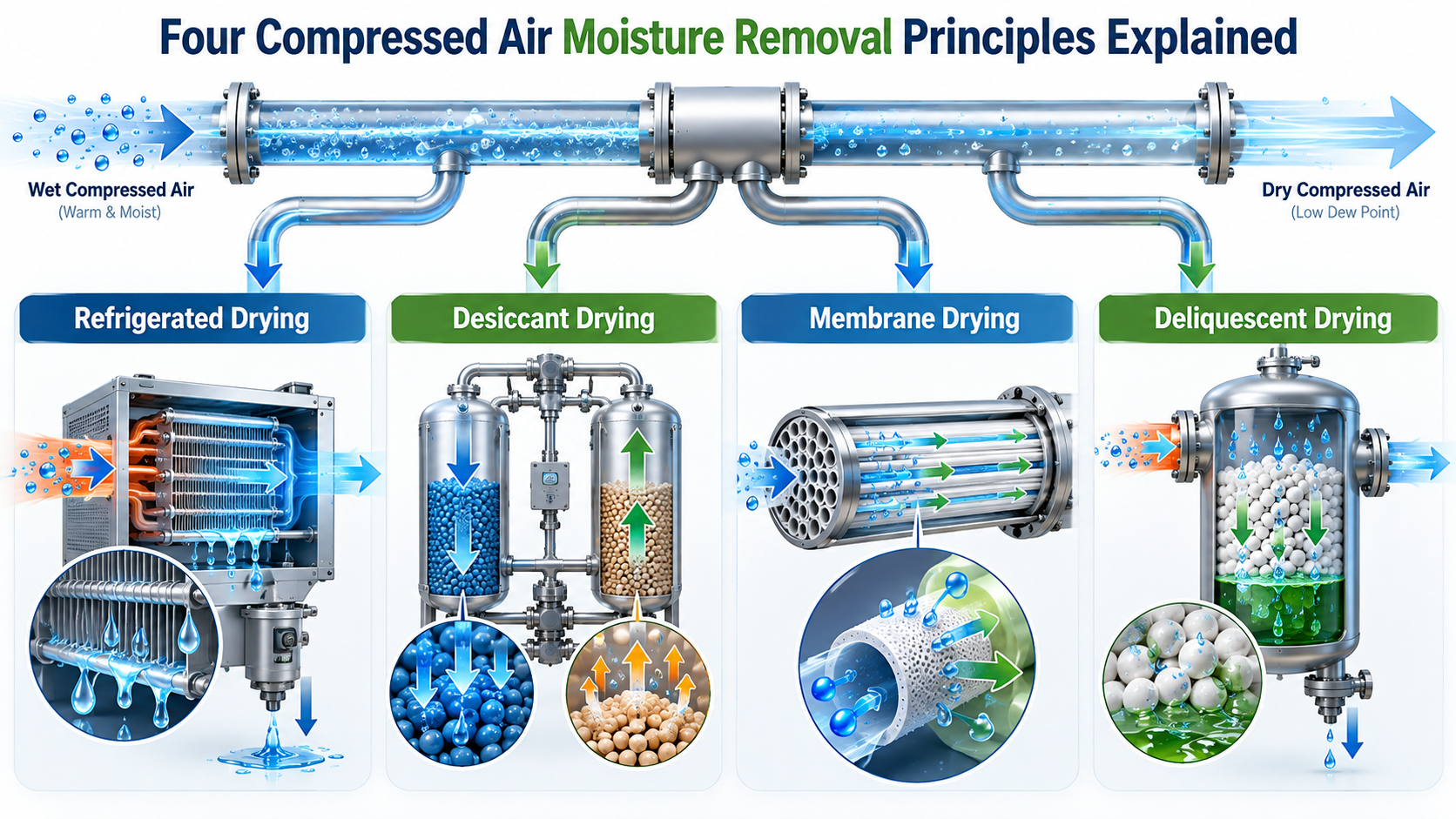
A refrigerated air dryer removes moisture by cooling compressed air until water vapor condenses. The liquid condensate is then separated and drained from the system.
This type of dryer is commonly suited to general industrial compressed air applications where an ultra-low dew point is not required.
Lingyu refrigerated dryers can provide a pressure dew point of approximately 2–10°C under the specified operating conditions. The drying process cools the compressed air, separates condensed moisture, and then reheats the treated air before discharge.
For many workshop and production environments, this degree of moisture control may provide a practical starting point, provided it also satisfies the plasma cutter manufacturer’s compressed-air requirements.
You can read more about the technology in what a refrigerant air dryer is and how it works.
Desiccant Air Dryer for Plasma Cutting
Where significantly drier compressed air is required, a desiccant or adsorption dryer may be more appropriate.
Instead of cooling the air to condense moisture, adsorption dryers use a desiccant material to remove water vapor from the compressed air stream.
Lingyu’s M Series modular desiccant dryer, for example, provides an outlet pressure dew point of ≤−20°C, with −40°C available as an option, using activated alumina and high-performance molecular sieve as desiccants.
Other regenerative adsorption configurations are designed for outlet pressure dew points of −20°C / −40°C, while selected heated-regeneration units provide ≤−40°C.
A desiccant system may make sense where the required dew point is lower than a refrigerated dryer can provide, where ambient conditions create a risk of downstream condensation or freezing, or where the cutting equipment manufacturer specifies particularly dry compressed air.
For the operating principle, see how a desiccant air dryer system works.
Can You Use Only a Moisture Separator and Filter?
A moisture separator and filter can be useful, but they should not automatically be treated as equivalent to an air dryer.
A separator is effective at removing liquid water that has already condensed, while a coalescing or particulate filter targets particular classes of contamination. Neither necessarily removes enough water vapor to establish a controlled low pressure dew point.
That distinction becomes especially important during long cutting cycles or in humid environments. Air that appears dry at one point in the system can still contain sufficient water vapor to condense later if its temperature drops.
For occasional or relatively low-demand applications, point-of-use filtration may still form part of a suitable solution, but the final configuration should be based on the plasma cutter manufacturer’s required air quality rather than assuming a filter alone is sufficient.
The five core components of a compressed air purification system provides additional context on how different treatment components perform different functions.
Refrigerated vs. Desiccant Dryer: Which Is Better?
Neither technology is automatically better for every plasma cutter.
| Factor | Refrigerated Dryer | Desiccant Dryer |
|---|---|---|
| Moisture-removal principle | Cooling and condensation | Adsorption |
| Lingyu reference dew point | Approx. 2–10°C PDP | −20°C / −40°C depending on model |
| Typical system complexity | Lower | Higher |
| Regeneration required | No adsorption regeneration cycle | Yes |
| Best selection basis | Moderate dew-point requirement | Very low dew-point requirement |
| Key consideration | Inlet/ambient conditions and refrigeration capacity | Purge/regeneration method and desiccant condition |
If you are unsure which technology fits the cutting environment, the more useful comparison is refrigerated air dryer vs. desiccant air dryer rather than choosing solely on price.
How to Choose an Air Dryer for Your Plasma Cutter
The dryer should first meet the actual compressed-air requirement of the plasma cutter, particularly airflow and operating pressure. After that, evaluate the required pressure dew point, compressor type, inlet-air temperature, ambient temperature, humidity, contaminant load, allowable pressure drop, and expected duty cycle.
There is no universal reason to specify a dryer at exactly 20–30% more CFM than the plasma cutter.
A better approach is to determine the cutter’s maximum required airflow and then size the dryer using the manufacturer’s rated conditions and applicable correction factors for inlet temperature, pressure, and ambient temperature.
Lingyu’s AH refrigerated dryer ratings are based on defined operating conditions including rated inlet pressure, inlet temperature, ambient temperature, and pressure dew point. This illustrates why two dryers with the same nominal airflow rating may not deliver identical usable capacity under different workshop conditions.
For refrigerated units specifically, see how to size a refrigerated air dryer.
Don’t Ignore Pressure Drop
A plasma cutter needs adequate air pressure at the machine—not simply at the compressor outlet.
Every filter, dryer, pipe, hose, fitting, and valve adds some resistance to airflow. If the complete treatment system creates excessive pressure drop, pressure available at the cutter may fall below the required operating level during high-flow conditions.
That is why dryer selection should consider flow capacity and pressure drop together.
Pressure-drop requirements are part of refrigerated dryer operating specifications because drying performance is only one part of complete system design.
For a detailed explanation, see compressed air pressure drop and system efficiency.
A Practical Compressed Air Treatment Setup for Plasma Cutting
There is no single universal piping arrangement for every plasma cutter, but a practical treatment train often follows this logic:
Compressor → Air Receiver / Condensate Separation → Appropriate Pre-Filtration → Air Dryer → Required Final Filtration → Plasma Cutter
The precise filter locations and grades depend on the compressor, dryer type, and required air quality.
Different filter and dryer arrangements may be required according to actual operating conditions rather than prescribing one fixed configuration.
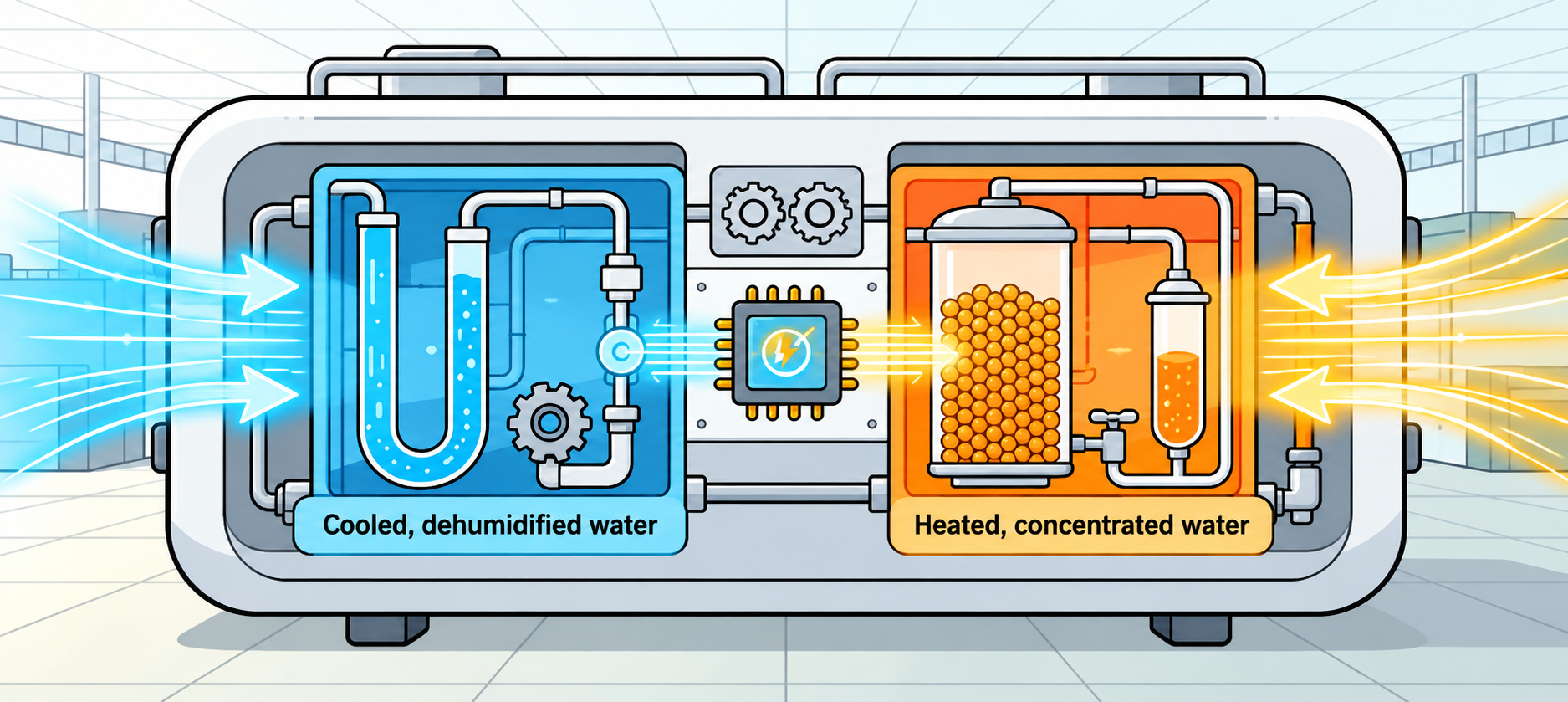
For applications that require considerably lower pressure dew points, a combined refrigerated-plus-adsorption drying solution can also be considered. In a combined dryer, refrigerated drying first removes a large portion of the moisture before the adsorption stage performs deeper drying, reducing the moisture load on the desiccant.
Lingyu’s DC Series combined compressed air dryer is designed for an outlet pressure dew point of ≤−40°C and includes an intermediate filter as standard, with additional intermediate filtration available according to requirements.
Maintenance Is Part of Air Quality
Installing an air dryer does not guarantee permanently dry air.
Automatic drains can fail, filters can become restricted, refrigeration performance can deteriorate, and desiccant can lose adsorption performance over time. Any of these conditions can affect downstream air quality or pressure.
For plasma cutting systems that operate regularly, maintenance should therefore include the whole treatment train rather than only the compressor.
Filter elements in particular need to be serviced according to actual operating conditions and manufacturer recommendations. The air dryer filter replacement guide covers this part of routine maintenance.
Benefits of Properly Treated Air for Plasma Cutting
Proper air treatment can help maintain a cleaner and more consistent compressed-air supply while reducing moisture and contamination reaching the cutting equipment. In practical terms, that supports stable operation, reduces moisture-related problems, and can help protect downstream components.
Exact percentage improvements in consumable life or fixed payback periods should not be assumed without data from the specific plasma cutter or measured operating results.
The practical objective is to ensure that the plasma cutter receives compressed air that closely matches the flow, pressure, dryness, and cleanliness conditions for which it was designed.
Final Thoughts
Choosing an air dryer for a plasma cutter is not simply a matter of buying the smallest dryer that matches the compressor’s nominal CFM.
Start with the plasma cutter manufacturer’s required airflow and pressure, then determine the necessary air cleanliness and dew point. Evaluate the actual inlet temperature, ambient conditions, humidity, pressure drop, compressor contamination level, and duty cycle before sizing the dryer.
For many general workshop installations, a refrigerated dryer combined with appropriate filtration may provide sufficient moisture control. Where substantially lower dew points are required, an adsorption dryer or combined refrigerated-and-adsorption system may be more suitable.
Ultimately, the best system is not the one that produces the lowest possible dew point at any cost. It is the one that consistently delivers clean, dry compressed air at the required pressure and flow at the plasma cutter inlet.