Clean, dry compressed air is essential for processes where moisture can affect pneumatic equipment, instrumentation, product quality, or production reliability.
When a conventional refrigerated dryer cannot provide a sufficiently low pressure dew point, an adsorption or desiccant dryer may be required. For applications that also value compact installation and flexible system design, a modular heatless desiccant air dryer offers another approach.
Lingyu’s M Series Modular Desiccant Air Dryer combines heatless regeneration with a modular adsorption structure designed to improve airflow distribution, desiccant utilization, and long-term dew-point stability.
What Is a Modular Heatless Desiccant Air Dryer?
A modular heatless desiccant air dryer removes water vapor from compressed air through adsorption.
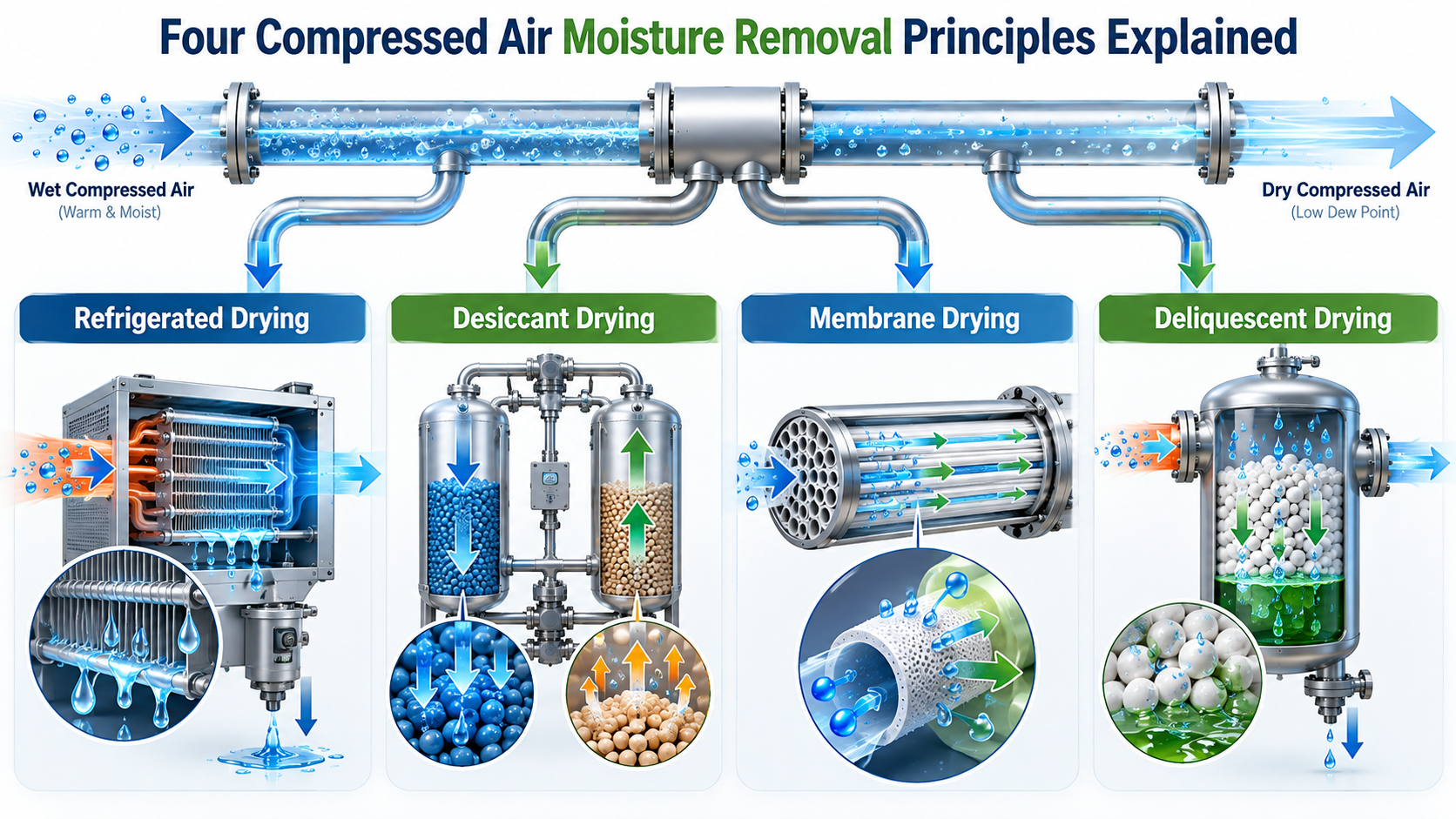
Unlike refrigerated drying, which cools compressed air so moisture condenses, a desiccant dryer passes compressed air through an adsorption medium that captures water vapor.
A heatless dryer does not use an external heater to regenerate the desiccant. Instead, a portion of the already dried compressed air is expanded and used as regeneration air.
The “modular” part refers to the equipment construction.
Lingyu’s M Series is based on the operating principle of a conventional twin-tower desiccant dryer but replaces the traditional large-vessel arrangement with multiple adsorption chambers integrated into a modular structure.
For a broader introduction to this equipment category, see modular adsorption air dryers.
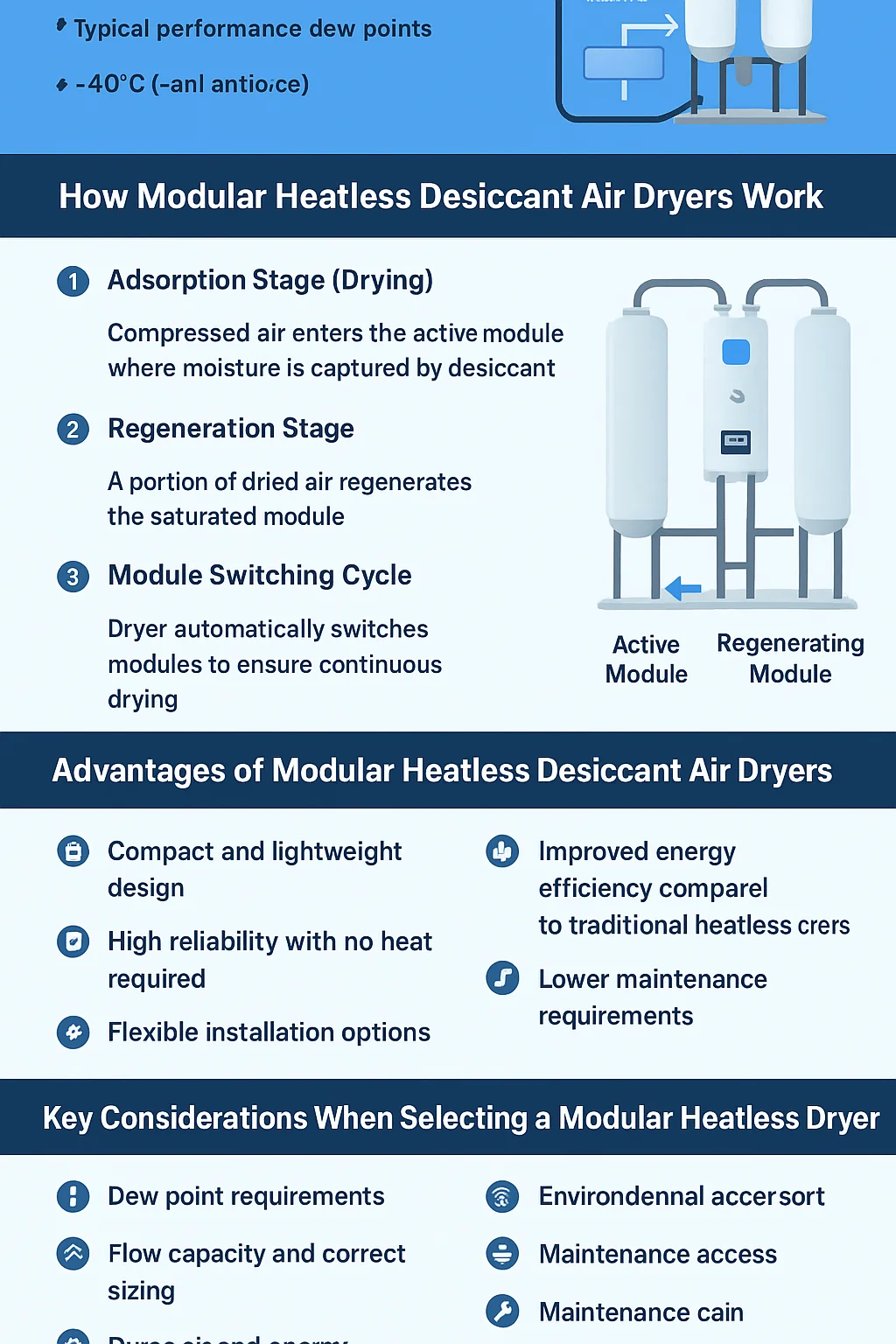
How Does a Modular Heatless Desiccant Air Dryer Work?
The drying process alternates between adsorption and regeneration.
Adsorption
During adsorption, wet compressed air enters the active adsorption group and passes through the desiccant chambers. Water vapor is adsorbed by the desiccant while the dried compressed air passes toward the outlet.
A portion of this dry product air is diverted into the opposite adsorption group for regeneration.
Regeneration
During regeneration, the inlet to that group is closed and the exhaust valve opens.
The regeneration air passes through the saturated adsorption chambers, lowering the water-vapor partial pressure and helping desorb the accumulated moisture. The released moisture is then discharged through the exhaust system.
After regeneration, the adsorption groups switch operating roles so that drying can continue.
This basic principle is closely related to other heatless regenerative dryers. For a broader explanation, see how heatless desiccant air dryers work.
What Makes the M Series Modular?
The key distinction is not simply the use of smaller vessels instead of large vessels.
The M Series uses a straight-through adsorption chamber design intended to improve desiccant utilization and adsorption efficiency.
Its base also includes an inlet-air buffer chamber and a specialized desiccant-filling arrangement designed to address uneven airflow distribution, adsorption dead zones, channeling, and tunneling.
This construction also helps reduce desiccant attrition and dusting caused by compressed-air impact.
These characteristics provide a more technically meaningful explanation of the modular design than relying on an unsupported fixed percentage for footprint reduction.
Pressure Dew Point: What Can the M Series Achieve?
Pressure dew point is one of the most important parameters when selecting a desiccant air dryer.
For Lingyu’s M Series Modular Desiccant Air Dryer, the specified outlet pressure dew point is:
- ≤−20°C standard
- −40°C optional
These values are important because dryer selection should be based on the pressure dew point actually required by the process.
Specifying a substantially lower dew point than necessary can increase system complexity and operating cost without providing a meaningful process benefit.
For users still determining the appropriate dryer technology, this refrigerated air dryer vs. desiccant air dryer comparison provides useful context.
How Much Regeneration Air Does a Modular Heatless Dryer Use?
Heatless regeneration requires compressed air.
This is one of the main operating-cost considerations for any heatless desiccant dryer because a portion of the dry product air is not delivered to production. Instead, it is used to regenerate the desiccant.
For Lingyu’s M Series, regeneration-air consumption is specified at 5–8%.
For comparison, Lingyu’s conventional HH Series heatless regenerative dryer specifies average purge-air consumption of 8–14%.
Regeneration-air consumption is therefore an important parameter when comparing heatless dryer designs. It affects the amount of compressed air that must be produced upstream and should be considered when evaluating total system operating requirements.
What Desiccant Does a Modular Dryer Use?
The M Series uses activated alumina combined with high-performance molecular sieve.
These adsorption materials remove water vapor as compressed air passes through the adsorption chambers.
The condition of the desiccant is important because contamination, mechanical wear, poor airflow distribution, and prolonged service can affect adsorption performance and pressure dew point.
This is one reason the M Series design emphasizes controlled airflow distribution and reduced desiccant dusting rather than simply increasing the quantity of desiccant installed.
For general maintenance guidance, see air dryer desiccant replacement.
Advantages of a Modular Heatless Desiccant Air Dryer
The characteristics of the Lingyu M Series include an integrated modular adsorption structure, heatless regeneration using dry product air, regeneration-air consumption of 5–8%, a standard pressure dew point of ≤−20°C, an optional pressure dew point of −40°C, and an activated alumina and high-performance molecular sieve desiccant combination.
Standard M Series capacities extend up to 55 m³/min. The design also emphasizes airflow distribution, reduced channeling, desiccant utilization, and compact installation.
The compact construction allows the unit to pass through standard doorways and supports installation in a variety of locations.
Rather than relying on a fixed percentage reduction in footprint, the practical compact-design benefit should be evaluated according to actual model dimensions and available installation space.
What Are the Limitations?
A modular heatless dryer still has many of the same fundamental considerations as other heatless regenerative systems.
The main one is regeneration-air consumption. Although the M Series specifies relatively low regeneration consumption of 5–8%, that air still represents compressed air that must be produced by the upstream compressor.
Capacity is another consideration. The standard M Series range extends to approximately 55 m³/min. For flow rates above this level, or for special material, temperature, or specification requirements, the system should be selected according to the specific project conditions.
For much larger compressed-air systems, other regeneration technologies may also be worth evaluating because their regeneration-energy profiles differ.
For example, blower-heated technology uses a blower and heat to reduce the amount of dry compressed air required for regeneration. For comparison, see the blower-heated adsorption dryer guide.
Why Inlet Air Quality Matters
A desiccant dryer should not be expected to compensate for every type of contamination in the compressed air system.
Oil, condensed water, and particles reaching the adsorption material can adversely affect dryer operation and desiccant performance. Appropriate upstream separation and filtration should therefore be considered as part of the complete compressed-air treatment system.
The correct arrangement depends on compressor type, inlet contamination, dryer configuration, and required downstream air quality.
For this reason, filters and dryers should normally be selected together rather than treating filtration as an optional accessory.
See this guide to air compressor filters and dryers for additional system-design information.
How to Size a Modular Desiccant Air Dryer
Dryer sizing should not be based only on the compressor’s nominal flow rating.
For the Lingyu M Series, the key inlet and operating parameters include:
- Rated inlet pressure: 0.7 MPa
- Operating pressure range: 0.6–1.0 MPa
- Rated inlet temperature: 10–30°C
- Maximum inlet temperature: ≤40°C
- Inlet-air dew point: ≤15°C
- Rated ambient temperature: 35°C
Actual capacity therefore needs to be considered against operating pressure, inlet temperature, ambient conditions, peak airflow, and required outlet pressure dew point.
This is particularly important because higher inlet temperatures generally increase the moisture load reaching the adsorption system.
For more detailed selection logic, see how to choose a desiccant air dryer and avoid common sizing mistakes.
Pressure Drop Should Also Be Considered
Dew point and flow capacity are not the only system parameters that matter.
Every dryer, filter, valve, fitting, and section of piping contributes to total pressure drop. An improperly selected treatment system can therefore deliver dry air while still negatively affecting downstream operating pressure.
The M Series straight-through adsorption chambers and airflow-distribution design are intended to improve gas distribution through the desiccant, but the complete system must still be evaluated for acceptable pressure loss.
For additional system-design context, see compressed air pressure drop.
Where Can Modular Desiccant Dryers Be Used?
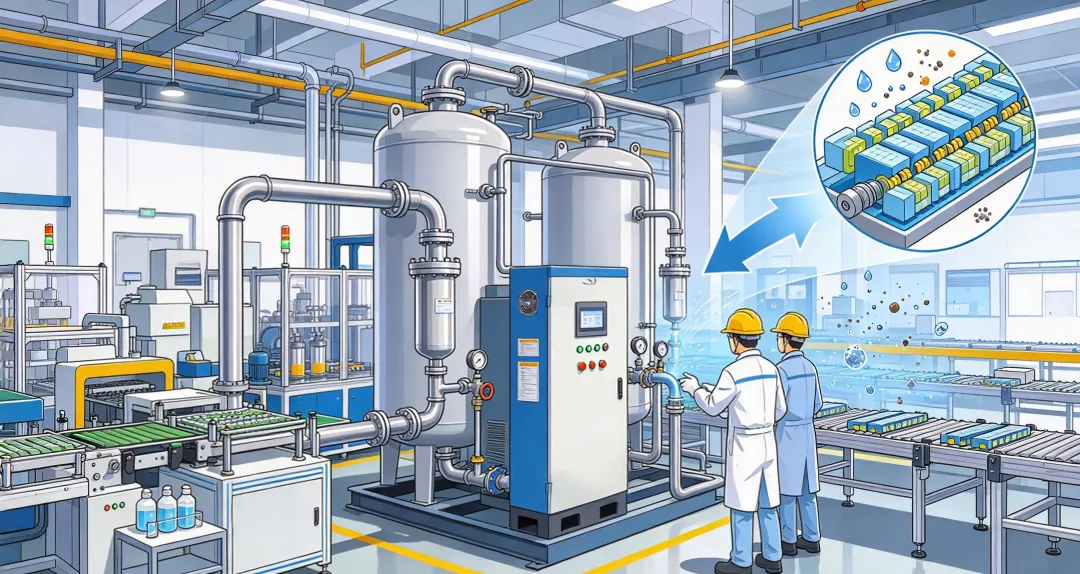
Lingyu’s M Series is particularly suitable for food and pharmaceutical applications. Surfaces in contact with compressed air receive anti-corrosion treatment intended to help prevent secondary contamination.
Beyond these applications, a modular desiccant dryer can be considered wherever a process requires a lower pressure dew point than a standard refrigerated dryer can practically provide and where the dryer’s flow range and operating conditions match the application.
Application suitability should be evaluated according to the actual air-quality, dew-point, flow, pressure, contamination-control, and installation requirements rather than assuming that one dryer configuration is appropriate for every industry.
Modular vs. Conventional Twin-Tower Heatless Dryers
Both technologies rely on adsorption and heatless regeneration, but their construction and operating specifications differ.
Lingyu’s conventional heatless regenerative dryers use twin adsorption vessels. The HH Series specifies average purge-air consumption of 8–14% and an outlet pressure dew point of ≤−40°C.
The M Series uses a modular adsorption-chamber structure and specifies regeneration-air consumption of 5–8%, with a ≤−20°C standard pressure dew point and −40°C optional.
This means the decision should not be reduced to “modular is always better.” The appropriate choice depends on required dew point, airflow, available space, purge-air consumption, maintenance strategy, and process requirements.
For readers who want to understand how alternating adsorption cycles maintain continuous drying, see how twin-tower desiccant dryers achieve continuous operation.
Conclusion
A modular heatless desiccant air dryer combines adsorption drying with heatless regeneration in a compact modular structure.
Lingyu’s M Series uses multiple adsorption chambers, controlled airflow distribution, activated alumina, and high-performance molecular sieve to remove moisture from compressed air. Part of the dried product air is then used to regenerate the opposite adsorption group, allowing the drying and regeneration processes to alternate continuously.
For the Lingyu M Series specifically, the key specifications include 5–8% regeneration-air consumption, ≤−20°C standard outlet pressure dew point, −40°C optional dew point, 0.7 MPa rated inlet pressure, 0.6–1.0 MPa operating pressure, 10–30°C rated inlet temperature, ≤40°C maximum inlet temperature, ≤15°C inlet-air dew point, 35°C rated ambient temperature, and standard capacities up to 55 m³/min.
The right dryer should therefore be selected according to actual flow, pressure, inlet temperature, required pressure dew point, purge-air consumption, contamination level, and installation conditions rather than simply selecting the lowest advertised dew point.